
The mycotoxin guide
Mycotoxins in homes: the complete guide
What they are, which molds make them, where they hide, how to test for them and how they're removed.
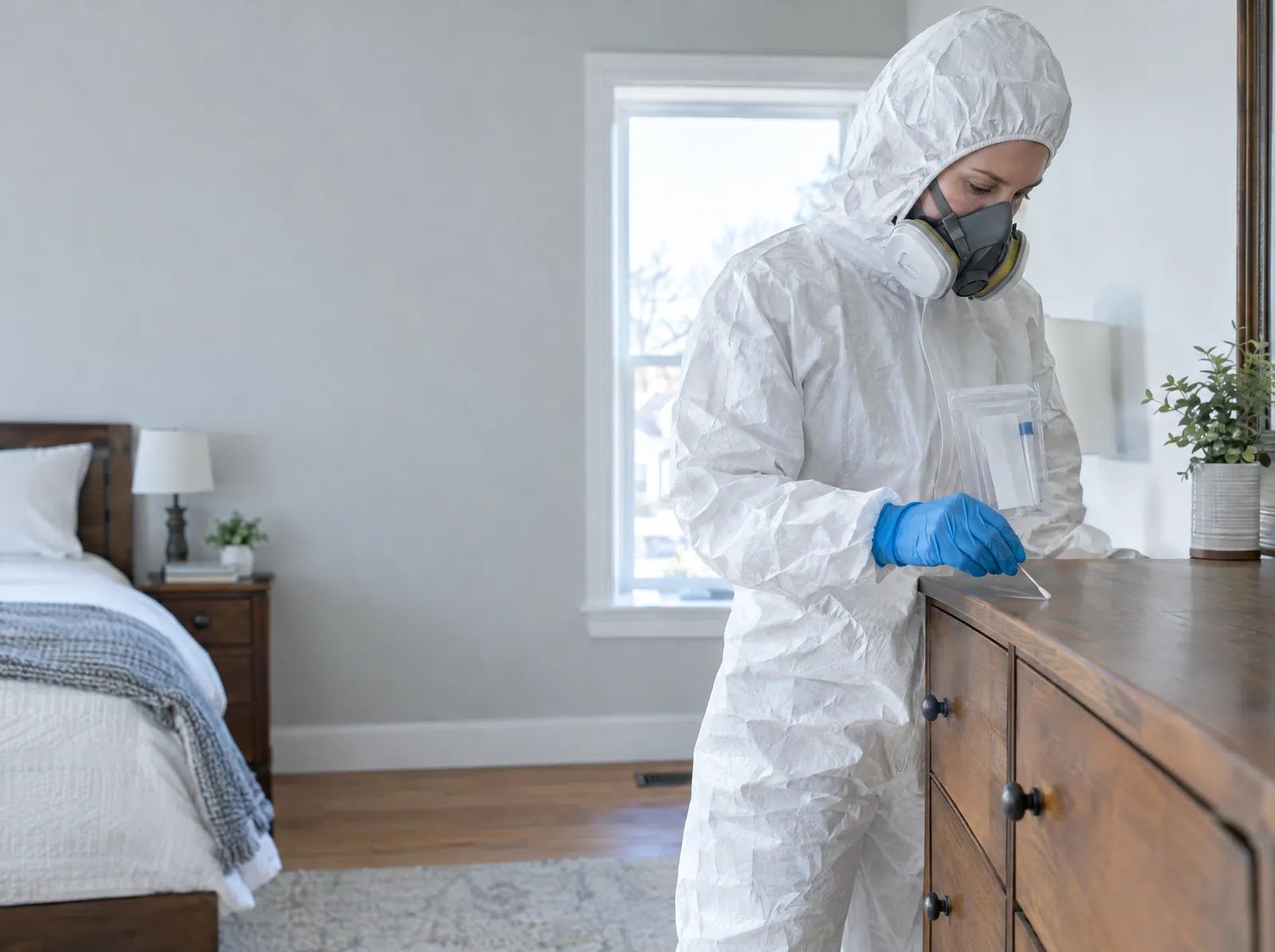
What are mycotoxins in homes?
Mycotoxins in homes are chemical compounds produced by certain molds, usually after water damage has let mold grow on building materials. They are not alive, so they can't be killed, and they stay behind after the mold dies. They collect in settled dust, porous materials, HVAC systems and belongings. The only way to know they're present is testing, and removing them takes physical cleanup plus treatments that break them down.
Why mycotoxins get missed in so many homes
Mold work in most homes is judged by what you can see. The stain is gone, the smell is gone, the job is called done. Mycotoxins don't show up in that kind of inspection. They sit in the dust on top of the door frame, in the carpet, in the return duct and in the couch, and nobody looks there because nobody tested for them in the first place.
The result is a house that looks fixed and still isn't. That is the pattern we're called in to sort out more often than any other.
Sound familiar?
- The mold was cleaned up, but no one ever tested for toxins.
- You've read about mycotoxins and can't tell which advice to trust.
- You don't know whether the problem is one room or the whole house.
- You're not sure what to do with furniture, clothes and keepsakes.
We do it differently.
| A mold-only approach | A mycotoxin-aware approach | |
|---|---|---|
| What gets measured | Visible growth and spore counts | Molds, spores and the toxins themselves |
| Where the work happens | The stained area | The source, the dust, the HVAC system and the contents |
| Main tool | Something that kills mold | Removal, HEPA cleaning and toxin breakdown together |
| How dead mold is handled | Often left in place | Removed under containment |
| How you know it worked | It looks and smells clean | Before and after lab numbers |

Why families trust us with their homes
-
Family-owned since 2008
A multigenerational family business. Not a franchise, not a private-equity rollup.
-
Credentialed where it isn't required
Indiana doesn't license mold remediators. We hold IICRC, CMR, CRMI and CCMI credentials anyway.
-
Called on as experts
Attorneys bring us into legal cases involving mold and mycotoxins.
-
Lab results in 24 to 48 hours
Every inspection comes with a written report, color photos and lab results.
- IICRC Certified Firm
- CMR
- CRMI
- CCMI
- BBB A+ Accredited
- NAMRI
- IAQA
- NORMI
- AMMA
- PMII
The AME Clearance Method
How mycotoxins are removed from a home
Getting mycotoxins out of a house follows a set order. Each step protects the work of the one before it.
Talk to a specialist-
Measure first
Air, dust DNA and mycotoxin testing show which molds have grown, which toxins they left and which rooms carry the most. That map sets the scope.
-
Cut off the water
Leaks, condensation, high humidity or poor drainage get corrected. Without water, mold stops growing and stops producing new toxins.
-
Seal off the work
Plastic containment and negative air pressure keep disturbed dust inside the work zone and out of the rooms you're living in.
-
Take out what can't be cleaned
Porous materials that are heavily contaminated, such as soaked drywall, insulation or carpet pad, are bagged and removed. Sound framing and hard surfaces stay.
-
Capture the dust
HEPA vacuuming, damp wiping and air scrubbing, room by room, pull out the fine particles toxins travel on. The HVAC system and ducts are cleaned too.
-
Break down the rest
Enzyme treatments made to split mycotoxin molecules are applied to framing, cavities and rough surfaces that cleaning alone can't fully reach.
-
Retest and compare
Clearance sampling, including a repeat mycotoxin panel, is compared against the starting numbers. The lab decides when the job is finished.
What a complete mycotoxin project should cover
- Testing for mycotoxins, not only for mold spores
- A written scope based on the test results
- Finding and correcting the moisture source
- Containment with negative air pressure
- Targeted removal of contaminated porous materials
- Whole-area HEPA vacuuming and damp wiping
- HVAC and ductwork cleaning where testing points to it
- A treatment designed to break mycotoxins down
- A room-by-room plan for belongings
- Clearance testing with the full lab report

Proof you can hold in your hands
When we finish, you don't get a handshake and a promise. You get the paperwork your family, your doctor, your insurer or your buyer can rely on.
Inspection report
What we found, where it is coming from, with color photos.
Written remediation plan
Scope, timeline and what will and won't be removed, before work starts.
Clearance lab report
Air, surface and mycotoxin results after the work is done.
A report for your doctor
With your permission, we share results directly with your care team.
The complete guide to mycotoxins in homes
What mycotoxins are, in plain terms
Mold is a living organism. Mycotoxins are something mold makes. Certain species release these compounds as they grow, especially on building materials that have stayed wet, and researchers generally believe the toxins help the mold compete with other microbes for food and space. The compounds end up in the mold’s spores, in the tiny fragments that break away from it, and in the material it grew on.
Three facts explain almost everything else in this guide. Mycotoxins are chemicals, not organisms, so they can’t be killed. They are stable, so they don’t disappear when the mold dies or the room dries out. And they travel on particles far too small to see, so they go wherever dust goes.
Not every mold makes mycotoxins, and a mold that can make them doesn’t always do so. Species, moisture, temperature, the material it’s growing on and competition from other organisms all play a part. That’s one reason a basic mold test can’t tell you whether toxins are present. For a side-by-side comparison, see the difference between mold spores and mycotoxins.
The molds and toxins you’ll hear about
Scientists have identified hundreds of mycotoxins, but a short list comes up again and again in water-damaged homes. Here is what each one is and where it usually comes from.
Trichothecenes, including satratoxins
Trichothecenes are a large family of mycotoxins. The ones most tied to homes, the satratoxins, come from Stachybotrys chartarum, the slow-growing dark mold most people mean when they say “black mold.” Stachybotrys needs material that stays wet for a long time and prefers cellulose, so it turns up on the paper face of drywall, on ceiling tiles and on soaked cardboard. Some Fusarium species also make trichothecenes. Our guides to trichothecenes in homes and what Stachybotrys is go further.
Ochratoxin A
Ochratoxin A is made by some Aspergillus and Penicillium species, two of the most common mold groups found indoors. It’s well known as a food contaminant in grains, coffee and dried fruit, and it is one of the toxins most often included on environmental dust panels. See ochratoxin A in homes for the detail.
Aflatoxins
Aflatoxins come mainly from Aspergillus flavus and Aspergillus parasiticus. They’re best known from food safety, particularly corn and peanuts, where regulators monitor them closely. They can show up in homes, though less often than the toxins above. Read more about aflatoxins in homes.
Gliotoxin
Gliotoxin is associated with Aspergillus fumigatus, a mold that handles warmth well and is common in compost and decaying organic matter. Indoors, damp HVAC components are one place it can take hold. Our page on gliotoxin and Aspergillus indoors covers where it tends to grow.
Others worth knowing
Sterigmatocystin, made by Aspergillus versicolor and related species, is chemically related to aflatoxin and common on damp building materials. Chaetomium species produce chaetoglobosins and grow on the same kinds of long-wet drywall and wood that Stachybotrys favors (see what Chaetomium mold is). Citrinin comes from some Penicillium and Aspergillus species.
A word about the phrase “black mold.” Plenty of dark molds have nothing to do with Stachybotrys, and a pale or colorless mold can still produce toxins. Color tells you very little. Our page on black mold vs. mycotoxins explains why.
Where mycotoxins hide in a home
When people picture a mold problem, they picture the stain on the wall. In our experience the stain is often the smallest part of it. Mycotoxins move on dust and fragments, so they end up wherever air and dust travel.
Settled dust
Dust is the main reservoir. Spores and fragments drift out of a moldy area, settle on flat surfaces, and get stirred back up every time someone walks through, runs an ordinary vacuum or turns on a fan. The tops of cabinets, door frames, baseboards, the floor under beds and the backs of closets collect dust that may not have been touched in years. That’s also why dust, not air, is what usually gets sent to the lab for a mycotoxin panel. Mycotoxins in house dust goes deeper.
HVAC systems and ductwork
A forced-air system moves the air in a house over and over through the day. If there is mold in or near the system, such as on a wet evaporator coil, in a damp return plenum, or in ducts that run through a moldy crawlspace or attic, the system can pick up contaminated particles and deliver them to every room it serves. Contaminated dust also builds up inside the ducts themselves. See mycotoxins in HVAC systems and ductwork.
Porous building materials
Drywall, insulation, carpet and pad, ceiling tiles and unfinished wood soak up water and give mold something to grow into, not just onto. Toxins produced inside these materials can’t be wiped off the surface. When porous materials are heavily affected, they usually have to come out.
Wall cavities, crawlspaces and attics
The places you don’t see often matter most. A slow plumbing leak can feed growth inside a wall for months before anything shows on the room side. Crawlspaces and attics can hold large areas of growth, and air from those spaces can move into the living area through gaps around pipes, wiring and ducts.
Your belongings
Upholstered furniture, mattresses, rugs, curtains, clothing, stuffed toys, books and papers collect the same dust as the rest of the house, and soft materials hold onto it. That’s why belongings get their own section further down.
Which homes are most likely to have them
Mycotoxins in homes almost always trace back to water. The houses we worry about most have a history of it: a basement that has flooded or seeps after heavy rain, a crawlspace with standing water or high humidity, a roof or plumbing leak that went unnoticed, an ice dam, or a failed sump pump. Homes where a previous mold job killed the growth but nobody tested afterward belong on the list too.
Age isn’t a reliable guide. Older homes have had more years for something to go wrong, but new construction can have mycotoxins as well, for example when framing or drywall got wet before the house was closed in, or when a tightly sealed house doesn’t get enough ventilation. We explain more in can a new house have mycotoxins? And if you’re wondering how toxins get from a hidden wall cavity into the rooms you live in, are mycotoxins airborne? answers it.
How testing for mycotoxins works
You can’t see, smell or feel mycotoxins, and no inspector can confirm them by eye. Testing is the only way to know what’s there. Good testing answers three separate questions, and each one needs a different method.
| The question | The test | What it shows | What it can’t show |
|---|---|---|---|
| What’s in the air right now? | Air sampling | Spore types and counts, compared with outdoor air | Toxins, small fragments, or conditions on any other day |
| Which molds have been growing here? | Dust DNA testing, such as ERMI or HERTSMI-2 | Mold species in settled dust, reflecting conditions over time | Which toxins those molds produced |
| Which toxins are present? | Mycotoxin panel on dust or surfaces | Specific mycotoxins and their amounts | Where the source is, on its own |
Used together, these tests show which molds have been active, where to look for the source, and which toxins need to be removed. Lab results usually come back in 24 to 48 hours.
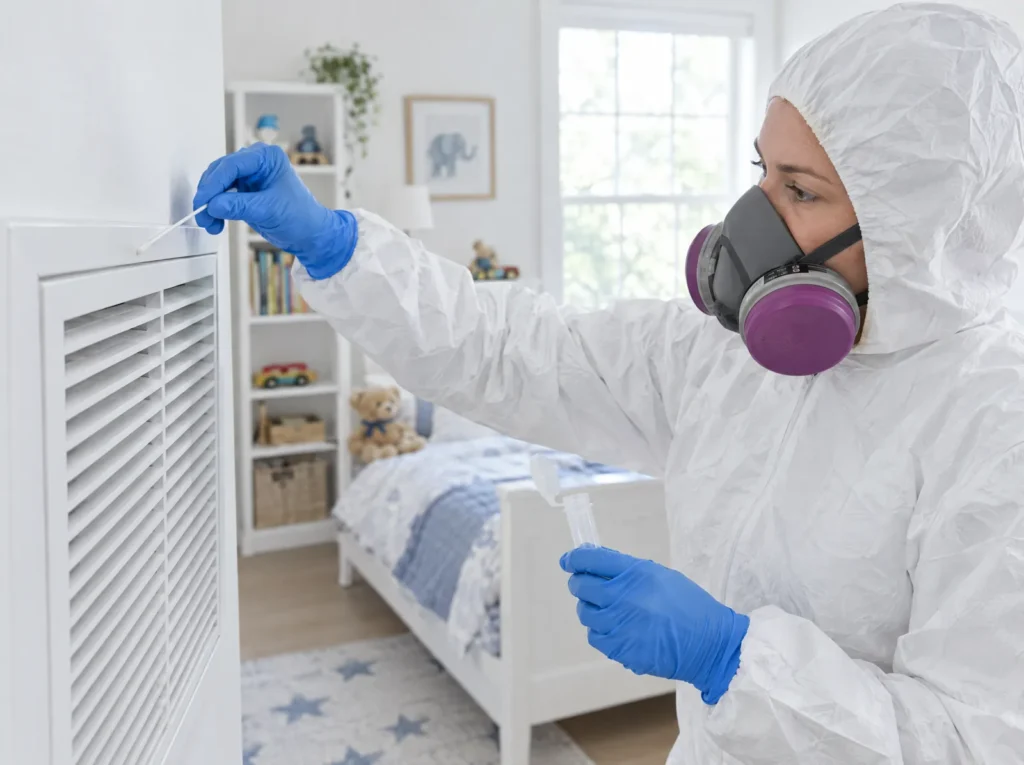
There are no federal limits for mold in homes, and there’s no widely accepted standard for how much of a given mycotoxin in house dust is acceptable. So results need interpretation: comparison with the lab’s reference data, with other rooms in the same house, and with the home’s own numbers before and after work. Mycotoxin testing for homes walks through the process step by step, and our guide to reading mycotoxin test results explains what’s on the report.
What about doing it yourself? Hardware-store settle plates only show that mold spores exist, and they exist everywhere. Some mail-in kits run a dust DNA test or a mycotoxin panel on a sample you collect, which can be a reasonable first look, as long as you know that sampling technique affects the result. We cover the tradeoffs in can you test your home for mycotoxins yourself?
Why killing mold isn’t enough
This idea is the center of how we work. Picture a mold colony on the back of a basement wall. Spray it with a biocide and the mold dies. But everything it produced is still there: the toxins in the drywall, the spores and fragments in the dust, and the particles that drifted into the ductwork months ago. The room may look better and smell better, but the toxin load has barely changed.
Dead mold can even become easier to spread. Dry, dead growth crumbles into fine fragments, and if it’s disturbed without containment, those fragments travel through the house. That’s why methods that only kill mold fall short when they’re used on their own. We look at the common ones individually: bleach, fogging and ozone.
Waiting doesn’t solve it either. Mycotoxins are chemically stable and can persist in dust and materials for a long time, as we explain in do mycotoxins go away on their own? Opening windows, running a dehumidifier or adding an air purifier can improve conditions, but none of them remove the toxins that have already settled into the house.
How mycotoxin removal works
Removal comes down to two jobs done together: physically taking out as much contaminated material and dust as possible, and chemically breaking down what’s left. The steps earlier on this page show the order. A few points matter more than the rest.
- Moisture comes first. If the water problem isn’t fixed, mold grows back and makes more toxins.
- Containment protects the rest of the house. Cleanup without it spreads contamination into clean rooms.
- Removal is selective. Most homes don’t need to be gutted. Heavily contaminated porous material comes out, while framing, subfloors and hard surfaces are usually cleaned and treated in place.
- Dust removal is the core of the job. HEPA vacuuming, damp wiping and air scrubbing, repeated room by room, take out the particles toxins travel on.
- The HVAC system gets cleaned. Otherwise it redistributes whatever is left.
- A breakdown treatment reaches what cleaning can’t. Rough framing, cavities and hard-to-reach surfaces are treated with products made to break the toxin molecules apart.
For that last step we use plant-based enzyme treatments from US Enzyme. They’re designed to break down mold and mycotoxins, they don’t replace removing materials that can’t be saved or fixing the moisture, and we confirm every project with testing instead of asking anyone to take our word for it. You can read more about enzyme mold remediation, or see how a full mycotoxin remediation project runs from start to finish.
What to do with your belongings
Families ask about belongings more than anything else, and it’s the hardest question to answer in general terms. The right call depends on the material, how much dust it has absorbed, how long it sat in the affected space, and how sensitive the people using it are. This table shows where we usually start.
| Type of item | Usual starting point |
|---|---|
| Glass, metal, ceramic and hard plastic | HEPA vacuum and damp wipe. Nearly always kept. |
| Finished or sealed wood furniture | HEPA vacuum and wipe, including undersides, backs and drawers. |
| Clothing, bedding and washable fabric | Repeated laundering, then a decision on anything that still smells musty. |
| Mattresses, upholstered furniture and pillows | The hardest to clean all the way through. Decided case by case, and heavily contaminated pieces are often replaced. |
| Books, papers and photos | Surface cleaning and individual judgment. Irreplaceable items are worth extra effort. |
| Electronics | Exterior cleaning. Devices with fans pull in dust, so those need a closer look. |
| Food stored in the affected area | Sealed cans and jars can be wiped. Opened dry goods are usually discarded. |
Whatever is kept should be cleaned before it goes back into a cleaned space, or it can carry dust right back in. A few questions come up often enough that we’ve answered them on their own pages: can mycotoxins be washed out of clothes?, should you throw away a mattress after mold exposure? and can books and papers hold mycotoxins? For the full approach, see cleaning belongings exposed to mycotoxins.
Keeping mycotoxins from coming back
A home that passes clearance testing stays that way only if the conditions that caused the problem stay fixed. Keep indoor humidity in a normal range, repair leaks quickly, keep gutters and grading sending water away from the foundation, change HVAC filters on schedule, and dry anything that gets wet right away. The CDC’s NIOSH guidance recommends drying wet materials within 48 hours or removing them.
If retesting after a job finds toxins again, something was missed: a hidden source, an HVAC system that wasn’t cleaned, belongings brought back without cleaning, or a moisture problem that was never corrected. Our page on mycotoxins after remediation explains how to find out which.
How to choose help
Indiana doesn’t license mold remediators, and many other states don’t either, so anyone can advertise mold removal. Credentials and a clear, testable process are how you tell companies apart. Before you hire anyone, ask:
- Do you test for mycotoxins, or only for mold spores?
- Will you test before and after, and will I get the full lab reports?
- How will you find and fix the moisture source?
- What containment will you set up, and how will you protect the rest of the house?
- How will you handle dust, the HVAC system and our belongings?
- What product do you use on mycotoxins, and why that one?
- What certifications does your firm and its team hold?
For our part, we’re an IICRC Certified Firm, we hold CMR, CRMI and CCMI credentials, and we’re members of NAMRI, IAQA, NORMI, AMMA and PMII. We’ve been family-owned since 2008, and we travel for mycotoxin projects anywhere in the country. For a longer checklist that applies to any company, including us, read how to choose a mold remediator.
We remove mold and mycotoxins from buildings. We don’t diagnose or treat medical conditions, and nothing on this page is medical advice. If you or anyone in your home has symptoms, please work with a doctor. With your permission, we’re glad to share test results and our plan with them.
Common questions
Have a question that isn't here? Call a specialist
Are mycotoxins airborne?
They can be. Mycotoxins ride on spores, mold fragments and dust, and those particles become airborne whenever they're disturbed by walking, cleaning or a running HVAC system. Most of the time they're sitting in settled dust, which is why dust testing matters more than an air sample alone.
Do mycotoxins ever go away?
Eventually some break down, but not on any timeline a family can count on. They are stable compounds that can last a long time in dust and building materials, even after the mold is dead and the house has dried out. Removal has to be deliberate.
Which mycotoxins are most common in homes?
The ones that come up most on environmental dust panels include trichothecenes from Stachybotrys, ochratoxin A from some Aspergillus and Penicillium species, gliotoxin, sterigmatocystin and, less often, aflatoxins. Which ones show up depends on which molds grew and on what.
Is black mold the same thing as mycotoxins?
No. Black mold usually means Stachybotrys chartarum, which is one mold that can produce mycotoxins. Many other molds, including light-colored ones, can produce them too, and plenty of dark molds aren't Stachybotrys at all.
Can a new house have mycotoxins?
Yes. Age doesn't protect a home. Framing and drywall that got wet during construction, a plumbing leak, or poor ventilation in a tightly sealed new home can all lead to mold growth, and with it, mycotoxins.
Can I test my home for mycotoxins myself?
Some mail-in kits let you collect a dust sample yourself for a mycotoxin panel, and that can be a useful first look. Where and how the sample is taken affects the result, and a single sample can't show where the source is. Professional testing adds inspection, moisture checks and multiple sample points.
Will an air purifier remove mycotoxins?
A HEPA air purifier can capture some of the airborne particles that carry mycotoxins, which helps. It can't reach the toxins in settled dust, carpet, furniture or wall cavities, and it doesn't fix the source.
Do I have to throw away everything I own?
Almost never. Hard items can nearly always be cleaned, and many fabrics can be laundered. Heavily contaminated soft items, such as some mattresses and upholstered furniture, are the ones most often replaced. Testing helps decide the close calls.
We're done when the lab says so.
Every remediation ends with clearance testing, and our work is backed by a complete-removal guarantee. We don't close a job on a failed result.
Talk to a specialistFind out what's in your home
Tell us about your house and what's been going on. A mycotoxin specialist will call you back to talk through testing, with no obligation to hire us for the work.
- (833) 772-6653
- info@americanmoldexperts.com
- Open 7 days, 8am to 8pm