
Mycotoxin profiles
Ochratoxin A from mold in your home
Which molds make it, how it ends up in house dust, and what a positive result means.
What is ochratoxin A?
Ochratoxin A is a mycotoxin made by certain Aspergillus and Penicillium molds. It's best known as a contaminant of stored foods like grains, coffee and dried fruit, but the same kinds of ochratoxin A mold also grow on damp building materials, and the toxin can turn up in house dust. It's chemically stable and heat resistant, so it doesn't go away when the mold dies. A mycotoxin panel on settled dust is how it's found in a home.
Why ochratoxin A is hard to trace
Trichothecenes usually point to one thing: drywall that stayed wet. Ochratoxin A doesn't. The molds that can make it are among the most common indoors, they grow on a wide range of damp materials, and only some species and strains produce it. So a positive result points to a group of possible sources instead of one obvious wall.
It also has more than one way into a house. Water-damaged materials are one. Stored goods that got damp are another. Sorting out which one you're dealing with changes the plan.
Sound familiar?
- Your dust panel flagged ochratoxin A and you don't know where it came from.
- Dust testing shows Aspergillus and Penicillium but no obvious growth.
- You've heard it's a food issue and wonder whether the house result matters.
- You want to know what to clean, what to remove and how to confirm it worked.
We do it differently.
| Guessing at the source | Tracing it | |
|---|---|---|
| Starting point | The ochratoxin A number alone | The number plus the molds found in dust DNA testing |
| Where to look | The most visible mold | Damp materials, HVAC, storage areas and stored goods |
| Sampling | One composite sample | Several locations, compared with each other |
| Stored goods | Ignored | Checked, since damp stored products can be a source |
| Confirmation | Visual | A repeat panel from matching locations |

Why families trust us with their homes
-
Family-owned since 2008
A multigenerational family business. Not a franchise, not a private-equity rollup.
-
Credentialed where it isn't required
Indiana doesn't license mold remediators. We hold IICRC, CMR, CRMI and CCMI credentials anyway.
-
Called on as experts
Attorneys bring us into legal cases involving mold and mycotoxins.
-
Lab results in 24 to 48 hours
Every inspection comes with a written report, color photos and lab results.
- IICRC Certified Firm
- CMR
- CRMI
- CCMI
- BBB A+ Accredited
- NAMRI
- IAQA
- NORMI
- AMMA
- PMII
The AME Clearance Method
How we track down and remove ochratoxin A
Because several molds can produce it, the source search matters as much as the cleanup.
Talk to a specialist-
Line up toxins with molds
We compare the panel with dust DNA results. Ochratoxin A alongside Aspergillus or Penicillium species known to include producers narrows the search.
-
Check damp materials and hidden areas
Moisture mapping of walls, floors, basements and crawlspaces finds materials that have stayed damp long enough to grow mold.
-
Look at storage
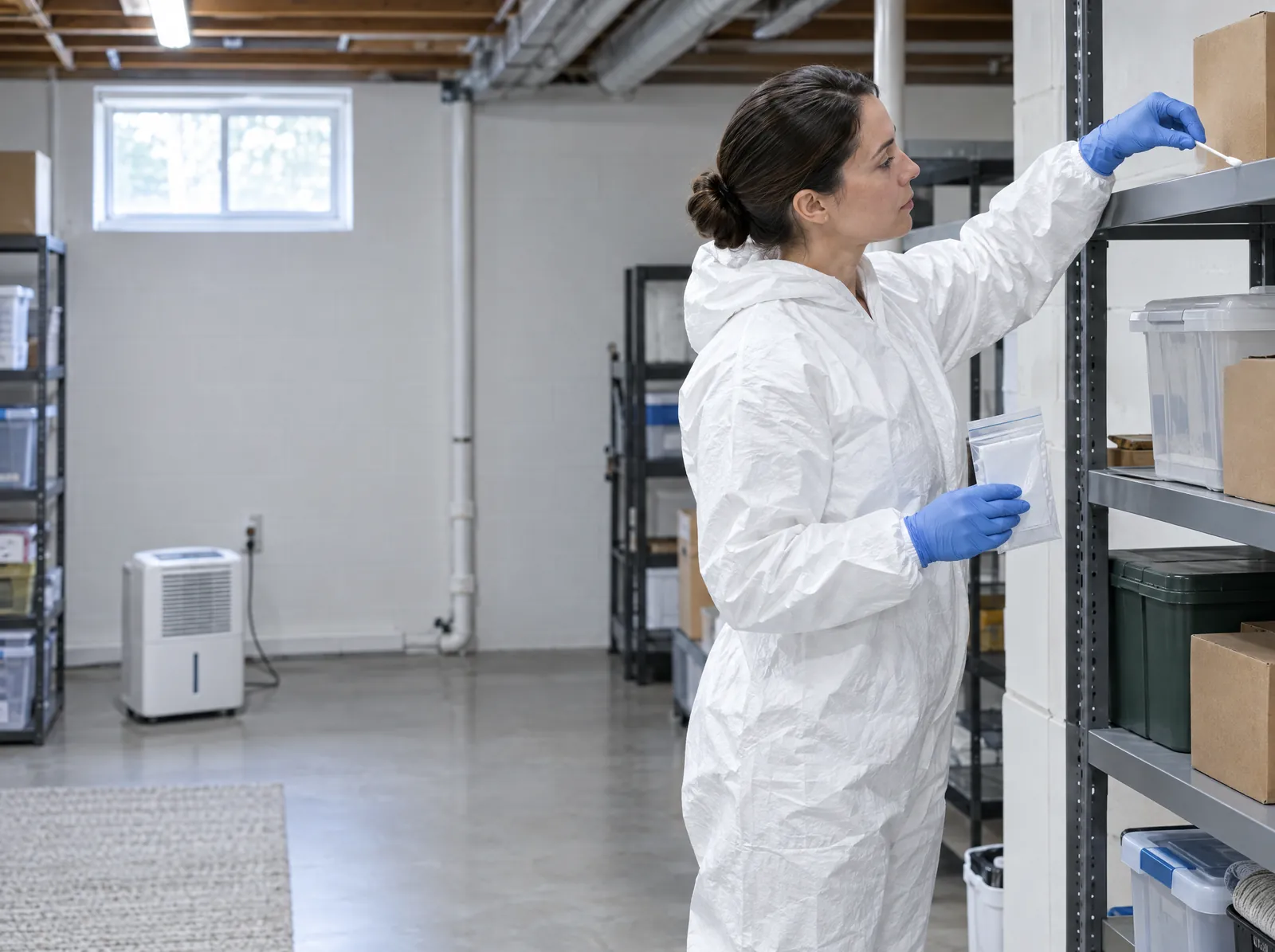
Basement shelving, damp cardboard, bulk pet food, birdseed and pantry goods kept in humid spaces get checked, since mold on stored goods can add to what's in the dust.
-
Sample more than one spot
Separate dust samples from the suspected source and from living areas show whether the toxin is concentrated or spread through the house.
-
Remove, clean and treat
Damp porous materials come out under containment, dust is HEPA-cleaned, and remaining surfaces get an enzyme treatment designed to break mycotoxins down.
-
Retest the same way
Clearance samples use the same lab, method and kinds of locations, so the before and after numbers can be compared fairly.
What an ochratoxin A project includes
- Dust DNA testing to identify likely producing molds
- A mycotoxin panel that includes ochratoxin A
- Moisture mapping of walls, floors, basement and crawlspace
- Inspection of storage areas and stored goods
- Dust sampling from several locations
- Containment and removal of damp porous materials
- HEPA vacuuming and damp wiping
- Enzyme treatment of affected areas
- Clearance testing with the same panel

Proof you can hold in your hands
When we finish, you don't get a handshake and a promise. You get the paperwork your family, your doctor, your insurer or your buyer can rely on.
Inspection report
What we found, where it is coming from, with color photos.
Written remediation plan
Scope, timeline and what will and won't be removed, before work starts.
Clearance lab report
Air, surface and mycotoxin results after the work is done.
A report for your doctor
With your permission, we share results directly with your care team.
Ochratoxin A, explained
Which molds make ochratoxin A
Ochratoxin A comes from two of the most familiar mold groups, which is part of why it shows up so often on panels. Within each group, only certain species, and only some strains of those species, are known producers.
| Mold group | Known producers | Notes |
|---|---|---|
| Aspergillus, ochraceus group | Aspergillus ochraceus, A. westerdijkiae, A. steynii | Yellow to ochre colonies. The toxin is named after A. ochraceus. |
| Aspergillus, black group | Aspergillus carbonarius, some A. niger strains | Common on fruit. Black, powdery growth. |
| Penicillium | Penicillium verrucosum, P. nordicum | Tolerate cooler temperatures. Associated with stored grain and cured meats. |
Many common indoor Aspergillus and Penicillium species aren’t known to make ochratoxin A at all. That’s why a dust DNA test showing a lot of Aspergillus and Penicillium doesn’t automatically mean ochratoxin A is present, and why the panel is worth running.
Why it’s so persistent
Chemically, ochratoxin A is a chlorine-containing ring structure linked to the amino acid phenylalanine. It holds up well to heat and to many ordinary cleaning conditions. In food processing, cooking and roasting reduce it only partly. In a house, that stability means it can stay in dust and materials long after the mold that made it has died.
You may see it described in the context of health research. The International Agency for Research on Cancer classifies ochratoxin A as possibly carcinogenic to humans (Group 2B), a rating based mainly on animal studies and dietary exposure. That classification doesn’t describe the risk from any particular house, and it isn’t something we can interpret for your family. Your doctor can.
How it gets into a home
- Damp building materials. Drywall, wood, carpet and insulation that stayed wet long enough for Aspergillus or Penicillium to grow.
- HVAC dust. Growth in or near the system, and dust it collects from across the house. See mycotoxins in HVAC systems.
- Stored goods. Grains, coffee, dried fruit, bulk pet food or birdseed stored in a damp basement or garage.
- Belongings from somewhere else. Furniture or boxes moved in from a moldy home can carry contaminated dust with them.
If stored food was in an affected area, our page on food stored in a moldy house covers what’s usually kept and what’s usually discarded.
What a positive dust result tells you
A detection means the toxin was in that dust sample at a measurable level. It doesn’t say where the source is, and on its own it doesn’t say whether the level is unusual. Compare it with other rooms, with the molds found in dust DNA testing, and with the lab’s reference data if it provides any. Our guide to reading mycotoxin test results goes through units, detection limits and flags.
Look at the other toxins on the report too. Ochratoxin A alongside citrinin points toward Penicillium, since some species make both. Ochratoxin A with sterigmatocystin suggests a mix of Aspergillus growth on damp materials. Ochratoxin A alone, in a house with a damp storage room, makes stored goods a stronger suspect. None of these patterns is proof, but each one tells you where to look first.
Getting it out
Ochratoxin A is removed the same way as other mycotoxins, with extra attention to storage areas. Moisture is corrected, contaminated porous materials are removed under containment, dust is captured with HEPA vacuuming and damp wiping, and remaining surfaces are treated. We use plant-based enzyme products from US Enzyme for that treatment. Clearance testing then confirms the result.
We remove mold and mycotoxins from buildings. We don’t diagnose or treat medical conditions, and nothing here is medical advice. If you have symptoms, please work with a doctor. With your permission, we’re glad to share test results with them.
Common questions
Have a question that isn't here? Call a specialist
What mold produces ochratoxin A?
Several. The main producers include Aspergillus ochraceus and related species, Aspergillus carbonarius and some strains of Aspergillus niger, and Penicillium verrucosum and Penicillium nordicum. Not every strain of these species makes it.
Is ochratoxin A only a food problem?
It's mostly studied in food, but it isn't only a food problem. Studies of water-damaged buildings have detected it in dust and building materials, though less consistently than in food.
Does heat destroy ochratoxin A?
Not reliably. It's quite heat stable, and ordinary household heat, from a hot summer attic to a space heater, doesn't break it down in a meaningful way. Removal and treatment are what work.
Can ochratoxin A be in my house if I can't see mold?
Yes. The growth may be hidden inside a wall, under flooring or in a crawlspace, or the toxin may have been carried in on dust or belongings from another source.
Why did my panel show ochratoxin A but no trichothecenes?
Because different molds make different toxins. Ochratoxin A points toward Aspergillus or Penicillium species rather than Stachybotrys, which usually means a different kind of source and a different search.
Which rooms should be sampled for ochratoxin A?
The rooms people use most, any area with a history of dampness, basement or storage spaces, and the HVAC return. Because the source isn't obvious, separate samples from each area are more useful than a single blended sample.
How is ochratoxin A removed from a house?
The same way as other mycotoxins: fix the moisture, remove contaminated porous materials under containment, HEPA-clean the dust and HVAC system, treat remaining surfaces with a product made to break the toxin down, and retest.
We're done when the lab says so.
Every remediation ends with clearance testing, and our work is backed by a complete-removal guarantee. We don't close a job on a failed result.
Talk to a specialistGot an ochratoxin A result?
Send us your report and tell us about the house. A specialist will call you back to talk through where it may be coming from.
- (833) 772-6653
- info@americanmoldexperts.com
- Open 7 days, 8am to 8pm