
The AME Clearance Method
The mold remediation process we follow on every job
Five steps in a fixed order: test, contain, remove, clean the air, and prove it with the lab.

What is the AME Clearance Method?
The AME Clearance Method is the mold remediation process we use on every project, from a single bathroom to a whole house. It has five steps: test to learn what is there and why, contain the work area, remove the growth and anything that can't be saved, clean the air and the fine dust, and prove the result with clearance testing. The lab result, not the crew, decides when the job is done.
Why the order of the steps matters
Most failed mold jobs don't fail because someone used the wrong spray. They fail because a step was skipped or done out of order. Cleaning before the moisture is fixed means the mold returns. Removing drywall without containment spreads spores and toxins into clean rooms. Skipping the final test means nobody knows whether any of it worked. A named, fixed process is how we keep that from happening on a busy day.
Sound familiar?
- You've had mold work done before and it came back.
- Nobody could tell you what was actually removed or why.
- The crew packed up without testing anything.
- You still don't know whether the house is clean.
We do it differently.
| Improvised mold removal | The AME Clearance Method | |
|---|---|---|
| Starting point | A look at the visible stain | Air, dust and mycotoxin testing plus a moisture investigation |
| Work area | Open to the rest of the house | Sealed containment under negative air pressure |
| What gets removed | Whatever is easiest to tear out | Only materials testing and inspection say can't be saved |
| Dust and air | Left to settle | HEPA air scrubbing, HEPA vacuuming and detailed wiping |
| Finish line | When the crew leaves | When clearance testing comes back clean |

Why families trust us with their homes
-
Family-owned since 2008
A multigenerational family business. Not a franchise, not a private-equity rollup.
-
Credentialed where it isn't required
Indiana doesn't license mold remediators. We hold IICRC, CMR, CRMI and CCMI credentials anyway.
-
Called on as experts
Attorneys bring us into legal cases involving mold and mycotoxins.
-
Lab results in 24 to 48 hours
Every inspection comes with a written report, color photos and lab results.
- IICRC Certified Firm
- CMR
- CRMI
- CCMI
- BBB A+ Accredited
- NAMRI
- IAQA
- NORMI
- AMMA
- PMII
The AME Clearance Method
The five steps of the AME Clearance Method
The same five steps, in the same order, whether the job is a crawlspace or a whole home.
Talk to a specialist-
Test
We sample the air, settled dust and surfaces, including mycotoxins where they matter, and trace the moisture source. The results shape a written plan before any work starts.
-
Contain
Sealed plastic barriers, zippered entries and negative air pressure keep spores and contaminated dust inside the work area and away from the rooms you're living in.
-
Remove
Materials that can't be saved are bagged and taken out. What can be cleaned is HEPA vacuumed and treated with plant-based enzymes designed to break down mold and mycotoxins.
-
Clean the air
HEPA air scrubbers run throughout the job, and every surface in the work area is HEPA vacuumed and wiped to capture the fine particles toxins travel on.
-
Prove it
Clearance testing repeats the sampling from step one. You get the lab report, and with your permission, so can your doctor.
What you receive at each stage
- An inspection report with photos and lab results
- The likely moisture source, identified and explained
- A written scope listing what will and won't be removed
- Containment set up before any material is disturbed
- Enzyme treatment of framing and surfaces that can be saved
- HEPA air scrubbing for the length of the job
- Detailed HEPA vacuuming and wipe-down of the work area
- Clearance testing that mirrors the first round of samples
- A final lab report you keep
Proof you can hold in your hands
When we finish, you don't get a handshake and a promise. You get the paperwork your family, your doctor, your insurer or your buyer can rely on.
Inspection report
What we found, where it is coming from, with color photos.
Written remediation plan
Scope, timeline and what will and won't be removed, before work starts.
Clearance lab report
Air, surface and mycotoxin results after the work is done.
A report for your doctor
With your permission, we share results directly with your care team.
Inside each step
Step 1: Test
Every project starts with questions only testing can answer. What kind of mold is growing, and where? Is it in the air, in the settled dust, or both? Are mycotoxins present? How far has contamination spread beyond the stain you can see? We use air sampling, dust-based testing and, where it matters, a mycotoxin panel. Lab results usually come back in 24 to 48 hours.
Testing also includes the part many companies skip: finding out why the mold grew. We check moisture levels with meters and thermal imaging and look at plumbing, drainage, grading, ventilation and humidity. Mold is a moisture problem first. If the water source isn’t corrected, no amount of cleaning will last. The findings go into a written plan that spells out what will be removed, what will be cleaned in place and what the clearance target is.
Step 2: Contain
Disturbing moldy material releases spores, fragments and toxin-laden dust. Containment keeps that inside the work area. We build sealed plastic barriers, cover vents and doorways, and set up HEPA-filtered air machines that pull air out of the space so it stays under negative pressure. If a barrier leaks, air flows in, not out. The size of containment matches the job: a small enclosure around one wall, or full isolation of a basement or wing of the house. Our guide to mold containment goes into more detail.
Step 3: Remove
Removal means two things. First, porous materials that are too contaminated to clean, such as some drywall, insulation or carpet pad, are cut out, bagged inside containment and carried out. Second, everything that can be saved is cleaned. That includes HEPA vacuuming, detailed wiping and treatment of framing, subfloors and cavities with plant-based enzyme products designed to break down mold and mycotoxins rather than just kill the mold.
We tear out as little as the evidence allows. Most homes don’t need the kind of demolition people fear. When something does have to go, we explain why before it goes. You can read more about how and where we use enzymes on our enzyme mold remediation page.
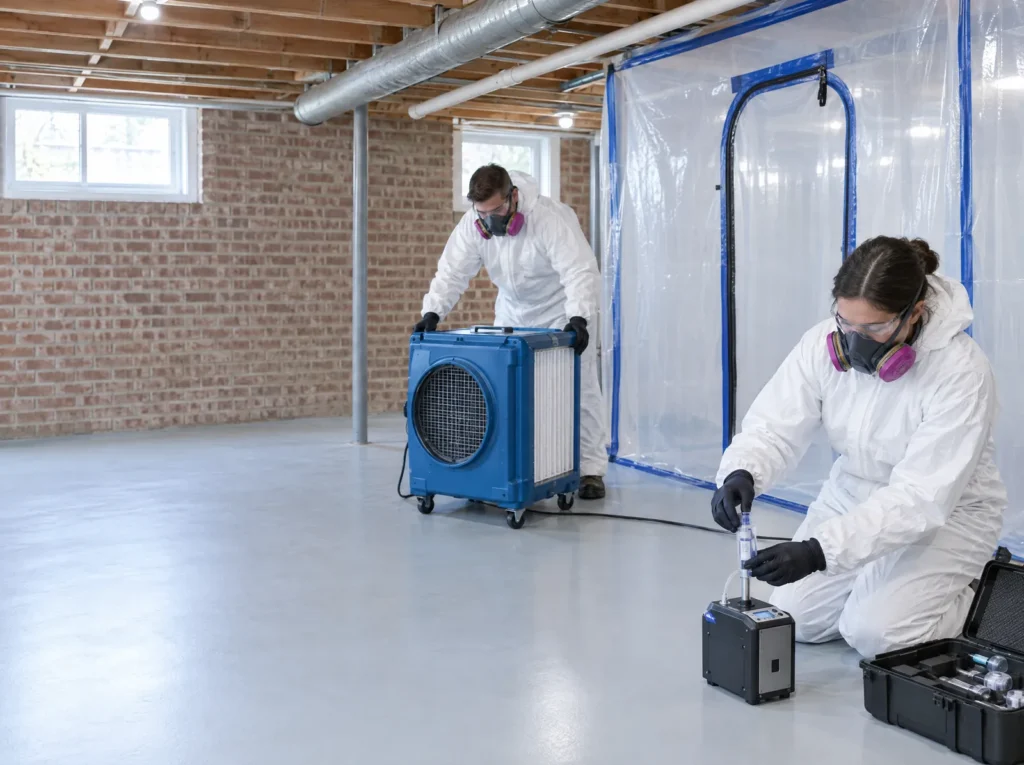
Step 4: Clean the air
The particles that cause the most trouble are the ones you can’t see. Mold fragments and the dust mycotoxins cling to are small enough to stay airborne for a long time and to settle on every surface in a room. HEPA air scrubbers run for the length of the project. Before we take containment down, every surface inside it gets another round of HEPA vacuuming and wiping. When testing shows the HVAC system is involved, cleaning the ductwork and air handler becomes part of this step, so the system stops recirculating contaminated dust through the house.
Step 5: Prove it
This is the step that gives the method its name. Clearance testing repeats the sampling from step one, in the same areas, so the before and after results can be compared directly. On mycotoxin projects, that includes a repeat mycotoxin panel. If the results aren’t where they need to be, the job isn’t done: we clean again and retest. See how clearance testing works for what the samples measure and how to read them.
You get the full lab report. It’s the document your family, your doctor, a buyer or an insurer can rely on, and it’s the difference between “we think it’s gone” and knowing it is.
How the method changes for mycotoxin projects
The five steps stay the same. What changes is the depth. On mycotoxin remediation projects, testing includes toxin panels from the start, the cleaning step reaches further into dust, ductwork and belongings, and clearance has to show the toxins are down, not just the spore count.
We remove mold and mycotoxins from buildings. We don’t diagnose or treat medical conditions. If you have symptoms, please work with a doctor. With your permission, we’re glad to share test results and our plan with them.
Common questions
Have a question that isn't here? Call a specialist
What are the steps of mold remediation?
Our mold remediation process has five: test, contain, remove, clean the air, and prove it. Correcting the moisture source is part of the plan that comes out of testing, and it has to be handled before or alongside removal, or the mold returns.
Why do you test before remediation instead of just removing the mold?
Because visible mold is rarely the whole story. Testing shows what is in the air and dust, whether mycotoxins are present, and how far contamination has spread. It also gives a baseline, so the clearance test at the end has something to be compared against.
Do you fix the leak or humidity problem?
We find and document the moisture source and make sure it is addressed before cleaning is considered finished. Depending on the problem, the repair may be handled by us or by a plumber, roofer or HVAC contractor, and we'll explain which in the written plan.
How long does the mold remediation process take?
It depends on the size of the affected area, how much material has to come out and how long lab results take. Lab results usually return in 24 to 48 hours. You'll get an expected schedule with your written plan.
Can my family stay home during the process?
Often, yes, in the parts of the home outside containment. No one should enter the work area. People who are sick from mold exposure sometimes choose to stay elsewhere until clearance testing passes.
What happens if clearance testing doesn't pass?
The job isn't finished. We look at where the results are high, clean or treat those areas again, and retest. A job isn't done until the lab says so.
Is this the same process for mycotoxin projects?
Yes, with more emphasis on dust, the HVAC system and belongings, and with a mycotoxin panel in both the first and final round of testing.
We're done when the lab says so.
Every remediation ends with clearance testing, and our work is backed by a complete-removal guarantee. We don't close a job on a failed result.
Talk to a specialistStart with step one
Tell us what's going on at home, and a specialist will call you back to talk through testing.
- (833) 772-6653
- info@americanmoldexperts.com
- Open 7 days, 8am to 8pm