
Contained, enzyme-based, lab-verified
Mold remediation that ends with a lab result
We find why the mold grew, remove it under containment, and test afterward so you know the job worked.
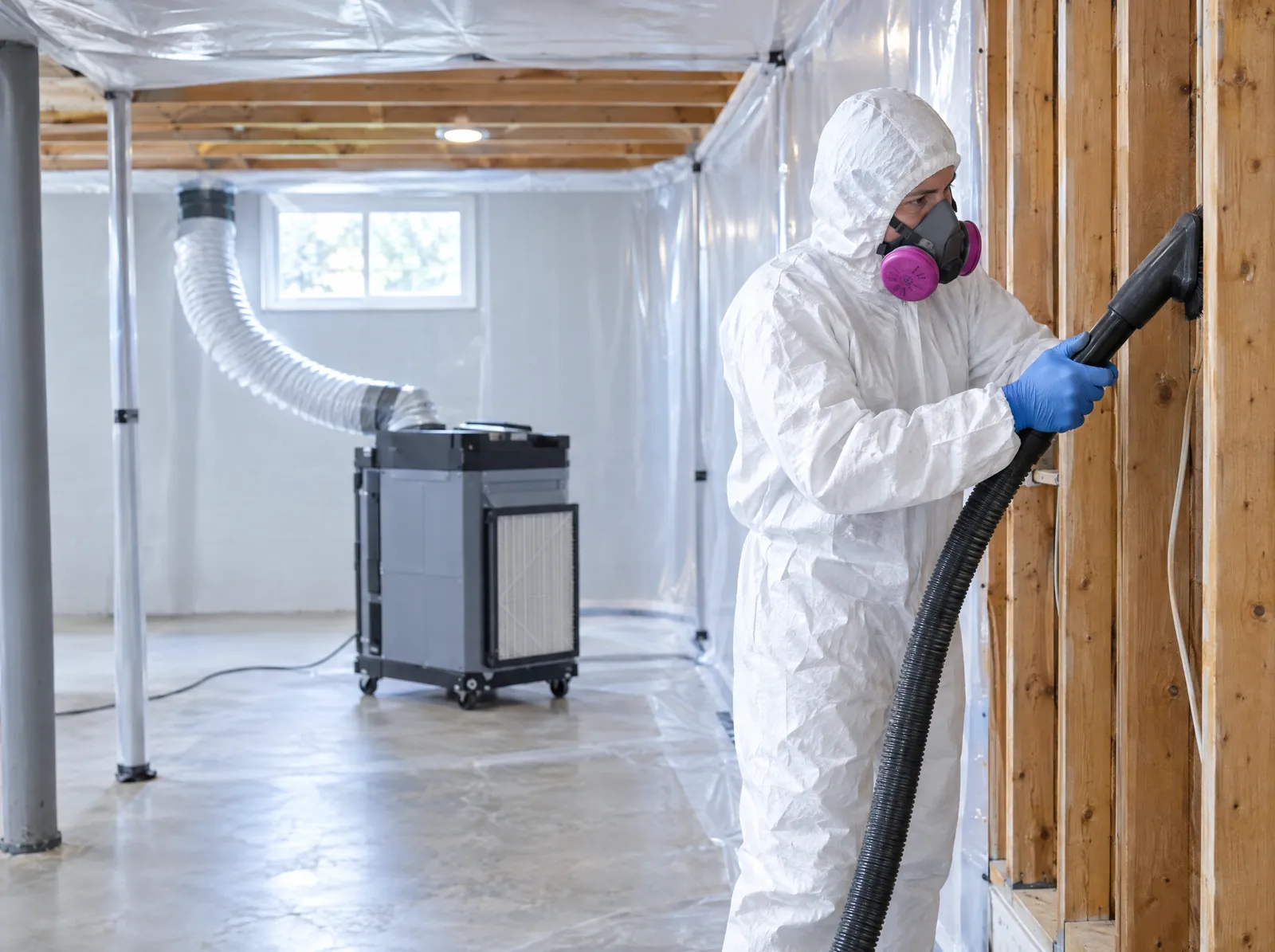
What is mold remediation?
Mold remediation is the process of correcting the moisture problem that let mold grow, isolating the affected area, physically removing the growth and contaminated materials, cleaning the fine dust mold leaves behind, and testing to confirm the space is back to normal. It differs from simple mold removal, which usually means scrubbing or spraying what you can see. Remediation deals with the cause, the hidden spread and the proof.
Why so many mold jobs don't hold
A lot of what gets sold as mold removal is really surface treatment. Someone sprays a biocide, maybe fogs the room, paints over the stain and leaves. The wall looks better for a while. But the leak or humidity that fed the mold is still there, the growth inside the cavity was never touched, and the dust that drifted into the rest of the house was never cleaned. Nobody tested afterward, so nobody knows.
Sound familiar?
- The mold came back in the same spot within a year.
- You were told to tear out half the basement and aren't sure it's necessary.
- The last company sprayed and left without testing anything.
- You can still smell it, even though the stain is gone.
We do it differently.
| Typical mold removal | AME mold remediation | |
|---|---|---|
| Moisture source | Often left for someone else | Found and corrected before cleaning starts |
| Containment | Sometimes a sheet of plastic | Sealed barriers with negative air pressure |
| Method | Spray, fog, paint over | Remove what can't be saved, HEPA clean and enzyme-treat the rest |
| Dust in the rest of the home | Not addressed | HEPA vacuuming, detailed wiping and air scrubbing |
| Proof | A visual walk-through | Clearance testing with lab results you keep |

Why families trust us with their homes
-
Family-owned since 2008
A multigenerational family business. Not a franchise, not a private-equity rollup.
-
Credentialed where it isn't required
Indiana doesn't license mold remediators. We hold IICRC, CMR, CRMI and CCMI credentials anyway.
-
Called on as experts
Attorneys bring us into legal cases involving mold and mycotoxins.
-
Lab results in 24 to 48 hours
Every inspection comes with a written report, color photos and lab results.
- IICRC Certified Firm
- CMR
- CRMI
- CCMI
- BBB A+ Accredited
- NAMRI
- IAQA
- NORMI
- AMMA
- PMII
The AME Clearance Method
The AME Clearance Method for mold remediation
Every remediation project follows the same order. The steps are simple to describe and easy to cut corners on, which is why we don't skip any of them.
Talk to a specialist-
Inspect and test
We look for the moisture, measure it, and sample the air and surfaces so we know what's growing, how far it has spread, and what the baseline is.
-
Correct the moisture
A leak, a failed sump pump, poor attic ventilation or high indoor humidity has to be fixed first. Otherwise the mold grows back.
-
Contain the area
Plastic barriers, zippered entry doors and HEPA air machines under negative pressure keep disturbed spores and dust inside the work zone.
-
Remove what can't be saved
Porous materials with growth inside them, such as some drywall, insulation or carpet pad, are cut out, bagged and taken away. Everything that can be cleaned stays.
-
Clean and treat
Framing, subfloors and hard surfaces are HEPA vacuumed, wiped and treated with plant-based enzyme products designed to break down mold and mycotoxins.
-
Scrub the air
HEPA air scrubbers run through the project to capture the fine particles cleaning stirs up, and HVAC is cleaned when testing shows it's involved.
-
Prove it with clearance testing
Once the area is dry and clean, we test again. Lab results typically come back in 24 to 48 hours, and you get the full report.
What a remediation project includes
- A pre-work inspection with moisture readings
- Air and surface testing to set a baseline
- A written scope before anything is removed
- Identification of the moisture source
- Containment with negative air pressure
- Removal and bagging of materials that can't be cleaned
- HEPA vacuuming and detailed surface cleaning
- Enzyme treatment of framing and hard surfaces
- HEPA air scrubbing during the work
- Clearance testing and a lab report you keep

Proof you can hold in your hands
When we finish, you don't get a handshake and a promise. You get the paperwork your family, your doctor, your insurer or your buyer can rely on.
Inspection report
What we found, where it is coming from, with color photos.
Written remediation plan
Scope, timeline and what will and won't be removed, before work starts.
Clearance lab report
Air, surface and mycotoxin results after the work is done.
A report for your doctor
With your permission, we share results directly with your care team.
Mold remediation, explained
Mold remediation vs. mold removal
The two terms get used as if they mean the same thing, and in advertising they often do. In practice there is a real difference. “Mold removal” usually describes getting rid of the growth you can see: scrubbing it, spraying it or cutting out a stained piece of drywall. “Mold remediation” describes the whole job: finding out why the mold grew, keeping the work from spreading contamination to clean rooms, removing growth wherever it actually is, cleaning up the particles it released, and testing to confirm the result.
Mold spores are present in nearly every indoor and outdoor environment, so no one can promise a home with zero mold. The realistic goal is to bring the affected area back to normal levels for that home and region, with no active growth left behind. The industry standard for professional work, ANSI/IICRC S520, describes this as returning the space to its normal fungal ecology. That is a measurable target, and it’s why testing matters at the end as much as at the beginning. We cover the terms in more detail in the difference between mold removal and mold remediation.
When you need a professional, and when you don’t
Not every mold problem needs a remediation company. The U.S. Environmental Protection Agency’s guidance for homeowners says that if the moldy area is smaller than about 10 square feet, roughly a 3 foot by 3 foot patch, you can generally handle it yourself. That assumes the water problem is fixed, the surface is something you can clean, and you protect yourself with gloves, goggles and an N95 respirator.
A little mildew on shower grout or a window sill is a cleaning job. These situations usually aren’t:
- The area is larger than about 10 square feet, or you keep finding more once you start looking.
- The mold is inside walls, ceilings, subfloors or ductwork. What you see on the surface is often the smallest part.
- The water was contaminated, such as a sewage backup or floodwater from outside.
- You smell it but can’t find it. A persistent musty odor points to hidden growth.
- It keeps coming back after you clean it, which means the moisture source hasn’t been found.
- Someone in the home has health concerns, or a doctor has asked you to look at the house.
- You’re buying or selling and need documentation that the work was done properly.
If you’re weighing a do-it-yourself cleanup, our answer to can I remediate mold myself? goes through the safe way to handle a small area.
What happens during a remediation project
The method section above lists the steps in order. Here is what the three parts homeowners ask about most actually look like on site.
Containment
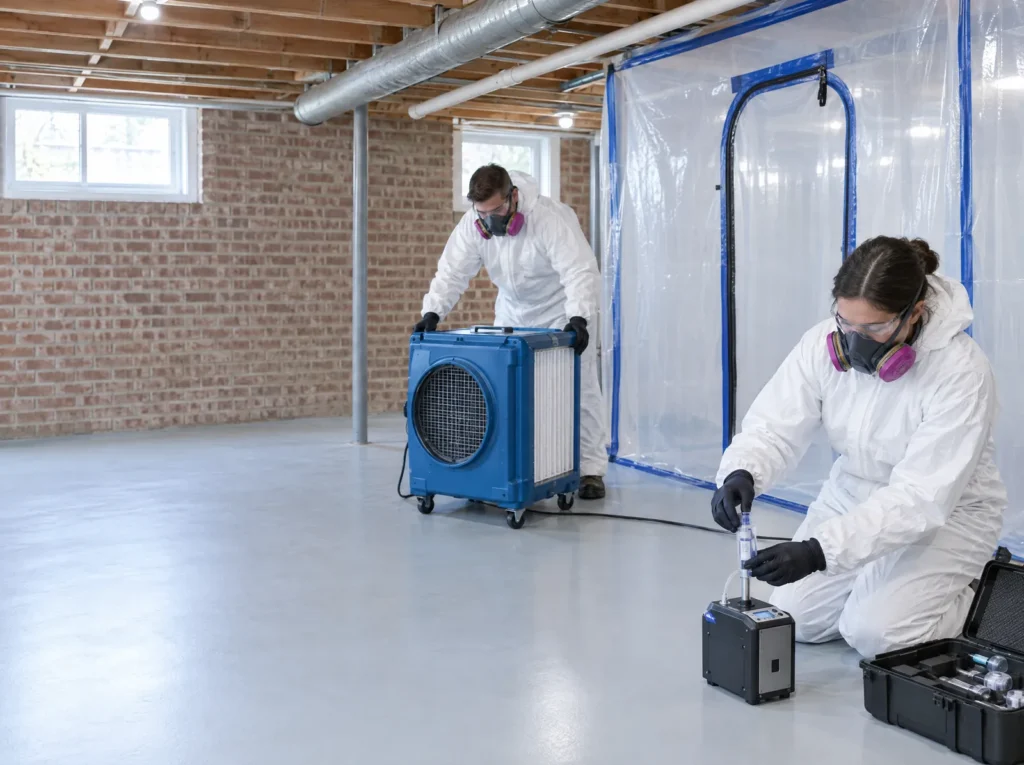
Removing moldy material releases spores and fragments into the air. Containment keeps that from reaching the rest of your home. We seal off the work area with plastic sheeting, cover vents and doorways, and install a zippered entry. HEPA air machines then pull air out of the enclosure and filter it, which puts the space under negative pressure: air flows into the work area through any small gap, never out of it. For a small bathroom job, containment might be a single enclosed room. For a basement or crawlspace, it can mean isolating an entire level. Our guide to mold containment shows how it is set up.
What gets removed and what gets cleaned
The deciding question is whether the material is porous and whether mold has grown into it, not just onto it. Porous materials hold growth in places no cleaner can reach. Hard materials usually hold it on the surface, where it can be physically removed.
| Material | Usual approach | Why |
|---|---|---|
| Drywall with growth in the paper or core | Remove and replace | The paper facing is food for mold, and growth runs through it |
| Fiberglass or cellulose insulation | Remove and replace | It traps spores and dust and can’t be cleaned |
| Carpet and pad that stayed wet | Usually remove | Pad in particular holds moisture and growth |
| Wood framing and subfloor | Clean and treat, unless structurally damaged | Surface growth on solid wood can be removed by HEPA vacuuming, wiping and treatment |
| Concrete, block and metal | Clean and treat | Non-porous or low-porosity surfaces clean well |
| Ceiling tiles and cardboard | Remove | Highly absorbent and inexpensive to replace |
We’re conservative about demolition. Tearing out more than necessary costs you money and spreads dust. Tearing out too little leaves growth behind. Moisture readings and testing, not guesswork, decide where the line is. If you’ve been told everything has to go, our answer on whether you have to remove drywall with mold can help you ask the right questions.
The enzyme approach
After the damaged materials are out and surfaces are HEPA vacuumed and wiped, something still has to deal with the residue left in wood grain, block pores and the corners you can’t scrub. Many companies use bleach or a strong biocide here. Those can kill living mold, but they don’t remove dead mold, and they aren’t designed to break down mycotoxins, the chemical compounds some molds produce that stay behind after the mold is dead.
We use plant-based enzyme treatments from US Enzyme instead. They’re designed to break down mold and mycotoxins rather than cover them up. We use them together with removal and HEPA cleaning, not in place of removing materials that can’t be saved or fixing the moisture, and we still test after every job, because the lab result is what counts. Read more about enzyme mold remediation.
Clearance testing: how you know it worked
A remediation job without testing at the end is a job you have to take on faith. Clearance testing, also called post-remediation verification, is the check that the work did what it was supposed to do. It happens while containment is still in place, once the area is dry and cleaning is complete.
- A visual inspection confirms there is no remaining visible growth, debris or dust in the work area.
- Moisture readings confirm materials are dry, so growth won’t restart.
- Air samples inside the work area are compared with an outdoor sample and with unaffected rooms.
- Surface samples check that cleaned materials are actually clean.
- Mycotoxin testing, when the project calls for it, checks settled dust for toxins that spore counts can’t show.
Containment comes down only after the results pass. Lab results typically come back in 24 to 48 hours, and the report is yours to keep for your records, your insurer, a future buyer or your doctor. Our page on post-remediation verification explains what the numbers mean and what happens if a sample doesn’t pass.
What mold remediation costs, and what insurance covers
What drives the price
Two jobs with the same square footage of visible mold can be priced very differently, because what you see isn’t what drives the cost. These factors do:
- How far it has spread, including inside wall cavities, under flooring and into ductwork.
- Access. A tight crawlspace or an attic with little headroom takes more time and setup than an open basement.
- How much has to be removed, and whether rebuilding is part of the quote. Many remediation bids stop at removal and cleaning, so ask.
- The size of the containment and how many air machines the space needs.
- HVAC involvement. If the system has been circulating spores, it has to be cleaned too.
- Testing before and after, and whether mycotoxin testing is included.
- Belongings that need cleaning, or a plan for what to keep.
For a local reference point, Angi reports that mold remediation in Indianapolis typically runs from $1,026 to $3,005, with an average of about $1,999. Treat that as a rough guide. Small, contained jobs can fall below it, and whole-level or multi-area projects can run well above it. We give you a written scope and price after testing, before any work begins. Our mold remediation cost guide goes through each factor in detail.
Insurance basics
Whether homeowners insurance helps usually comes down to the cause. Mold that results from a sudden, accidental event your policy already covers, such as a burst pipe or a failed water heater, has a better chance of being covered. Mold from a slow leak, long-term humidity or deferred maintenance is commonly excluded. Many policies also cap mold coverage at a set amount or exclude it unless you’ve added an endorsement.
Every policy is different, so read the mold, fungi and water damage sections of yours and call your agent before work begins. Document the damage with photos, keep receipts for any emergency repairs, and ask for your test results in writing. Our answer on whether homeowners insurance covers mold remediation has more detail on filing.
Remediation guides by problem area
The same method applies everywhere, but each part of a home fails in its own way and needs its own setup. These guides go deeper:
- Basement mold remediation: foundation seepage, sump failures and finished basements that hide moisture.
- Crawlspace mold remediation: ground moisture, vapor barriers and floor joists.
- Attic mold remediation: roof decking, bath fan venting and ventilation.
- Mold inside walls: plumbing leaks and condensation you can’t see.
- HVAC and duct mold: when the system spreads spores through the house.
- Mold after water damage: what to do in the first days after a leak or flood.
- Black mold removal: what the term means and how it’s handled.
- Commercial mold remediation: offices, schools and multifamily buildings.
How to choose a mold remediation company
Some states license mold work. Indiana does not, which means almost anyone can call themselves a mold remediator here. That puts the burden on you to ask good questions. These are the ones we’d ask if it were our own house:
- Do you test before and after? If the answer is “you’ll be able to see it’s gone,” keep looking.
- Who finds the moisture source? A company that only treats the mold will be back.
- What does containment look like? Ask for specifics: barriers, negative air, HEPA filtration.
- What will you remove, and why? A good scope explains each item. Be wary of both “we’ll just spray it” and “it all has to go” without testing to support it.
- What products do you use? Ask whether they address mycotoxins, not only living mold, and why the company chose them.
- What credentials does the firm hold? Look for IICRC certification and membership in industry groups. We’re an IICRC Certified Firm with CMR, CRMI and CCMI credentials, and members of NAMRI, IAQA, NORMI, AMMA and PMII.
- Will I get the lab reports? You should get every result, not a summary.
We’ve been doing this since 2008 as a family-owned company, working from our office in Avon, Indiana, and traveling for projects across the country. If you’d like to see how the steps fit together from the first call to the final report, read the AME Clearance Method. If testing has already shown toxins in your home, mycotoxin remediation covers the added steps, and if you’re not sure yet what you’re dealing with, start with mold testing and inspection.
We remove mold and mycotoxins from buildings. We don’t diagnose or treat medical conditions. If you or anyone in your home has symptoms, please work with a doctor. With your permission, we’re glad to share test results and our plan with them.
Common questions
Have a question that isn't here? Call a specialist
Can a house full of mold be saved?
Most can. If the framing and subfloors are structurally sound and the moisture problem can be fixed for good, a home with widespread mold can usually be remediated. Porous materials with heavy growth get replaced, and the structure is cleaned and treated. Severe rot is the main exception, and that's a question for a contractor as well as a remediator.
Can I clean up mold myself?
For a small patch on a hard surface, often yes. The EPA suggests a homeowner can generally handle areas smaller than about 10 square feet, as long as the moisture problem is fixed and you wear gloves, goggles and an N95 respirator. Bigger areas, mold inside walls, mold after sewage backup, or anyone in the home with health concerns are good reasons to call a professional.
Does homeowners insurance cover mold remediation?
Sometimes. Coverage usually depends on the cause. Mold that follows a sudden, accidental event covered by your policy, like a burst pipe, is more likely to be covered than mold from a slow leak or long-term humidity. Many policies limit or exclude mold, so read yours and ask your agent before work begins.
Should I spray bleach on mold before you arrive?
Please don't. Bleach doesn't penetrate drywall or wood, the water in it can feed growth below the surface, and scrubbing or spraying disturbs spores. It also changes what testing will find. Stop disturbing the area, keep people and pets out, and close the door if you can.
Do you have to remove drywall with mold on it?
Not always. Drywall with growth that has gone into the paper and gypsum usually needs to come out, because it can't be reliably cleaned. Light surface growth on painted drywall can sometimes be cleaned. We decide based on moisture readings and what we find, and we keep as much of the home intact as the testing supports.
Can we stay home during mold remediation?
Many families stay in the unaffected part of the house while we work behind containment. People with health concerns, or whose doctor has advised it, often stay elsewhere until clearance testing passes. We'll help you decide based on the size of the job and where it is.
Why does mold keep coming back after it's cleaned?
Almost always because the moisture was never corrected, or because growth inside a wall, subfloor or HVAC system was left behind. Surface cleaning makes the visible part go away for a while. Finding the water source and cleaning the hidden areas is what stops the cycle.
Do you only work in Indiana?
No. Our office is in Avon, Indiana, and our crews work across the Midwest. We also have a Southwest Florida team and travel for projects anywhere in the United States.
We're done when the lab says so.
Every remediation ends with clearance testing, and our work is backed by a complete-removal guarantee. We don't close a job on a failed result.
Talk to a specialistTalk to a mold remediation specialist
Tell us what you're seeing, where it is and how long it's been there. A specialist will call you back.
- (833) 772-6653
- info@americanmoldexperts.com
- Open 7 days, 8am to 8pm