
Clearance sampling and lab reports
Mold clearance testing: the samples and the report
Air, surface, dust and mycotoxin samples compared with an outdoor baseline, so the lab report decides when work is done.
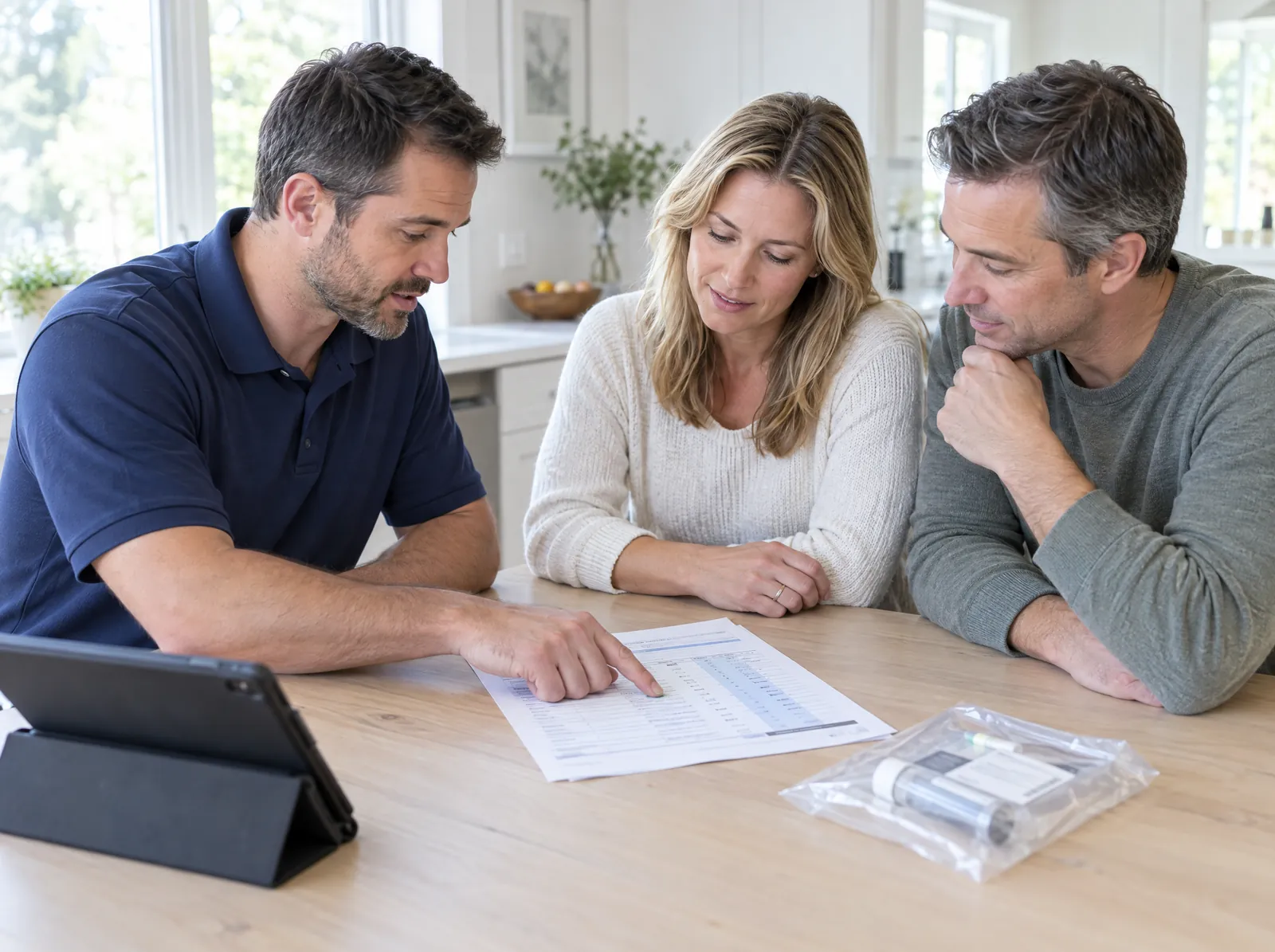
What is mold clearance testing?
Mold clearance testing is the lab sampling done at the end of a mold job to show the work area is back to normal. Air samples from the work area are compared with an outdoor baseline and an unaffected room, and surface, dust or mycotoxin samples are added when the project calls for them. A lab analyzes each sample, and the clearance report shows whether the area passed or needs more cleaning.
Why a finished job still needs lab results
A clean-looking room tells you the visible part of the job went well. It can't tell you what's floating in the air, what settled on the tops of the framing, or whether the molds that caused the problem are still concentrated in the work area. Those are questions only a sample and a lab can answer. Clearance testing turns the end of a job from someone's opinion into a report you can read, keep and hand to a doctor, a buyer or an insurer.
Sound familiar?
- You've been told the job is done, but no one has shown you a lab report.
- You have a clearance report and can't tell whether the numbers are good.
- A previous job passed an air test, but a later dust test still came back high.
- You're selling the home and the buyer wants proof the work was verified.
We do it differently.
| Minimal sign-off | AME clearance testing | |
|---|---|---|
| Samples | None, or one air sample | Work-area air, an unaffected room and outdoors, plus surface, dust or mycotoxin samples as needed |
| Comparison | A single number with no context | Every result read against the outdoor baseline and the control room from the same visit |
| Pass criteria | Decided after the results come in | Written into the scope before work begins |
| The report | A summary line saying it passed | Original lab results, sample locations and a plain explanation |
| If it fails | Discovered after move-in | Cleaned again and resampled while containment is still up |

Why families trust us with their homes
-
Family-owned since 2008
A multigenerational family business. Not a franchise, not a private-equity rollup.
-
Credentialed where it isn't required
Indiana doesn't license mold remediators. We hold IICRC, CMR, CRMI and CCMI credentials anyway.
-
Called on as experts
Attorneys bring us into legal cases involving mold and mycotoxins.
-
Lab results in 24 to 48 hours
Every inspection comes with a written report, color photos and lab results.
- IICRC Certified Firm
- CMR
- CRMI
- CCMI
- BBB A+ Accredited
- NAMRI
- IAQA
- NORMI
- AMMA
- PMII
The AME Clearance Method
How clearance sampling works
Clearance is planned before remediation starts, then carried out once the remediation checklist is complete.
Talk to a specialist-
Write the sampling plan
Where samples will be taken, which kinds and what counts as a pass are agreed before work begins. If your doctor has a target, it goes in too.
-
Confirm the area is ready
Sampling starts only after the work area is dry and visibly clean. Testing a dusty or damp area wastes a lab fee and a day.
-
Settle the air
Equipment and air movement are managed before sampling, so the samples reflect the cleaned space rather than the machines working in it.
-
Collect air samples
Samples inside the work area, in an unaffected room and outdoors, all at the same visit so weather and season affect them equally.
-
Collect surface, dust and mycotoxin samples
Tape lifts or swabs on cleaned materials, settled dust where the scope calls for it, and a repeat mycotoxin panel on mycotoxin projects.
-
Lab analysis
Samples go to the lab with a chain of custody. Standard results typically come back in 24 to 48 hours. Specialty panels can take longer.
-
Report and decision
You receive the clearance report with the original lab results. If the area passes, containment can come down. If not, it's cleaned again and resampled.
What clearance testing includes
- A sampling plan and pass criteria written before work begins
- Air samples inside the work area
- An outdoor baseline sample from the same visit
- A control sample from an unaffected room
- Tape lift or swab samples on cleaned surfaces where needed
- Settled dust samples where the scope calls for them
- A repeat mycotoxin panel on mycotoxin projects
- Laboratory analysis with chain of custody
- A clearance report with the original lab results and an explanation
- Resampling of any area that doesn't pass
Proof you can hold in your hands
When we finish, you don't get a handshake and a promise. You get the paperwork your family, your doctor, your insurer or your buyer can rely on.
Inspection report
What we found, where it is coming from, with color photos.
Written remediation plan
Scope, timeline and what will and won't be removed, before work starts.
Clearance lab report
Air, surface and mycotoxin results after the work is done.
A report for your doctor
With your permission, we share results directly with your care team.
Clearance testing, explained
The samples a clearance test takes
No single sample can prove a job worked. A clearance test is a small set of samples that only make sense side by side. Which ones a project needs depends on what was found at the start and who lives in the home.
| Sample | Where it’s taken | What it shows | When it’s used |
|---|---|---|---|
| Work-area air | Inside containment, near where the growth was | The kinds and amounts of spores in the cleaned space | Every clearance |
| Outdoor baseline | Outside the home, at the same visit | The normal background for that day, season and weather | Every clearance |
| Unaffected room | A room the problem never reached | What normal looks like inside this particular house | Almost every clearance |
| Surface (tape lift or swab) | Cleaned framing, subfloor or other materials | Whether growth or settled spores remain on surfaces | When surfaces were cleaned rather than removed |
| Settled dust | Horizontal surfaces in and near the work area | What has built up in the dust, which air samples can miss | Sensitive households and larger projects |
| Mycotoxin panel | Settled dust, compared with the panel taken before the work | Whether mold toxins remain after the mold is gone | Mycotoxin projects and mold-sensitive households |
The outdoor and unaffected-room samples are not extras. Outdoor spore counts can swing a lot between a dry morning and a humid afternoon, so the baseline has to come from the same visit. Without it, a work-area number has nothing to be compared with.
What a pass means
The mold remediation industry’s main standard, IICRC S520, describes indoor mold in terms of three conditions. Clearance samples are read to decide which one the work area is in now.
| Condition | What it describes | Clearance meaning |
|---|---|---|
| Condition 1 | Normal fungal ecology: the kinds and amounts of mold you’d expect in a building without a mold problem | Pass |
| Condition 2 | Settled spores or mold fragments that came from growth elsewhere | Fail. More cleaning needed. |
| Condition 3 | Actual mold growth, active or dormant | Fail. Growth was missed. |
Clearance doesn’t mean zero mold. Every building has some, carried in on air and shoes. A pass means the work area now looks like a normal space rather than one that recently had a problem. In practice, that usually comes down to a handful of pass criteria written into the scope before work begins: work-area air similar to or lower than outdoor air, with a similar mix of molds; results in line with the unaffected room; water-damage molds absent or at trace levels; clean surface samples; and, on mycotoxin projects, a repeat panel that meets the target agreed at the start.
How to read a clearance report
An air sample report lists the spore types the lab identified and how many it counted, usually per cubic meter of air, for each sample location. On its own a number means little. The comparisons are what count:
| What to compare | What a passing result usually looks like | What raises concern |
|---|---|---|
| Work area vs. outdoors | Similar types of mold, at similar or lower levels | Types inside that are rare or absent outdoors |
| Work area vs. unaffected room | Comparable results | Work area noticeably higher |
| Water-damage indicator molds | Absent or at trace levels | Stachybotrys, Chaetomium or elevated Aspergillus and Penicillium types in the work area |
| Hyphal fragments and debris | Low | Elevated, suggesting fine dust remains |
| Surface samples | No growth, only normal background | Hyphae or dense spores on a cleaned material |
Beyond the numbers, a clearance report you can rely on should show the lab’s name, the date and time of each sample, a map or description of each location, the outdoor conditions at the visit, the raw counts rather than just a verdict, and a chain of custody from the site to the lab. Our answer on what mold spore counts mean walks through a sample report line by line.
Who should collect the samples
The person who takes clearance samples decides where they’re taken, and placement affects results. That’s why many owners, insurers and attorneys prefer an independent assessor to sample the remediator’s work. Some states that license mold professionals require that separation on regulated jobs. Indiana doesn’t license mold remediators, so for Indiana homes it’s a matter of preference. We sample our own projects, share every original result, and are glad to coordinate with any qualified assessor you choose. Whoever does it, ask them to follow the sampling plan written before the work began, not one chosen after.
If a sample fails
A failed sample is the test doing its job. The usual cause is fine dust left on horizontal surfaces, in the tops of framing or on the inside of the plastic. Sometimes it points to a small area of growth that was missed. The area stays contained, the likely source is found and cleaned again, the air is allowed to settle, and the failed locations are resampled. Clearance testing is the last item on the remediator’s post remediation verification checklist, so a fail usually sends the job back one or two steps on that list rather than to the start.
When clearance should include mycotoxins
Mold samples measure mold. They can come back clean while fine dust carrying mycotoxins remains on framing or in nearby rooms. On any project where toxins were part of the problem, and for households where someone is sensitive, clearance should include a repeat mycotoxin panel compared with the one taken before the work. Our page on mycotoxins after remediation explains why they can linger.
After clearance: checking over time
Clearance describes the work area at the moment the job ends. It can’t promise what happens after the next heavy rain or a new plumbing leak. Families who want extra confidence often retest later with the same dust test used at the start, under normal living conditions. For the signs to watch in the months after, see how to know mold remediation was successful.
Clearance testing verifies the condition of a building. It doesn’t diagnose or treat any medical condition, and passing clearance isn’t a health guarantee. If anyone in the home has symptoms, please work with a doctor. With your permission, we’ll share the clearance report with them.
Common questions
Have a question that isn't here? Call a specialist
Who should collect clearance samples?
Many owners prefer an independent firm to sample the remediator's work, and some states that license mold professionals require that separation on regulated projects. Indiana doesn't license mold remediators, so there it comes down to your preference. We sample our own projects and give you every original lab report, and we're glad to coordinate with an independent assessor if you hire one.
What does it take to pass clearance?
There are no federal numeric limits for mold, so pass criteria are set in the scope. Typical criteria are work-area air comparable to or lower than outdoor air with a similar mix of molds, results close to the unaffected room, no elevated water-damage molds, and clean surface samples. On mycotoxin projects, the repeat panel should meet the target agreed at the start.
What happens if clearance fails?
The area stays contained. We look at which samples failed and why, clean again, fix anything that was missed, and resample. Containment comes down only when the results pass.
Is clearance testing the same as post-remediation verification?
Not quite. Post-remediation verification is the whole end-of-job checklist: moisture fixed, materials dry, no visible growth or dust, surfaces cleaned and the work documented. Clearance testing is the lab-sampling step on that list, and it comes last.
Should clearance include mycotoxin testing?
When the project involved mycotoxins, or when someone in the home is sensitive to mold, yes. Mold samples can pass while toxin-laden dust remains, so a repeat mycotoxin panel compared with the one taken before the work is the way to check.
Can I retest later with ERMI or HERTSMI-2?
Yes, and many families do. A dust test taken right after a deep clean mainly shows how well the cleaning went. One taken after a period of normal living shows whether the source is truly gone. Use the same lab and method as any earlier test so the results compare.
How long does clearance testing take?
Sampling is usually done in one visit. Lab results typically come back in 24 to 48 hours, and specialty tests such as mycotoxin panels can take longer.
We're done when the lab says so.
Every remediation ends with clearance testing, and our work is backed by a complete-removal guarantee. We don't close a job on a failed result.
Talk to a specialistSchedule clearance testing
Tell us about the remediation and who did it. A specialist will call you back to plan the samples and the clearance visit.
- (833) 772-6653
- info@americanmoldexperts.com
- Open 7 days, 8am to 8pm