
After the job
Mycotoxins after remediation: why they linger
Why toxins can remain after mold is removed, how to test for them, and how to find what was missed.
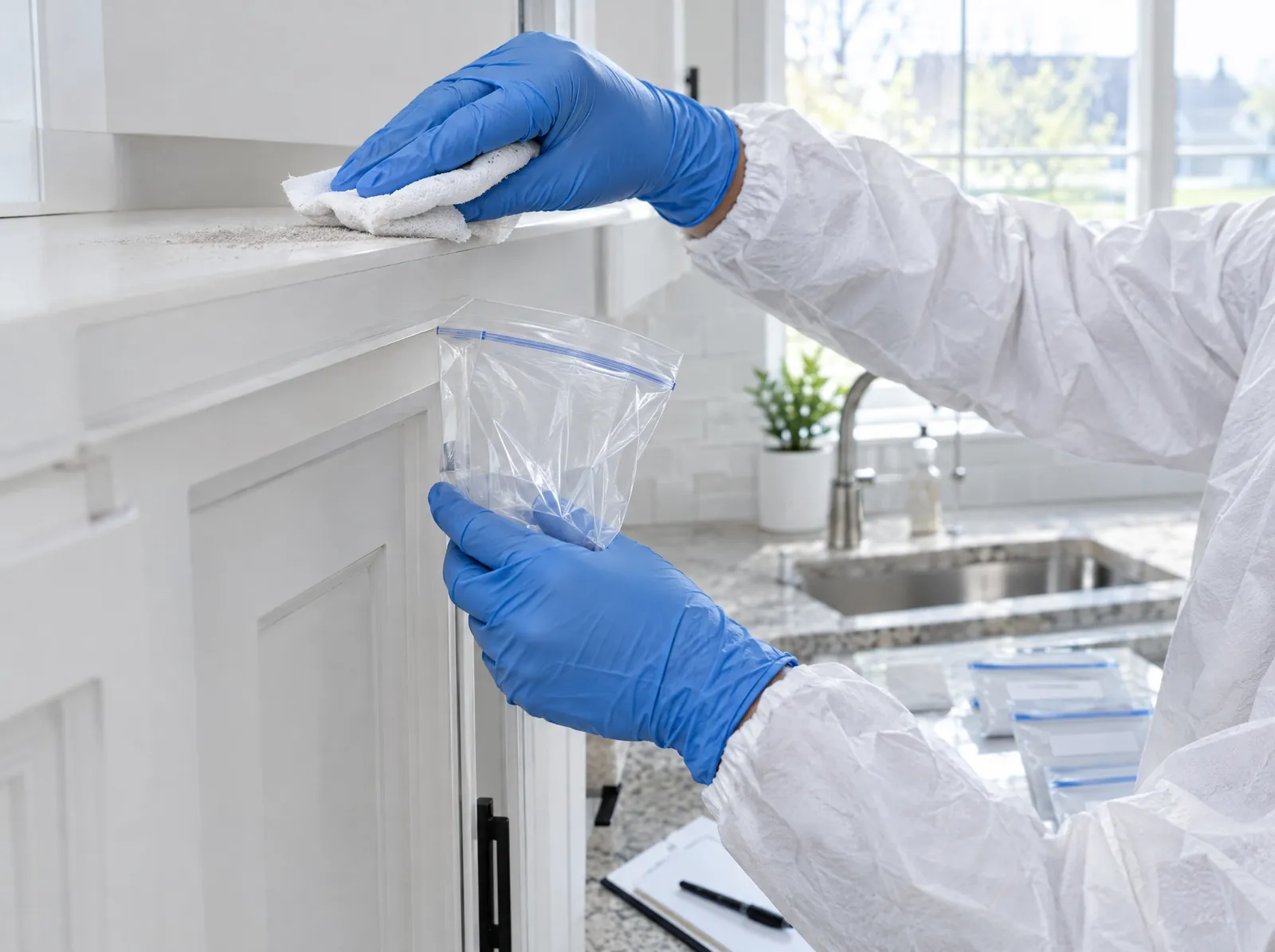
Can mycotoxins remain after mold remediation?
Yes. Mycotoxins after remediation are common when a job focused on killing or removing visible mold but not on the dust, the HVAC system or the belongings. The toxins are stable chemicals, so they stay in settled dust and porous materials unless someone removes them on purpose. A mycotoxin panel on settled dust, compared with any earlier results, shows whether toxins remain and helps point to what was missed.
Why a finished mold job can still leave toxins behind
Most remediation is judged on sight and smell, or on an air test taken right after cleaning while the air scrubbers have just been running. None of that looks at the dust in the next room, the inside of the return duct or the sofa that sat in the house through the whole project. When mycotoxins turn up later, it's usually not a mystery. Something was left out of the scope.
Sometimes the cause is new: a moisture problem that was never corrected, and mold growing back.
Sound familiar?
- The mold was removed, but the house still doesn't feel right to you.
- Nobody tested for mycotoxins before or after the job.
- Your belongings went back in without being cleaned.
- You passed an air test, but a dust panel still shows toxins.
We do it differently.
| Visual or air-only clearance | Mycotoxin-aware clearance | |
|---|---|---|
| What's checked | Visible growth, odor and spore counts | Settled dust and a mycotoxin panel as well |
| Where | The work area | The work area plus the rooms and systems around it |
| HVAC system | Often left out | Inspected and sampled |
| Belongings | Returned uncleaned | Cleaned before they come back |
| Comparison | None | Before and after results from the same method |

Why families trust us with their homes
-
Family-owned since 2008
A multigenerational family business. Not a franchise, not a private-equity rollup.
-
Credentialed where it isn't required
Indiana doesn't license mold remediators. We hold IICRC, CMR, CRMI and CCMI credentials anyway.
-
Called on as experts
Attorneys bring us into legal cases involving mold and mycotoxins.
-
Lab results in 24 to 48 hours
Every inspection comes with a written report, color photos and lab results.
- IICRC Certified Firm
- CMR
- CRMI
- CCMI
- BBB A+ Accredited
- NAMRI
- IAQA
- NORMI
- AMMA
- PMII
The AME Clearance Method
How we find what the first job missed
Whether the earlier work was ours or someone else's, we start by assuming nothing and checking everything.
Talk to a specialist-
Gather the history
Earlier reports, the scope of work, photos and test results show what was done, where, and what wasn't measured.
-
Recheck the moisture
We confirm the original water problem was actually fixed and look for new ones. Regrowth means a moisture source is still active.
-
Sample dust across the house
Dust from the former work area, the main living spaces and a comparison room shows whether toxins are concentrated or spread out.
-
Inspect the HVAC system
The coil, pan, returns and ducts are checked and sampled, since a system left out of the first job can keep spreading contaminated dust.
-
Look at belongings and hidden areas
Soft furnishings, stored items and nearby wall cavities, crawlspaces and attics are reviewed as possible reservoirs.
-
Close the gaps
Targeted removal, HEPA cleaning and enzyme treatment address what was found, under containment where needed.
-
Clear it with numbers
A repeat panel from matching locations confirms the result, and you keep the full reports.
What a post-remediation assessment includes
- Review of earlier reports, scopes and test results
- Moisture mapping to confirm the original source was fixed
- Dust sampling from the former work area and living spaces
- A mycotoxin panel and, where useful, dust DNA testing
- HVAC inspection and sampling
- Review of belongings, storage and hidden areas
- A written summary of what was found and likely causes
- A scope to close any gaps
- Clearance testing after corrective work

Proof you can hold in your hands
When we finish, you don't get a handshake and a promise. You get the paperwork your family, your doctor, your insurer or your buyer can rely on.
Inspection report
What we found, where it is coming from, with color photos.
Written remediation plan
Scope, timeline and what will and won't be removed, before work starts.
Clearance lab report
Air, surface and mycotoxin results after the work is done.
A report for your doctor
With your permission, we share results directly with your care team.
Mycotoxins after remediation, explained
The usual reasons toxins remain
When we’re called in after a job that didn’t hold, the causes usually fall into a short list.
- The dust was never addressed. The growth was removed, but the settled dust in surrounding rooms was left alone.
- The HVAC system was skipped. Ducts and equipment held contaminated dust and kept spreading it.
- Belongings came back uncleaned. Furniture, rugs and boxes carried dust straight back into the cleaned space. See cleaning belongings exposed to mycotoxins.
- A second source was missed. A hidden wall cavity, crawlspace or attic that wasn’t in the original scope.
- The moisture wasn’t fixed. Mold grew back and started producing toxins again.
- The work spread contamination. Demolition without proper containment moved fragments into clean rooms.
- The mold was killed, not removed. Spraying or fogging left dead growth, and the toxins in it, in place.
Air clearance vs. dust clearance
Many mold jobs are cleared with an air test comparing indoor and outdoor spore counts. That’s a reasonable check for airborne spores right after work, but it isn’t designed to find mycotoxins.
| Air clearance | Dust and mycotoxin clearance | |
|---|---|---|
| What it measures | Airborne spores during a short window | Toxins and mold particles in settled dust and on surfaces |
| Timing effect | Right after scrubbing, air is at its cleanest | Reflects what’s left on surfaces |
| Finds mycotoxins? | No | Yes, for the toxins on the panel |
| Covers the rest of the house? | Only where the pump is placed | Wherever dust is sampled |
Both have a place. For families concerned about mycotoxins, a clearance that stops at spore counts leaves the main question unanswered. Post-remediation verification covers how a finish line should be set.
Timing matters
Right after a project, surfaces have just been cleaned and there’s very little dust to sample, so a clean result may partly reflect timing. Some consultants retest after normal living has let new dust settle, to see whether the house stays clean. A rise at that point suggests something is still feeding the dust: a missed source, the HVAC system or belongings. Neither timing is wrong. They answer different questions, so know which one you’re asking.
What a useful clearance report includes
A clearance report you can rely on later, for your own records, a buyer or your doctor, should say where each sample was taken, what type of sample it was, which lab ran it and by what method, and how the results compare with the starting numbers. It should also note the moisture repair and the areas that were cleaned. Without those details, a passing result is hard to trust and impossible to compare with a future test.
What to ask the company that did the work
- What was the moisture source, and how was it fixed?
- What was removed, and where did containment go?
- Was the HVAC system inspected or cleaned?
- What testing was done before and after, and can I have the full lab reports?
- Was any mycotoxin testing done?
- What was done with belongings in the work area?
The answers usually point straight at the gap. If they don’t, or the documentation doesn’t exist, testing fills in the picture. Our page on second opinions after failed remediation explains how we handle these projects, including outside our local areas. And if you’re hoping the problem will fade with time, do mycotoxins go away on their own? explains why that’s unlikely.
We test for and remove mold and mycotoxins in buildings. We don’t diagnose or treat medical conditions, and nothing here is medical advice. If you still have symptoms after remediation, please keep working with your doctor. With your permission, we’ll share every result with them.
Common questions
Have a question that isn't here? Call a specialist
How long after remediation should I test for mycotoxins?
Clearance sampling usually happens right after the work. Some consultants also retest weeks or months later, once normal household dust has had time to settle, to see whether levels stay down. There's no single standard, so ask what each test is meant to show.
Why did my air test pass but my dust test didn't?
An air test right after cleaning measures a short window of air that has just been filtered. Settled dust holds material from much longer periods and from places the work didn't reach. The two tests answer different questions.
Do mycotoxins go away after remediation on their own?
Not on a timeline you can count on. They're stable chemicals. If they remain after the work, they usually have to be found and removed.
Can remediation make mycotoxins worse?
It can if moldy materials are disturbed without containment and negative air. Tearing out drywall releases fragments and dust, which can spread to clean rooms. That's why containment matters on every job.
Is it safe to buy a house that had mold remediation?
It can be. Ask for the scope of work, the moisture repair details and the clearance results. If mycotoxins matter to your family, a dust panel before closing adds information a spore test won't.
Should belongings be retested after remediation?
Usually the house is retested, not individual items. If certain items are in doubt, such as a sofa or a mattress, a surface sample before and after cleaning can help you decide. There's no standard result for belongings, so it works best as a comparison.
Will you assess another company's work?
Yes. We review the earlier documentation, test the house and give you a written summary, with no obligation to hire us for any corrective work.
We're done when the lab says so.
Every remediation ends with clearance testing, and our work is backed by a complete-removal guarantee. We don't close a job on a failed result.
Talk to a specialistGet a second look after remediation
Tell us what was done and what's still bothering you. A specialist will call you back to talk through testing and what it could show.
- (833) 772-6653
- info@americanmoldexperts.com
- Open 7 days, 8am to 8pm