
Inspection first, then the right test
Mold testing and inspection that finds the source
We look for the moisture, choose the test that answers your question, and walk you through the lab report.
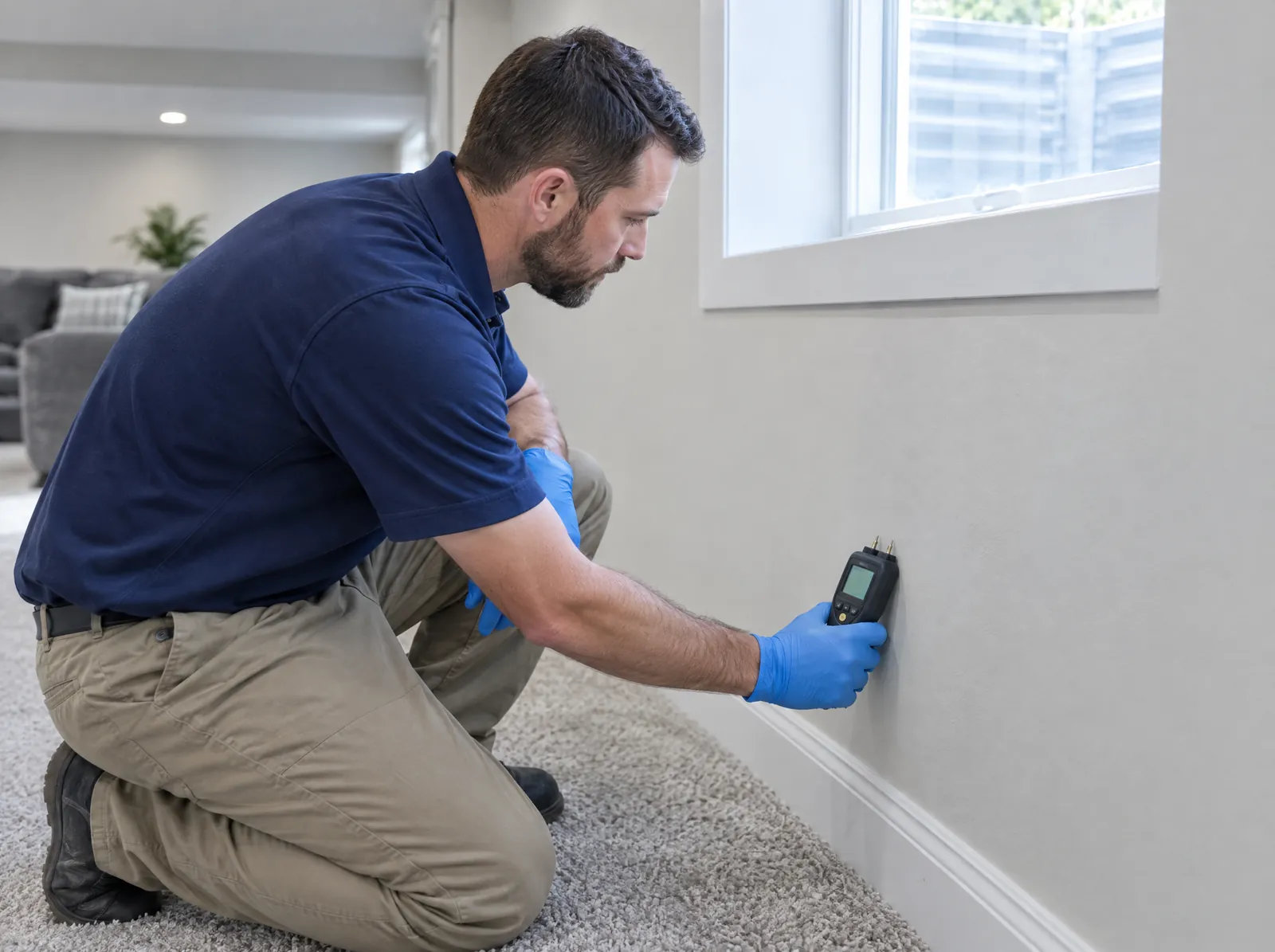
What does mold testing tell you?
Mold testing collects samples of air, surfaces or settled dust and sends them to a laboratory to identify which molds are present and in what amounts. On its own, a test can't tell you where mold is growing or why. That's the job of an inspection, which looks for moisture and hidden growth. Used together, testing and inspection show whether you have a problem, how big it is, and what to do next.
Why a lot of mold tests don't answer the question
Most people who order a mold test want to know one thing: is there a problem in my house, and where? A single air sample pulled in the middle of a room can't tell you that. Neither can a petri dish left on the kitchen counter. Without an inspection to find the moisture, and without the right test for the question being asked, you end up with a number that's hard to interpret and no plan.
Sound familiar?
- A home kit grew mold, and you don't know what that means.
- An air test came back normal, but the house still smells musty.
- Your doctor asked for an ERMI or HERTSMI-2 and you've never heard of either.
- You're buying a house and want to know what you're getting into.
We do it differently.
| Test-only approach | AME testing and inspection | |
|---|---|---|
| Starting point | Take a sample and send it off | Inspect for moisture and hidden growth first |
| Tools | One air sample, or a home kit | Moisture meters, thermal imaging, air, surface and dust sampling |
| Choice of test | Same test for everyone | Matched to your question: source, extent, history or toxins |
| Mycotoxins | Not tested | Mycotoxin panels available when the situation calls for them |
| Results | A lab printout | A walk-through of what the numbers mean and what to do next |

Why families trust us with their homes
-
Family-owned since 2008
A multigenerational family business. Not a franchise, not a private-equity rollup.
-
Credentialed where it isn't required
Indiana doesn't license mold remediators. We hold IICRC, CMR, CRMI and CCMI credentials anyway.
-
Called on as experts
Attorneys bring us into legal cases involving mold and mycotoxins.
-
Lab results in 24 to 48 hours
Every inspection comes with a written report, color photos and lab results.
- IICRC Certified Firm
- CMR
- CRMI
- CCMI
- BBB A+ Accredited
- NAMRI
- IAQA
- NORMI
- AMMA
- PMII
The AME Clearance Method
How a mold inspection and test works
Every visit follows the same sequence, whether it's a single musty closet or a full house before a purchase.
Talk to a specialist-
Listen first
We ask about leaks, odors, past water damage, remodeling and any health concerns, because the history tells us where to look.
-
Inspect the building
A room-by-room look at walls, ceilings, windows, plumbing, the HVAC system, attic, basement or crawlspace, with attention to staining, odor and condensation.
-
Measure moisture
Moisture meters and thermal imaging help find wet materials and cold spots behind finished surfaces, where hidden growth usually starts.
-
Choose and collect samples
Air, surface, dust or mycotoxin samples, depending on what we need to learn. Air samples are compared against an outdoor control.
-
Send to the lab
Samples go to a laboratory for analysis. Results typically come back in 24 to 48 hours.
-
Explain the results
We go through the report with you, point out what matters and what doesn't, and give written recommendations. There's no obligation to hire us for the work.
What a mold inspection includes
- A conversation about the home's water and moisture history
- A visual inspection of accessible areas
- Moisture meter readings on suspect materials
- Thermal imaging to spot hidden moisture
- Relative humidity readings
- Air sampling with an outdoor comparison, when useful
- Surface, dust or mycotoxin samples, when useful
- Laboratory analysis of every sample
- A written report with the lab results attached
- Clear next steps, whether or not remediation is needed

Proof you can hold in your hands
When we finish, you don't get a handshake and a promise. You get the paperwork your family, your doctor, your insurer or your buyer can rely on.
Inspection report
What we found, where it is coming from, with color photos.
Written remediation plan
Scope, timeline and what will and won't be removed, before work starts.
Clearance lab report
Air, surface and mycotoxin results after the work is done.
A report for your doctor
With your permission, we share results directly with your care team.
Mold testing, explained
Mold inspection vs. mold testing
People search for both terms, and many companies sell them as one package, but they are different tools that answer different questions.
An inspection is the investigation. A trained inspector walks the home looking for staining, water marks, peeling paint, warped materials and condensation, follows musty odors to their source, and uses instruments to find moisture that isn’t visible. The point is to find where mold is growing, or could be, and why. The National Institute for Occupational Safety and Health (NIOSH), part of the CDC, has found that a thorough visual inspection, or tracking down a musty odor, is often more reliable for finding mold problems than air sampling alone.
The instruments matter because most hidden mold starts with hidden water. A pin or pinless moisture meter shows whether drywall, trim or subfloor is wetter than it should be. A thermal imaging camera shows temperature differences across a wall or ceiling, which can reveal a damp patch or a cold spot where condensation forms. Neither one sees mold directly, but together they tell an inspector where to look and where to sample. Our answer on whether a mold inspection can find hidden mold explains how far these tools reach.
Testing is the measurement. Samples of air, surfaces or dust go to a laboratory, which identifies the molds and reports how much of each is present. Testing can confirm a suspicion, show whether spores from a problem area have spread to the rest of the house, reveal the history of growth in a home, or check for mycotoxins.
A test without an inspection gives you numbers without a location. An inspection without a test can miss what’s in the air or dust. That’s why we almost always pair them. For a longer comparison, see the difference between a mold inspection and mold testing.
When mold testing is worth it
Testing isn’t always necessary, and we’ll tell you when it isn’t. The EPA’s position is that if you can see mold growing, sampling usually isn’t needed to decide it should be cleaned up, and that there are no EPA or other federal limits for mold or mold spores. A small patch of visible mold in a bathroom is a cleaning and ventilation problem, not a lab problem.
Testing earns its cost in these situations:
- You smell mold but can’t see it. Testing, together with moisture mapping, helps confirm and locate hidden growth.
- There’s been water damage and you need to know whether mold followed and how far it has spread.
- A doctor has asked you to check the home. Physicians who work with mold-related illness often request specific tests, such as ERMI, HERTSMI-2 or a mycotoxin panel.
- You’re buying, selling or renting and want documentation.
- Remediation just finished and you need proof that it worked.
- You need a record for an insurance claim, a landlord dispute or a legal matter.
Our answer on when you should test for mold goes through more of these cases.
The main types of mold tests
Air sampling
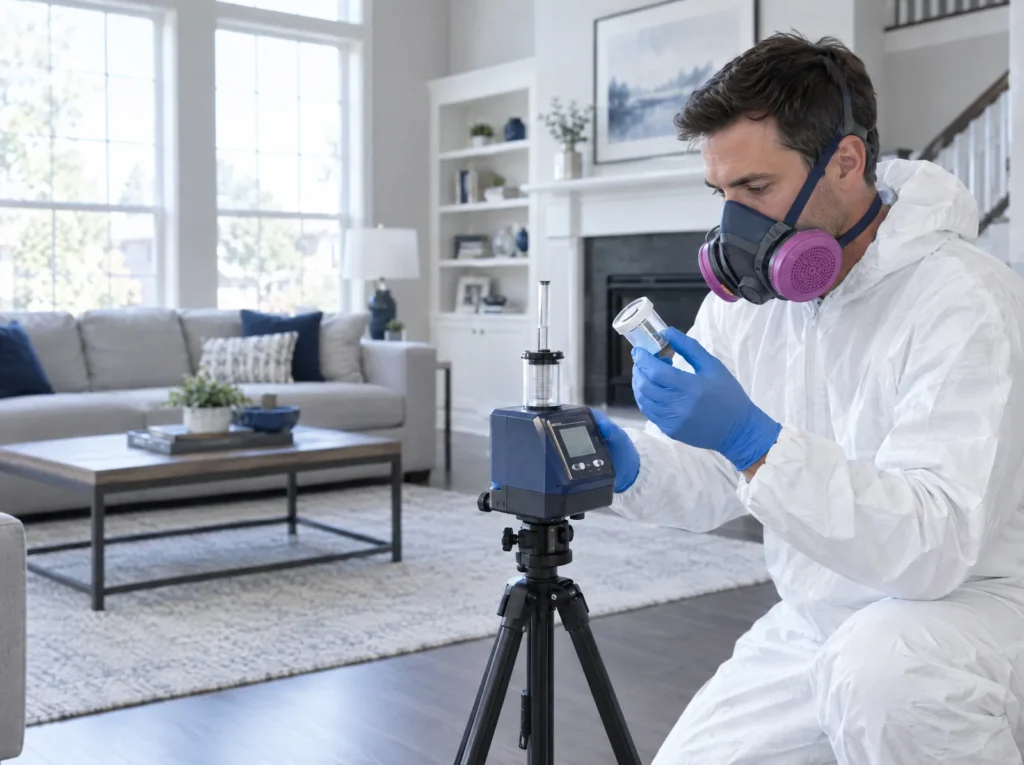
A pump draws a measured volume of air through a sealed cassette that traps spores and particles. The lab counts and identifies them and reports spores per cubic meter of air. At least one sample is always taken outdoors at the same visit, because the outdoor air is the baseline: indoor air in a healthy home should look similar to outside, with similar types of mold and lower or comparable counts.
Air sampling is good at showing what’s in the air right now. It has limits. It’s a snapshot of a few minutes, counts change with activity and weather, and some molds, including Stachybotrys, have heavy, sticky spores that don’t stay airborne well. A normal air test doesn’t rule out a hidden problem. We cover this in more depth under indoor air quality testing.
Surface samples: tape lifts, swabs and bulk samples
When there’s a visible spot, a tape lift or swab tells the lab what it is. Tape lifts press clear adhesive onto the surface. Swabs work better on uneven or damp areas. A bulk sample, a small piece of the material itself, is sometimes taken from insulation or drywall. Surface samples answer “what is this?” and “is this actually mold?” They don’t tell you how much is in the air or elsewhere in the house.
ERMI and HERTSMI-2 dust tests
Both tests analyze settled dust, usually collected with a vacuum cassette or a dust cloth, using a DNA-based lab method called MSQPCR. Because dust builds up over months, these tests reflect the history of mold in a home rather than a single moment.
- ERMI (Environmental Relative Moldiness Index) was developed by EPA researchers. It measures 36 mold species, 26 associated with water damage and 10 common in most homes, and produces a single score that compares the home to a national sample of homes. The EPA has said ERMI was designed as a research tool and shouldn’t be used on its own to make decisions about a building.
- HERTSMI-2 scores five molds strongly associated with water-damaged buildings. It’s a shorter, targeted version that some physicians prefer for patients with mold-related illness.
These tests are useful for learning whether a home has had a water-damage mold problem and for tracking change after remediation. They don’t point to a location on their own. Our pages on ERMI testing and HERTSMI-2 testing explain the scoring.
Mycotoxin panels
Mold tests identify mold. They don’t measure the toxins some molds produce. A mycotoxin panel tests settled dust or surfaces for specific compounds, such as trichothecenes, ochratoxin A, gliotoxin and aflatoxins. Because mycotoxins remain after mold is dead, this is the test that shows whether a home still carries toxins after cleanup. See mycotoxin testing for how samples are taken and read.
| Test | What it samples | Question it answers |
|---|---|---|
| Air sample | A measured volume of indoor and outdoor air | What is in the air right now, compared with outside? |
| Tape lift or swab | A visible spot on a surface | What is this growth? |
| Wall cavity sample | Air inside a wall, through a small hole | Is something growing behind this surface? |
| ERMI or HERTSMI-2 | Settled dust | Has this home had a water-damage mold problem over time? |
| Mycotoxin panel | Settled dust or surfaces | Which toxins are present, and how much? |
The limits of DIY mold test kits
Most hardware-store kits are settle plates: a petri dish of growth medium you leave open for a set time, then cover and watch. Something nearly always grows, because mold spores are present in virtually all indoor air. That result tells you very little.
- A settle plate doesn’t measure a known volume of air, so there’s no real concentration to compare.
- There’s usually no outdoor comparison, which is the baseline professionals rely on.
- Fast-growing molds crowd out others on the dish, and some important molds don’t grow well on it at all.
- It can’t find the moisture source or tell you where growth is.
A kit can be a reasonable curiosity check. It’s not a basis for spending money on remediation, or for deciding a home is fine. More in are home mold test kits accurate?
How to read mold test results
Because there are no federal limits for indoor mold, a lab report won’t say “pass” or “fail” on its own. Interpreting results means comparing, and looking at which molds are present as well as how many.
- Indoor vs. outdoor. Indoor counts well above outdoor counts, or indoor mold types that differ from what’s outside, suggest an indoor source.
- Room vs. room. One room much higher than the others helps narrow down where the problem is.
- Which molds. Some types, such as Stachybotrys and Chaetomium, grow on materials that stayed wet for a long time. Finding them indoors, even in small numbers, carries more weight than common outdoor molds.
- Hyphal fragments. Pieces of mold filaments in an air sample point to active or disturbed growth.
Results are only as good as the lab and the sampling behind them. Whoever tests your home should use a laboratory accredited for mold analysis (AIHA’s Environmental Microbiology Laboratory Accreditation Program is the common one), take an outdoor control with every air sample, and give you the original lab report, not just a summary of it.
We go through every report with you, line by line. You don’t need to become an expert in spore counts, but you should understand why we’re recommending what we recommend.
What happens after the results
If results are normal and the inspection found no active moisture, you’re done, and you have a record to keep. If they point to a problem, the next steps are usually to correct the moisture, plan the work with a written scope, and schedule mold remediation sized to what the testing found. You’re free to take our report to any company you choose.
Real-estate inspections
A general home inspection may note visible mold or water staining, but it usually doesn’t include sampling. If the house has a history of leaks, a finished basement, a crawlspace, or a musty smell, a dedicated mold inspection during your inspection window gives you facts to negotiate with. Read more about real estate mold inspections.
Clearance testing after remediation
Clearance testing is the final check before containment comes down. It combines a visual inspection, moisture readings and samples from inside the work area, compared with outdoors and with unaffected rooms. When the project involved mycotoxins, it includes a repeat mycotoxin panel. Our mold clearance testing page explains the criteria.
Mold testing cost and insurance
Cost depends on the size of the home, how many samples are needed, and which tests are run. A single-area inspection with a few air samples costs less than a whole-house inspection with dust testing and a mycotoxin panel. According to Angi, the national average for a professional mold inspection is $671, with most homeowners paying between $303 and $1,045. Our answer on how much mold testing costs breaks down the factors.
Insurance coverage for testing usually follows coverage for the underlying damage. If mold followed a sudden, accidental water event your policy covers, testing may be included in the claim. Testing for general concern usually isn’t. Check the mold and water damage sections of your policy, and ask your agent before scheduling.
We test and remediate buildings. We don’t diagnose or treat medical conditions, and home test results aren’t a medical diagnosis. If you have symptoms, please work with a doctor. With your permission, we’re glad to share test results with them.
Common questions
Have a question that isn't here? Call a specialist
How much does a mold inspection cost?
Angi puts the national average for a professional mold inspection at $671, with most homeowners paying between $303 and $1,045. The final cost depends on the size of the home, how many samples are taken, and which tests are run. Dust-based tests and mycotoxin panels cost more than a basic air sample.
Will insurance pay for mold testing?
Sometimes. Testing is most likely to be covered when it's tied to a sudden, accidental water event your policy already covers, such as a burst pipe. Testing for general concern, or for mold from a slow leak, usually isn't. Check your policy and call your agent before you schedule, and keep the report either way.
What's the difference between a mold inspection and a mold test?
An inspection is a person looking for moisture and growth with their eyes, nose and instruments. A test is a sample analyzed by a lab. The inspection tells you where and why. The test tells you what and how much. Either one alone leaves a gap.
Do I need a mold test if I can see mold?
Often not for the mold you can see. The EPA notes that when mold is visible, sampling usually isn't necessary to decide it should be removed. Testing still helps when you need to know how far it has spread, whether it's in the air of other rooms, or what a clearance baseline looks like.
Are home mold test kits accurate?
They can tell you mold spores exist, which is true of almost every home. Settle-plate kits don't measure a known volume of air, don't compare against outdoors, and favor molds that grow quickly on the dish. They're not a reliable way to decide whether your home has a problem.
How long do mold test results take?
Lab results typically come back in 24 to 48 hours after the samples reach the lab. Some specialty tests, such as dust-based DNA tests and mycotoxin panels, can take longer depending on the laboratory.
Can you test for mold behind walls?
Yes. We start without opening anything: moisture meters and thermal imaging point to wet areas, and air samples can be drawn from inside a wall cavity through a small hole. That helps confirm hidden growth before anyone cuts drywall.
We're done when the lab says so.
Every remediation ends with clearance testing, and our work is backed by a complete-removal guarantee. We don't close a job on a failed result.
Talk to a specialistSchedule mold testing
Tell us what you're noticing and why you want the home tested. A specialist will call you back to recommend the right test.
- (833) 772-6653
- info@americanmoldexperts.com
- Open 7 days, 8am to 8pm