
Dust DNA testing
ERMI test: your home's mold history, read from its dust
A lab measures the DNA of 36 molds in settled dust and scores your home against a national sample.
What is an ERMI test?
An ERMI test (Environmental Relative Moldiness Index) analyzes settled dust for the DNA of 36 mold species using a lab method called MSQPCR. Developed by EPA researchers, it splits the species into 26 associated with water damage and 10 common in most homes, then produces one score that compares your home with a national sample. The EPA has cautioned that ERMI was built as a research tool, not for routine public use.
Why ERMI results get misread
ERMI is popular because it produces one number, and one number feels like an answer. But the score depends on how and where the dust was collected, it says nothing about where mold is growing, and the national comparison behind it wasn't designed to say whether a particular house is safe to live in. Used alongside an inspection, it's a strong way to see a home's water-damage history. Used alone, it can send people in the wrong direction.
Sound familiar?
- Your doctor asked for an ERMI, and you're not sure how it should be collected.
- You have a score and don't know whether it's good or bad.
- A second ERMI came back very different from the first.
- The score is high, but nobody can tell you where the mold is.
We do it differently.
| Mail-in ERMI kit alone | ERMI with an AME inspection | |
|---|---|---|
| Dust collection | Wherever the homeowner chooses | Collected to the lab's protocol from rooms chosen for the question |
| Moisture source | Not investigated | Moisture meters and thermal imaging look for the cause |
| Location of growth | Unknown | Inspection narrows down where the water-damage molds are coming from |
| Interpretation | A score and a quartile | Species-by-species review tied to what we found in the house |
| After remediation | A new kit, new rooms | Repeat sampling set up the same way, so the numbers compare |

Why families trust us with their homes
-
Family-owned since 2008
A multigenerational family business. Not a franchise, not a private-equity rollup.
-
Credentialed where it isn't required
Indiana doesn't license mold remediators. We hold IICRC, CMR, CRMI and CCMI credentials anyway.
-
Called on as experts
Attorneys bring us into legal cases involving mold and mycotoxins.
-
Lab results in 24 to 48 hours
Every inspection comes with a written report, color photos and lab results.
- IICRC Certified Firm
- CMR
- CRMI
- CCMI
- BBB A+ Accredited
- NAMRI
- IAQA
- NORMI
- AMMA
- PMII
The AME Clearance Method
How we collect and read an ERMI
The lab analysis is standardized. Collection isn't, so that's the part we control carefully.
Talk to a specialist-
Confirm the purpose
We ask why the test is being run and whether a doctor has a target in mind. That decides how many samples we take and from which rooms.
-
Leave the dust alone
Settled dust is the sample. Before the visit we'll ask you not to deep-clean or vacuum the rooms being sampled, following the lab's guidance.
-
Inspect for moisture
A walk-through with moisture meters and thermal imaging looks for the wet materials that would explain a high score if we get one.
-
Collect the dust
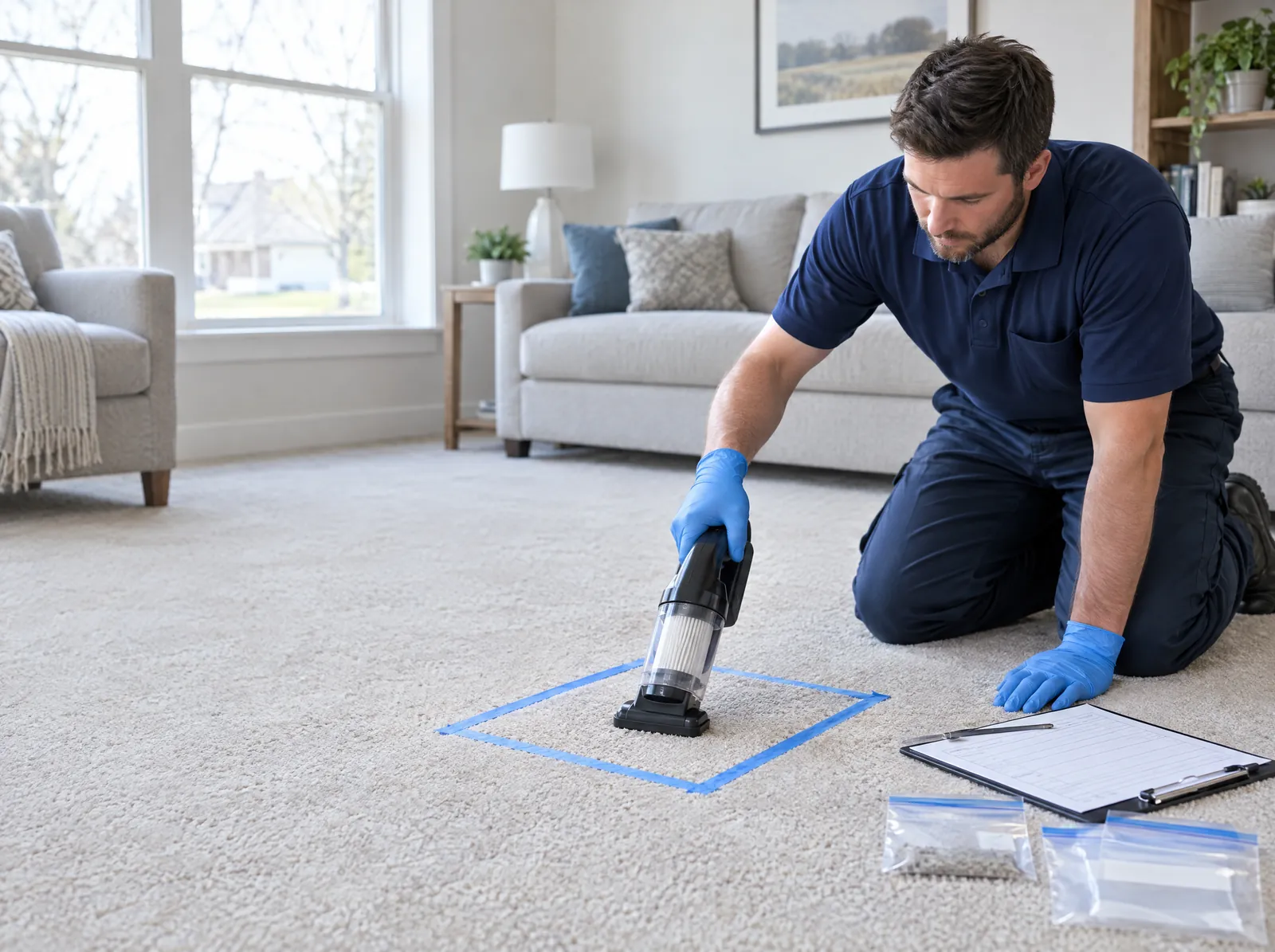
Using the lab's method, usually a vacuum with a filter cassette over a measured area of floor or a cloth wipe of surfaces where dust collects, we sample and seal each room separately or as a composite.
-
MSQPCR at the lab
The lab extracts DNA from the dust and measures each of the 36 species, then reports the concentrations and the calculated ERMI score.
-
Read it species by species
We look past the headline score at which water-damage molds are elevated, because different molds point to different kinds of moisture problems.
-
Plan, then retest the same way
Recommendations follow the findings. When it's time to retest, we use the same lab, method and rooms so the two results can be compared.
What an ERMI test with us includes
- A conversation about why the ERMI is being run
- Sampling instructions before the visit
- A moisture inspection of the home
- Dust collection following the lab's protocol
- Chain-of-custody paperwork for every sample
- MSQPCR analysis of all 36 ERMI species
- The calculated ERMI score and each species' concentration
- A species-by-species review of the report with you
- Written recommendations tied to what the inspection found
- Results shared with your doctor, if you ask us to

Proof you can hold in your hands
When we finish, you don't get a handshake and a promise. You get the paperwork your family, your doctor, your insurer or your buyer can rely on.
Inspection report
What we found, where it is coming from, with color photos.
Written remediation plan
Scope, timeline and what will and won't be removed, before work starts.
Clearance lab report
Air, surface and mycotoxin results after the work is done.
A report for your doctor
With your permission, we share results directly with your care team.
The ERMI test, explained
Where ERMI came from
ERMI grew out of work by EPA scientists who developed a DNA-based method for identifying and counting specific molds, called mold-specific quantitative PCR, or MSQPCR. Instead of growing mold on a dish or counting spores under a microscope, the lab measures the genetic material of each target species directly. That makes it possible to identify molds that are hard to tell apart by eye, and to measure them in dust where most of the material is no longer intact spores.
To give the numbers meaning, the researchers needed a reference point. They built one from dust collected in homes across the United States, then used it to rank how moldy a home’s dust is relative to that national sample. The result is the Environmental Relative Moldiness Index. The word “relative” matters: the score says how your dust compares with other homes’ dust, not whether the building is safe.
How the score is calculated
The 36 species fall into two groups:
| Group | How many | What they represent | Examples |
|---|---|---|---|
| Group 1 | 26 | Molds associated with water-damaged buildings | Stachybotrys chartarum, Chaetomium globosum, Aspergillus versicolor, Aspergillus penicillioides, Wallemia sebi |
| Group 2 | 10 | Molds common in most homes, much of it from outdoors | Cladosporium herbarum, Alternaria alternata, Epicoccum nigrum |
The lab takes the logarithm of each species’ concentration, adds up the Group 1 values, and subtracts the sum of the Group 2 values. The result is a single number that commonly falls somewhere between about -10 and 20. Two things follow from that math. First, because it’s logarithmic, a difference of a few points is a real difference in mold load. Second, because Group 2 is subtracted, a home with very little ordinary outdoor mold in its dust can score higher than you’d expect from its Group 1 counts alone. That’s one reason we read the species list, not only the score. Our answer on what a good ERMI score is covers the quartiles and targets.
What changes a result
- Recent cleaning. A deep clean, new carpet or fresh paint removes the dust history the test depends on, and can make a home read better than it is.
- Where the dust came from. A bedroom closet, a living room floor and the top of a door frame collect dust at different rates and from different air.
- Flooring. Carpet holds far more dust than hard floors, so the same house can give different results depending on which rooms are sampled.
- Recent disturbance. Demolition, remediation or moving furniture can stir up and redistribute old dust.
- Lab and method. Vacuum and cloth methods, and different labs, aren’t always interchangeable. Keep them the same for before and after comparisons.
Using ERMI the right way
The EPA has been clear that ERMI was developed as a research tool and hasn’t been validated for routine use by the public. That doesn’t make the test useless. It means the score shouldn’t be the only thing a decision rests on. In practice, ERMI works best when it’s paired with an inspection that finds the moisture, when the collection method is documented so it can be repeated, and when the target is agreed before the sample is taken.
If your doctor is the one asking for the test, find out whether they want ERMI specifically or would rather see a HERTSMI-2 score, which many labs can calculate from the same dust. Our comparison of ERMI vs. HERTSMI-2 explains the choice, and working with your doctor on a moldy home covers how to agree on a target.
An ERMI score describes the dust in a building. It isn’t a medical test and doesn’t diagnose anything. We don’t diagnose or treat medical conditions. If you have symptoms, please work with a doctor, and with your permission we’ll share results with them.
Common questions
Have a question that isn't here? Call a specialist
What is a good ERMI score?
Lower is better, and the lab report shows where your score falls against the national sample of homes, usually in quartiles. There's no official safe line. Physicians who work with mold-sensitive patients often set stricter targets than the national comparison, so ask your doctor what number they want before testing.
How accurate is an ERMI test?
MSQPCR is a precise way to measure mold DNA in the sample the lab receives. Most of the variation comes from collection: which rooms, which surfaces, how long dust has built up and whether the house was recently cleaned. Two samples from the same home can differ, which is why we keep collection consistent from one test to the next.
Does an ERMI test tell me where the mold is?
No. Dust collects from the whole area it settles in, so ERMI shows that water-damage molds have been present, not where they're growing. Finding the source takes an inspection with moisture readings, and sometimes targeted air or cavity samples.
Does ERMI detect mycotoxins?
No. It measures mold DNA, not toxins. A mold on the ERMI list can be present without producing mycotoxins, and toxins can remain after the mold is gone. A mycotoxin panel is a separate lab test.
Can dead mold raise an ERMI score?
Yes. DNA testing doesn't tell living mold from dead mold, so ERMI reflects mold material that has built up in the dust, including from growth that's no longer active. That's useful for seeing a home's history, and a limitation when you want to know what's happening right now.
Can I collect an ERMI sample myself?
Yes. Several labs sell mail-in kits with instructions. Follow them exactly. The trade-off is that you get a score without anyone looking for the moisture behind it, which is the part you'll need if the number comes back high.
Why has the EPA cautioned against relying on ERMI?
EPA researchers built ERMI for research, and the agency has cautioned that it wasn't validated for routine public use, such as deciding whether a building is safe or whether a cleanup worked. We treat it as one input alongside an inspection, never as a verdict on its own.
We're done when the lab says so.
Every remediation ends with clearance testing, and our work is backed by a complete-removal guarantee. We don't close a job on a failed result.
Talk to a specialistSchedule an ERMI test
Tell us why you need the test and whether your doctor has a target score. A specialist will call you back.
- (833) 772-6653
- info@americanmoldexperts.com
- Open 7 days, 8am to 8pm