
Five-mold dust test
HERTSMI-2 testing for water-damage molds
A short DNA dust test that scores five molds tied to water-damaged buildings, often requested by physicians.
What is HERTSMI-2?
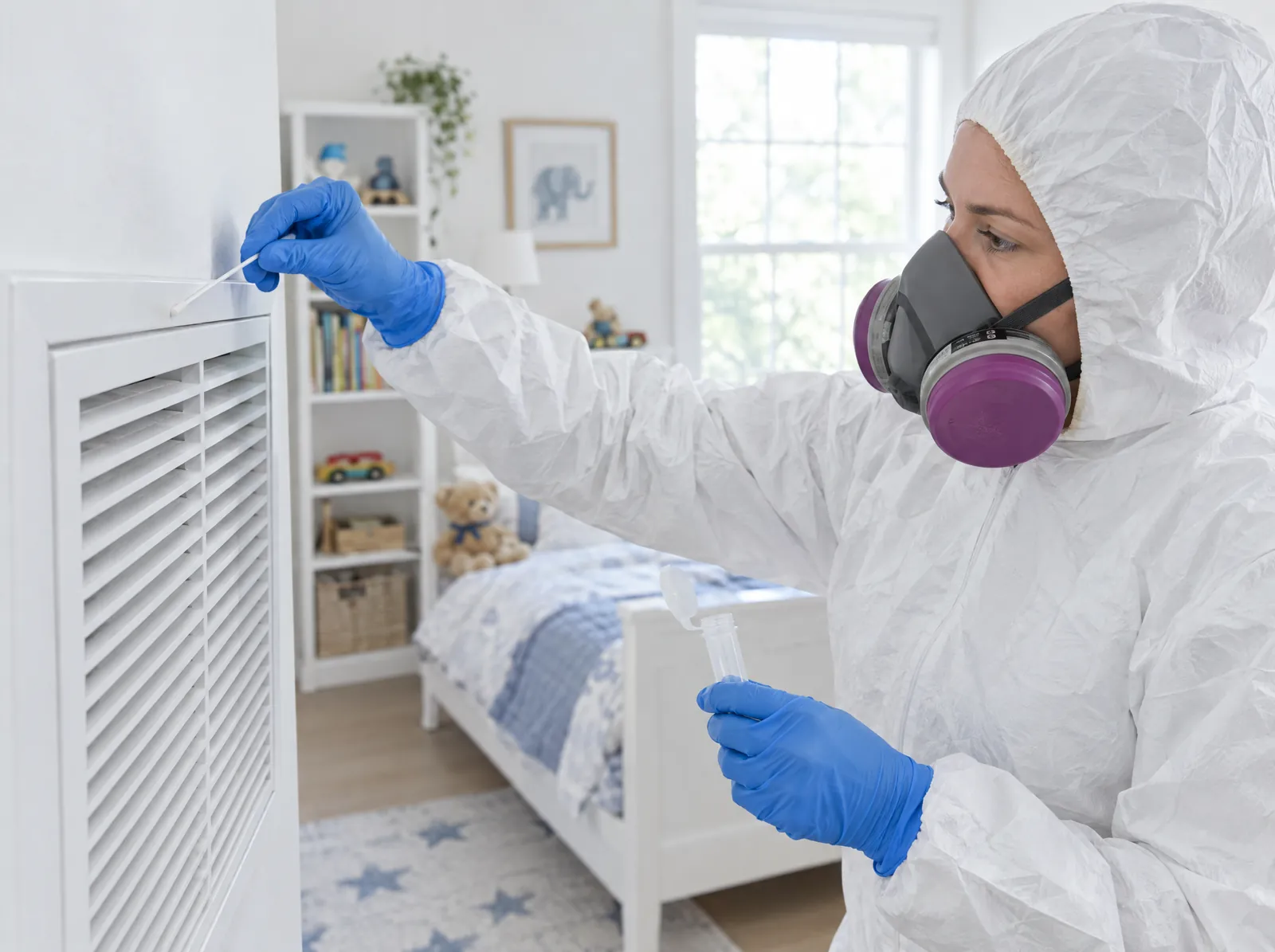
HERTSMI-2 is a DNA-based dust test that scores five molds strongly associated with water-damaged buildings: Aspergillus penicillioides, Aspergillus versicolor, Chaetomium globosum, Stachybotrys chartarum and Wallemia sebi. The lab measures each one in settled dust with MSQPCR, assigns points based on its concentration, and adds them into a single score. Physicians who work with mold-related illness often request it, and the doctor, not the lab, decides what score is acceptable.
Why a five-mold score needs context
HERTSMI-2 is short on purpose. Rather than comparing a home to a national average, it focuses on five molds that thrive where materials or dust have stayed damp. That focus makes the result easy to act on, and it also means the test can miss things. A home can score low and still have a moisture problem feeding other molds, or still carry mycotoxins from growth that has since been cleaned up. We treat the score as one clear signal among several.
Sound familiar?
- Your doctor gave you a HERTSMI-2 target, and you need someone who will test to it.
- You don't know whether to order HERTSMI-2, ERMI or both.
- A score came back borderline and you're not sure what happens next.
- You're about to rent or buy and want to screen the house before you commit.
We do it differently.
| Score-only approach | AME HERTSMI-2 testing | |
|---|---|---|
| Target | Whatever the report implies | The number your doctor set, confirmed before sampling |
| Sampling | One sample from wherever | Rooms chosen for how your household actually uses them |
| Species detail | Total score only | Each of the five molds reviewed for what it suggests about moisture |
| Other checks | None | A moisture inspection, plus mycotoxin or ERMI testing when useful |
| Retesting | New method, new rooms | Same method and locations, so before and after compare |

Why families trust us with their homes
-
Family-owned since 2008
A multigenerational family business. Not a franchise, not a private-equity rollup.
-
Credentialed where it isn't required
Indiana doesn't license mold remediators. We hold IICRC, CMR, CRMI and CCMI credentials anyway.
-
Called on as experts
Attorneys bring us into legal cases involving mold and mycotoxins.
-
Lab results in 24 to 48 hours
Every inspection comes with a written report, color photos and lab results.
- IICRC Certified Firm
- CMR
- CRMI
- CCMI
- BBB A+ Accredited
- NAMRI
- IAQA
- NORMI
- AMMA
- PMII
The AME Clearance Method
How a HERTSMI-2 test works with us
Six steps, built around the target your doctor gives you.
Talk to a specialist-
Get the target first
Before we sample, we ask what score your doctor wants to see and write it into the plan, so everyone is working toward the same number.
-
Choose the rooms
Bedrooms, the main living area and any room with a known water history are the usual choices. We agree on locations with you instead of sampling by default.
-
Look for the moisture
Moisture meters and thermal imaging check walls, floors and ceilings, with extra attention to basements, crawlspaces, attics and plumbing walls.
-
Collect settled dust
Dust is collected with the lab's vacuum or cloth method, sealed, labeled and documented with chain-of-custody paperwork.
-
Lab scoring
The lab measures each of the five species by MSQPCR, converts each concentration to points and reports the total with the species detail.
-
Report and next steps
We walk through which molds drove the score and what they suggest about the building, and send the report to your doctor if you'd like.
What HERTSMI-2 testing includes
- Confirmation of your doctor's target before sampling
- A room plan agreed with you
- A moisture inspection with meters and thermal imaging
- Settled-dust collection to the lab's protocol
- Chain-of-custody documentation
- MSQPCR analysis of all five HERTSMI-2 species
- The total score with each species' concentration and points
- A review of what drove the score
- Written recommendations for the building
- Results shared with your doctor on request

Proof you can hold in your hands
When we finish, you don't get a handshake and a promise. You get the paperwork your family, your doctor, your insurer or your buyer can rely on.
Inspection report
What we found, where it is coming from, with color photos.
Written remediation plan
Scope, timeline and what will and won't be removed, before work starts.
Clearance lab report
Air, surface and mycotoxin results after the work is done.
A report for your doctor
With your permission, we share results directly with your care team.
HERTSMI-2, explained
The five molds, and what each one points to
The five HERTSMI-2 species don’t all need the same conditions to grow. Knowing which ones drove a score helps narrow down what kind of moisture problem a home has.
| Mold | Conditions it favors | What an elevated level can suggest |
|---|---|---|
| Stachybotrys chartarum | Cellulose materials, like drywall paper and ceiling tile, that stay wet for a long time | A sustained leak or flood that wasn’t dried quickly |
| Chaetomium globosum | Wet drywall, wood and paper | Long-term water damage, often alongside Stachybotrys |
| Aspergillus versicolor | Damp building materials and dust | Ongoing dampness, sometimes without an obvious leak |
| Aspergillus penicillioides | Drier conditions; can grow in dust and on surfaces with high humidity | Chronic high indoor humidity |
| Wallemia sebi | Drier conditions; tolerates low water availability | Humidity problems, stored items, or damp dust in closets and basements |
So a score driven mostly by Stachybotrys and Chaetomium sends us looking for wet walls and past leaks. A score driven by Wallemia and Aspergillus penicillioides points more toward humidity control. The treatment of the building is different in each case, which is why the species detail matters as much as the total.
How the score is built
The lab measures each species in the dust, reported as a concentration such as spore equivalents per milligram of dust. Each concentration falls into a band that carries a set number of points, and the points for all five species are added together. A species that isn’t detected, or is present only at a low level, contributes nothing. Because of that structure, one heavily elevated mold can push a home into a higher range even when the other four are clean.
Reading a borderline result
A borderline score is where most of the hard questions come from. Before deciding anything, we usually look at three things:
- Which species scored. One mold scoring points is a different situation from all five scoring a little.
- Where the dust came from. If one room was sampled on its own, a second sample from another room can show whether the problem is local or house-wide.
- What the inspection found. A wet wall or a failing dehumidifier gives the number an explanation, and a clear repair.
What happens next is your doctor’s call on the health side and ours on the building side. For many families, it’s a targeted fix of the moisture source followed by cleaning and a retest, rather than a full remediation.
Timing: recently cleaned or remodeled homes
Dust tests need dust. A home that was just professionally cleaned, painted or given new flooring may score low simply because the history was wiped away. That’s a real risk when screening a house for sale or a rental that was turned over between tenants. The same applies after remediation: testing right after a deep clean shows how well the cleaning went, and testing again after a period of normal living shows whether the source is truly gone. We’ll help you decide which one your situation needs.
Where HERTSMI-2 fits with other tests
HERTSMI-2 answers one question well: are the molds most tied to water-damaged buildings present in this home’s dust, and how much? It doesn’t locate them, and it doesn’t measure toxins. For a household managing mold illness, it’s often paired with mycotoxin testing and a moisture inspection. If you’re still deciding between dust tests, our side-by-side look at ERMI vs. HERTSMI-2 walks through the trade-offs.
HERTSMI-2 measures molds in a building’s dust. It isn’t a medical test, and the score bands above are published guidance, not medical advice. We don’t diagnose or treat medical conditions. Your doctor sets your target, and with your permission we’ll share every result with them.
Common questions
Have a question that isn't here? Call a specialist
What does HERTSMI-2 stand for?
Health Effects Roster of Type-Specific Formers of Mycotoxins and Inflammagens, version 2. It comes out of Dr. Ritchie Shoemaker's work on water-damaged buildings and is built on the same MSQPCR lab method used for ERMI.
What is a good HERTSMI-2 score?
Lower is better. Commonly cited guidance from Dr. Shoemaker's published work treats scores below 11 as generally acceptable, 11 to 15 as borderline, and above 15 as too high for people sensitive to water-damaged buildings. Those bands are guidance, not a regulation, and your doctor sets the actual target for your household.
Is HERTSMI-2 the same as ERMI?
No, but they're related. All five HERTSMI-2 molds are among ERMI's 26 water-damage species, so many labs can report a HERTSMI-2 score from the same dust sample as an ERMI. The difference is in the scoring: ERMI compares 36 species against a national sample, while HERTSMI-2 adds up points for five.
Why only five molds?
They were chosen because they grow on chronically damp building materials and dust, and because they were the species most closely associated with water-damaged buildings in the research behind the test. Keeping the list short makes the score easier to interpret and track over time.
Does HERTSMI-2 measure mycotoxins?
No. It measures mold DNA. Whether those molds produced toxins, and whether toxins remain, takes a separate mycotoxin panel on settled dust or surfaces.
Can I use HERTSMI-2 to screen a home before moving in?
Many families do. Keep the limits in mind: a house that was just cleaned, painted or re-carpeted for sale may have little dust history, and a vacant house may have little dust at all. Pair the test with an inspection for moisture, and ask the seller or landlord about past leaks.
How long do HERTSMI-2 results take?
It depends on the lab. DNA-based dust tests can take longer than a standard air sample. We'll tell you the expected turnaround when we book, so you can plan around a move or a doctor's appointment.
We're done when the lab says so.
Every remediation ends with clearance testing, and our work is backed by a complete-removal guarantee. We don't close a job on a failed result.
Talk to a specialistTest your home to your doctor's HERTSMI-2 target
Send us the target and the rooms that matter most. A specialist will call you back to plan the sampling.
- (833) 772-6653
- info@americanmoldexperts.com
- Open 7 days, 8am to 8pm