
For home buyers
Mold inspection before buying a house
A focused mold inspection inside your contingency window, with lab results in 24 to 48 hours.
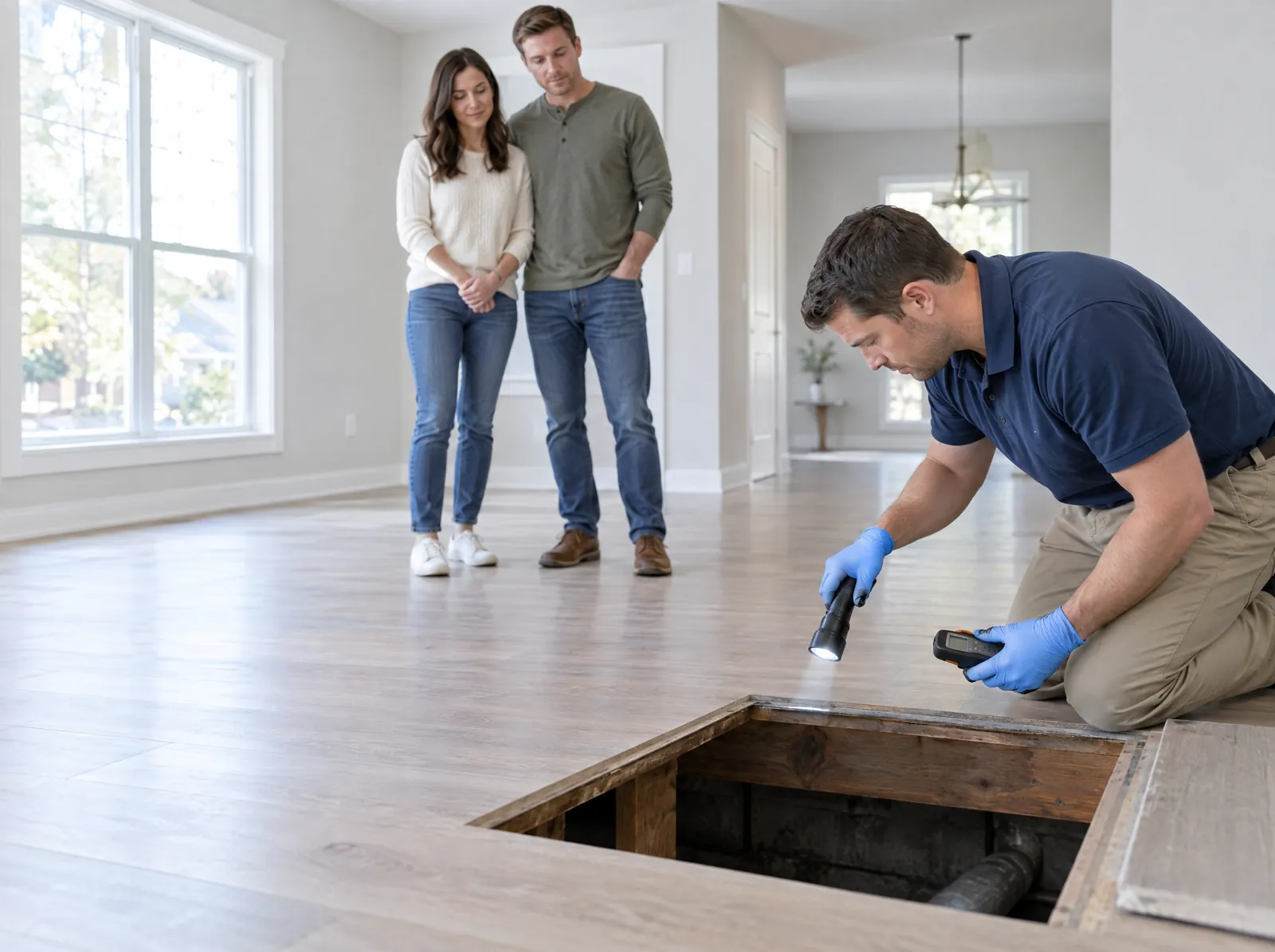
Should you get a mold inspection before buying a house?
Get a mold inspection before buying a house whenever the listing, the seller's disclosure or your home inspector hints at water: a basement or crawlspace, past leaks, a musty odor, or fresh paint and flooring in odd places. General home inspections look for visible signs but usually don't sample for mold. A dedicated mold inspection traces moisture, tests air and dust, and gets lab results back in 24 to 48 hours, inside most contingency windows.
What a standard home inspection leaves out
A home inspector covers the whole house in a few hours: roof, structure, electrical, plumbing, heating and cooling. Most home inspection standards of practice exclude mold testing, so the report may note water staining or possible growth, recommend further evaluation, and stop there. That note often arrives with only days left before your deadline. Sellers also prepare a house for showings, and fresh paint, new carpet or a running dehumidifier can hide exactly what a buyer needs to see.
Sound familiar?
- The home inspection report says to get further evaluation, and the clock is running.
- The basement smells musty, but it was just painted.
- The seller's disclosure mentions a past leak with no details.
- Someone in your family is sensitive to mold, so a guess isn't good enough.
We do it differently.
| General home inspection | AME pre-purchase mold inspection | |
|---|---|---|
| Focus | Every system in the house | Moisture, mold and the conditions that cause them |
| Moisture tools | Varies by inspector | Moisture meters and thermal imaging on every suspect area |
| Lab sampling | Usually excluded | Air, surface and dust samples sent to an accredited lab |
| Hidden areas | Noted if visible | Crawlspace, attic, HVAC and wall cavities checked where accessible |
| What you get | A line item to follow up on | Lab results and a written scope you can put in front of the seller |

Why families trust us with their homes
-
Family-owned since 2008
A multigenerational family business. Not a franchise, not a private-equity rollup.
-
Credentialed where it isn't required
Indiana doesn't license mold remediators. We hold IICRC, CMR, CRMI and CCMI credentials anyway.
-
Called on as experts
Attorneys bring us into legal cases involving mold and mycotoxins.
-
Lab results in 24 to 48 hours
Every inspection comes with a written report, color photos and lab results.
- IICRC Certified Firm
- CMR
- CRMI
- CCMI
- BBB A+ Accredited
- NAMRI
- IAQA
- NORMI
- AMMA
- PMII
The AME Clearance Method
How a pre-purchase mold inspection works
Built around your contract deadline, from the first call to a report your agent can use.
Talk to a specialist-
Share the paperwork
Send us the seller's disclosure, the home inspection report if you have it, and the listing photos. They often show where water has been.
-
Schedule against the deadline
Tell us when your inspection contingency ends. Your agent arranges access with the listing agent, and we plan the visit so results arrive in time.
-
Trace the moisture
Foundation walls, the sump pit, crawlspace, attic sheathing, windows, under sinks and around the water heater, with meters and thermal imaging.
-
Sample what matters
Air samples with an outdoor control, surface samples on anything suspicious, and dust or mycotoxin testing for buyers who need that level of detail.
-
Lab results in 24 to 48 hours
Standard samples typically come back within 24 to 48 hours of reaching the lab. Specialty dust and mycotoxin tests can take longer.
-
Report and scope
You get the findings, the original lab reports and, if there's a problem, a written outline of what fixing it would involve.
What a pre-purchase mold inspection includes
- A review of the disclosure, inspection report and listing photos
- Moisture meter readings and thermal imaging
- A check of the basement or crawlspace, attic and HVAC system
- Air samples with an outdoor control
- Surface samples of suspect areas
- Optional dust DNA or mycotoxin testing
- Analysis by an accredited laboratory
- A written report with photos and original lab results
- An outline of the remediation scope, if one is needed

Proof you can hold in your hands
When we finish, you don't get a handshake and a promise. You get the paperwork your family, your doctor, your insurer or your buyer can rely on.
Inspection report
What we found, where it is coming from, with color photos.
Written remediation plan
Scope, timeline and what will and won't be removed, before work starts.
Clearance lab report
Air, surface and mycotoxin results after the work is done.
A report for your doctor
With your permission, we share results directly with your care team.
Buying a house with mold in mind
Red flags worth a mold inspection
You don’t need a mold inspection on every house. You need one when the house gives you a reason. These are the signs we’d look for during a showing or in the paperwork:
- Fresh paint on one wall, one ceiling patch or the lower part of basement walls, but nowhere else.
- New baseboards, new carpet or new drywall in a basement that is otherwise older.
- A dehumidifier running hard, or several of them, in the basement or crawlspace.
- White, chalky deposits on foundation walls, rust stains around the water heater or furnace, or water lines on stored boxes.
- Stained ceiling tiles or drywall below bathrooms, the kitchen or an attic.
- A strong air freshener or candle smell in closed-up rooms.
- A sump pump, a crawlspace, or a history of flooding in the disclosure.
- Soft or warped flooring near tubs, toilets, dishwashers or exterior doors.
One of these isn’t proof of mold. Two or three together, especially with a musty smell, is a good reason to order an inspection before you’re committed. Our answer on whether mold can cause a house to fail inspection covers what home inspectors typically write up. And if your home inspection came back clean but something still bothers you, read is a mold test worth it if the home inspection found nothing before you decide.
Fitting it into your contingency period
Your purchase contract sets how long you have to inspect and negotiate. That window is often short, and a mold inspection that’s ordered only after the home inspection report comes back can run out of time. Two habits help. First, call as soon as your offer is accepted and schedule the mold inspection alongside the home inspection, not after it. Second, decide up front which tests you need. Standard air and surface samples typically come back in 24 to 48 hours. Dust DNA and mycotoxin tests can take longer, so they need an earlier start.
Using the results in a negotiation
A lab report and a written scope turn a vague worry into something specific you can put in front of the seller. Buyers usually take one of four paths:
| Option | When it tends to fit | What to insist on |
|---|---|---|
| Price reduction or credit | You want to control who does the work and how | A realistic scope, so the credit matches the job |
| Seller-paid remediation before closing | The problem is contained and the seller is cooperative | Moisture repair, a written scope and clearance test results before closing |
| Further testing | Results are unclear or the source wasn’t found | A deadline extension in writing, if needed |
| Walking away | The problem is widespread, or the moisture source can’t be fixed reasonably | Follow your contract terms exactly |
We can explain what the findings mean for the building and what the work would involve. Questions about your contract belong with your agent or a real estate attorney.
Houses that already had mold remediation
A past remediation isn’t a reason to walk away by itself. Ask for the paperwork: what caused the mold, how the moisture was fixed, the scope of work, and the clearance report. If the seller can’t produce a clearance report, or the moisture source was never addressed, test the area yourself. More in is it safe to buy a house that had mold remediation?
Buyers with mold sensitivities
If someone in your household has been told to avoid water-damaged buildings, a standard buyer’s inspection may not go far enough. A dust DNA test such as HERTSMI-2 or ERMI, and sometimes a mycotoxin panel, gives a view of the home’s history that air samples can’t. Ask your doctor which test and target they’d want, and see mold testing for mold illness for how we set that up.
We inspect and test buildings. We don’t give legal advice or medical advice. Contract questions belong with your agent or attorney, and health questions with your doctor.
Common questions
Have a question that isn't here? Call a specialist
Can a mold inspection kill a home sale?
Sometimes, but more often it changes the terms. Mold findings usually lead to a repair request, a price reduction or a credit, or seller-paid remediation with clearance testing. Whether to walk away is your decision, and your agent can tell you what your contract allows.
Who pays for a mold inspection when buying a house?
Usually the buyer, the same as other inspections during the contingency period. It's paid whether or not you buy, so it's worth ordering when the house gives you a reason to.
Can the seller just have the mold cleaned before closing?
They can, but ask for proof: what caused it and how it was fixed, a written scope of the work, and a clearance test report from someone who can show the area passed. Cleaning without fixing the moisture usually means the mold comes back.
Do sellers have to disclose mold?
Rules vary by state. Many disclosure forms ask about known water damage or mold, but a seller can only disclose what they know about, and a form is no substitute for an inspection. Your agent or a real estate attorney can explain the rules where you're buying.
Should I test a vacant or staged house?
Yes, but ask for the utilities and HVAC to be on for a while before the visit. A house that sat closed with no heating or cooling can run humid, and air samples in a house with no one living in it can look different from normal conditions.
Can you test for mycotoxins before I buy?
Yes. Mycotoxin panels on settled dust are available, though they can take longer at the lab than standard samples. If you need them, tell us early so the results fit your deadline.
We're done when the lab says so.
Every remediation ends with clearance testing, and our work is backed by a complete-removal guarantee. We don't close a job on a failed result.
Talk to a specialistGet a mold inspection before your deadline
Tell us the address and when your inspection period ends. A specialist will call you back to schedule the visit.
- (833) 772-6653
- info@americanmoldexperts.com
- Open 7 days, 8am to 8pm