
Inspections from our Avon office
Mold testing in Indiana that finds the source
A moisture-first inspection, air and dust sampling, and lab results you can read, usually back within 48 hours.
What does mold testing in Indiana include?
Mold testing in Indiana starts with an inspection: we look for water damage, take moisture readings and check the places Indiana homes usually hide mold, like basements, crawlspaces and attics. Then we collect air samples indoors and outdoors, settled-dust samples and, where growth is visible, surface samples. A lab analyzes them, results come back in 24 to 48 hours, and we walk you through what they mean.
Why a quick mold test often misses the problem
A single air sample in the living room is the most common mold test sold, and it's the easiest to misread. Air changes by the hour. The mold behind a finished basement wall or under a crawlspace vapor barrier may barely register in the room above it. Without a moisture inspection and a sample of settled dust, a clean-looking number can send a family home with the wrong answer.
Sound familiar?
- You smell something musty, but a store-bought kit came back fine.
- You're buying an Indiana home and the inspection report only says possible microbial growth.
- A company offered free testing and then quoted a large removal job.
- Your doctor asked you to have the house checked, and you don't know which test to order.
We do it differently.
| A quick mold test | An AME inspection | |
|---|---|---|
| Inspection | Little or none | Moisture readings and a room-by-room walkthrough |
| Samples | One indoor air sample | Indoor and outdoor air, settled dust, surfaces as needed |
| Hidden growth | Often missed | Traced with moisture mapping before any sample is taken |
| Results | A lab sheet with no explanation | A walkthrough in plain English, with recommendations |
| Obligation | Tied to a removal quote | Testing stands on its own |

Why families trust us with their homes
-
Family-owned since 2008
A multigenerational family business. Not a franchise, not a private-equity rollup.
-
Credentialed where it isn't required
Indiana doesn't license mold remediators. We hold IICRC, CMR, CRMI and CCMI credentials anyway.
-
Called on as experts
Attorneys bring us into legal cases involving mold and mycotoxins.
-
Lab results in 24 to 48 hours
Every inspection comes with a written report, color photos and lab results.
- IICRC Certified Firm
- CMR
- CRMI
- CCMI
- BBB A+ Accredited
- NAMRI
- IAQA
- NORMI
- AMMA
- PMII
The AME Clearance Method
How an Indiana mold inspection works
The samples are only as good as the places they're taken from, so the inspection comes first.
Talk to a specialist-
Start with the history
Leaks, floods, sump pump failures, past repairs, where the smell is strongest and who in the house feels worse. It tells us where to look first.
-
Map the moisture
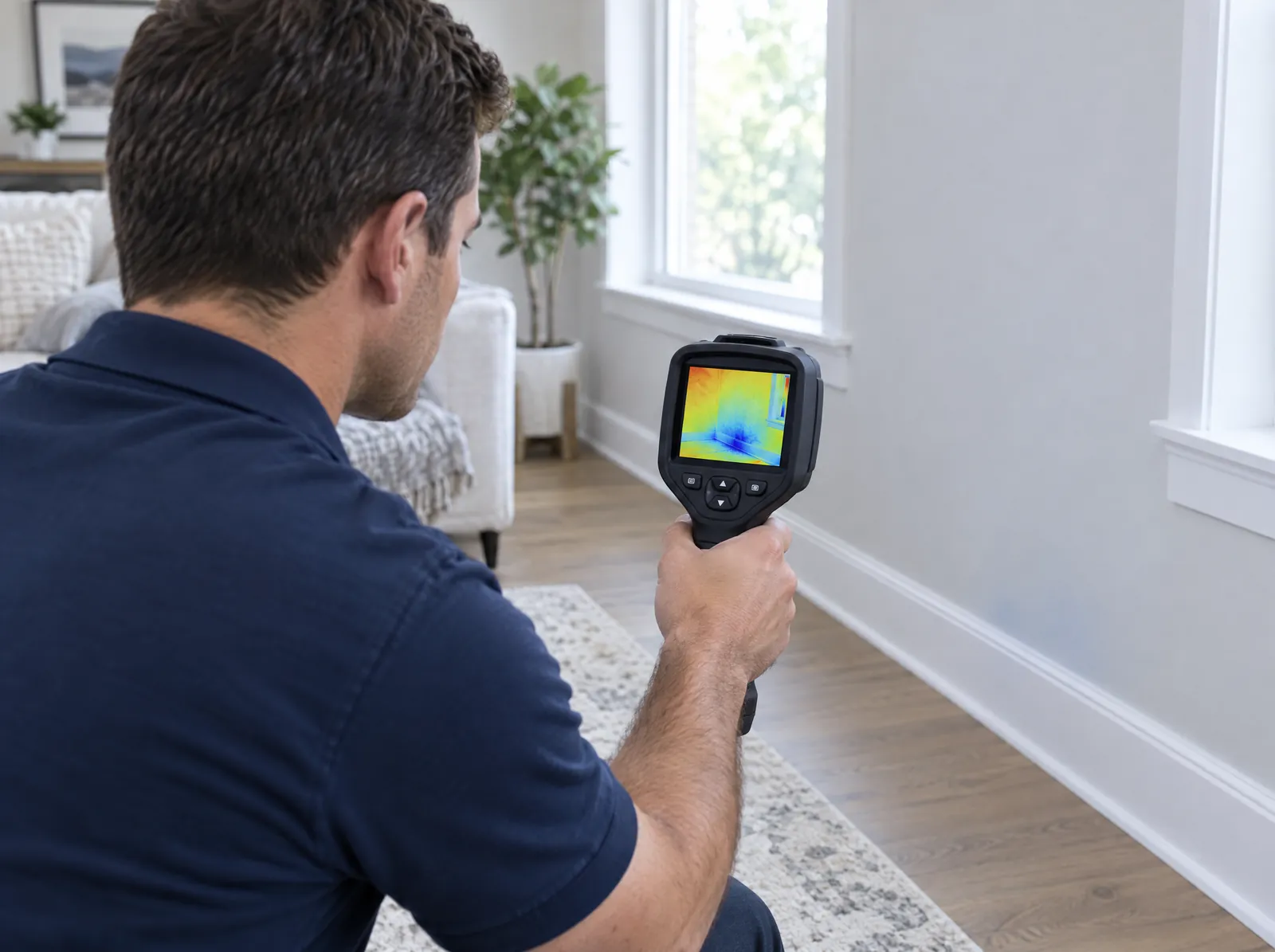
Moisture meters and a thermal camera find damp materials behind finished walls, under flooring and around foundations without cutting anything open.
-
Sample the air
Indoor air samples are paired with an outdoor sample taken the same day, so indoor results are judged against what's normal outside at that time of year.
-
Sample the dust
Settled dust shows which molds have been growing in the house over time. We use DNA-based tests like ERMI and HERTSMI-2 when the situation calls for them.
-
Lab analysis
Samples go to a lab for analysis. Results are typically back in 24 to 48 hours.
-
Explain and recommend
We go through each number with you, say what it means for your house, and put our recommendations in writing, including when no work is needed.
What's included in an Indiana mold inspection
- A room-by-room visual inspection
- Moisture meter and thermal camera readings
- Basement, crawlspace and attic checks where accessible
- Indoor air samples with an outdoor comparison
- Settled-dust sampling when the situation calls for it
- Surface samples of visible growth
- Lab analysis of every sample
- A written report with plain-English results
- Recommendations, with no obligation to hire us for the work

Proof you can hold in your hands
When we finish, you don't get a handshake and a promise. You get the paperwork your family, your doctor, your insurer or your buyer can rely on.
Inspection report
What we found, where it is coming from, with color photos.
Written remediation plan
Scope, timeline and what will and won't be removed, before work starts.
Clearance lab report
Air, surface and mycotoxin results after the work is done.
A report for your doctor
With your permission, we share results directly with your care team.
Mold testing in Indiana, explained
Which test answers which question
There is no single mold test. Each sample type answers one question well and others poorly, so we choose them based on what you need to know.
| Test | What it tells you | Where it falls short |
|---|---|---|
| Air sampling | Spore types and counts in the air right now, compared with outdoors | A snapshot; hidden growth may not show up |
| Surface or tape sample | What a visible spot actually is | Says nothing about the rest of the house |
| ERMI or HERTSMI-2 dust test | Which molds have built up in settled dust over time | Doesn’t pinpoint where the source is |
| Mycotoxin panel | Which mold toxins are present in dust or on surfaces | Best paired with mold testing, not used alone |
For a family dealing with health concerns, we usually add dust testing and a mycotoxin panel. For a real estate deal, air and surface samples paired with a thorough moisture inspection are often enough. For more on dust testing, see ERMI vs. HERTSMI-2.
Testing through Indiana’s seasons
Outdoor mold levels in Indiana swing with the seasons. They tend to run high in late summer and fall and drop off once the ground freezes. That’s why every air test we run includes an outdoor sample from the same day. An indoor count that looks high in October may be normal for the season. The same count in January, with the house closed up and outdoor levels low, tells a very different story.
Weather matters on test day too. Heavy rain, a running dehumidifier or a window left open can shift results, so we note conditions on every report.
Finding mold you can’t see
Most Indiana homes we inspect have basements or crawlspaces, and many basements are finished. Finished walls, carpet and drop ceilings hide growth well. Before we collect a single sample, we check foundation walls, sump pits, window wells, the underside of subfloors and attic sheathing for moisture. A thermal camera shows cold, damp areas behind drywall, and a moisture meter confirms them. That keeps sampling focused and keeps unnecessary demolition off the table later.
Testing without a sales pitch
Indiana doesn’t license mold inspectors, and some companies use free or cheap testing to open the door to a large removal job. Our testing isn’t tied to a removal quote, and our recommendations stand on their own. Sometimes the right answer is a dehumidifier and a gutter repair. When the results say you don’t need remediation, we tell you that. If you’re buying, see our guidance on how to fit a mold test into an Indiana inspection period.
We test buildings for mold and mycotoxins. We don’t diagnose or treat medical conditions. If you have symptoms, please work with a doctor. With your permission, we’re glad to share test results with them.
Common questions
Have a question that isn't here? Call a specialist
How much does a mold inspection cost in Indianapolis?
Angi lists typical mold inspection costs in the Indianapolis area at roughly $240 to $400. The number and type of lab samples change the total, and dust-based DNA tests or mycotoxin panels add to it. We'll tell you what we recommend and what it costs before we come out.
What is the difference between a mold inspection and a mold test?
An inspection is the search: looking for water damage, measuring moisture and finding likely growth. A test is the lab analysis of samples collected during that search. A test without an inspection often samples the wrong place.
Do I need a mold test if I can already see mold?
Not always to confirm it's there. Testing still helps show how far it has spread, whether it's in the air in other rooms, and gives a baseline to compare against after remediation.
Will insurance pay for mold testing?
Sometimes, when the mold is tied to a covered claim such as a sudden pipe break. Many policies don't pay for testing on its own. Check with your insurer before scheduling if coverage matters to you.
Are home mold test kits accurate?
Settle-plate kits sold in stores will grow mold in almost any home, because spores are always present in normal air. They can't tell you whether levels are elevated or where the source is.
How fast can I get results?
Lab results usually come back in 24 to 48 hours after the samples reach the lab, which fits inside most Indiana home-purchase inspection periods.
We're done when the lab says so.
Every remediation ends with clearance testing, and our work is backed by a complete-removal guarantee. We don't close a job on a failed result.
Talk to a specialistSchedule a mold inspection in Indiana
Tell us what you've noticed and where. A specialist will call you back to set a time.
- (833) 772-6653
- info@americanmoldexperts.com
- Open 7 days, 8am to 8pm