
Mold-focused air testing, Avon office
Air quality testing in Indiana homes, focused on mold
Indoor and outdoor air samples, humidity readings and an HVAC check, so you know whether mold is in your air.
What does air quality testing in Indiana measure?
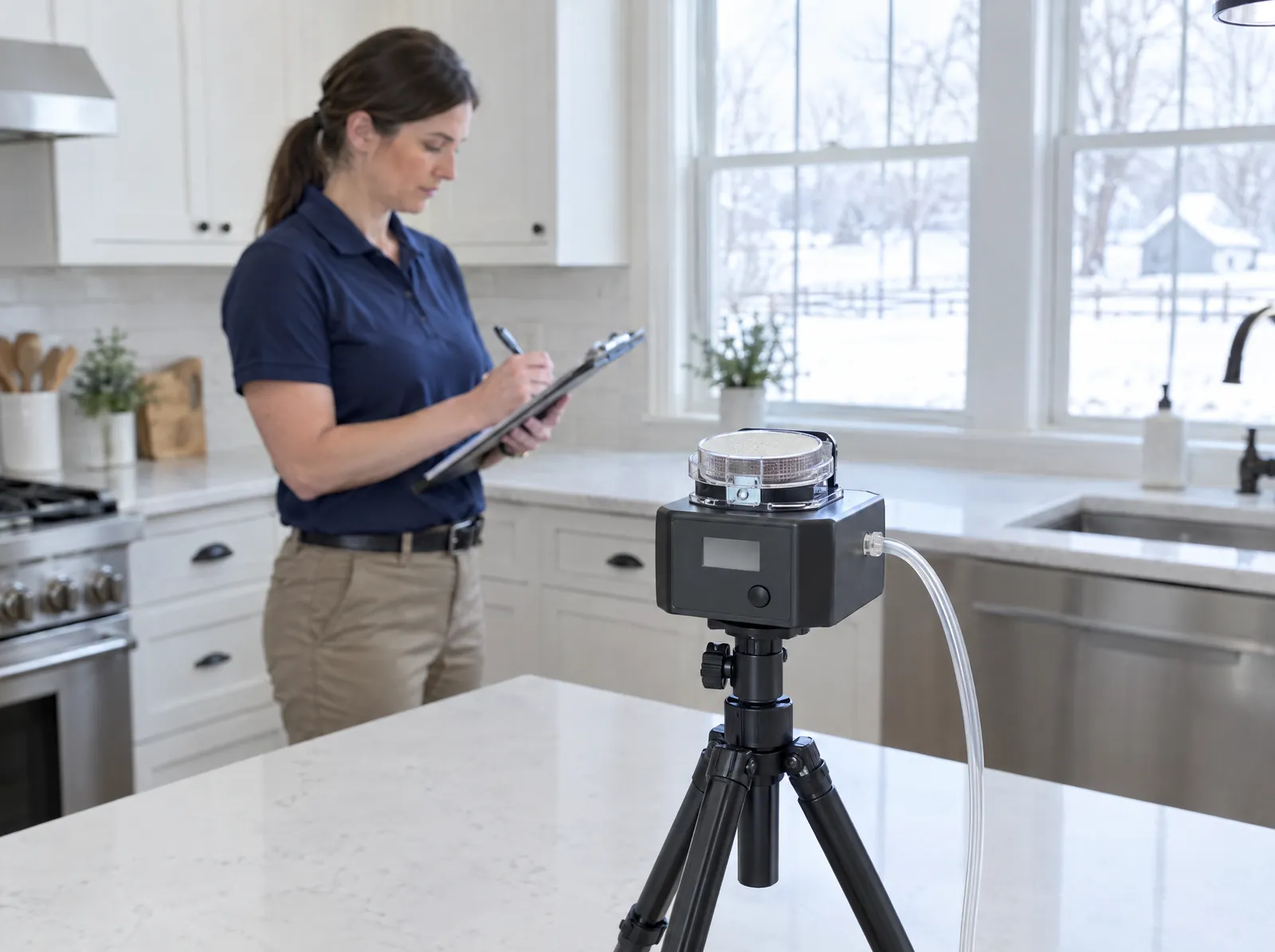
Our air quality testing in Indiana focuses on mold and the moisture that feeds it. We collect air samples in the rooms that concern you and one outdoors for comparison, measure temperature and humidity, and check the HVAC system that moves air through the house. A lab identifies the spore types and counts, and results come back in 24 to 48 hours. Radon and other pollutants need separate tests.
Why a musty house can still test fine, and the reverse
Air quality is easy to measure badly. A cheap sensor reports numbers without context, and a single indoor sample means little without knowing what the outdoor air held that day. Indiana's outdoor mold levels move with the seasons, and humidity inside can swing widely between a muggy July and a furnace-dry January. An air test only helps when it's read against those conditions.
Sound familiar?
- The house smells musty after rain, but you can't find anything.
- An air purifier is running constantly and the air still feels heavy.
- Your consumer air monitor shows numbers you don't know how to read.
- You want a baseline before buying, renting or moving someone vulnerable in.
We do it differently.
| Consumer air monitors | AME air quality testing | |
|---|---|---|
| What's measured | General particles or VOCs | Mold spore types and counts, humidity, temperature |
| Comparison | None | An outdoor sample taken the same day |
| Analysis | An estimate on a screen | Lab identification of what's in the sample |
| HVAC | Not considered | Visual check of the air handler, coil and returns |
| Next steps | Buy a better filter | Written findings and recommendations |

Why families trust us with their homes
-
Family-owned since 2008
A multigenerational family business. Not a franchise, not a private-equity rollup.
-
Credentialed where it isn't required
Indiana doesn't license mold remediators. We hold IICRC, CMR, CRMI and CCMI credentials anyway.
-
Called on as experts
Attorneys bring us into legal cases involving mold and mycotoxins.
-
Lab results in 24 to 48 hours
Every inspection comes with a written report, color photos and lab results.
- IICRC Certified Firm
- CMR
- CRMI
- CCMI
- BBB A+ Accredited
- NAMRI
- IAQA
- NORMI
- AMMA
- PMII
The AME Clearance Method
What happens during an air quality visit
A focused visit, built around the rooms you're concerned about and how air moves between them.
Talk to a specialist-
Walk the house with you
Where the air feels or smells wrong, when it's worse, and what has changed recently. It shapes where the sampling pumps go.
-
Measure humidity and temperature
Readings on each level, including basement and crawlspace, show where moisture is high enough to support mold growth.
-
Check the HVAC system
We look at the air handler, coil, drain pan, filter and returns for moisture, dirt buildup and leaks that pull basement or crawlspace air into the system.
-
Collect air samples
Sampling pumps draw a measured volume of air in each area of concern, plus an outdoor control sample for comparison.
-
Lab identification
The lab identifies spore types and counts. Results typically come back in 24 to 48 hours.
-
Written findings
We explain how indoor results compare with outdoor, which spore types matter, and whether the next step is more testing, a moisture fix or nothing at all.
What's included in air quality testing
- Indoor air samples in the rooms that concern you
- An outdoor control sample taken the same day
- Temperature and relative humidity readings on each level
- A visual check of the furnace, coil and return ducts
- Moisture meter checks of suspect walls and floors
- Lab identification of spore types and counts
- A written summary in plain English
- Recommendations for next steps, if any are needed

Proof you can hold in your hands
When we finish, you don't get a handshake and a promise. You get the paperwork your family, your doctor, your insurer or your buyer can rely on.
Inspection report
What we found, where it is coming from, with color photos.
Written remediation plan
Scope, timeline and what will and won't be removed, before work starts.
Clearance lab report
Air, surface and mycotoxin results after the work is done.
A report for your doctor
With your permission, we share results directly with your care team.
Indoor air quality in Indiana, explained
Indiana’s humidity, season by season
Indoor air quality in Indiana follows the weather more than most people realize. From late spring through early fall, humid outdoor air finds its way inside through open doors, leaky ducts and basement walls. Cool basement surfaces and supply ducts drop below the dew point, and condensation forms. That’s the season when basements smell musty and when relative humidity below grade often climbs past what the EPA recommends.
Winter flips the problem. Furnace heat dries out upstairs air, yet windows sweat, attics collect frost, and the house is closed up for months. Whatever is in the indoor air stays there longer. Testing in either season works, but the results need to be read with the season in mind. For target numbers, see how humid an Indiana home should be.
Why the outdoor sample matters
Mold spores are always in outdoor air, and Indiana’s outdoor counts shift with farming seasons, leaf fall and weather. A healthy house generally has indoor spore levels at or below outdoor levels, with a similar mix of types. Two patterns get our attention:
- Indoor counts well above outdoor counts, which suggests a source inside the house.
- Indoor types that are rare outdoors, such as Stachybotrys, Chaetomium or elevated Aspergillus and Penicillium, which often point to hidden water damage even when total counts look modest.
Without the outdoor sample, neither pattern can be seen. It’s the most skipped step in cheap air testing, and it’s included in every test we run. Our guide to what mold spore counts mean goes deeper.
The HVAC system is part of the test
In a forced-air house, the furnace circulates air through nearly every room. When the air handler sits in a damp basement or crawlspace, a leaky return can pull that space’s air straight into the system. A wet drain pan or dirty coil can grow mold on its own. That’s why we look at the system during every air quality visit, and why a sample near a supply register can tell us something a sample in the middle of the room won’t.
When air testing isn’t the right first step
Air testing is fast and useful, but it’s a snapshot. If someone in the home is sick and a doctor has asked about mold, dust-based testing and a mycotoxin panel show what has built up over months, not just what’s floating today. If you already see mold, a full mold inspection that traces the moisture is usually a better use of your money than air samples alone. And radon needs a separate test entirely.
We test buildings for mold and moisture. We don’t diagnose or treat medical conditions. If you have symptoms, please work with a doctor. With your permission, we’re glad to share test results with them.
Common questions
Have a question that isn't here? Call a specialist
Do you test for radon, VOCs or carbon monoxide?
Our air quality testing focuses on mold and moisture. Radon needs its own test, usually over several days, and carbon monoxide calls for a detector. If you suspect another pollutant, we'll tell you what kind of test you need.
What humidity should an Indiana home be?
The EPA recommends keeping indoor humidity below 60 percent, ideally between 30 and 50 percent. In Indiana, basements often run above that range in summer, which is when mold growth picks up.
What do spore counts actually mean?
There's no single safe number. What matters is how indoor counts compare with outdoor counts from the same day, and whether indoor samples contain types rarely found outdoors, like Stachybotrys or Chaetomium, which usually point to water damage inside.
Is an air test enough to rule out mold?
Not always. Air testing is a snapshot and can miss growth sealed inside a wall. When the air results don't match what you're experiencing, dust-based testing or a fuller mold inspection is the next step.
Can an air purifier fix a mold problem?
A good HEPA purifier can lower airborne spores, but it doesn't touch the source or the contaminated dust already settled in the house. It's a support tool, not a fix.
How long does the visit take?
It depends on the size of the home and how many areas you want sampled. We'll give you an estimate when we schedule.
We're done when the lab says so.
Every remediation ends with clearance testing, and our work is backed by a complete-removal guarantee. We don't close a job on a failed result.
Talk to a specialistFind out what's in your Indiana home's air
Tell us what you've noticed and when it's worst. A specialist will call you back.
- (833) 772-6653
- info@americanmoldexperts.com
- Open 7 days, 8am to 8pm