
Plant-based, and verified by testing
Enzyme mold remediation, explained plainly
What enzyme treatments do, how they compare to bleach and biocides, and what they can't replace.
What is enzyme mold remediation?
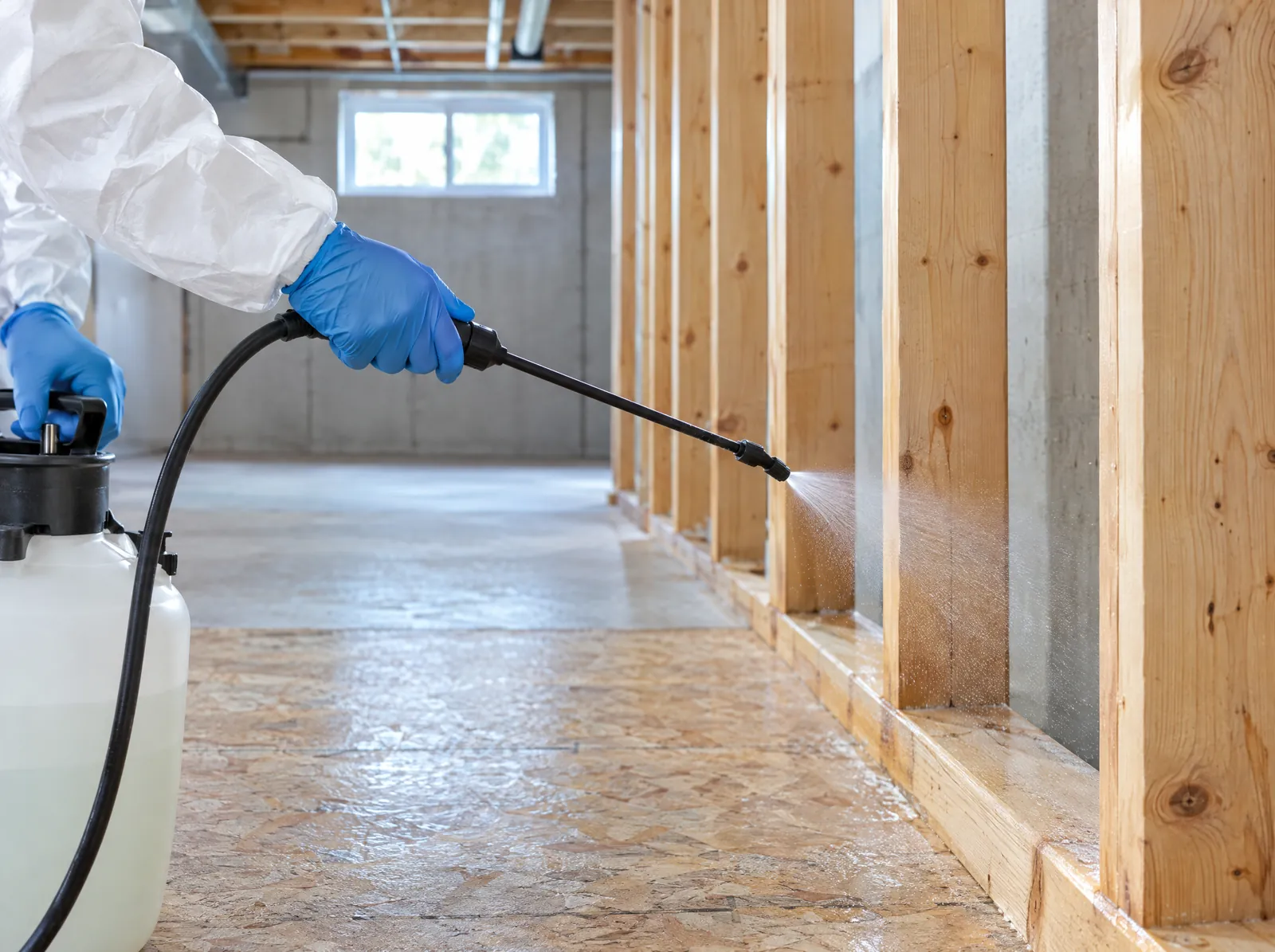
Enzyme mold remediation is mold removal that uses plant-based enzyme treatments designed to break down mold and mycotoxins, instead of relying on bleach or biocides that only kill mold. It is one part of a full remediation, not a replacement for it. The moisture source still has to be fixed, badly contaminated materials still have to come out, and the result still has to be confirmed with testing.
Where bleach and biocides fall short
Bleach and most biocides are built to kill living mold, and on hard surfaces they can. But dead mold is still mold. It still carries allergens, it still breaks into fine fragments, and any mycotoxins it produced are still there, because toxins aren't alive and can't be killed. Harsh chemicals can also leave their own residue in a home where someone is already sensitive. That gap is why we use enzymes.
Enzymes don't close that gap on their own. They go on after the materials that can't be saved are removed and the remaining surfaces are HEPA vacuumed, and the result is checked with clearance testing. The rest of this page explains how the treatments work, where they fit in a job and where they stop.
Sound familiar?
- A company sprayed bleach and the smell came back.
- You're worried about chemical residue around your kids or pets.
- You were told the only option is tearing out every wall.
- Nobody has explained what happens to the toxins after the mold dies.
We do it differently.
| Bleach and biocides | Enzyme treatments | |
|---|---|---|
| Designed to | Kill living mold | Break down mold and mycotoxins |
| Mycotoxins | Not reliably addressed | Part of what the products are designed for |
| Base ingredients | Chlorine or synthetic biocides | Plant-based enzymes |
| Porous materials | Bleach mostly stays on the surface | Applied to framing, subfloors and cavities |
| Still needs removal, HEPA cleaning and testing | Yes | Yes |

Why families trust us with their homes
-
Family-owned since 2008
A multigenerational family business. Not a franchise, not a private-equity rollup.
-
Credentialed where it isn't required
Indiana doesn't license mold remediators. We hold IICRC, CMR, CRMI and CCMI credentials anyway.
-
Called on as experts
Attorneys bring us into legal cases involving mold and mycotoxins.
-
Lab results in 24 to 48 hours
Every inspection comes with a written report, color photos and lab results.
- IICRC Certified Firm
- CMR
- CRMI
- CCMI
- BBB A+ Accredited
- NAMRI
- IAQA
- NORMI
- AMMA
- PMII
The AME Clearance Method
Where enzymes fit in the AME Clearance Method
Enzyme treatment is one tool inside a five-step process. It never stands in for the other four.
Talk to a specialist-
Test
Sampling and a moisture investigation tell us what is growing, whether mycotoxins are present and which materials can realistically be saved.
-
Contain
The work area is sealed and kept under negative air pressure before anything is disturbed or treated.
-
Remove, then treat
Materials that can't be saved come out first. The framing, subfloor and surfaces left behind are HEPA vacuumed and then treated with enzymes.
-
Clean the air
HEPA air scrubbing and detailed wiping capture the fine dust and fragments that enzymes alone won't lift out of a room.
-
Prove it
Clearance testing shows whether the treatment and cleaning worked. The lab decides, not the product label.
What an enzyme-based remediation includes
- Pre-remediation testing, with mycotoxins where indicated
- A moisture investigation and a plan to correct the source
- A written scope of what will be removed and what will be treated
- Containment with negative air pressure
- Removal of materials that can't be saved
- HEPA vacuuming before any treatment is applied
- Plant-based enzyme treatment of framing, subfloors and cavities
- HEPA air scrubbing and detailed surface cleaning
- Clearance testing and a lab report you keep

Proof you can hold in your hands
When we finish, you don't get a handshake and a promise. You get the paperwork your family, your doctor, your insurer or your buyer can rely on.
Inspection report
What we found, where it is coming from, with color photos.
Written remediation plan
Scope, timeline and what will and won't be removed, before work starts.
Clearance lab report
Air, surface and mycotoxin results after the work is done.
A report for your doctor
With your permission, we share results directly with your care team.
Enzyme remediation in detail
What enzyme treatments are
The products we use are plant-based enzyme treatments designed to break down mold and mycotoxins. That design goal is what sets them apart. Traditional mold products aim to kill living mold. Enzyme treatments aim to break down what is there, including the toxins mold leaves behind, so there is less left in the building to breathe or to tear out.
We apply them after removal and HEPA vacuuming, to the framing, subfloors, wall cavities and surfaces that remain. That order matters. A treatment works on what it can reach, and a layer of dust or debris is something it shouldn’t have to work through.
Enzymes compared with bleach and biocides
| Household bleach | Biocides and foggers | Enzyme treatments | |
|---|---|---|---|
| Main purpose | Kill surface mold on hard materials | Kill mold across surfaces or in the air | Break down mold and mycotoxins |
| What’s left afterward | Dead mold, any toxins, chemical residue | Dead mold, any toxins, product residue | Less mold material to remove, with HEPA cleaning to follow |
| Role in a proper remediation | Rarely used by professionals on porous building materials | Sometimes used as a supplement | Our treatment step, after removal and HEPA vacuuming |
For more on why chlorine falls short with toxins specifically, see does bleach kill mycotoxins.
What enzymes can’t do
No product fixes a mold problem by itself, and anyone who tells you otherwise is selling a spray, not a remediation. Enzyme treatment has real limits:
- It doesn’t fix moisture. If a leak, high humidity or poor drainage is still feeding the problem, mold will return no matter what was applied. The water source has to be corrected.
- It doesn’t save everything. Drywall that stayed wet for weeks, soaked insulation and carpet pad with deep growth usually have to be removed. Enzymes reduce how much comes out, not whether anything does.
- It doesn’t replace cleaning. Fine dust and mold fragments still have to be physically captured with HEPA vacuums, wiping and air scrubbing.
- It doesn’t replace testing. The only way to know a treatment worked is to measure the result.
Where the treatment step falls in a job
Enzyme treatment comes late in a remediation, and that’s on purpose. Before anything is applied, testing tells us what is growing, whether mycotoxins are present and which materials can realistically be saved. The moisture source is found and a plan to correct it is in place. The work area is sealed and kept under negative air pressure so disturbed dust stays where it is.
Then the materials that can’t be saved come out and are bagged inside containment. What remains, usually framing, subfloors, joists and hard surfaces, is HEPA vacuumed so the treatment reaches the material itself rather than a layer of debris. Only then do the enzymes go on. After treatment, HEPA air scrubbing and detailed wiping capture the fine particles that a treatment alone won’t lift out of a room.
How we check that the treatment worked
A treatment step is only as good as the result you can measure. We judge enzyme remediation by clearance testing, not by how a room looks or smells when the crew packs up.
Clearance testing happens after removal, treatment and cleaning are finished, while containment is still in place. Samples go to the lab, and where mycotoxins were a concern before the work, they are part of the testing afterward too. Results usually come back within 24 to 48 hours, and we compare them with the testing done at the start. If the results aren’t where they should be, the area is cleaned again and retested before containment comes down. You keep the full lab report, and with your permission, so does your doctor.
Questions to ask about any treatment product
Whoever you hire, the product they spray matters less than the process around it. These questions help you compare companies:
- What products will you use, and why?
- What will be removed, and what will be cleaned and treated in place?
- How will the moisture source be corrected?
- Will you test for mycotoxins, and is clearance testing included?
- Who reads the lab results, and will I get a copy?
When enzyme remediation makes the most sense
Enzymes earn their place most clearly on jobs where mycotoxins are a concern, where someone in the home is sensitive to harsh chemicals, and where structural materials like framing and subfloors can be kept rather than replaced. They are a standard part of our mycotoxin remediation work and of the treatment step in the AME Clearance Method.
We remove mold and mycotoxins from buildings. We don’t diagnose or treat medical conditions. If you have symptoms, please work with a doctor. With your permission, we’re glad to share test results and our plan with them.
Common questions
Have a question that isn't here? Call a specialist
Do enzymes kill mold?
The enzyme products we use are designed to break down mold and mycotoxins rather than simply kill mold and leave it in place. That is the main difference from bleach and biocides.
Is enzyme mold remediation better than bleach?
For mold remediation in a home, we think so, because bleach doesn't reliably address mycotoxins and doesn't do much below the surface of porous materials. But neither one works on its own. Removal, HEPA cleaning and testing matter more than which product is sprayed.
What enzyme products do you use?
We use MTR94, our proprietary blend of plant-based enzyme products from US Enzyme, available exclusively through American Mold Experts. It's applied to framing, subfloors and cavities after removal and HEPA vacuuming, and we're glad to explain what we'll use on your job and why.
How do you know the enzyme treatment worked?
We don't go by the product label or by how the room looks. After treatment and cleaning, clearance testing is done while containment is still up, and the lab results are compared with the testing done before the work. If the results aren't where they should be, the area is cleaned again and retested.
Can enzymes save drywall that has mold on it?
Sometimes, when growth is light and on the surface. Drywall that has been wet for a long time or has growth through the paper usually has to be removed. Enzymes reduce how much has to come out. They don't make every material salvageable.
Is enzyme treatment safe for kids and pets?
The products are plant-based and don't rely on bleach or harsh biocides. We still keep family members and pets out of the work area until clearance testing is complete.
Can I use enzyme treatments and do it myself?
A small spot of surface mold on a hard material is often a reasonable do-it-yourself job. For anything larger, hidden inside walls or tied to someone's illness, the product matters less than containment, removal and testing, and those are hard to do yourself.
We're done when the lab says so.
Every remediation ends with clearance testing, and our work is backed by a complete-removal guarantee. We don't close a job on a failed result.
Talk to a specialistAsk whether enzyme remediation fits your home
Tell us what you're dealing with. A specialist will call you back and talk through what testing would show.
- (833) 772-6653
- info@americanmoldexperts.com
- Open 7 days, 8am to 8pm