
Barriers, negative air and HEPA filtration
Mold remediation containment, explained
The plastic walls and humming machines have one job: keep what we disturb from reaching the rest of your home.
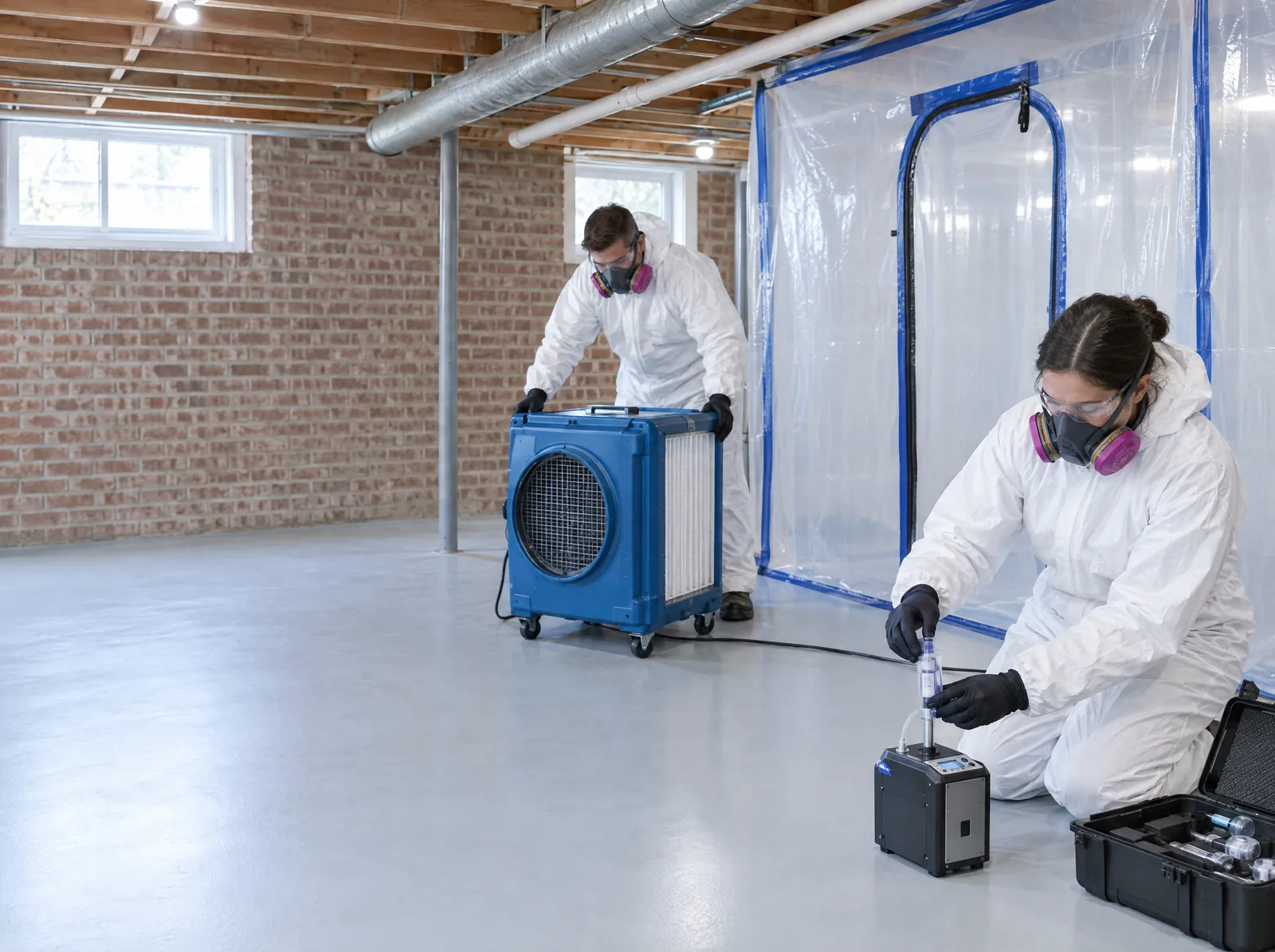
What is mold remediation containment?
Mold remediation containment is the temporary enclosure built around a work area so the spores, fragments and dust released during removal can't spread to the rest of the building. It typically uses plastic sheeting sealed to walls, floor and ceiling, a zippered entry, covered vents, and HEPA-filtered air machines that pull air out of the enclosure. That creates negative pressure, so air leaks into the work area rather than out of it.
The step you can't see is the one most often skipped
Removing moldy drywall or scrubbing framing releases far more spores and fine particles into the air than the undisturbed mold ever did. Without containment, that dust drifts down hallways, into the HVAC returns and onto everything in the house. The homeowner sees clean studs where the mold was and assumes the job went well. Then air testing in the bedroom upstairs comes back worse than it was before the work began.
Sound familiar?
- A previous contractor worked with the doors open and no plastic.
- Your air tested worse after remediation than before it.
- You want to stay in the house but don't know if it's safe during the work.
- You've been quoted two jobs and can't tell why one includes containment and one doesn't.
We do it differently.
| No real containment | AME containment | |
|---|---|---|
| Barrier | A tarp or nothing | Sealed polyethylene walls with a zippered entry |
| Air pressure | Neutral or positive | Negative, confirmed during the work |
| Filtration | Box fans blowing out a window | HEPA air machines |
| HVAC | Left running | Vents and returns sealed in the work area |
| Coming down | When the crew leaves | After clearance testing passes |

Why families trust us with their homes
-
Family-owned since 2008
A multigenerational family business. Not a franchise, not a private-equity rollup.
-
Credentialed where it isn't required
Indiana doesn't license mold remediators. We hold IICRC, CMR, CRMI and CCMI credentials anyway.
-
Called on as experts
Attorneys bring us into legal cases involving mold and mycotoxins.
-
Lab results in 24 to 48 hours
Every inspection comes with a written report, color photos and lab results.
- IICRC Certified Firm
- CMR
- CRMI
- CCMI
- BBB A+ Accredited
- NAMRI
- IAQA
- NORMI
- AMMA
- PMII
The AME Clearance Method
How we build and run a containment
Containment goes up before any material is disturbed and stays up until the lab says it can come down.
Talk to a specialist-
Size it to the job
The extent of growth and what will be disturbed decide whether the job needs a small enclosure, a sealed room or an entire level.
-
Seal the openings
HVAC supplies and returns, doorways, outlets and gaps in the work area are covered so air and dust have no easy path out.
-
Build the barriers
Polyethylene sheeting is sealed to the floor, walls and ceiling, with a zippered door for entry and, on larger jobs, an airlock or decontamination chamber.
-
Put it under negative air
HEPA air machines draw air out of the enclosure. The walls bow gently inward, and pressure is checked during the work.
-
Work clean inside it
Removed materials are bagged inside the enclosure, and HEPA vacuums follow demolition so dust doesn't build up.
-
Take it down last
Containment stays in place through final cleaning and clearance testing, and comes down only after results pass.
What our containment includes
- Containment sized to the extent of the work
- Polyethylene barriers sealed at floor, walls and ceiling
- A zippered entry, with an airlock on larger jobs
- Sealed HVAC vents and returns in the work area
- HEPA air machines creating negative pressure
- Pressure checks during the work
- Bagging of removed materials inside the enclosure
- Clearance testing before containment is removed

Proof you can hold in your hands
When we finish, you don't get a handshake and a promise. You get the paperwork your family, your doctor, your insurer or your buyer can rely on.
Inspection report
What we found, where it is coming from, with color photos.
Written remediation plan
Scope, timeline and what will and won't be removed, before work starts.
Clearance lab report
Air, surface and mycotoxin results after the work is done.
A report for your doctor
With your permission, we share results directly with your care team.
Mold containment, explained
Why removal needs a barrier
Undisturbed mold releases spores slowly. Cutting, tearing and scrubbing it releases a burst of spores, hyphal fragments and fine dust, much of it small enough to stay in the air for a long time and travel on the slightest draft. Some of those particles can carry mycotoxins. Containment exists to make sure all of that ends up in a HEPA filter or a sealed bag rather than in your bedroom, your ductwork or your furniture. It’s the difference between removing a problem and relocating it.
Levels of containment
Not every job needs an entire floor wrapped in plastic. The EPA’s guidance for schools and commercial buildings scales containment to the size of the contaminated area, and residential work follows similar logic. As a rough guide:
| Scale of work | Typical containment | Example |
|---|---|---|
| Small, under about 10 square feet | Source containment: a small enclosure or careful work with HEPA vacuuming at the point of removal | A section of drywall under a sink |
| Medium, about 10 to 100 square feet | Limited containment: a single layer of polyethylene enclosing the area, with a slit or zipper entry and negative air | A bathroom wall and subfloor |
| Large, over about 100 square feet | Full containment: sealed barriers, an airlock or decontamination chamber, and negative air | A finished basement or crawl space |
Square footage is only one input. Heavy contamination, hidden growth likely to be exposed during demolition, HVAC connections, and occupants with health concerns can all justify a higher level of containment than the area alone suggests.
The parts of a containment
- Critical barriers: plastic sealed over openings that must stay closed during the work, such as HVAC registers, returns, doorways and pass-throughs.
- Enclosure walls: polyethylene sheeting, commonly 6-mil and fire-retardant, taped or poled tightly to the floor, walls and ceiling.
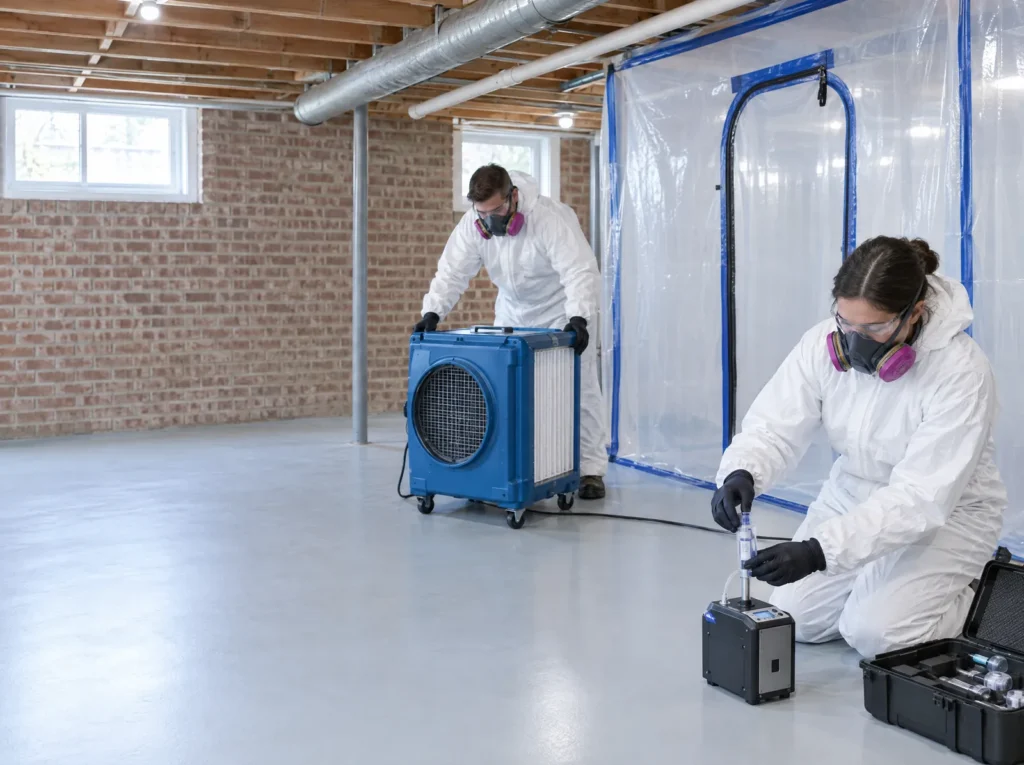
- Entry: an adhesive zipper door, and on larger projects a small chamber where workers remove protective suits before leaving.
- Negative air machines: fans fitted with HEPA filters that pull air from the enclosure and exhaust it, filtered, outdoors or to a safe area.
- Pressure monitoring: a gauge or visual check that confirms air is flowing into the work area, not out of it.
Living with a containment in your home
Many families stay home during remediation, and containment is what makes that reasonable. Expect a closed-off area you can’t enter, the steady hum of air machines running around the clock, a hose or duct leading to a window or door, and a crew coming and going through one entry. Your HVAC may be adjusted so it doesn’t draw air from the work zone. Keep children and pets away from the plastic, don’t unzip the door to look inside, and tell us right away if a seam comes loose. Our answer on whether you can stay in your house during mold remediation covers the decision in more depth.
Why it comes down last
It’s tempting to pull the plastic as soon as the moldy material is out. We don’t, because containment also protects the rest of the house during final cleaning, and it keeps the work area isolated for post-remediation verification. If a sample doesn’t pass, the area gets cleaned again with the barriers still in place. Only after the results pass does the containment come down, and the plastic itself is bagged as contaminated waste. If you’d like to see how containment fits into larger buildings, read about commercial mold remediation. For Indiana homes, see mold remediation in Indiana.
We remove mold and mycotoxins from buildings. We don’t diagnose or treat medical conditions. If anyone in your home has symptoms, please work with a doctor. With your permission, we’re glad to share test results and our plan with them.
Common questions
Have a question that isn't here? Call a specialist
Is containment really necessary for mold remediation?
For anything beyond a small area, yes. Disturbing mold releases spores and fragments, and without containment they spread to clean parts of the home. The EPA's guidance calls for containment on larger areas, and the IICRC S520 standard treats it as a core part of professional remediation.
What is negative air pressure?
It means air is being pulled out of the work area faster than it leaks in. HEPA-filtered machines exhaust air from the enclosure, so any gap in the plastic draws clean air in rather than letting contaminated air out. You can often see it: the plastic walls bow slightly inward.
Can we stay in the house while containment is up?
Often, yes. A well-built containment is designed to protect the rest of the home. Anyone with health concerns, or whose doctor has advised it, may choose to stay elsewhere until clearance passes. We'll help you decide based on the job's size and location.
How do I know if a containment is working?
The plastic should be sealed at every edge and bow inward, the zipper door should stay closed, HEPA machines should run continuously, and HVAC vents in the area should be sealed. You shouldn't see or smell dust outside the enclosure.
Do HEPA air machines run all night?
Yes. They run continuously while the containment is up, including overnight, so negative pressure is maintained whether or not the crew is working. They make a steady fan noise, similar to a large air purifier.
When does containment come down?
After the work area is cleaned, dry and has passed clearance testing. Taking it down earlier would mean any problem found in testing has to be fixed without protection in place.
We're done when the lab says so.
Every remediation ends with clearance testing, and our work is backed by a complete-removal guarantee. We don't close a job on a failed result.
Talk to a specialistAsk us how we'd contain your job
Tell us where the mold is and who's living in the home. A specialist will call you back.
- (833) 772-6653
- info@americanmoldexperts.com
- Open 7 days, 8am to 8pm