
Serving Indiana homes since 2008
Mold remediation in Indiana, finished when the lab agrees
Contained, enzyme-based remediation for Indiana homes, with testing before and after so you know the job is actually done.
What does mold remediation in Indiana involve?
Mold remediation in Indiana means finding why the mold is growing, stopping the moisture, sealing off the affected area, removing or cleaning contaminated materials, breaking down the mycotoxins left behind, and proving the result with clearance testing. Because Indiana doesn't license mold remediators, that final test is your best evidence the work was done right. We run every Indiana project from our office in Avon.
Why so many Indiana mold jobs don't hold up
Anyone in Indiana can print business cards that say mold removal. There's no state license and no required test at the end, so a lot of jobs stop at killing what's visible. The stain disappears, the paint goes on, and the moisture that caused it is still there. Months later the smell is back, or a family still feels worse at home and can't say why.
Sound familiar?
- The mold was sprayed and painted over, and now it's coming back.
- No one tested before or after, so you have no idea whether it worked.
- The quote says to gut the basement, and you're not sure that's necessary.
- You're paying for remediation and have nothing in writing to show for it.
We do it differently.
| Typical Indiana mold removal | AME mold remediation | |
|---|---|---|
| Starting point | A visual look and a quote | Air, dust and moisture testing, then a written scope |
| Moisture source | Often left for the homeowner | Identified and corrected before cleaning |
| Treatment | Bleach, biocide or fogging | Containment, removal, HEPA cleaning and enzymes |
| Demolition | Tear out anything that looks stained | Remove only what testing shows can't be saved |
| Finish line | When the crew leaves | When the clearance test passes |

Why families trust us with their homes
-
Family-owned since 2008
A multigenerational family business. Not a franchise, not a private-equity rollup.
-
Credentialed where it isn't required
Indiana doesn't license mold remediators. We hold IICRC, CMR, CRMI and CCMI credentials anyway.
-
Called on as experts
Attorneys bring us into legal cases involving mold and mycotoxins.
-
Lab results in 24 to 48 hours
Every inspection comes with a written report, color photos and lab results.
- IICRC Certified Firm
- CMR
- CRMI
- CCMI
- BBB A+ Accredited
- NAMRI
- IAQA
- NORMI
- AMMA
- PMII
The AME Clearance Method
The AME Clearance Method in an Indiana home
Six steps, in the same order on every Indiana project. The order matters: cleaning before the water is fixed just resets the clock.
Talk to a specialist-
Test and trace the water
Air and settled-dust samples show what is growing. Moisture readings show where the water comes from, whether that's a sump pit, a window well, a roof leak or summer humidity.
-
Write the scope
You get a written plan before anything is removed: what comes out, what gets cleaned, what we expect clearance to show, and the price.
-
Seal off the work area
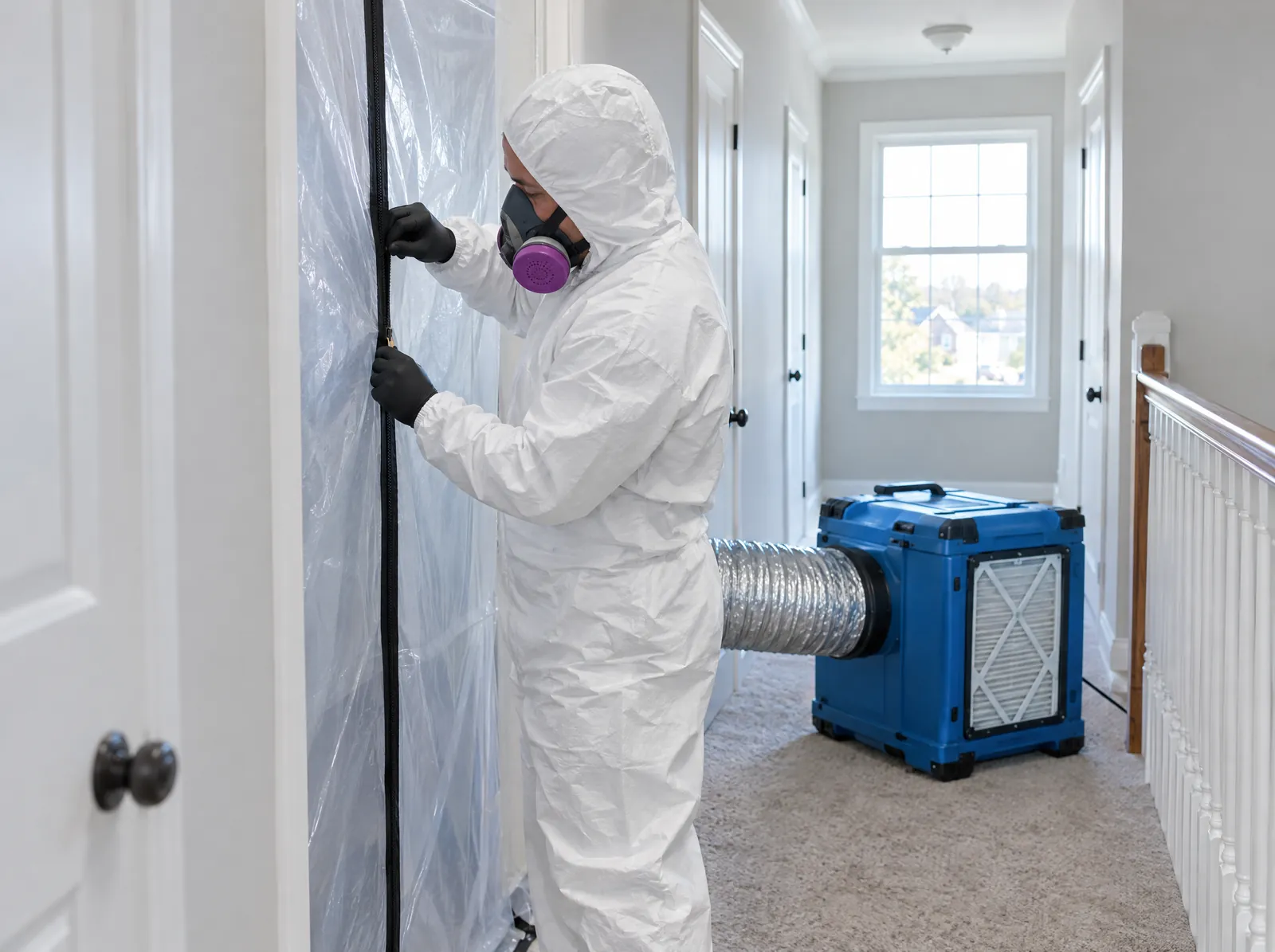
Plastic containment with zipper doors and HEPA air scrubbers under negative pressure keep spores and dust from drifting into the rest of the house.
-
Remove and clean
Contaminated drywall, insulation or carpet pad that can't be saved is bagged and removed. Framing, subfloors and hard surfaces are HEPA vacuumed and wiped.
-
Break down what's left
Plant-based enzyme treatments go onto framing and cavities to break down mycotoxins that biocides leave behind.
-
Clearance test
Containment stays up until the lab confirms the area is clean. You get the full report, not just our word for it.
What an Indiana remediation project includes
- Pre-remediation air and dust testing
- Moisture mapping to find the water source
- A written scope and price before work starts
- Containment with negative air pressure
- Removal of materials that can't be cleaned
- HEPA vacuuming and detailed surface wiping
- Enzyme treatment for mycotoxins
- Post-remediation clearance testing
- A final report for your records, insurer or buyer

Proof you can hold in your hands
When we finish, you don't get a handshake and a promise. You get the paperwork your family, your doctor, your insurer or your buyer can rely on.
Inspection report
What we found, where it is coming from, with color photos.
Written remediation plan
Scope, timeline and what will and won't be removed, before work starts.
Clearance lab report
Air, surface and mycotoxin results after the work is done.
A report for your doctor
With your permission, we share results directly with your care team.
Mold remediation in Indiana, explained
Removal and remediation are not the same job
People search for both terms, and plenty of companies use them interchangeably. They describe different amounts of work. Removal is the part you can see: scrubbing a wall, cutting out a stained section of drywall. Remediation includes that, plus the parts that decide whether the problem comes back: finding the moisture, containing the dust, cleaning what the mold contaminated beyond the visible patch, and testing afterward. We cover the distinction in more depth in mold removal vs. mold remediation.
Where Indiana mold usually starts
Indiana’s weather puts water into houses in a few predictable ways. Spring rain and snowmelt push groundwater against foundation walls, and much of the state sits on clay-heavy soil that holds that water in place. Humid summers condense on basement walls and ducts. Winter freeze-thaw cycles open small gaps, and warm indoor air leaking into cold attics turns to frost on the roof deck.
The fix almost always involves something outside the mold itself: a sump pump, a downspout, a bathroom fan vented into the attic instead of outdoors, a dehumidifier sized too small for the basement. If the scope you’re handed doesn’t mention the water source, ask why.
What drives the price
Angi puts the average mold remediation job in Indianapolis at about $1,999, with most falling between $1,026 and $3,005. Those figures are useful as a starting point. Your price depends on a handful of things we can only measure on site:
- Size and location. A closet wall costs less than a finished basement. Crawlspaces and attics take longer to work in safely.
- What has to come out. Drywall, insulation and carpet pad add labor and disposal.
- HVAC involvement. Ductwork cleaning is a separate line item when testing shows the system is spreading contamination.
- Mycotoxins. Toxin-focused cleaning and testing add steps a basic mold job skips.
Our Indianapolis mold remediation cost guide breaks this down further. Either way, you get a written price before we start.
Insurance, and when to do it yourself
Insurance coverage usually turns on the cause. A burst supply line that soaked a wall is a different claim from a basement that has been damp for years. Read your policy for mold exclusions and limits, and see our notes on homeowners insurance and mold in Indiana. The test reports and written scope we provide are the kind of documentation adjusters ask for.
Small problems can be a homeowner job. EPA guidance puts the line at roughly 10 square feet, on the condition that the moisture source is fixed. Past that size, inside walls or ductwork, or when someone in the home is already unwell, containment and testing are worth paying for.
Hiring in a state without a mold license
Indiana leaves it to you to vet a mold company. Look for third-party credentials such as IICRC certification, ask to see a sample clearance report, and ask whether the price includes post-remediation testing by a lab. A company that tests its own work has nothing to hide from the results.
We remove mold and mycotoxins from buildings. We don’t diagnose or treat medical conditions. If you have symptoms, please work with a doctor. With your permission, we’re glad to share test results and our plan with them.
Common questions
Have a question that isn't here? Call a specialist
How much does mold remediation cost in Indianapolis?
According to Angi, mold remediation in Indianapolis averages about $1,999, and most projects fall between $1,026 and $3,005. Larger jobs, crawlspaces, HVAC work and mycotoxin remediation can cost more. We price each job from test results and give you a written scope before any work begins.
What's the difference between mold removal and mold remediation?
Mold removal usually means cleaning or tearing out visible growth. Remediation is the full process: finding and fixing the moisture, containing the area, removing and cleaning contaminated materials, and testing to confirm the home is back to normal levels. Mold spores exist everywhere outdoors, so the goal is normal indoor levels, not zero.
Does homeowners insurance cover mold removal in Indiana?
It depends on your policy and the cause. Many policies cover mold that results from a sudden, covered event like a burst pipe, and exclude mold from long-term leaks, flooding or humidity. Coverage limits vary. Our test results and written scope give your adjuster documentation to work from.
Can I remediate mold myself?
For a small patch on a hard surface, often yes. EPA guidance says homeowners can usually handle areas under about 10 square feet if the moisture problem is fixed. Larger areas, mold inside walls or HVAC systems, or anyone in the home with health concerns are good reasons to bring in a professional.
Does Indiana require a license for mold remediation?
No. Indiana doesn't license mold remediators or inspectors. We hold IICRC, CMR, CRMI and CCMI credentials anyway and test before and after every job, so you have independent proof of the result.
Will you have to tear out my walls?
Most homes don't need large-scale demolition. Testing and moisture mapping show which materials are actually affected, and enzyme treatment lets us clean and keep framing and other materials that would otherwise be removed.
Do you serve my part of Indiana?
Very likely. We work across the Indianapolis metro from our Avon office and regularly travel to Fort Wayne, South Bend, Evansville, Bloomington, Lafayette and other Indiana cities.
We're done when the lab says so.
Every remediation ends with clearance testing, and our work is backed by a complete-removal guarantee. We don't close a job on a failed result.
Talk to a specialistGet a remediation plan for your Indiana home
Tell us what you're seeing or smelling. A specialist from our Avon office will call you back.
- (833) 772-6653
- info@americanmoldexperts.com
- Open 7 days, 8am to 8pm