
Buyer's guide
How to choose a mold remediation company
Credentials, written scopes and clearance testing tell you more than any sales pitch. Here's how to compare them.
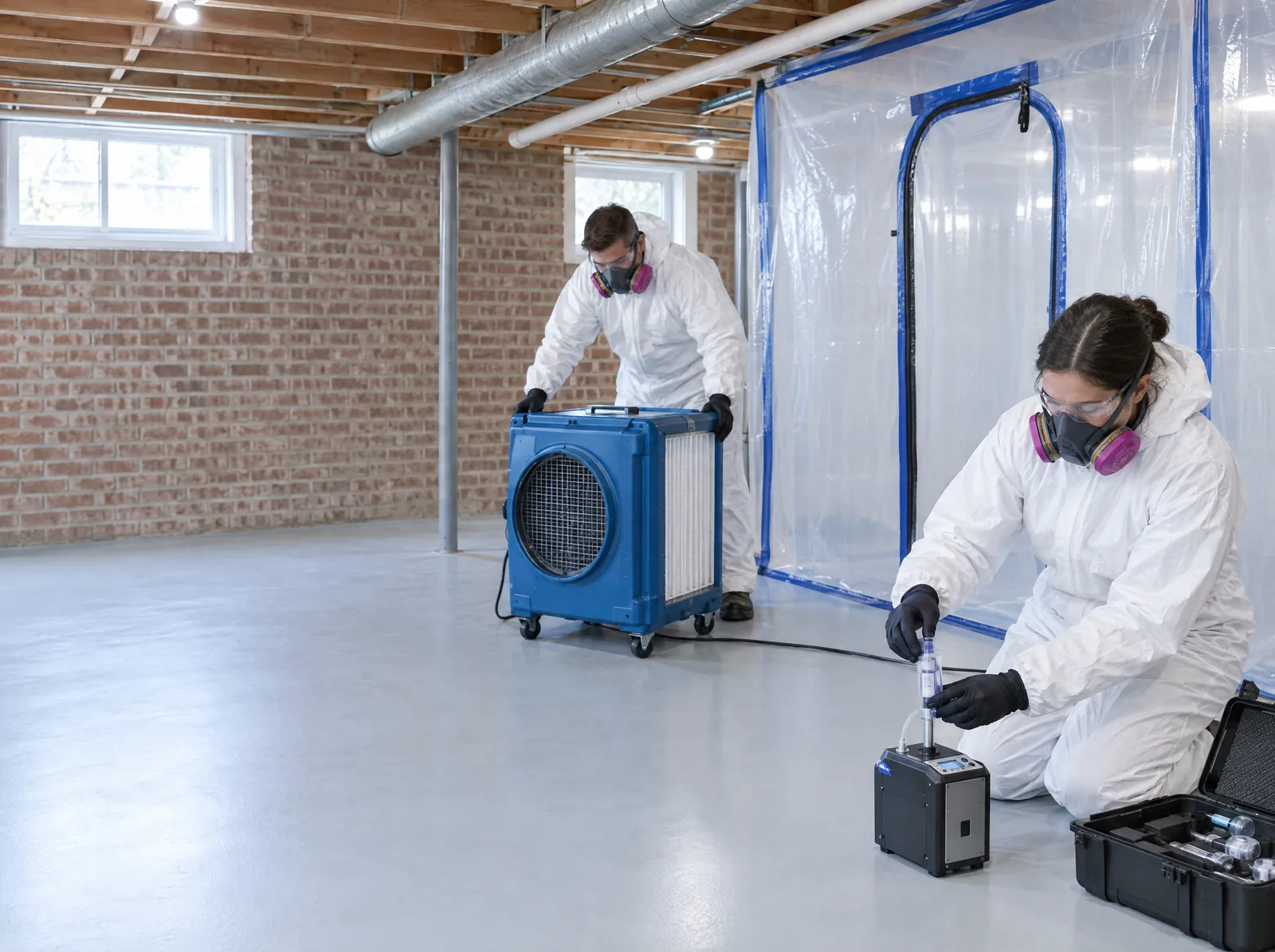
How do you choose a mold remediation company?
To choose a mold remediation company, compare three things: credentials and track record, the written scope of work, and how the job will be proven finished. Look for recognized certifications such as IICRC, an on-site inspection before any price, a scope that names the moisture source, containment, HEPA cleaning and the HVAC system, and clearance testing with complete lab reports. Be wary of fogging-only plans and anyone who quotes without testing.
Why comparing mold companies is so hard
Most people hire a mold remediator once in their life, usually under stress. Every company says it's certified, experienced and thorough. The quotes arrive in different formats, cover different areas and use different words for the same work, so the lowest number often looks like the obvious choice.
It usually isn't. The difference between a job that holds and one that fails the retest is almost always in the scope: what was tested, what was contained, how far the cleaning reached, and what clearance measured. Those details are all on paper, if you know where to look.
Sound familiar?
- Three quotes, three formats, and no way to line them up.
- Every company claims certification, and you can't tell what it means.
- One bid is half the price of the others and you don't know why.
- Nobody has explained how you'll know the job actually worked.
We do it differently.
| A weak bid | A bid worth trusting | |
|---|---|---|
| Pricing | Given by phone or from photos | Given after an on-site inspection and testing |
| Moisture source | Not mentioned | Named, with who is fixing it |
| Method | Fogging or spraying alone | Containment, removal, HEPA cleaning and treatment |
| Scope | The visibly moldy area | The source, surrounding dust, HVAC and contents |
| Finish line | "Looks good" or a spore count | Clearance testing with complete lab reports |

Why families trust us with their homes
-
Family-owned since 2008
A multigenerational family business. Not a franchise, not a private-equity rollup.
-
Credentialed where it isn't required
Indiana doesn't license mold remediators. We hold IICRC, CMR, CRMI and CCMI credentials anyway.
-
Called on as experts
Attorneys bring us into legal cases involving mold and mycotoxins.
-
Lab results in 24 to 48 hours
Every inspection comes with a written report, color photos and lab results.
- IICRC Certified Firm
- CMR
- CRMI
- CCMI
- BBB A+ Accredited
- NAMRI
- IAQA
- NORMI
- AMMA
- PMII
The AME Clearance Method
Choosing a company, step by step
Use this to compare any company, including us. The goal is to get bids that can be compared line by line.
Talk to a specialist-
Shortlist on credentials
Look for an IICRC Certified Firm and individual certifications in mold remediation, then check your state's licensing rules. Some states license mold work and many, including Indiana, don't.
-
Ask how they test
Which tests they run before the work, whether they test for mycotoxins, and whether you'll receive the full lab reports rather than a summary.
-
Insist on an on-site inspection
A fair price depends on the source, the materials and the layout. Nobody can see those from a phone call or a few photos.
-
Compare written scopes line by line
Containment, removal, cleaning, HVAC, contents and clearance. If a line is missing from one bid, ask whether it's excluded or just unwritten.
-
Check the finish line
Ask what test clearance will use, what result counts as passing, and what happens if the result doesn't pass.
-
Verify the business
Insurance, BBB standing, years in business, and what products they use and why.
What a trustworthy bid should include
- Testing results or a testing plan
- The moisture source, and who will fix it
- Which rooms will be contained, and how
- What will be removed and what will be cleaned
- How remaining contamination will be treated
- HEPA cleaning beyond the moldy area
- Whether the HVAC system is included
- A plan for belongings
- The clearance test and passing target
- What happens if clearance doesn't pass

Proof you can hold in your hands
When we finish, you don't get a handshake and a promise. You get the paperwork your family, your doctor, your insurer or your buyer can rely on.
Inspection report
What we found, where it is coming from, with color photos.
Written remediation plan
Scope, timeline and what will and won't be removed, before work starts.
Clearance lab report
Air, surface and mycotoxin results after the work is done.
A report for your doctor
With your permission, we share results directly with your care team.
Choosing a mold remediator, in more depth
What credentials actually tell you
Credentials are a floor, not a ceiling. They show that a company’s people were trained in accepted methods, and some require ongoing education. They don’t show whether a particular crew follows those methods on your job. Here’s how to read the common ones:
| What you see | What it means | What to ask next |
|---|---|---|
| IICRC Certified Firm | The company employs IICRC-certified technicians and meets the organization’s firm standards | Which people on my job hold which certifications? |
| Individual mold certifications (such as CMR, CRMI, CCMI) | A person has completed training and testing in mold remediation or assessment | Will that person be on site or supervising? |
| Trade association membership | The company belongs to an industry group | Membership alone doesn’t certify anyone. Ask what it involves. |
| State license | Required in some states, not in others | Does my state license mold work? Indiana doesn’t. |
| BBB rating | How the company handles complaints | Read the complaints themselves, not just the grade. |
Red flags worth walking away from
- A firm price before anyone has seen the house. The source, the materials and the layout decide the job.
- Fogging or spraying as the whole plan. Killing mold isn’t removing it, and dead mold still carries toxins.
- Painting over or “sealing in” as the main fix. Encapsulation has a place on cleaned framing. It isn’t a substitute for removal.
- No mention of the moisture source. If nobody is fixing the water, the mold comes back.
- Pressure to sign today. Mold rarely requires a same-day decision. Stopping active water does.
- No clearance testing, or a vague promise to “check it.” You should know exactly what will be tested and what counts as passing.
- Reluctance to share lab reports. You paid for the testing. The complete reports are yours.
Lining up bids so they can be compared
Make a simple grid with one column per company and a row for each item in the “what a trustworthy bid should include” list on this page. Fill it in from each written scope. Wherever a cell is empty, call and ask: is this excluded, or just not written down? The answers usually explain the price difference, and they tell you a lot about how each company communicates. Our answer on what questions to ask a mold remediation company gives you the exact wording to use.
If someone in the house is sick
For a family working with a doctor on mold illness, add three more tests of fit. Will the company test to the target your doctor asked for, including a mycotoxin panel? Will they talk with your doctor’s office if you give permission? And do they have a clear plan for keeping dust out of the rooms you’re living in? A company that does excellent work on a flooded basement may still not be set up for a household that needs a stricter standard. Our page on working with your doctor on a moldy home explains what that coordination looks like.
Ask what products and methods they use
It’s fair to ask any contractor what products and methods they plan to use, and why those. A good answer explains how each product fits with removal, HEPA cleaning and clearance testing, and doesn’t treat any product as a substitute for removing materials that can’t be saved or fixing the moisture. For our part, we use plant-based enzyme products from US Enzyme, designed to break down mold and mycotoxins. You can read how that step fits into the work on our page about enzyme mold remediation.
Where we fit
For the record, here’s what you’d put in our column: family-owned since 2008, an IICRC Certified Firm, with CMR, CRMI and CCMI credentials, members of NAMRI, IAQA, NORMI, AMMA and PMII, and BBB A+ accredited. We test before and after every job, mycotoxins included, and we travel for projects anywhere in the country. Compare that with everyone else on your list, and choose the company whose written scope you trust most.
We remove mold and mycotoxins from buildings. We don’t diagnose or treat medical conditions, and nothing on this page is medical advice. If anyone in your home has symptoms, please work with a doctor. With your permission, we’re glad to share test results and our plan with them.
Common questions
Have a question that isn't here? Call a specialist
What certifications should a mold remediation company have?
Look for an IICRC Certified Firm and individual certifications such as the IICRC Applied Microbial Remediation Technician. Other recognized mold credentials include CMR, CRMI and CCMI. Certifications show training, not results, so weigh them alongside the written scope and references.
Do mold remediators need a license?
It depends on the state. Some states license mold assessors or remediators, and many, including Indiana, don't. Check your state's rules, and if your state doesn't license mold work, lean more heavily on certifications and track record.
Should the same company test and remediate?
Some families prefer separate companies to avoid a conflict of interest. Others prefer one company that owns the result from testing through clearance. Either way, ask for complete lab reports from an accredited lab so you can see the numbers yourself.
Why is one mold quote so much cheaper than the others?
Usually because it covers less. Common gaps are no containment, no HVAC cleaning, no whole-home dust removal, no contents plan and no clearance testing. Line the scopes up and the difference is usually on the page.
Is fogging a red flag?
Fogging on its own is. It may kill surface mold, but it doesn't remove contaminated materials, fix the moisture source or remove the dust that mycotoxins travel on. As one step inside a full scope, it's a different conversation.
What should I ask for in writing?
The scope of work, the containment plan, the clearance test and its passing target, the price, and what happens if clearance fails. Get changes in writing too, especially if something new turns up once walls are opened.
How do I know the job worked?
Clearance testing, compared with the testing done before the work. Ask for the complete lab reports. If someone in the home is working with a doctor, make sure clearance measures the result the doctor wants to see.
We're done when the lab says so.
Every remediation ends with clearance testing, and our work is backed by a complete-removal guarantee. We don't close a job on a failed result.
Talk to a specialistPut us through the checklist
Ask us anything on this page. A specialist will call you back and answer it plainly, including the parts that don't make us the obvious choice.
- (833) 772-6653
- info@americanmoldexperts.com
- Open 7 days, 8am to 8pm