
Where mycotoxins hide
Mycotoxins in dust: why house dust matters most
Why settled dust holds most of a home's mycotoxin load, and how to sample and clean it properly.
Why do mycotoxins collect in dust?
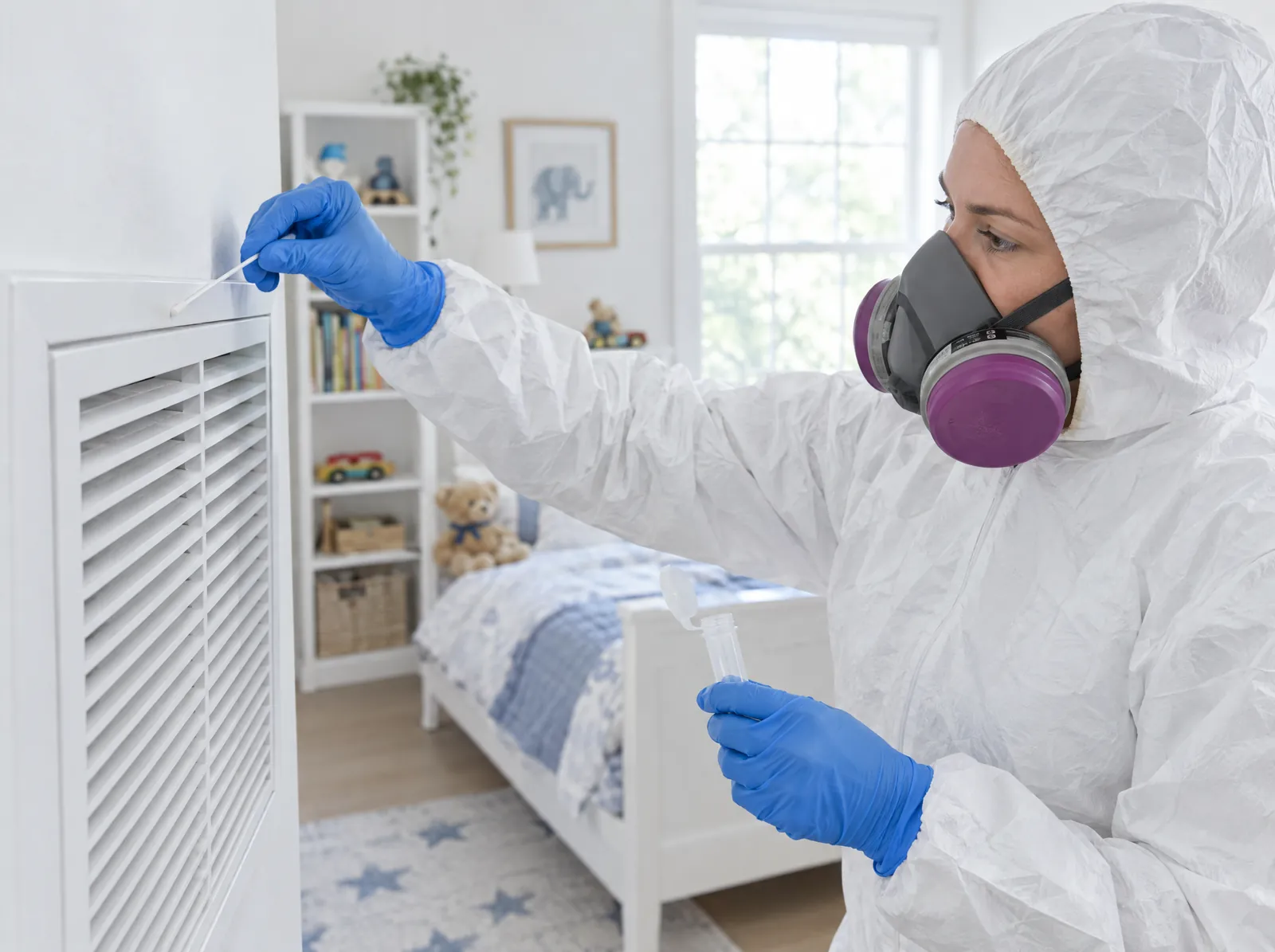
Mycotoxins in dust come from spores and tiny mold fragments that drift away from growth, settle and mix with ordinary house dust. Because the toxins are chemically stable, dust holds onto them long after the mold is gone. That makes settled dust the main reservoir in most affected homes and the usual sample for a mycotoxin test. Removing them means capturing that dust with HEPA vacuuming and damp wiping, not stirring it back into the air.
Why ordinary cleaning can make dust worse
Dust is the part of a mold problem everyone lives with and nobody thinks about. It lifts into the air with every footstep, every bed that gets made and every run of the furnace fan, then settles again somewhere else. A vacuum without a sealed HEPA system catches the large debris and can blow the finest particles, the ones most likely to carry toxins, back into the room.
Dry dusting does the same thing. A feather duster or dry cloth mostly moves dust from the shelf into the air, where it drifts until it lands again.
Sound familiar?
- You clean all the time and the dust keeps coming back.
- You don't know which rooms the dust is coming from.
- The vacuum smells musty when it runs.
- You've heard about dust testing but not what to do with the result.
We do it differently.
| Everyday cleaning | Toxin-aware dust removal | |
|---|---|---|
| Vacuum | Standard vacuum, filter may leak around the edges | Sealed HEPA vacuum |
| Dusting | Dry cloth or duster | Damp microfiber, changed often |
| Order | Wherever looks dirtiest | Top down, room by room, cleanest areas first |
| Hidden dust | Left alone | Tops of cabinets, door frames, fan blades, under furniture |
| Air | Not addressed | HEPA air scrubbing during and after cleaning |

Why families trust us with their homes
-
Family-owned since 2008
A multigenerational family business. Not a franchise, not a private-equity rollup.
-
Credentialed where it isn't required
Indiana doesn't license mold remediators. We hold IICRC, CMR, CRMI and CCMI credentials anyway.
-
Called on as experts
Attorneys bring us into legal cases involving mold and mycotoxins.
-
Lab results in 24 to 48 hours
Every inspection comes with a written report, color photos and lab results.
- IICRC Certified Firm
- CMR
- CRMI
- CCMI
- BBB A+ Accredited
- NAMRI
- IAQA
- NORMI
- AMMA
- PMII
The AME Clearance Method
How we sample and remove mycotoxins from dust
Dust work has two halves: learning what's in it, then getting it out without spreading it.
Talk to a specialist-
Find the old dust
Dust that has sat undisturbed for months holds the history of the house. We look above door frames, on top of cabinets and appliances, on fan blades and behind furniture.
-
Sample room by room
Separate samples from bedrooms, living areas and the suspected source show where toxin levels are highest instead of blending them into one number.
-
Stop new dust at the source
Moisture problems are corrected and growth is removed under containment first. Cleaning dust while the source is still active just starts the cycle again.
-
HEPA vacuum from the top down
Ceilings, walls, trim, furniture, soft furnishings and floors, in that order, with sealed HEPA vacuums so fine particles stay in the machine.
-
Damp wipe every surface
Microfiber cloths dampened with a cleaning solution, wiped in one direction, folded to a clean face and swapped out often.
-
Scrub the air
HEPA air scrubbers run during and after cleaning to capture particles that get lifted back into the air.
-
Retest the dust
Once dust has had a chance to resettle, samples from the same kinds of locations show whether the toxin load has actually dropped.
What a dust-focused mycotoxin cleaning includes
- Dust sampling from living areas and suspected sources
- A mycotoxin panel and, where useful, mold DNA testing
- Correction of the moisture source before cleaning
- Sealed HEPA vacuuming of every surface, top to bottom
- Damp microfiber wiping of hard and finished surfaces
- Attention to high ledges, fan blades, vents and under furniture
- Carpet and upholstery HEPA cleaning, or removal where needed
- HEPA air scrubbing during and after the work
- Follow-up dust testing to confirm results
- Guidance on keeping dust down afterward

Proof you can hold in your hands
When we finish, you don't get a handshake and a promise. You get the paperwork your family, your doctor, your insurer or your buyer can rely on.
Inspection report
What we found, where it is coming from, with color photos.
Written remediation plan
Scope, timeline and what will and won't be removed, before work starts.
Clearance lab report
Air, surface and mycotoxin results after the work is done.
A report for your doctor
With your permission, we share results directly with your care team.
Mycotoxins in house dust, explained
What’s in household dust
House dust is a mix of skin flakes, textile fibers, soil tracked in on shoes, pollen, pet dander and whatever the house produces. In a home with mold growth, that mix also includes spores and fragments of mold. Laboratory studies have found that growing mold can shed fragments smaller than spores, sometimes in larger numbers than the spores themselves, and that some of those fragments carry mycotoxins. They’re far too small to see and light enough to stay airborne longer than spores do.
None of this needs the mold to be alive. Dead growth crumbles into the same kind of fine material, which is one reason killing mold without removing it leaves the dust problem in place.
Why dust holds toxins for so long
Mycotoxins are stable chemicals. Sitting in a dry pile of dust on top of a kitchen cabinet, there’s very little to break them down. Dust that settles in places nobody cleans can hold a record of the house going back years. That’s useful for testing, because old dust shows what has been circulating. It’s also the reason a house can look spotless and still test poorly: the places that hold the most dust are the places nobody sees.
Reservoirs you probably haven’t cleaned
- Tops of door frames, window casings and crown molding
- Tops of kitchen cabinets, refrigerators and tall furniture
- Ceiling fan blades and light fixtures
- Supply registers, return grilles and the ducts behind them
- Under beds, sofas and dressers
- Carpet, carpet pad and area rugs
- Upholstered furniture, mattresses and curtains
- Closet shelves and the backs of closets on exterior walls
The HVAC system deserves its own mention. A forced-air system pulls dust from across the house into its returns and pushes fine particles back out through the supplies. If the ducts are full of contaminated dust, they’ll keep putting it back. Our page on mycotoxins in HVAC systems covers that side.
How dust samples are taken
There are two common approaches. Vacuum sampling pulls dust from a measured area into a filter cassette or collection sock, which gives the lab enough material to report toxins per gram of dust. Wipe sampling draws a cleaning cloth across surfaces holding old dust and is what many mail-in kits use. Either can work. What matters most is picking dust that has sat undisturbed, avoiding freshly cleaned surfaces, and keeping the method the same when you test again. Mycotoxin testing for homes walks through the full process.
Cleaning technique that actually captures dust
The goal is to trap particles, not move them. A few details make the difference:
- Sealed HEPA vacuums. The filter only helps if the machine is built so air can’t sneak around it.
- Top down. Ceilings and high ledges first, floors last, so dust falls onto surfaces you haven’t cleaned yet.
- Vacuum before wiping. Wiping a dusty surface first smears fine material into cracks and texture.
- Damp, not wet. A damp microfiber cloth grabs fine dust. Soaking surfaces adds moisture you don’t want.
- Fresh faces, often. Fold the cloth to a clean side after each pass and swap it out regularly.
- Air scrubbing. Portable HEPA units catch what gets lifted during cleaning.
A good air purifier helps between cleanings, but it only sees what’s in the air. It can’t reach dust on the top of a door frame. Do HEPA filters capture mycotoxins? explains what filters can and can’t do, and are mycotoxins airborne? covers how dust ends up in the air in the first place.
When dust testing comes back high
A high dust result is a reason to look for the source, not a reason to start scrubbing. If mold is still growing somewhere, cleaning buys a few weeks at most. The order that works is find the moisture, remove the growth under containment, clean the dust and the HVAC system, then retest from the same kinds of locations.
We remove mold and mycotoxins from buildings. We don’t diagnose or treat medical conditions, and nothing on this page is medical advice. If you or anyone in your home has symptoms, please work with a doctor. With your permission, we’ll gladly share dust results with them.
Common questions
Have a question that isn't here? Call a specialist
Is dust or air better for mycotoxin testing?
Dust, in most homes. Air samples show a few minutes or hours, and airborne toxin levels are usually very low. Settled dust builds up over weeks and months, so it gives a longer view of what has been circulating.
Where should dust be sampled?
From surfaces that haven't been cleaned in a while, in the rooms people use most, near the suspected source and in at least one comparison room. Tops of door frames, cabinets, refrigerators and ceiling fan blades are common choices.
Can a regular vacuum remove mycotoxins?
It removes some dust, but vacuums without a sealed HEPA system can exhaust fine particles back into the room. A HEPA filter only works if the vacuum is built so air can't bypass it. Empty or change the bag outdoors.
Do HEPA filters capture mycotoxins?
They capture the particles that carry them. A true HEPA filter is rated to capture at least 99.97 percent of particles 0.3 microns in size, which covers spores and most fragments. Filters don't break toxins down, so they need careful handling when changed.
Does carpet hold mycotoxins?
It can hold a lot of dust deep in the fibers and pad. Repeated HEPA vacuuming helps, but heavily affected carpet, especially where it was wet, is often removed along with the pad.
How should I clean after remediation to keep dust down?
Damp dust with microfiber, use a sealed HEPA vacuum, change HVAC filters on schedule and work top down. Most of all, keep moisture under control so there's no new growth feeding the dust.
We're done when the lab says so.
Every remediation ends with clearance testing, and our work is backed by a complete-removal guarantee. We don't close a job on a failed result.
Talk to a specialistFind out what's in your dust
Tell us about the house and how long the dust problem has been going on. A specialist will call you back to talk through sampling and cleanup.
- (833) 772-6653
- info@americanmoldexperts.com
- Open 7 days, 8am to 8pm