
Are mycotoxins airborne?
Short answer
Yes, but not on their own. Mycotoxins aren't volatile, so they don't evaporate into the air the way odors do. They become airborne attached to spores, tiny mold fragments and dust, and they settle again when the air is still. Air levels rise when that material is disturbed, which is why dust control and containment matter more than air treatments.
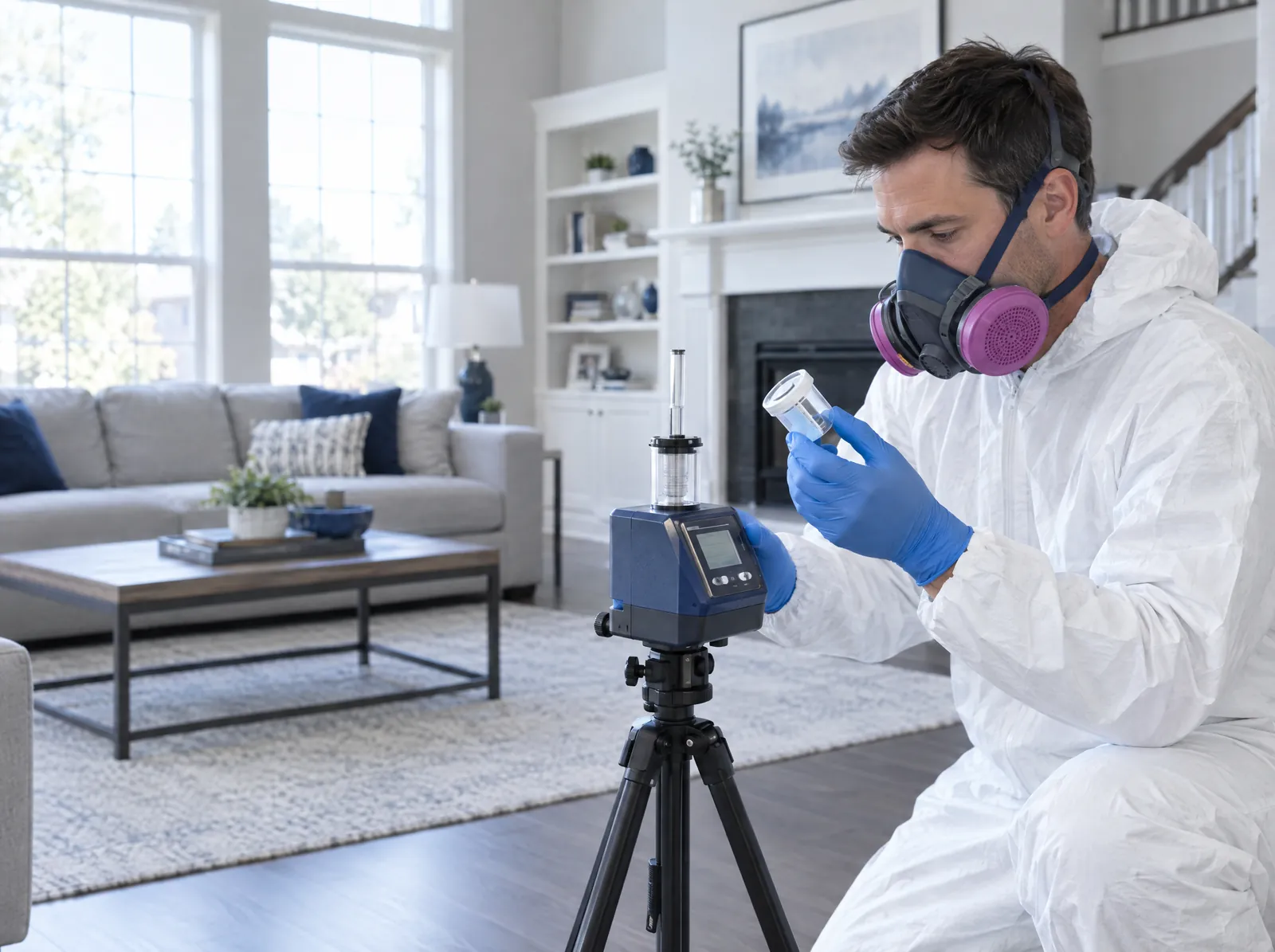
How mycotoxins get into the air
A mycotoxin is a molecule, not a particle you could see. It doesn’t turn into a gas at room temperature, so it needs something to ride on. In a home, three things do that job:
- Spores. Some mold species carry toxins on or in their spores.
- Mold fragments. Pieces of the mold’s threadlike body break off, and many are smaller than spores.
- House dust. Toxin-carrying material settles into dust, and dust gets stirred back up.
Those particles don’t stay aloft forever. Larger ones settle within minutes to hours in still air, while the finest can linger longer. What sends them back up is disturbance: walking across carpet, the HVAC fan starting, dry sweeping, a non-HEPA vacuum, or someone scraping at mold without containment. For more on how spores and toxins differ, see the difference between mold spores and mycotoxins.
What research has found
Studies of water-damaged buildings have detected mycotoxins in air samples. One widely cited line of research on buildings with Stachybotrys growth found trichothecene mycotoxins on airborne particles, including particles smaller than intact spores. That matters because smaller particles stay airborne longer and can reach deeper into the lungs than larger ones.
What research hasn’t done is set a safe or unsafe airborne level for homes. There are no federal standards for mycotoxins in indoor air. Measured levels also swing widely depending on what was happening in the room when the sample was taken. A reading taken during demolition and one taken in a quiet, closed room can look like two different houses.
It’s also worth separating mycotoxins from the musty smell. The smell comes from gases growing mold releases. Those gases are airborne on their own, but they aren’t mycotoxins, and smelling them doesn’t tell you how much toxin is in the air.
Why air tests often miss them
An air sample captures a short window, often a few minutes, and toxin levels in air are usually low. If nothing was disturbed during sampling, the result can look clean in a house with a real problem. Settled dust tells a longer story, because it collects what has been floating around for months. That’s why mycotoxin testing for homes usually relies on dust. Air sampling still has a role for mold spores, which is covered on our air quality testing page.
Reducing what’s in the air
- Stop the source. Mold that keeps growing keeps adding particles.
- Don’t disturb moldy material without containment and negative air pressure.
- Replace dry dusting and sweeping with HEPA vacuuming and damp wiping.
- Check the HVAC system, since it can pick up and redistribute dust through the whole house.
- Run a HEPA purifier in bedrooms. HEPA filters capture the particles that carry mycotoxins, even though they can’t reach settled dust.
When to call a professional
If you’re planning to open walls, pull carpet or clean a moldy area yourself, that’s when airborne levels are most likely to spike. Talk to someone who works under containment first. The same goes if a musty smell spreads when the heat or air conditioning runs. A professional inspection and dust testing can show where the particles are coming from.
We test and clean buildings. We don’t diagnose or treat medical conditions, and air or dust results are not medical results. If you have symptoms, please work with a doctor, and we’ll share our data with them if you’d like.
We're done when the lab says so.
Every remediation ends with clearance testing, and our work is backed by a complete-removal guarantee. We don't close a job on a failed result.
Talk to a specialistWondering what's in your air?
We'll explain which tests fit your situation, from air sampling to settled-dust mycotoxin panels.
- (833) 772-6653
- info@americanmoldexperts.com
- Open 7 days, 8am to 8pm