
What is the difference between mold spores and mycotoxins?
Short answer
Mold spores are microscopic reproductive cells that molds release to spread, and they can grow into new mold when they land somewhere damp. Mycotoxins are chemical compounds that some molds produce. They aren't alive and can't grow. Spores can carry mycotoxins, but the toxins also sit on mold fragments and dust, and they remain after spores are dead or gone.
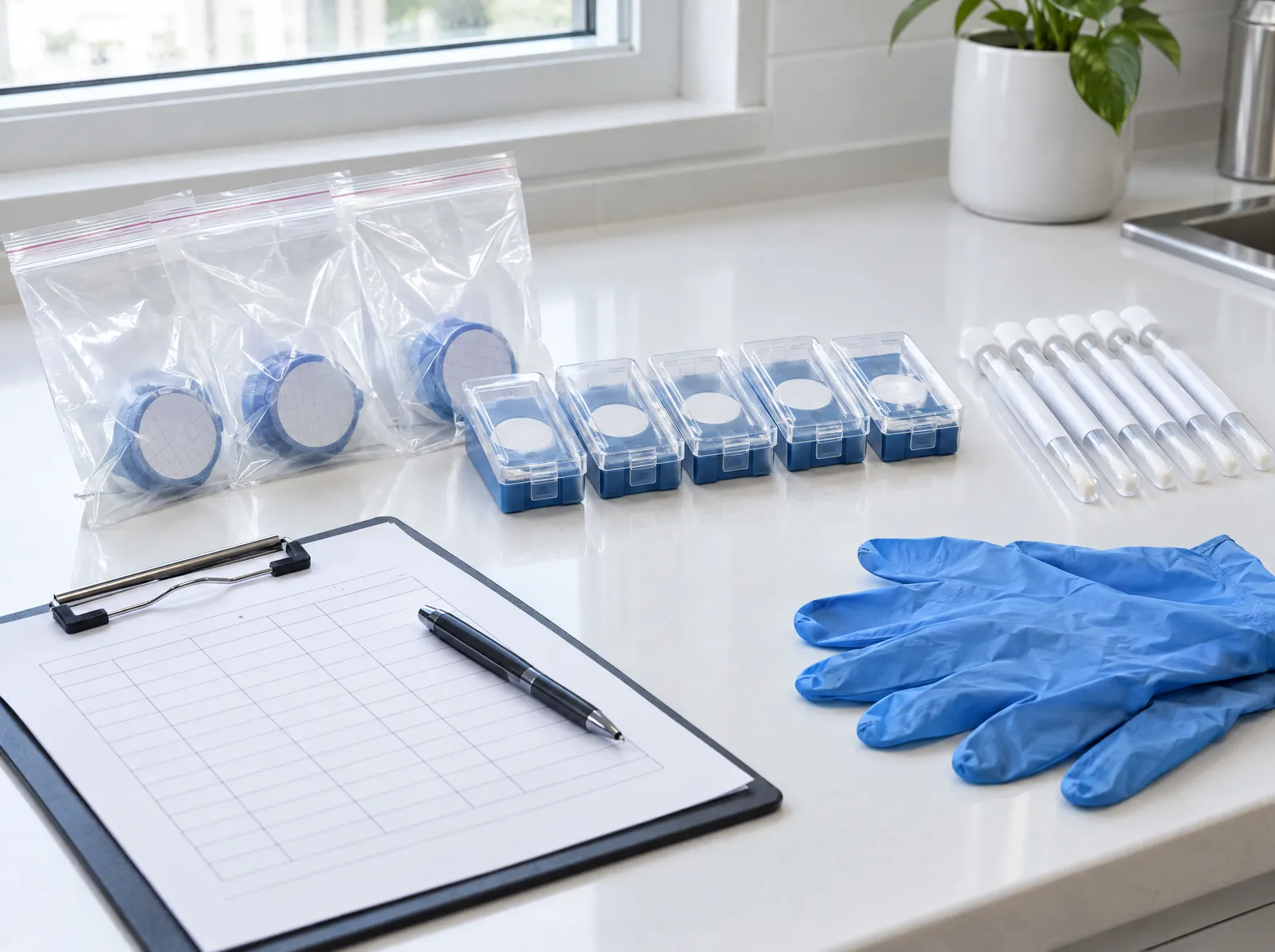
Spores, in plain terms
A spore is how a mold spreads, a little like a seed. Most are only a few microns across, far too small to see individually. Outdoor air carries them all the time, so every house has some. A spore that lands on a damp surface with something to feed on can start a new colony. One that lands somewhere dry may sit dormant for a long time.
Spores can be counted, identified and cultured. They can also be killed. A dead spore can’t grow, but it’s still a particle, and it still carries whatever was on or in it.
Indoor spore results are usually compared with an outdoor sample taken at the same time. When indoor counts run higher than outside, or the mix of molds is different, it suggests something is growing inside the house.
Mycotoxins, in plain terms
Mycotoxins are molecules. Molds make them as by-products, and not every mold makes them. Whether a given colony produces toxins depends on the species, the strain, what it’s growing on and how wet it is. The toxins end up inside and on spores, on the fine fragments of mold that break off as growth dries, and on the surrounding material and dust.
Because they aren’t alive, mycotoxins can’t be killed, don’t reproduce and don’t need moisture to persist. They’re stable, which is why they can outlast the mold that made them. Many mycotoxins have been identified, most of them through food and agricultural research. Home testing panels focus on a smaller set tied to indoor molds, such as trichothecenes, ochratoxin A, gliotoxin and aflatoxins.
Side by side
| Mold spores | Mycotoxins | |
|---|---|---|
| What it is | Living reproductive cell | Chemical compound |
| Can it grow? | Yes, with moisture and food | No |
| Can it be killed? | Yes | No. It has to be removed or broken down. |
| Found in | Air, dust, surfaces | Spores, mold fragments, dust, porous materials |
| Usually measured by | Air spore traps, tape lifts, dust DNA tests | Mycotoxin panel on settled dust or surfaces |
| Normal in homes? | Yes, at some level | No accepted normal level for house dust |
Why the difference matters for testing
An air sample tells you about spores in the air during the few minutes it ran. It says little about toxins sitting in the dust on a bookshelf or inside an air handler. A home can have spore counts that look unremarkable and still have mycotoxins built up from past growth. That’s why spore count results are best read as one piece of the picture.
The reverse is also true: high spore counts show mold activity, but they don’t tell you which toxins, if any, are present. A mycotoxin panel on settled dust answers that question directly, and dust DNA testing links the toxins back to the molds likely producing them.
Why it matters for cleanup
Most mold products are designed to kill spores and growth. That’s a reasonable goal for living mold, but it leaves the toxins in place. Effective cleanup removes the particles themselves, spores and fragments included, then treats what remains and tests to confirm. How those particles move through a house is covered in whether mycotoxins are airborne.
We test for and remove mold and mycotoxins in buildings. We don’t diagnose or treat medical conditions, and nothing here is medical advice. If you’re concerned about exposure, please talk with a doctor. With your permission, we’ll share our results with them.
We're done when the lab says so.
Every remediation ends with clearance testing, and our work is backed by a complete-removal guarantee. We don't close a job on a failed result.
Talk to a specialistSpore count normal, but still worried?
A spore count and a mycotoxin panel answer different questions. Tell us what testing you've had and we'll explain what else might be worth checking.
- (833) 772-6653
- info@americanmoldexperts.com
- Open 7 days, 8am to 8pm