
Mycotoxin profiles
Trichothecenes and Stachybotrys in homes
The mycotoxin family behind most black mold worry: where it comes from, how it's found and how it's removed.
What are trichothecenes?
Trichothecenes are a large family of mycotoxins made by several molds, including Stachybotrys chartarum and some Fusarium species. In homes, the ones that matter most are the macrocyclic trichothecenes, such as satratoxins, produced by some strains of Stachybotrys growing on wet drywall paper and other cellulose. They're chemically stable, travel on dust and mold fragments, and can be detected with a mycotoxin panel on settled dust.
Why trichothecenes are easy to underestimate
Stachybotrys doesn't behave like the molds an air test catches easily. Its spores form in sticky clusters and are relatively heavy, so they often don't show up in large numbers in the air even when there's a lot of growth behind a wall. People read a quiet air test as good news. Meanwhile, the toxins it produced can sit in the drywall and in the dust, and research has detected trichothecenes on particles smaller than spores.
Sound familiar?
- An air test found little or no Stachybotrys, but you know that wall was wet for months.
- Dust testing flagged Stachybotrys and you don't know what it means for toxins.
- A previous company cut out the stain but left the surrounding drywall and dust.
- You've read frightening things about black mold and want the facts instead.
We do it differently.
| A spore-count approach | A trichothecene-aware approach | |
|---|---|---|
| What it looks for | Airborne Stachybotrys spores | Stachybotrys DNA in dust and trichothecenes on a mycotoxin panel |
| Where it looks | Room air | Long-wet cellulose, wall cavities and settled dust |
| Removal scope | The visible stain | All affected cellulose material, under containment |
| Dust | Left in place | HEPA-cleaned throughout the affected zone |
| Proof | The air looks normal | A repeat panel compared with the starting numbers |

Why families trust us with their homes
-
Family-owned since 2008
A multigenerational family business. Not a franchise, not a private-equity rollup.
-
Credentialed where it isn't required
Indiana doesn't license mold remediators. We hold IICRC, CMR, CRMI and CCMI credentials anyway.
-
Called on as experts
Attorneys bring us into legal cases involving mold and mycotoxins.
-
Lab results in 24 to 48 hours
Every inspection comes with a written report, color photos and lab results.
- IICRC Certified Firm
- CMR
- CRMI
- CCMI
- BBB A+ Accredited
- NAMRI
- IAQA
- NORMI
- AMMA
- PMII
The AME Clearance Method
How we find and remove trichothecene sources
Stachybotrys needs water for a long time, so the work starts with finding where that happened.
Talk to a specialist-
Trace the long-term water
Stachybotrys grows where cellulose stayed wet for a long stretch: behind a leaking supply line, under a window that has leaked for years, along the base of a basement wall. We map moisture to find those places.
-
Test dust for DNA and toxins
Dust DNA testing shows whether Stachybotrys has been growing. A mycotoxin panel shows whether trichothecenes are present. Together they show whether the two line up.
-
Contain before opening walls
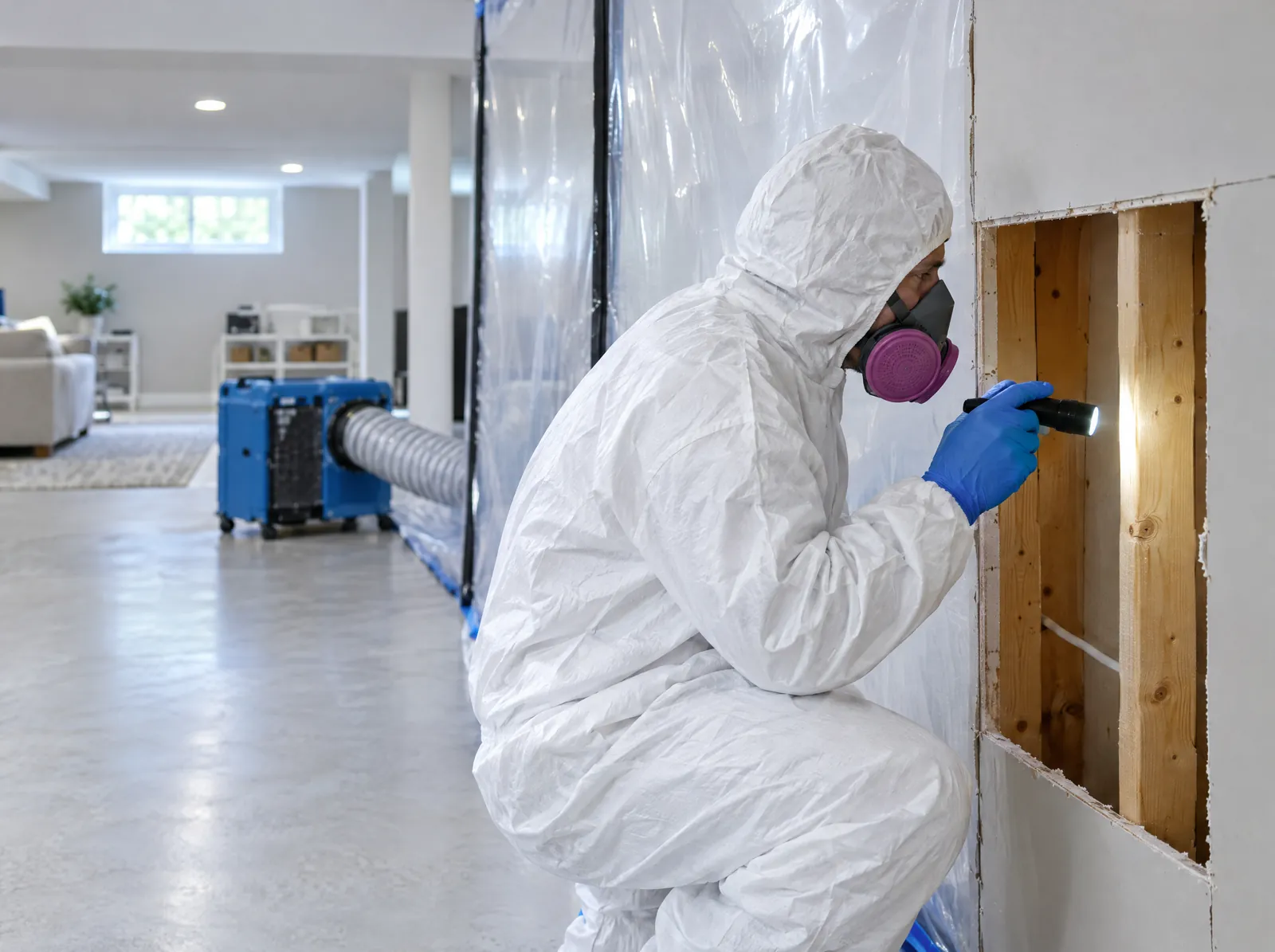
Cutting into moldy drywall releases fragments. Containment and negative air go up before anything is opened.
-
Remove the affected cellulose
Drywall, paper-faced insulation, ceiling tile and cardboard that grew Stachybotrys are bagged and removed. Framing that's structurally sound is cleaned and kept.
-
Clean out the dust
HEPA vacuuming and damp wiping inside containment and in the rooms around it remove the fine particles trichothecenes ride on.
-
Treat and verify
Framing and cavities get an enzyme treatment designed to break mycotoxins down, then the same panel is repeated to confirm the result.
What a trichothecene project includes
- Moisture mapping focused on long-wet cellulose materials
- Dust DNA testing for Stachybotrys and related molds
- A mycotoxin panel that includes trichothecenes
- Containment with negative air before any wall is opened
- Removal of affected drywall, insulation and ceiling tile
- HEPA cleaning inside and around the work area
- Enzyme treatment of framing and cavities
- A repeat panel from matching locations for clearance
- A written report with before and after results

Proof you can hold in your hands
When we finish, you don't get a handshake and a promise. You get the paperwork your family, your doctor, your insurer or your buyer can rely on.
Inspection report
What we found, where it is coming from, with color photos.
Written remediation plan
Scope, timeline and what will and won't be removed, before work starts.
Clearance lab report
Air, surface and mycotoxin results after the work is done.
A report for your doctor
With your permission, we share results directly with your care team.
Trichothecenes, explained
A large family with a shared core
Trichothecenes are a group of related compounds that share the same core ring structure, including a small epoxide group that researchers consider central to their biological activity. Chemists sort them into types. The simpler ones, such as T-2 toxin and deoxynivalenol (sometimes called vomitoxin), come mostly from Fusarium molds on grain crops and are a food and feed issue.
The macrocyclic trichothecenes carry an extra large ring across the core. This group includes satratoxins, roridins and verrucarins, and it’s produced by Stachybotrys and a few other molds, such as Myrothecium species. When an environmental dust panel lists trichothecenes, it’s usually the macrocyclic group it’s looking for.
| Compound | Group | Main sources |
|---|---|---|
| Satratoxins G and H | Macrocyclic | Some strains of Stachybotrys chartarum |
| Roridins and verrucarins | Macrocyclic | Stachybotrys and Myrothecium species |
| T-2 toxin | Simple (type A) | Fusarium, mainly on grain |
| Deoxynivalenol | Simple (type B) | Fusarium, mainly on grain |
Stachybotrys: the main indoor source
Stachybotrys chartarum is a slow-growing mold that needs material to stay wet for a long time, and it prefers cellulose. That’s why it turns up on the paper face of drywall, on ceiling tile, on wet cardboard and on wood that has been soaked for weeks. On drier materials, faster molds usually beat it to the space. It’s typically dark green to black, looks slimy when wet and can turn powdery as it dries. For a closer look at the organism itself, see what Stachybotrys is.
An important detail often left out: not every Stachybotrys chartarum strain makes macrocyclic trichothecenes. Research has identified two chemical types, one that produces satratoxins and one that produces atranones instead. Growth conditions also affect how much toxin a strain makes. Finding Stachybotrys tells you to test for trichothecenes. It doesn’t tell you the answer.
How trichothecenes spread through a house
Because Stachybotrys spores clump together in a sticky mass, they’re less likely to float off than the dry spores of many other molds. That doesn’t keep the toxins in place. Growth dries out, crumbles and sheds fragments. Walls get opened during repairs. Dust from the area gets carried on shoes, pets and air currents, and an HVAC system can move it through the whole house. Research on Stachybotrys has found trichothecenes on particles smaller than spores, which helps explain why dust panels can pick them up in rooms far from the wall where the mold grew.
Testing for trichothecenes
Two tests work together. Dust DNA testing, such as ERMI or HERTSMI-2, shows whether Stachybotrys has been growing in the home. A mycotoxin panel on settled dust shows whether trichothecenes are present. Some labs measure macrocyclic trichothecenes as a group with an antibody-based test, while others measure individual compounds with mass spectrometry, so check the method before comparing results. Our page on mycotoxin testing for homes explains the sampling in detail.
What the science does and doesn’t settle
Trichothecenes have been studied heavily in laboratories, and they’re among the most studied mycotoxins. How much household-level exposure matters for people is a harder question, and it’s still debated. Stachybotrys drew national attention after a cluster of infant illnesses in Cleveland in the 1990s. The CDC later reviewed that investigation and concluded that the link to the mold had not been proven. We don’t take a position on medical questions. We treat trichothecenes the way we treat any mycotoxin in a building: find the source, remove it and prove the result.
Getting them out
Removal follows the method above: fix the water, contain the area, take out the affected cellulose, capture the dust and treat what’s left. For that last step we use plant-based enzyme treatments from US Enzyme. More on that approach is on our enzyme mold remediation page.
We remove mold and mycotoxins from buildings. We don’t diagnose or treat medical conditions, and this page isn’t medical advice. If you have symptoms, please work with a doctor. With your permission, we’re glad to share test results and our plan with them.
Common questions
Have a question that isn't here? Call a specialist
Does all black mold produce trichothecenes?
No. Stachybotrys chartarum strains fall into two chemical groups. One can produce macrocyclic trichothecenes such as satratoxins. The other produces a different set of compounds called atranones instead. Growth conditions matter too, and many dark molds aren't Stachybotrys at all.
Are trichothecenes airborne?
They don't evaporate. They travel on particles: spores, mold fragments and dust. Those particles become airborne when growth is disturbed, when dust is stirred up, or when an HVAC system moves air across a contaminated area.
Can trichothecenes be cleaned off drywall?
Not reliably from drywall that grew mold. The paper face and gypsum are porous, and growth goes into the material, not just onto it. Affected drywall is removed. Hard surfaces and sound framing can be cleaned and treated.
Does bleach break down trichothecenes?
Laboratory decontamination work has shown that strong hypochlorite solutions, often with added alkali and long contact times, can degrade some trichothecenes. Household bleach sprayed on building materials isn't that, and it doesn't remove the dust or the material holding the toxins.
Where do Fusarium trichothecenes fit in?
Fusarium makes simpler trichothecenes, such as deoxynivalenol and T-2 toxin, that are mainly a concern in grain crops. Fusarium can grow on very wet materials indoors, for example after flooding, but Stachybotrys is the source most often discussed in homes.
How long do trichothecenes last in a house?
They're chemically stable, and there's no dependable timeline for them to break down on their own in dust or building materials. Plan on removing them rather than waiting them out.
We're done when the lab says so.
Every remediation ends with clearance testing, and our work is backed by a complete-removal guarantee. We don't close a job on a failed result.
Talk to a specialistWorried about Stachybotrys in your walls?
Tell us about the water history and what testing has shown so far. A specialist will call you back to talk through next steps.
- (833) 772-6653
- info@americanmoldexperts.com
- Open 7 days, 8am to 8pm