
Stachybotrys and other dark molds
Black mold removal, without the panic
What black mold really is, why it usually can't be wiped off, and how it's removed safely.
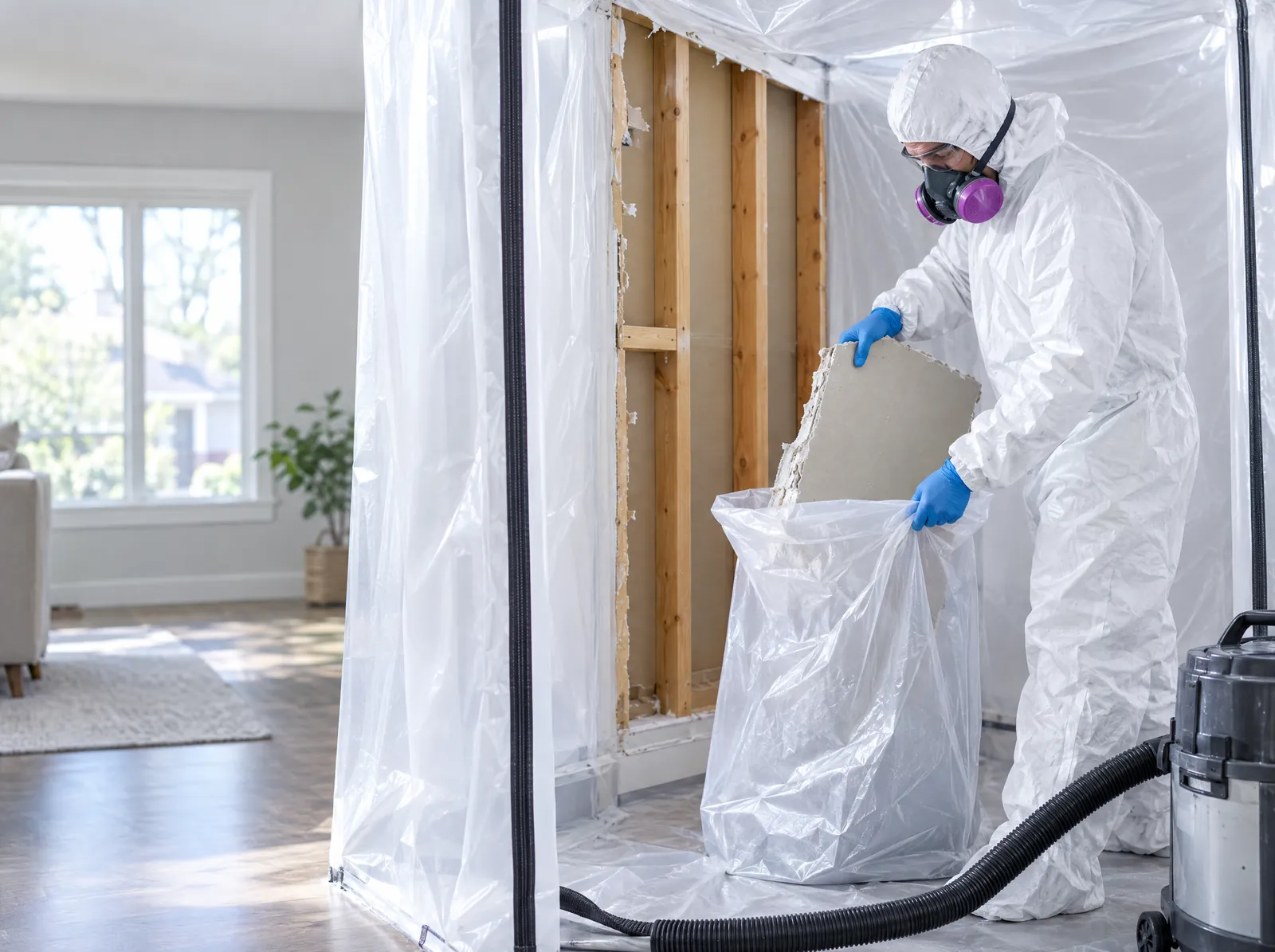
What does black mold removal involve?
Black mold removal means taking out dark mold growth, most often Stachybotrys chartarum, together with the wet material it is growing in, under containment so spores and fragments don't spread through the house. Stachybotrys grows into drywall paper and other cellulose rather than sitting on top, so it rarely wipes away. A proper job fixes the water source, removes affected porous materials, HEPA cleans and treats the framing, and ends with clearance testing.
When a color becomes a diagnosis
The words black mold push people toward one of two bad decisions. Some panic and tear out far more than they need to, spreading dust as they go. Others grab a spray bottle of bleach, wipe the stain until it fades, and paint over it. Neither answers the two questions that matter: which mold is it, and how long has the material been wet? Color can't tell you either one. A sample and a moisture meter can.
Sound familiar?
- You found dark spots behind a vanity or under a sink and don't know how worried to be.
- Someone told you it's toxic black mold without testing anything.
- You bleached it once and the stain is back.
- You don't know whether the family should stay in the house.
We do it differently.
| The spray-and-paint approach | AME black mold removal | |
|---|---|---|
| Identification | Guessed from the color | Sampled and identified by a lab |
| Wet drywall and paper | Bleached and painted over | Cut out and bagged inside containment |
| Water source | Not investigated | Traced and corrected before cleanup |
| Mycotoxins | Never considered | Addressed in cleaning and tested when warranted |
| Finish line | The stain is gone | Clearance testing with a lab report |

Why families trust us with their homes
-
Family-owned since 2008
A multigenerational family business. Not a franchise, not a private-equity rollup.
-
Credentialed where it isn't required
Indiana doesn't license mold remediators. We hold IICRC, CMR, CRMI and CCMI credentials anyway.
-
Called on as experts
Attorneys bring us into legal cases involving mold and mycotoxins.
-
Lab results in 24 to 48 hours
Every inspection comes with a written report, color photos and lab results.
- IICRC Certified Firm
- CMR
- CRMI
- CCMI
- BBB A+ Accredited
- NAMRI
- IAQA
- NORMI
- AMMA
- PMII
The AME Clearance Method
How we remove black mold, step by step
Dark mold on drywall usually means water has been there a while. The steps below deal with the growth, the water and the dust, in that order.
Talk to a specialist-
Identify it
A tape-lift or surface sample tells us whether it's Stachybotrys, Cladosporium or something else, and air sampling shows whether it has spread beyond the visible patch.
-
Trace the water
Stachybotrys needs material that stayed wet for a long time. We use moisture meters and thermal imaging to find the leak or condensation that fed it.
-
Contain before cutting
Plastic barriers, a zippered entry and HEPA air machines under negative pressure go up before a single piece of drywall comes off.
-
Remove the cellulose
Drywall, paper backing, ceiling tile or cardboard with growth in it is cut past the visible edge, bagged inside the containment and carried out sealed.
-
Clean and treat the framing
Studs and sheathing are HEPA vacuumed, wiped and treated with plant-based enzyme products designed to break down mold and the mycotoxins Stachybotrys can leave behind.
-
Verify the result
Once everything is dry, we sample again. Containment stays up until the lab results pass, and you keep the report.
What a black mold project includes
- Lab identification of the mold, not a guess by color
- Moisture mapping to find the source
- A written scope showing what will be removed and why
- Containment with negative air before demolition
- Removal and sealed bagging of affected drywall and paper
- HEPA vacuuming and detailed wiping of framing
- Enzyme treatment of exposed wood and cavities
- HEPA air scrubbing throughout the work
- Clearance testing, with mycotoxin testing when warranted
- A lab report you keep

Proof you can hold in your hands
When we finish, you don't get a handshake and a promise. You get the paperwork your family, your doctor, your insurer or your buyer can rely on.
Inspection report
What we found, where it is coming from, with color photos.
Written remediation plan
Scope, timeline and what will and won't be removed, before work starts.
Clearance lab report
Air, surface and mycotoxin results after the work is done.
A report for your doctor
With your permission, we share results directly with your care team.
Black mold removal, explained
What people mean by “black mold”
Black mold isn’t a scientific category. It’s a nickname, and most of the time it refers to Stachybotrys chartarum, a greenish-black mold that grows on water-damaged building materials. The trouble is that plenty of other molds are dark too. When we sample a black stain, the lab result is just as likely to come back as one of these:
| Mold | Typical appearance | Where it tends to grow |
|---|---|---|
| Stachybotrys chartarum | Greenish-black, slimy when wet, sooty when dry | Drywall paper, ceiling tile, cardboard and other cellulose that stayed wet a long time |
| Cladosporium | Olive green to black, often speckled | Window frames, bathroom surfaces, the back of cool exterior walls |
| Alternaria | Dark gray to black, fuzzy | Showers, window sills, damp carpet |
| Aspergillus niger | Black with a powdery texture | Damp surfaces, dust and HVAC components |
The distinction matters. A few spots of Cladosporium on a bathroom window frame is a cleaning job. Stachybotrys growing across the back of a drywall panel is a sign that water has been sitting in that wall for a long time, and it calls for removal under containment. The only way to know which one you have is to sample it.
Why Stachybotrys points to a long-term leak
Many molds will grow on a surface that is merely damp. Stachybotrys is fussier. It needs a food source rich in cellulose and a lot of water for an extended period, which is why it shows up behind leaking toilets and dishwashers, under sinks with slow drips, on the back side of drywall below a failed window, and in basements that flood repeatedly. Finding it tells you something useful: there is, or was, a persistent moisture problem nearby. Removing the growth without finding that problem only resets the clock.
What to do if you find it
- Leave it alone. Scraping, scrubbing or pulling at damp drywall releases spores and fragments into the air.
- Skip the bleach. It won’t reach growth inside the paper, and it changes what a sample will show. Our answer on whether bleach kills mold on drywall explains why.
- Stop the water if you can. Shut off a leaking supply line or fixture.
- Close the room off. Shut the door and keep children and pets out.
- Take photos. They help with insurance and with planning the work.
Why it usually has to be cut out
Drywall is a gypsum core wrapped in paper, and the paper is exactly what Stachybotrys feeds on. By the time you can see growth on the face of a wall, it has typically grown through the paper and often across the back side facing the cavity. No cleaner reaches that. The affected section is cut out past the visible edge, until moisture readings and inspection show clean, dry material, and the pieces are bagged inside containment before they’re carried through the house. Solid wood framing behind it is a different story: surface growth on studs can usually be HEPA vacuumed, wiped and treated rather than replaced.
The mycotoxin question
Stachybotrys is known for producing trichothecenes, a group of mycotoxins that stay behind after the mold is dead. That’s the main reason we don’t treat black mold removal as finished when the wall is replaced. Fine dust from the work area gets HEPA cleaned, exposed framing is treated with plant-based enzyme products designed to break down mold and mycotoxins, and we test settled dust for toxins when the situation calls for it. We use products from US Enzyme for that step. Read more about trichothecenes and the difference between black mold and mycotoxins.
In Indiana? See black mold removal in Indiana.
We remove mold and mycotoxins from buildings. We don’t diagnose or treat medical conditions. If you or anyone in your home has symptoms, please work with a doctor. With your permission, we’re glad to share test results and our plan with them.
Common questions
Have a question that isn't here? Call a specialist
Is black mold more dangerous than other mold?
Stachybotrys chartarum, the mold most people mean, can produce mycotoxins called trichothecenes, which is why it gets extra attention. But many dark molds aren't Stachybotrys, and the CDC's position is that any indoor mold growth should be removed regardless of type. Testing tells you what you have so the response fits the problem.
Can I remove black mold myself?
If it's a small patch on a hard surface like tile, glass or a sealed window frame, and the moisture is fixed, you can usually clean it with detergent and water while wearing gloves, goggles and an N95. If it's growing in drywall, ceiling tile or anything made of paper, or if the area is larger than about 10 square feet, it needs to be removed under containment.
Does bleach kill black mold?
On a hard, non-porous surface bleach can kill surface mold. On drywall or wood it doesn't reach growth inside the material, the water in it can soak in, and it leaves dead mold and mycotoxins behind. Removal, not bleaching, is what fixes mold growing in porous materials.
Is every black-looking mold Stachybotrys?
No. Cladosporium, Alternaria, Aspergillus niger and several other common molds are dark green, gray or black. Stachybotrys is usually slimy when wet and sooty when dry, and it favors cellulose that has been wet for a long time. Only a lab sample can confirm which one it is.
Should black mold be tested before it's removed?
We recommend it. A sample confirms what you're dealing with, and air testing shows whether spores have spread beyond the visible area. That baseline also gives the clearance test something to be compared against at the end.
Do we need to leave the house during black mold removal?
Often not. With proper containment, many families stay in the unaffected parts of the home. If anyone has health concerns or a doctor has advised against staying, it makes sense to be elsewhere until clearance testing passes.
Will black mold come back after removal?
Not if the water source is corrected and the affected material is removed rather than covered. Stachybotrys regrowth almost always means the leak or condensation that fed it is still active.
We're done when the lab says so.
Every remediation ends with clearance testing, and our work is backed by a complete-removal guarantee. We don't close a job on a failed result.
Talk to a specialistFound dark mold? Talk it through first
Tell us where it is and what it's growing on. A specialist will call you back and help you decide what to do next.
- (833) 772-6653
- info@americanmoldexperts.com
- Open 7 days, 8am to 8pm