
Hidden growth, found without guesswork
Mold inside walls: finding it before opening it
Most hidden mold can be located without demolition. Then we open only the wall that needs it.
How do you deal with mold inside walls?
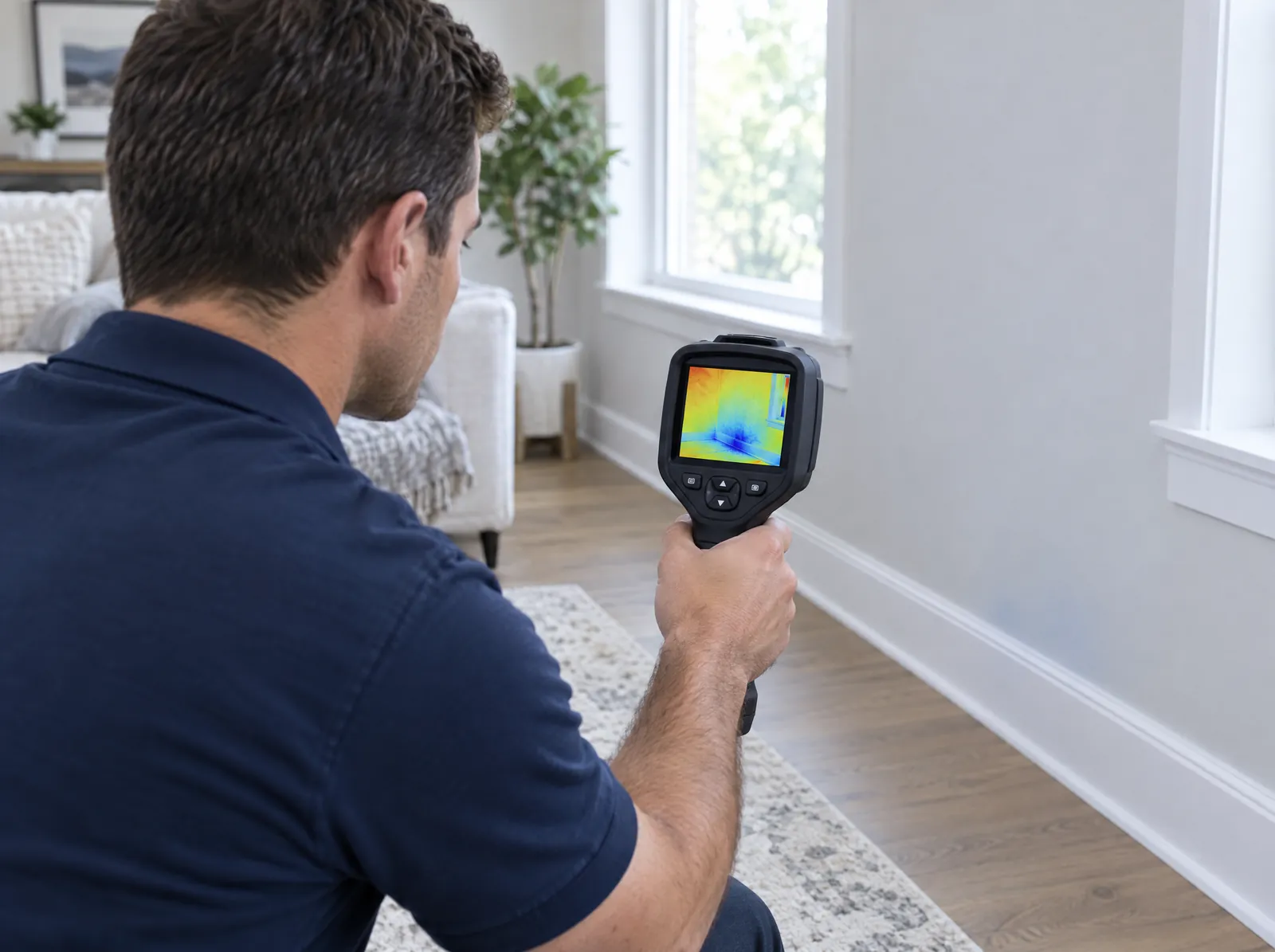
Mold inside walls is first located with moisture meters, thermal imaging, a borescope and wall cavity air sampling, so only the affected section is opened. That section is then opened under containment, drywall and insulation with growth are removed, framing is HEPA cleaned and treated, and the leak or condensation behind it is repaired. Clearance testing confirms the cavity is clean and dry before the wall is closed up again.
The two ways hidden mold gets handled badly
Mold inside a wall cavity puts homeowners between two bad options. One contractor wants to open walls room by room until something turns up, which is expensive and spreads dust along the way. Another says there's nothing to worry about because the wall surface looks clean. Neither one has measured anything. Hidden mold can be found with tools that don't require demolition, and that information is what should decide which wall comes open, and how much of it.
Sound familiar?
- You smell mustiness in one room but can't see any mold.
- Paint is bubbling or the baseboard is swelling along one wall.
- There was a leak inside the wall and it was never opened up.
- You've been told to open every wall on the floor to be sure.
We do it differently.
| Guess-and-open | AME wall cavity remediation | |
|---|---|---|
| Finding it | Open walls until something turns up | Meters, thermal imaging, borescope and cavity sampling |
| How much is opened | Whole rooms | The affected section, past the edge of the growth |
| Dust control | Drop cloths | Containment with negative air before cutting |
| Cause | Patched and painted | Leak or condensation found and repaired |
| Closing the wall | As soon as it's dry-looking | After clearance testing passes |

Why families trust us with their homes
-
Family-owned since 2008
A multigenerational family business. Not a franchise, not a private-equity rollup.
-
Credentialed where it isn't required
Indiana doesn't license mold remediators. We hold IICRC, CMR, CRMI and CCMI credentials anyway.
-
Called on as experts
Attorneys bring us into legal cases involving mold and mycotoxins.
-
Lab results in 24 to 48 hours
Every inspection comes with a written report, color photos and lab results.
- IICRC Certified Firm
- CMR
- CRMI
- CCMI
- BBB A+ Accredited
- NAMRI
- IAQA
- NORMI
- AMMA
- PMII
The AME Clearance Method
How we find and remove mold inside walls
Six steps. The first two exist so the third one is as small as possible.
Talk to a specialist-
Measure from the outside
Moisture meters and thermal imaging trace wet areas behind the drywall and show how far they extend.
-
Look and sample inside
A small hole lets us look into the cavity with a borescope and draw an air sample from inside the wall, compared against the room.
-
Contain, then open
Containment with negative air goes up before cutting. We open the affected section and extend it only as far as growth and moisture go.
-
Remove and clean
Moldy drywall and insulation are bagged. Studs, plates and sheathing are HEPA vacuumed, wiped and treated with plant-based enzyme products.
-
Fix the cause
The plumbing leak, window flashing or condensation problem is repaired while the cavity is open and the source is easy to reach.
-
Verify before closing
Moisture readings and clearance testing confirm the cavity is dry and clean before new insulation and drywall go in.
What a wall cavity project includes
- Moisture mapping and thermal imaging
- Borescope inspection through a small access hole
- Wall cavity air sampling compared with room air
- A written scope showing which sections will be opened
- Containment with negative air before cutting
- Removal of affected drywall and insulation
- HEPA cleaning and enzyme treatment of framing
- Clearance testing before the wall is closed
- A lab report you keep

Proof you can hold in your hands
When we finish, you don't get a handshake and a promise. You get the paperwork your family, your doctor, your insurer or your buyer can rely on.
Inspection report
What we found, where it is coming from, with color photos.
Written remediation plan
Scope, timeline and what will and won't be removed, before work starts.
Clearance lab report
Air, surface and mycotoxin results after the work is done.
A report for your doctor
With your permission, we share results directly with your care team.
Mold inside walls, explained
How water gets inside a wall
Wall cavities are closed, dark and have little air movement, so once they get wet they stay wet. The water usually arrives one of five ways:
- Plumbing. Pinhole leaks in supply lines, slow drain leaks, and failed seals at shower valves and tub spouts. Walls shared with bathrooms and kitchens are the usual suspects.
- Appliance lines. Refrigerator ice-maker lines, dishwasher connections and washing machine boxes can drip for months without anyone noticing.
- Windows and doors. Missing or failed flashing lets rain into the wall below the window, where it runs down onto the bottom plate.
- Roof and ice-dam leaks. Water can enter at the roof and travel down inside an exterior wall, showing up a floor or two below where it came in.
- Condensation. Warm, humid indoor air reaching a cold exterior wall, or cold air conditioning ducts in a wall, can wet the cavity from the inside.
Finding it without demolition
Each tool answers a different question, and together they usually narrow the search to one section of one wall.
| Tool | What it shows | Its limits |
|---|---|---|
| Moisture meter | Whether drywall and framing are wet right now, and how far the wet area extends | A dry wall can still hold old growth from a past leak |
| Thermal camera | Temperature differences that often indicate damp areas or missing insulation | It shows temperature, not mold; readings need confirming |
| Borescope | A direct look inside the cavity at the back of the drywall, insulation and framing | Only sees what’s near the access hole |
| Wall cavity air sample | Whether spore levels inside the wall are elevated compared with the room | Results depend on careful technique and a lab |
Our answer on whether you can test for mold behind walls goes into cavity sampling in more detail.
Opening the wall the right way
Cutting into a wall with mold inside it is the moment most likely to spread contamination, so containment comes first. We seal the work area, put it under negative pressure with HEPA air machines, and cover nearby vents and doorways. The first cut is usually a small inspection opening. From there we extend the cut until we reach clean, dry framing and drywall on every side, rather than stopping at a line drawn in advance. Pieces are bagged inside the containment, and a HEPA vacuum follows the saw so dust doesn’t build up in the cavity.
When the drywall can stay
Not every wall with a moisture history needs to come apart. If a small leak was caught and dried quickly, inspection shows no growth on the back of the drywall, and cavity sampling comes back normal, the right answer may be to fix the leak and monitor. When growth is limited to the framing, some cavities can be cleaned and treated through small access openings with plant-based enzyme products. When the drywall itself has growth in the paper, though, it comes out. Our answer on whether you have to remove drywall with mold explains how that decision gets made.
Before the wall gets closed
Once drywall and insulation go back in, whatever is left in the cavity is sealed in with them. So the cavity has to pass two checks first: moisture readings that show the framing is dry, and clearance testing that shows it’s clean. It’s also the time to confirm the leak repair holds. If the leak can’t be run and checked, we’ll say so. For what the clearance step involves, see post-remediation verification. For help in Indiana, see mold remediation in Indiana.
We remove mold and mycotoxins from buildings. We don’t diagnose or treat medical conditions. If anyone in your home has symptoms, please work with a doctor. With your permission, we’re glad to share test results and our plan with them.
Common questions
Have a question that isn't here? Call a specialist
How can you tell if there is mold inside a wall?
Common signs are a musty smell that's strongest near one wall, bubbling or peeling paint, staining, warped or swollen baseboards, and a history of leaks. Moisture readings and thermal imaging show whether the wall is wet, and a cavity air sample shows whether mold is growing inside it.
Can you test for mold behind walls without opening them?
Mostly, yes. A wall cavity air sample is drawn through a hole about the size of a nail, and a borescope camera can look inside through a slightly larger one. These tell you whether there is growth before anyone cuts a wall open.
Do you have to remove drywall if there is mold inside the wall?
If mold is growing on the back of the drywall or in the insulation, those need to come out. If testing shows the drywall is clean and growth is limited to framing, some jobs can be handled by treating the cavity through small openings. We decide based on what testing and inspection show.
Can mold inside walls spread to other rooms?
It can. Wall cavities connect to other cavities, floor systems and attics, and air moves through gaps around outlets, switches and baseboards. That's one reason we sample room air as well as the cavity.
Can I just paint over mold on a wall?
No. Paint, including mold-resistant paint, covers the stain without removing the growth or fixing the moisture, and the mold keeps growing underneath. It also hides the problem from the next inspector.
What causes mold inside walls?
Usually a slow plumbing leak, water entering around a window or door, a roof or ice-dam leak running down the cavity, or condensation on the inside of cold exterior walls. Appliance lines behind refrigerators and dishwashers are common culprits.
We're done when the lab says so.
Every remediation ends with clearance testing, and our work is backed by a complete-removal guarantee. We don't close a job on a failed result.
Talk to a specialistSmell it but can't see it?
Tell us which room and what's changed. A specialist will call you back and explain how we'd find it without tearing walls apart.
- (833) 772-6653
- info@americanmoldexperts.com
- Open 7 days, 8am to 8pm