
Leaks, floods, burst pipes and backups
Mold after water damage: the first days matter
Fast drying prevents most mold. When it's too late for that, we remove it and prove it's gone.
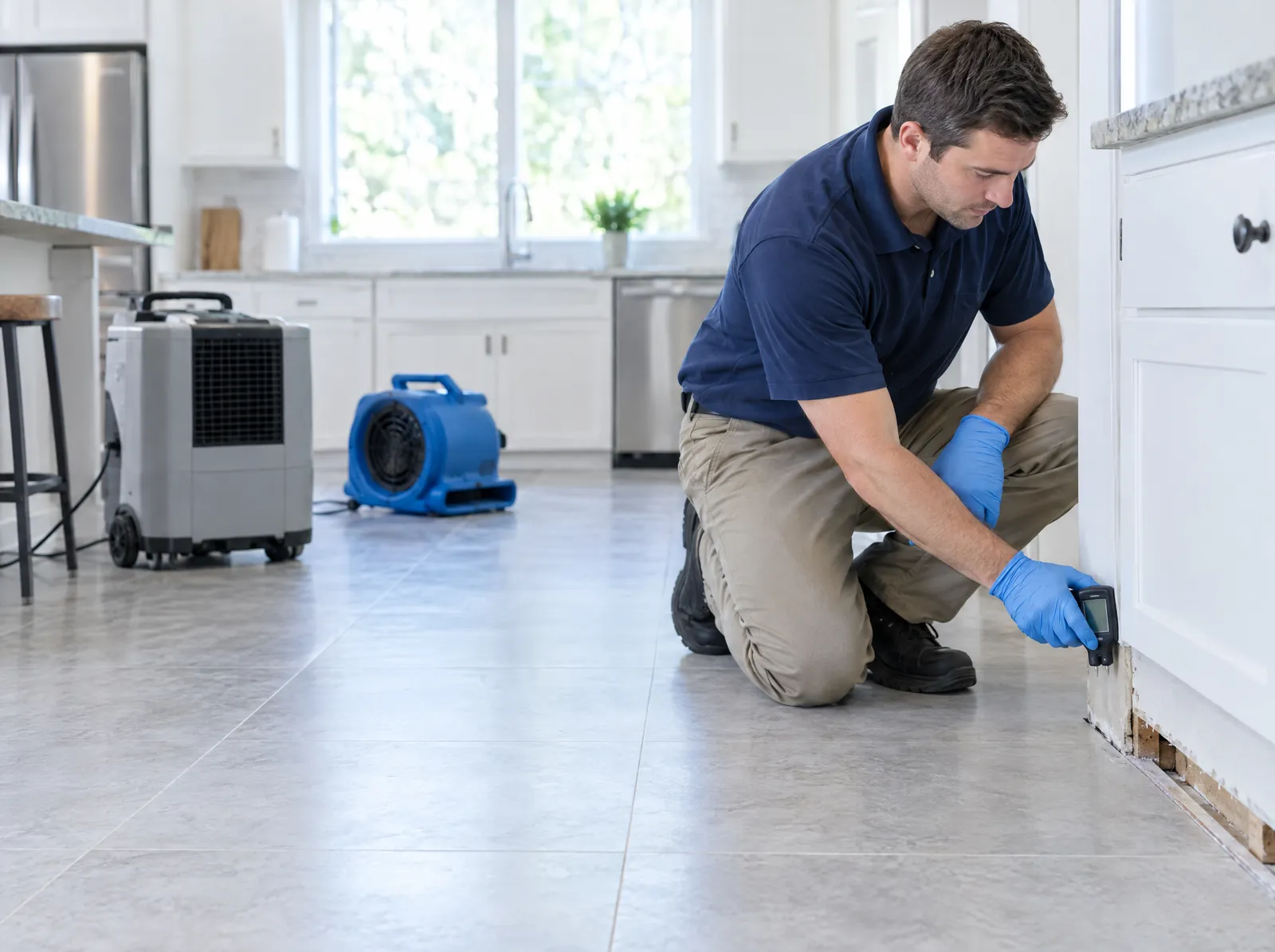
How do you prevent and remove mold after water damage?
Mold after water damage can begin within 24 to 48 hours, according to the EPA, so the first priority is removing water and drying materials completely and quickly. When drying is late or incomplete, or the water was contaminated, mold grows inside walls, under flooring and in cabinets. At that point, remediation means removing affected materials under containment, cleaning and treating the structure, and testing to confirm the home is clean and dry.
Dry on the surface, wet where it counts
After a leak or flood, a house can look dry within a few days while the insides of walls, the underside of flooring and the bottoms of cabinets are still wet. Fans pointed at a wet carpet dry the top layer. Drywall wicks water upward and holds it in the paper. Insulation stays soaked behind a wall that feels fine to the touch. That hidden moisture is where mold starts, often weeks after everyone thought the water problem was over.
Sound familiar?
- The water was cleaned up, but now there's a musty smell.
- Baseboards or flooring are starting to swell or stain weeks later.
- The restoration company left before you were sure everything was dry.
- You're not sure whether the water was clean or contaminated.
We do it differently.
| Dry it and hope | AME mold after water damage | |
|---|---|---|
| Drying check | Surfaces feel dry | Moisture readings inside walls, floors and cabinets |
| Contaminated water | Treated like a clean leak | Porous materials removed per the water category |
| Hidden areas | Left closed | Inspected with meters, thermal imaging and cavity checks |
| Mold that has started | Sprayed | Removed under containment and cleaned |
| Paperwork | Invoice only | Readings, photos and lab results for your records |

Why families trust us with their homes
-
Family-owned since 2008
A multigenerational family business. Not a franchise, not a private-equity rollup.
-
Credentialed where it isn't required
Indiana doesn't license mold remediators. We hold IICRC, CMR, CRMI and CCMI credentials anyway.
-
Called on as experts
Attorneys bring us into legal cases involving mold and mycotoxins.
-
Lab results in 24 to 48 hours
Every inspection comes with a written report, color photos and lab results.
- IICRC Certified Firm
- CMR
- CRMI
- CCMI
- BBB A+ Accredited
- NAMRI
- IAQA
- NORMI
- AMMA
- PMII
The AME Clearance Method
How we handle mold after a water loss
Six steps, whether you call us in the first week or months later when a smell appears.
Talk to a specialist-
Map the moisture
Readings in walls, subfloors, cabinets and under flooring show how far the water traveled and what is still wet, and thermal imaging helps find the edges.
-
Classify the water
Clean supply water, gray water from appliances or drains, and sewage or floodwater each call for a different level of removal.
-
Contain
Where mold has started, the area is sealed and put under negative air before wet or moldy materials are disturbed.
-
Remove what's lost
Porous materials that stayed wet too long, grew mold or were touched by contaminated water are removed and bagged.
-
Clean, treat and dry
Structure is HEPA vacuumed, cleaned and treated with plant-based enzyme products, then dried to normal moisture levels.
-
Test and document
Clearance testing and final moisture readings confirm the result, and you get the records for your insurer or a future buyer.
What a water-damage mold project includes
- Moisture mapping of walls, floors and cabinets
- Classification of the water source
- Air testing to see whether mold has spread
- A written scope before anything is removed
- Containment with negative air where mold has started
- Removal of materials that can't be dried or cleaned
- HEPA cleaning and enzyme treatment of the structure
- Final moisture readings to confirm drying
- Clearance testing and a lab report
- Photos and documentation for your insurer

Proof you can hold in your hands
When we finish, you don't get a handshake and a promise. You get the paperwork your family, your doctor, your insurer or your buyer can rely on.
Inspection report
What we found, where it is coming from, with color photos.
Written remediation plan
Scope, timeline and what will and won't be removed, before work starts.
Clearance lab report
Air, surface and mycotoxin results after the work is done.
A report for your doctor
With your permission, we share results directly with your care team.
Mold after water damage, explained
The 24 to 48 hour window
The EPA’s guidance is that water-damaged materials should be dried within 24 to 48 hours to prevent mold growth. That window is the single most useful thing to know after a leak. Mold spores are already present in every home. What they need is moisture that lasts, and wet drywall, carpet pad, insulation and wood give them that. Dry those materials quickly and completely and most water losses never become mold problems. Miss the window, or dry only the surfaces, and growth can begin inside the materials before anything shows on the outside.
Clean, gray and black water
The water damage industry sorts water into three categories, described in the IICRC S500 standard. The category changes what can be dried and kept, and what has to go.
| Category | Typical sources | What it means for porous materials |
|---|---|---|
| Category 1: clean water | A burst supply line, a leaking faucet or ice-maker line | Often dryable if drying starts promptly |
| Category 2: gray water | Washing machine or dishwasher overflow, a toilet overflow without feces | More material is usually removed, especially carpet pad |
| Category 3: black water | Sewage backups, rising floodwater, water that sat long enough to degrade | Porous materials it touched are generally removed |
Water also gets worse with time. Clean water that sits for days, picks up contaminants from the materials it soaks through, and starts growing microbes can end up treated like a higher category.
What to do in the first few days
- Safety first. Don’t walk into standing water where electrical outlets or cords may be submerged. Shut off power to the area if it’s safe to reach the panel.
- Stop the source at the fixture shutoff or the main water valve.
- Get water out with a wet vacuum or pump, and lift rugs, furniture and boxes off wet floors.
- Move air and remove moisture. Fans alone push humid air around; a dehumidifier pulls the water out.
- Pull baseboards and remove soaked carpet pad if you’re able, so walls and floors can dry.
- Document everything with photos and video before and during cleanup, and keep receipts.
- Call your insurer early. Our answer on whether homeowners insurance covers mold remediation explains why the cause and the timing matter.
Where water hides after it’s “cleaned up”
Most of the mold we find after a water loss is in places nobody checked. Drywall wicks water upward from the floor well above where the water line was. Laminate, vinyl plank and engineered flooring trap water beneath them. Kitchen and vanity cabinets have toe-kick spaces and hollow bases that stay wet for weeks. Insulation behind drywall holds water like a sponge. Water from an upstairs leak runs along joists and comes out somewhere else entirely. A moisture meter finds these spots; a hand on the wall doesn’t. If mold has started inside a wall, our guide to mold inside walls shows how it’s located without tearing everything out.
Drying company or mold remediator?
They’re different jobs. Water restoration is extraction and structural drying, and it’s time-critical. Mold remediation is what happens once growth has started: containment, removal, cleaning and verification. If drying was fast and thorough, you may never need remediation. If the home smells musty weeks later, flooring starts to cup, or readings stay high, it’s time for an inspection. Our answer on how to prevent mold after a flood covers the prevention side in more detail. For flooded basements in Indiana, see what to do after a basement flood in Indiana.
When remediation is needed, we treat cleaned framing and subfloor with plant-based enzyme products from US Enzyme, and every job still ends with testing.
We remove mold and mycotoxins from buildings. We don’t diagnose or treat medical conditions. If anyone in your home has symptoms, please work with a doctor. With your permission, we’re glad to share test results and our plan with them.
Common questions
Have a question that isn't here? Call a specialist
How soon does mold grow after water damage?
The EPA says mold can begin growing on wet materials within 24 to 48 hours. That's why fast, complete drying is the most effective prevention. Growth may not be visible for days or weeks, and much of it starts in places you can't see.
Is it too late to prevent mold if the leak happened last week?
Not necessarily too late to limit it. Check whether materials are still wet, especially drywall at the floor line, subfloor, insulation and cabinet bottoms. Anything still wet after several days is a strong candidate for growth and should be evaluated.
Does homeowners insurance cover mold after water damage?
It depends on your policy and the cause. Mold from a sudden, accidental event the policy covers, like a burst pipe, has a better chance of coverage than mold from a slow leak. Many policies cap mold coverage. Report the water damage promptly and document everything.
Can water-damaged drywall be saved?
Sometimes. Drywall wet by clean water that is dried quickly and thoroughly can often stay. Drywall that stayed wet for days, grew mold, lost its shape, or was touched by sewage or floodwater should be removed.
Do I need a water restoration company or a mold remediator?
In the first days, a water restoration company's job is extraction and drying. Once mold has started, or if drying was late or incomplete, you need remediation: containment, removal and testing. Some situations need both, in that order.
What should I do right after a leak or flood?
Make the area safe, stop the water, remove standing water, move belongings out of wet areas, get air moving and a dehumidifier running, photograph everything and call your insurer. If water came from a sewer backup or flooding, keep people out and don't try to clean porous materials yourself.
We're done when the lab says so.
Every remediation ends with clearance testing, and our work is backed by a complete-removal guarantee. We don't close a job on a failed result.
Talk to a specialistHad a leak or flood? Let's check what's still wet
Tell us when it happened and what got wet. A specialist will call you back.
- (833) 772-6653
- info@americanmoldexperts.com
- Open 7 days, 8am to 8pm