
Foundations, finished walls and sump pits
Basement mold removal that starts with the water
Basements grow mold because water finds a way in. We find the way, then remove the mold.
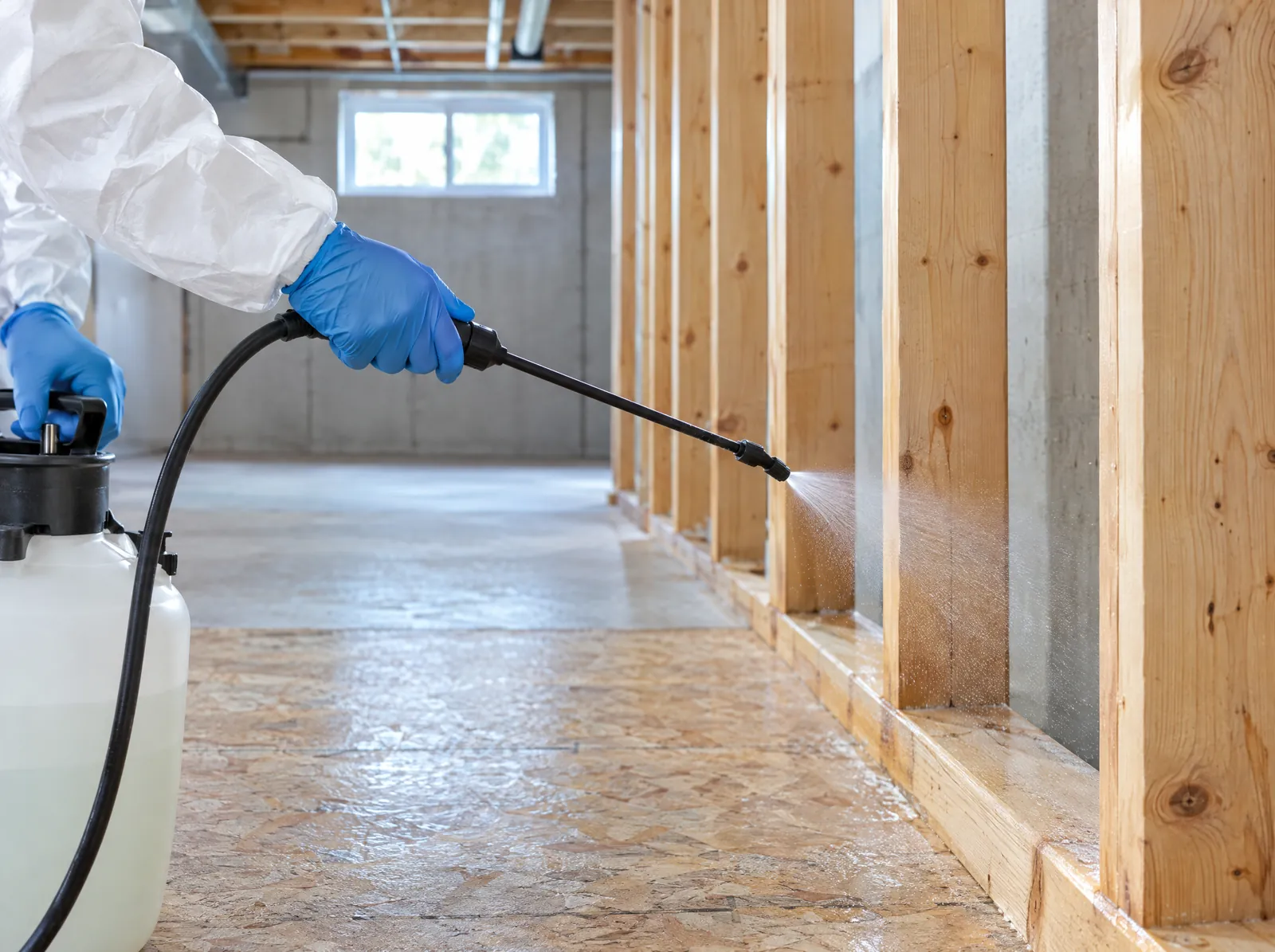
How does basement mold removal work?
Basement mold removal starts by finding how moisture is reaching the space: seepage through the foundation, a failed sump pump, a plumbing leak or summer humidity condensing on cool walls. Once that's corrected, the area is contained, moldy drywall, carpet, insulation and stored cardboard are removed, and concrete and framing are HEPA cleaned and treated. The job is done when moisture readings and clearance testing confirm the basement is dry and back to normal.
The basement that keeps growing mold back
Basements sit below grade, surrounded by damp soil, and their walls stay cooler than the air around them. That combination means a basement can grow mold without a single dramatic flood. When people clean it and it returns, the cleaning usually wasn't the problem. Water was still arriving, from outside, from below or out of the air, and nobody worked out which.
Sound familiar?
- The musty smell is back a few weeks after every cleaning.
- The finished basement looks fine, but the carpet feels damp near the walls.
- The sump pump failed once and you're not sure what's behind the drywall now.
- You've been told the whole lower level has to be gutted.
We do it differently.
| Clean-and-go basement jobs | AME basement remediation | |
|---|---|---|
| Moisture diagnosis | Assumed to be humidity | Mapped wall by wall with meters and thermal imaging |
| Finished walls | Surface cleaned or fully gutted | Opened where readings show moisture, left intact where they don't |
| Concrete and block | Sprayed | HEPA vacuumed, cleaned and treated |
| Stored belongings | Left in place | Sorted into clean, keep and discard |
| After the job | No drying plan | Humidity targets and a check that the source is fixed |

Why families trust us with their homes
-
Family-owned since 2008
A multigenerational family business. Not a franchise, not a private-equity rollup.
-
Credentialed where it isn't required
Indiana doesn't license mold remediators. We hold IICRC, CMR, CRMI and CCMI credentials anyway.
-
Called on as experts
Attorneys bring us into legal cases involving mold and mycotoxins.
-
Lab results in 24 to 48 hours
Every inspection comes with a written report, color photos and lab results.
- IICRC Certified Firm
- CMR
- CRMI
- CCMI
- BBB A+ Accredited
- NAMRI
- IAQA
- NORMI
- AMMA
- PMII
The AME Clearance Method
Basement mold removal, in the order it has to happen
Basements reward patience. Six steps, and the first two decide whether the other four last.
Talk to a specialist-
Map the moisture
We take readings along every wall, at the floor line, the rim joist and around windows and plumbing, and use thermal imaging to find damp areas behind finished surfaces.
-
Get the water source fixed
Grading, gutters, a sump pump, a plumbing leak or humidity. We tell you which one it is, and what needs to be corrected before cleanup starts.
-
Isolate the basement
The stairwell and any open returns are sealed, and HEPA air machines put the basement under negative pressure so dust doesn't travel upstairs.
-
Remove wet finishes
Drywall, carpet and pad, insulation and cardboard boxes with growth or moisture damage are removed and bagged. Dry, clean materials stay.
-
Clean concrete and framing
Foundation walls, slab, studs and joists are HEPA vacuumed, wiped and treated with plant-based enzyme products.
-
Dry, test and hand back
Dehumidification brings the space down to a stable humidity, then clearance testing confirms the result before containment comes down.
What a basement project includes
- Wall-by-wall moisture readings and thermal imaging
- A written explanation of the water source
- Air testing upstairs and down to see whether it has spread
- Containment that isolates the basement from the living space
- Targeted removal of wet drywall, carpet and insulation
- HEPA cleaning of concrete, block and framing
- Enzyme treatment of wood and masonry surfaces
- Help sorting stored belongings
- Dehumidification guidance for after the job
- Clearance testing and a lab report

Proof you can hold in your hands
When we finish, you don't get a handshake and a promise. You get the paperwork your family, your doctor, your insurer or your buyer can rely on.
Inspection report
What we found, where it is coming from, with color photos.
Written remediation plan
Scope, timeline and what will and won't be removed, before work starts.
Clearance lab report
Air, surface and mycotoxin results after the work is done.
A report for your doctor
With your permission, we share results directly with your care team.
Basement mold, explained
Reading where the mold is
Before we open a wall or pull up carpet, we look at where the growth and moisture sit. Basements leave clues, and the location of mold on a wall often points straight to the water source.
| Where you see it | What it usually points to |
|---|---|
| The bottom few inches of drywall, all around the room | Water on the slab: a past flood, sump overflow or seepage at the floor joint |
| One wall, worst at a low spot | Water entering from outside, often grading, a downspout or a crack |
| The rim joist and top of the foundation | Humid air condensing on a cold surface, or air leaks from outside |
| Around a window well | A clogged or uncovered well collecting rain |
| One isolated spot | A plumbing line, water heater or appliance above or nearby |
| Everywhere, lightly, on cool surfaces | High indoor humidity, especially in summer |
These are starting points, not conclusions. Moisture readings and a look at the outside of the house confirm which one is really happening, and a basement can have more than one.
Efflorescence, mildew or mold?
A lot of basement calls start with white or gray residue on a foundation wall. Efflorescence is mineral salt that water carries through concrete and leaves on the surface as it evaporates. It looks crystalline, crumbles when you rub it, and dissolves if you spray a little water on it. Mold looks fuzzy or slimy, smears rather than crumbles, and tends to come with a musty odor. Efflorescence isn’t a mold problem by itself, but it proves water is moving through the wall, and mold often follows on nearby drywall, framing or stored boxes. If you’re unsure, our answer on whether mold can grow on concrete goes further.
Finished and unfinished basements need different jobs
In an unfinished basement, almost everything is visible. Mold usually sits on exposed joists, the rim joist, the underside of the subfloor and the foundation walls, and most of it can be cleaned in place. The work is mostly HEPA vacuuming, wiping and treatment, plus removing anything stored in cardboard.
A finished basement is harder, because the finishes hide the problem. Drywall wicks water up from the slab. Carpet pad holds it. Fiberglass batts behind the drywall trap moisture against the foundation. Bottom plates of stud walls sit directly on concrete. We use readings and thermal imaging to decide exactly which sections to open, then cut and remove those sections under containment. Wet carpet pad is almost always removed; our answer on whether mold can grow in carpet explains why.
Keeping the basement dry afterward
Once the growth is gone, the job is to stop giving mold a reason to come back. The EPA recommends keeping indoor humidity below 60 percent, ideally between 30 and 50 percent. In most basements that takes a properly sized dehumidifier that drains on its own, not one you have to remember to empty.
- Outside: keep gutters clear, extend downspouts away from the foundation and make sure soil slopes away from the house.
- Sump: test the pump regularly and consider a battery backup or high-water alarm.
- Inside: store belongings in plastic bins off the floor, keep furniture a few inches from exterior walls, and watch a hygrometer through the humid months.
- When refinishing: ask your contractor about moisture-tolerant materials at the floor line.
If the mold has come back before, our answer on why mold keeps coming back covers the usual causes. In Indiana? See basement mold removal in Indiana.
A note on the treatment step: we use plant-based enzyme products from US Enzyme. They don’t replace removing materials that can’t be saved or fixing the moisture, and we still test every basement afterward, because the lab result is what decides when we’re done.
We remove mold and mycotoxins from buildings. We don’t diagnose or treat medical conditions. If anyone in your home has symptoms, please work with a doctor. With your permission, we’re glad to share test results and our plan with them.
Common questions
Have a question that isn't here? Call a specialist
What causes mold in a basement?
Moisture from one of three directions: water seeping through the foundation from outside, water from inside such as a plumbing leak or failed sump pump, or humid air condensing on cool concrete and framing. Most basements have a mix, and the pattern of the mold usually shows which one is dominant.
Is the white fuzzy stuff on my basement wall mold?
Maybe not. White, crystalline deposits on concrete or block are often efflorescence, mineral salts left behind as water moves through masonry. Efflorescence dissolves in water and crumbles to powder; mold smears and often has a musty smell. Either way it means water is getting through the wall.
Can mold grow on concrete?
Concrete itself isn't food for mold, but the dust, soil and organic film that settle on it are. Mold on concrete basement walls is common and usually cleans off well, which is why masonry is cleaned and treated rather than removed.
Do I have to remove all the drywall in a finished basement?
Usually not. Water tends to wick up from the floor or run in along one wall. We open the areas where readings show moisture or growth and leave dry, clean walls alone. Whole-level gut jobs are rarely necessary without evidence to support them.
Will a dehumidifier get rid of basement mold?
A dehumidifier helps prevent new growth by keeping humidity down, and it's part of most long-term fixes. It won't remove growth that's already there, and it can't keep up with active seepage or a leak.
Can basement mold affect the rest of the house?
It can. Air moves upward through a house, and a furnace or air handler in the basement can pull spores into the ductwork. That's why we test upstairs as well as in the basement, and why containment isolates the stairwell and returns during the work.
Should I throw away things stored in the basement?
Not automatically. Hard items can be cleaned. Cardboard boxes that got wet usually go, and paper, fabric and upholstered items are judged one at a time. We'll help you sort them.
We're done when the lab says so.
Every remediation ends with clearance testing, and our work is backed by a complete-removal guarantee. We don't close a job on a failed result.
Talk to a specialistGet your basement looked at properly
Tell us what you're seeing and whether the basement is finished. A specialist will call you back.
- (833) 772-6653
- info@americanmoldexperts.com
- Open 7 days, 8am to 8pm