
Midwest office in Avon, Indiana
Mold remediation in the Midwest, proven by the lab
Testing, remediation and mycotoxin removal for Indiana, Ohio, Kentucky, Illinois and Michigan, run from our Avon office.
Who handles mold remediation in the Midwest?
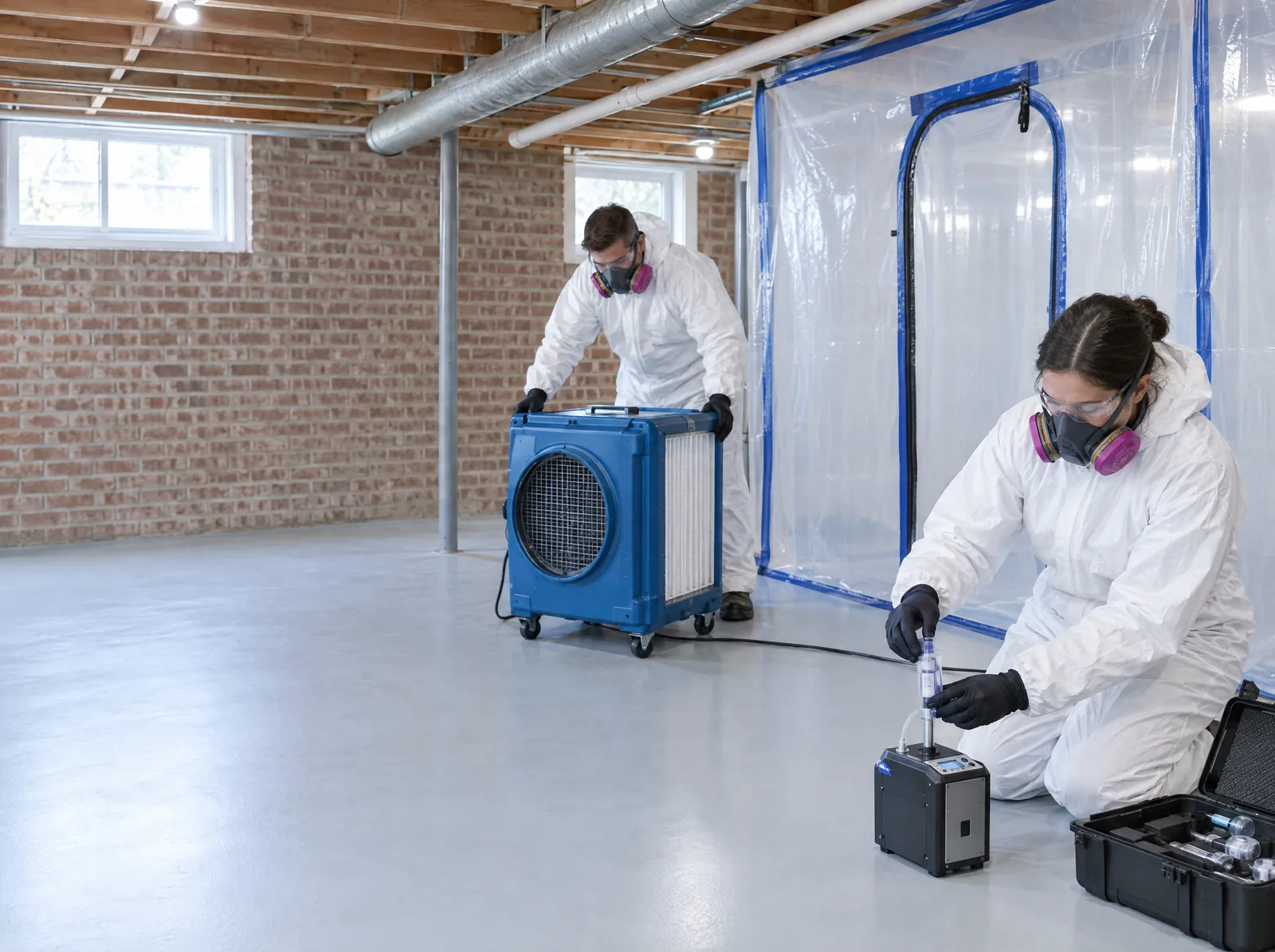
American Mold Experts provides mold remediation in the Midwest from our office in Avon, Indiana, just west of Indianapolis. We've been family-owned since 2008. Our crews test first, remove mold inside containment, break down the mycotoxins mold leaves behind, and confirm the result with lab clearance testing. Most of our work is in Indiana, and we regularly take projects in Ohio, Kentucky, Illinois and Michigan.
Why Midwest homes grow mold
Midwest houses deal with water from every direction. Spring storms push groundwater against foundations. Summer humidity condenses on cool basement walls and ductwork. Winter freeze-thaw cycles open small cracks, and warm indoor air leaking into cold attics turns into frost and then into water.
Construction adds to it. Basements and crawlspaces are common across the region, and many older homes were built with little or no vapor barrier. Newer homes are sealed tight for energy efficiency, which keeps heat in but also traps moisture when ventilation falls behind. That combination is why most of the mold we find sits below grade or above the ceiling, out of sight.
We've worked in these houses since 2008. Knowing where Midwest homes tend to hide moisture lets us test in the right places first, and it's why so many of our projects end without tearing out walls that didn't need to go.
- Office
- 137 Production Dr, Avon, IN 46123
- Hours
- Open 7 days, 8am to 8pm
- States served
- Indiana, Ohio, Kentucky, Illinois, Michigan
- Lab results
- Back in 24 to 48 hours
Midwest mold and mycotoxin services
- Mold remediation in IndianaContained removal, verified by clearance testing
- Mold testing and inspection in IndianaFind the source before anything comes out
- Mycotoxin testing in IndianaDust and surface panels for the toxins mold leaves
- Mycotoxin remediation in IndianaRemove the toxins, not just the mold
- Indoor air quality testing in IndianaIndoor and outdoor air sampling, compared
- Basement mold removalThe most common problem we see in the region

Why families trust us with their homes
-
Family-owned since 2008
A multigenerational family business. Not a franchise, not a private-equity rollup.
-
Credentialed where it isn't required
Indiana doesn't license mold remediators. We hold IICRC, CMR, CRMI and CCMI credentials anyway.
-
Called on as experts
Attorneys bring us into legal cases involving mold and mycotoxins.
-
Lab results in 24 to 48 hours
Every inspection comes with a written report, color photos and lab results.
- IICRC Certified Firm
- CMR
- CRMI
- CCMI
- BBB A+ Accredited
- NAMRI
- IAQA
- NORMI
- AMMA
- PMII
Midwest states we serve
Indiana is home base, and we travel to the rest of the region for testing and remediation. Pick your state to find your city.
Killing mold isn’t removing it
Most mold jobs in the Midwest follow the same script: find the visible growth, spray it with bleach or a biocide, maybe fog the house, and paint over the stain. That kills a lot of mold. It doesn’t remove what the mold left behind.
Some indoor molds produce mycotoxins, stable chemical compounds that cling to dust, drywall, framing and belongings. They aren’t alive, so there’s nothing to kill. Dead mold also breaks into tiny fragments that still carry those toxins. A house can pass a basic spore count and still hold a load of contaminated dust in the carpet, the ductwork and the wall cavities.
That’s why we build every project around mycotoxins, not just visible mold. We test for them, we remove the dust and materials they ride on, we break down what remains, and we test again before we call the job finished.
How a Midwest project runs, start to finish
Every project in the region follows the same order, whether it’s a finished basement in Hendricks County or a crawlspace across the state line. The steps don’t change. What changes is where we look first, and that comes from knowing how houses in this part of the country tend to fail.
- Test. Air samples, settled-dust samples and, where it matters, a mycotoxin panel. Moisture readings show where water is getting in. Lab results come back in 24 to 48 hours.
- Scope. You get a written plan and price before anything is removed. It lists what comes out, what gets cleaned, and what we expect the clearance test to show.
- Fix the water. Mold comes back if the moisture does. We identify the leak, the drainage problem or the humidity source and make sure it’s corrected.
- Contain and remove. Sealed barriers and negative air keep contaminated dust out of clean rooms. Porous materials that can’t be saved are bagged and taken out.
- Break down the toxins. We treat framing, subfloors and cavities with plant-based enzyme products made to break mycotoxins apart. We use products from US Enzyme.
- Clean the air and dust. HEPA vacuuming, detailed wiping and air scrubbing capture the fine particles toxins travel on. Ductwork gets cleaned when testing points to it.
- Prove it. Clearance testing confirms the result. You keep the full lab report.
The full method, with more detail on each step, is on our AME Clearance Method page.
Indiana first, and the states around it
Our office is at 137 Production Dr in Avon, in Hendricks County on the west side of Indianapolis. Most of our work is in central Indiana: the Indianapolis metro, Hamilton County suburbs like Carmel and Fishers, and towns south and west of the city. We also travel regularly to Fort Wayne, South Bend, Evansville, Bloomington and Lafayette.
Beyond Indiana, we take projects in the cities that are a reasonable drive from Avon: Cincinnati, Dayton and Columbus in Ohio, Louisville and Lexington in Kentucky, Champaign and the Chicago suburbs in Illinois, and Grand Rapids and Kalamazoo in Michigan. Travel is written into the scope, so you see it before you agree to anything. For projects farther away, we also work nationwide.
Where we find mold in Midwest homes
After enough years in these houses, patterns show up. These are the places we check first:
- Basements. Foundation walls and slabs stay cool and damp. In finished basements, drywall, carpet pad and bottom plates hide growth until someone notices a smell.
- Crawlspaces. Bare dirt floors, missing or torn vapor barriers and poor ventilation keep wood framing damp for months at a time.
- Attics. Warm, moist air from bathrooms and kitchens leaks upward in winter and condenses on the underside of the roof deck.
- HVAC systems. Air handlers and ducts in basements and crawlspaces pull in damp air and spread contaminated dust through the whole house.
- Exterior walls and windows. Condensation on cold glass and wall surfaces during long winters feeds growth on sills, in closets and behind furniture.
How the seasons change what we look for
Midwest mold problems follow the calendar. In spring, heavy rain and snowmelt test sump pumps, gutters and grading, and basement calls pick up. Summer brings long stretches of humid air that condense on anything cooler than the room, from basement walls to supply ducts. In fall, outdoor mold counts can run high, which is one reason we always take an outdoor air sample to compare against the indoor results. Winter closes the house up. Windows sweat, attics collect frost, and whatever is growing indoors has less fresh air diluting it.
None of that means you should wait for a particular season to test. It means we read the results with the season in mind, so a number taken in August isn’t judged the same way as one taken in January.
Choosing a mold company when the state doesn’t check
Indiana doesn’t license mold remediators or inspectors, so anyone can advertise mold removal. Rules differ from state to state across the region, which makes the credentials a company chooses to hold, and whether it tests its own work, the most useful signals you have.
We’re an IICRC Certified Firm, our team holds CMR, CRMI and CCMI credentials, and we’re members of NAMRI, IAQA, NORMI, AMMA and PMII. We’re BBB A+ accredited. Attorneys bring us into legal cases involving mold and mycotoxins, which means our reports are written to hold up when someone else reads them closely.
Whoever you hire, ask three questions: what testing do you do before and after, do you test for mycotoxins, and is clearance testing included in the price? Our guide to choosing a mold remediator has more.
When someone in the house is sick
Many of the families who call us have already spent months trying to figure out why they feel worse at home. Often a doctor has suggested the house could be part of the problem. For those families, a standard mold job isn’t enough. We plan the work around the most sensitive person in the home, test for mycotoxins as well as mold, and with your permission share the results and our plan with your doctor.
We remove mold and mycotoxins from buildings. We don’t diagnose or treat medical conditions. If you have symptoms, please work with a doctor. With your permission, we’re glad to share test results and our plan with them.
Midwest mold questions
Have a question that isn't here? Call a specialist
How much does mold remediation cost in the Midwest?
It depends on how much of the home is affected, what has to be removed and whether mycotoxins and the HVAC system need attention. For a local reference point, Angi reports an average of about $1,999 for mold remediation in Indianapolis, with most projects between $1,026 and $3,005. We give you a written scope and price after testing, before any work begins.
Do you work outside Indiana?
Yes. Indiana is where most of our work happens, and we regularly take projects in Ohio, Kentucky, Illinois and Michigan. Every Midwest job is run from our Avon office, and we travel nationwide for larger or specialized projects.
Does homeowners insurance cover mold removal?
Sometimes. Many policies cover mold only when it comes from a sudden, covered event like a burst pipe, and exclude mold from slow leaks, flooding or humidity. Policies and limits vary, so read yours or ask your agent. Our test results and written scope give your adjuster clear documentation.
Do you test for mycotoxins on every job?
Mycotoxin testing is part of how we plan and verify our remediation work, because killing mold doesn't remove the toxins it leaves behind. If you only need testing, we do that too, with no obligation to hire us for the work.
Can I stay in my home during remediation?
Often, yes, as long as you stay out of the contained work area. Families with someone who is sick from mold exposure sometimes choose to stay elsewhere until clearance testing passes. We'll help you decide based on the test results and your doctor's advice.
We're done when the lab says so.
Every remediation ends with clearance testing, and our work is backed by a complete-removal guarantee. We don't close a job on a failed result.
Talk to a specialistTalk to a Midwest mold specialist
Tell us what's going on and where you live. A specialist from our Avon office will call you back.
- (833) 772-6653
- info@americanmoldexperts.com
- Open 7 days, 8am to 8pm