
Served from our Avon, Indiana office
Crawl space mold removal in Indiana
We find why your crawl space stays damp, remove the mold and its toxins, and prove it with lab testing.
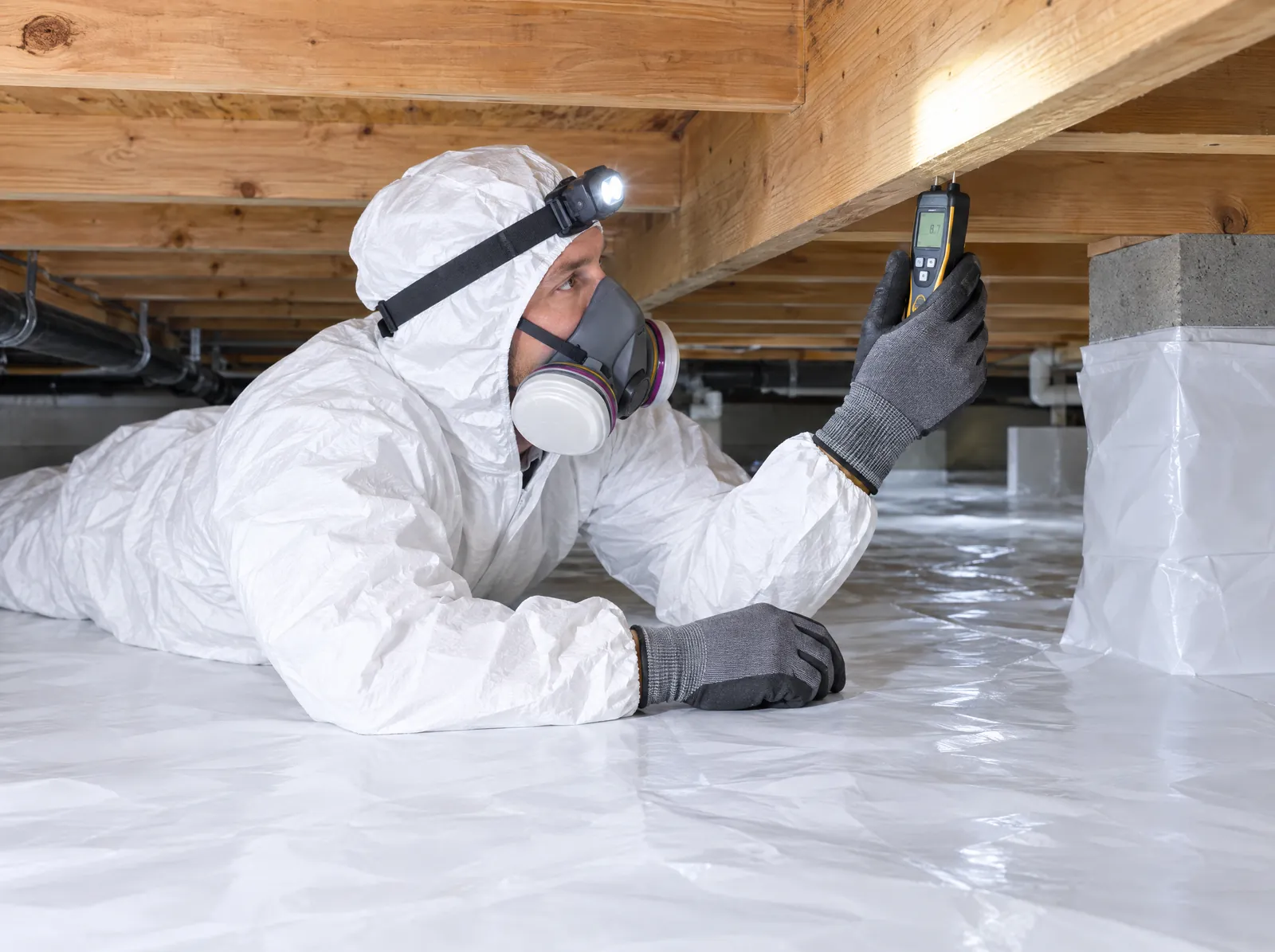
How do you get rid of crawl space mold in Indiana?
Crawl space mold in Indiana usually comes from humid summer air, damp soil and torn or missing vapor barriers, so getting rid of it starts with the moisture. We test first, contain the crawl space, remove ruined insulation, HEPA-clean the joists and subfloor, and treat the wood with enzymes. Then we correct the moisture source, and clearance testing, mycotoxins included, confirms the air rising into your home is clean.
Why Indiana crawl spaces grow mold
A crawl space is a room nobody visits. In Indiana it breathes humid air all summer, sits on soil that holds water after spring rain, and often has a plastic vapor barrier that was torn years ago by a plumber or a cable installer. The joists and subfloor stay damp enough for mold, and air from down there drifts up into the rooms you live in.
Sound familiar?
- There's a musty smell in the house that gets worse every summer.
- The vapor barrier is torn, missing or lying under standing water.
- Insulation between the joists is sagging, wet or falling down.
- Someone quoted encapsulation, but no one tested what's already growing.
We do it differently.
| Spray-and-seal crawl space jobs | AME crawl space remediation | |
|---|---|---|
| Starting point | A look around with a flashlight | Air, dust and surface testing, mycotoxins included |
| Moisture | Sometimes addressed, sometimes skipped | Source found and corrected before cleaning |
| Wood framing | Sprayed with biocide or painted over | HEPA-cleaned, then enzyme-treated |
| Air upstairs | Not checked | Tested before and after in the living space |
| Finish line | When the crew drives away | When clearance testing passes |

Why families trust us with their homes
-
Family-owned since 2008
A multigenerational family business. Not a franchise, not a private-equity rollup.
-
Credentialed where it isn't required
Indiana doesn't license mold remediators. We hold IICRC, CMR, CRMI and CCMI credentials anyway.
-
Called on as experts
Attorneys bring us into legal cases involving mold and mycotoxins.
-
Lab results in 24 to 48 hours
Every inspection comes with a written report, color photos and lab results.
- IICRC Certified Firm
- CMR
- CRMI
- CCMI
- BBB A+ Accredited
- NAMRI
- IAQA
- NORMI
- AMMA
- PMII
The AME Clearance Method
The AME Clearance Method, in a crawl space
Crawl spaces are tight, dark and connected to the air you breathe upstairs. These six steps are how we work in them.
Talk to a specialist-
Test above and below
We sample the crawl space and the rooms above it, including settled dust for mycotoxins, so we know whether the problem has already reached your living space.
-
Find the water
Standing water, poor grading, short downspouts, a failed sump pump, plumbing leaks or humid outdoor air through the vents. We identify which ones apply before we clean.
-
Contain and set negative air
The access point is sealed and HEPA air scrubbers pull air out of the crawl space, so disturbed dust doesn't travel up into the house.
-
Remove what's ruined
Wet, moldy insulation and failed vapor barrier are bagged and removed. Sound framing stays in place.
-
Clean and treat the wood
Joists, sill plates and subfloor are HEPA-vacuumed and wiped, then treated with a plant-based enzyme product that breaks down mold and mycotoxins.
-
Verify, then protect
Clearance testing confirms the result. Then we walk you through vapor barrier, sealing and dehumidification options so the moisture doesn't return.
What a crawl space project includes
- Air, dust and mycotoxin testing before work begins
- Testing in the living space above the crawl space
- A moisture assessment, including sump, grading and plumbing
- Containment with HEPA negative air
- Removal of contaminated insulation and vapor barrier
- HEPA vacuuming of joists, sill plates and subfloor
- Enzyme treatment of the framing
- Clearance testing, with lab results in 24 to 48 hours
- Written recommendations for keeping the crawl space dry

Proof you can hold in your hands
When we finish, you don't get a handshake and a promise. You get the paperwork your family, your doctor, your insurer or your buyer can rely on.
Inspection report
What we found, where it is coming from, with color photos.
Written remediation plan
Scope, timeline and what will and won't be removed, before work starts.
Clearance lab report
Air, surface and mycotoxin results after the work is done.
A report for your doctor
With your permission, we share results directly with your care team.
Crawl space mold in Indiana, explained
Where crawl space moisture comes from
Most Indiana crawl spaces we open have more than one moisture source. The usual suspects:
- Humid summer air. Vented crawl spaces pull in outdoor air. When warm, humid July air meets cooler soil, block walls and ductwork, it condenses, and the wood soaks it up.
- The ground itself. Bare or poorly covered soil releases moisture constantly. A torn or partial vapor barrier leaves that moisture free to rise.
- Surface water. Short downspouts, clogged gutters and soil that slopes toward the house send spring rain straight to the foundation.
- Plumbing. Slow drips from supply lines and drains can soak the same spot for months before anyone crawls in to look.
- A failed sump pump. If your crawl space has one and it quits during a storm, standing water follows. Our page on whether sump pump failure causes mold covers what to check.
Signs you have a crawl space problem
You rarely see crawl space mold from inside the house. You notice its effects instead: a musty smell near floor registers, floors that feel soft or bouncy, cupping hardwood, or a damp, earthy odor when the heat or air conditioning kicks on. Inside the crawl space, look for fuzzy growth on joists, dark staining on the subfloor, insulation hanging down, and a vapor barrier with water pooled on top of it.
Mold removal or mold remediation?
People search for both, and companies use the words loosely. In practice, “removal” often means spraying and wiping what’s visible. Remediation is the full job: testing, containment, removing what can’t be cleaned, cleaning what can, correcting the moisture and testing again. In a crawl space, the difference shows up months later. If the moisture wasn’t fixed or the dust wasn’t captured, the smell comes back. Our explainer on the difference between mold removal and remediation goes deeper.
Where encapsulation fits
Encapsulation means covering the floor and walls with a heavy liner, sealing the vents and usually adding a dehumidifier. It can be a good way to keep a crawl space dry. It is not a mold treatment. Sealing a liner over moldy framing locks the problem in with you. We clean and verify first, and then help you decide whether encapsulation, a better vapor barrier or simple drainage fixes make sense for your house. See whether crawl space encapsulation is worth it in Indiana for the tradeoffs.
Why we use enzymes on framing
Crawl space framing is structural, so tearing it out is rarely an option. Biocides kill mold on the surface but leave its mycotoxins behind. We HEPA-clean the wood and then apply a plant-based enzyme treatment designed to break mold and mycotoxins down. We use products from US Enzyme, and we test afterward to prove the treatment worked.
We remove mold and mycotoxins from buildings. We don’t diagnose or treat medical conditions. If you have symptoms, please work with a doctor. With your permission, we’re glad to share test results and our plan with them.
Common questions
Have a question that isn't here? Call a specialist
How much does crawl space mold removal cost in Indiana?
It depends on the size of the crawl space, how much insulation and vapor barrier has to come out, and what moisture repairs are needed. For context, Angi reports that mold remediation in Indianapolis averages about $1,999, with most jobs between $1,026 and $3,005. After testing, we give you a written scope and price.
Is crawl space mold removal the same as encapsulation?
No. Removal cleans up the mold that's already there. Encapsulation seals the crawl space to keep moisture out afterward. Sealing over active mold traps the problem instead of solving it, so we remediate and test first, then talk about sealing.
Does homeowners insurance cover crawl space mold in Indiana?
Sometimes. Policies often cover mold caused by a sudden, covered event like a burst pipe and exclude mold from long-term humidity or seepage, which is where most crawl space mold comes from. Read your policy and ask your agent. Our lab reports can help document a claim.
Can I clean crawl space mold myself?
The EPA says homeowners can often handle mold patches smaller than about 10 square feet. Crawl space mold is usually larger and hard to reach, and disturbing it without containment can push dust into the house. If you try, wear a respirator and fix the moisture first.
Can crawl space mold affect the air in my house?
It can. Air generally moves upward through a house, and crawl space air leaks into the living space through gaps around pipes, wires and ducts. That's why we test the rooms above, not just the crawl space itself.
Is white growth on crawl space joists a problem?
Often, yes. Several molds look white or fuzzy on wood. White crust on block or concrete walls, on the other hand, is often efflorescence, a mineral residue left by water. Testing tells you which you have. Either one means moisture needs attention.
Do you work on crawl spaces outside the Indianapolis area?
Yes. Every Midwest project is run from our Avon office. We work across Indiana and travel to neighboring states, and travel is spelled out in your written scope.
We're done when the lab says so.
Every remediation ends with clearance testing, and our work is backed by a complete-removal guarantee. We don't close a job on a failed result.
Talk to a specialistFind out what's under your floor
Tell us what you're noticing. A specialist from our Avon office will call you back.
- (833) 772-6653
- info@americanmoldexperts.com
- Open 7 days, 8am to 8pm