
Air handlers, coils and ductwork
HVAC and duct mold remediation in Indiana
Your HVAC system reaches every room. We clean it at the source and test to prove it's clean.
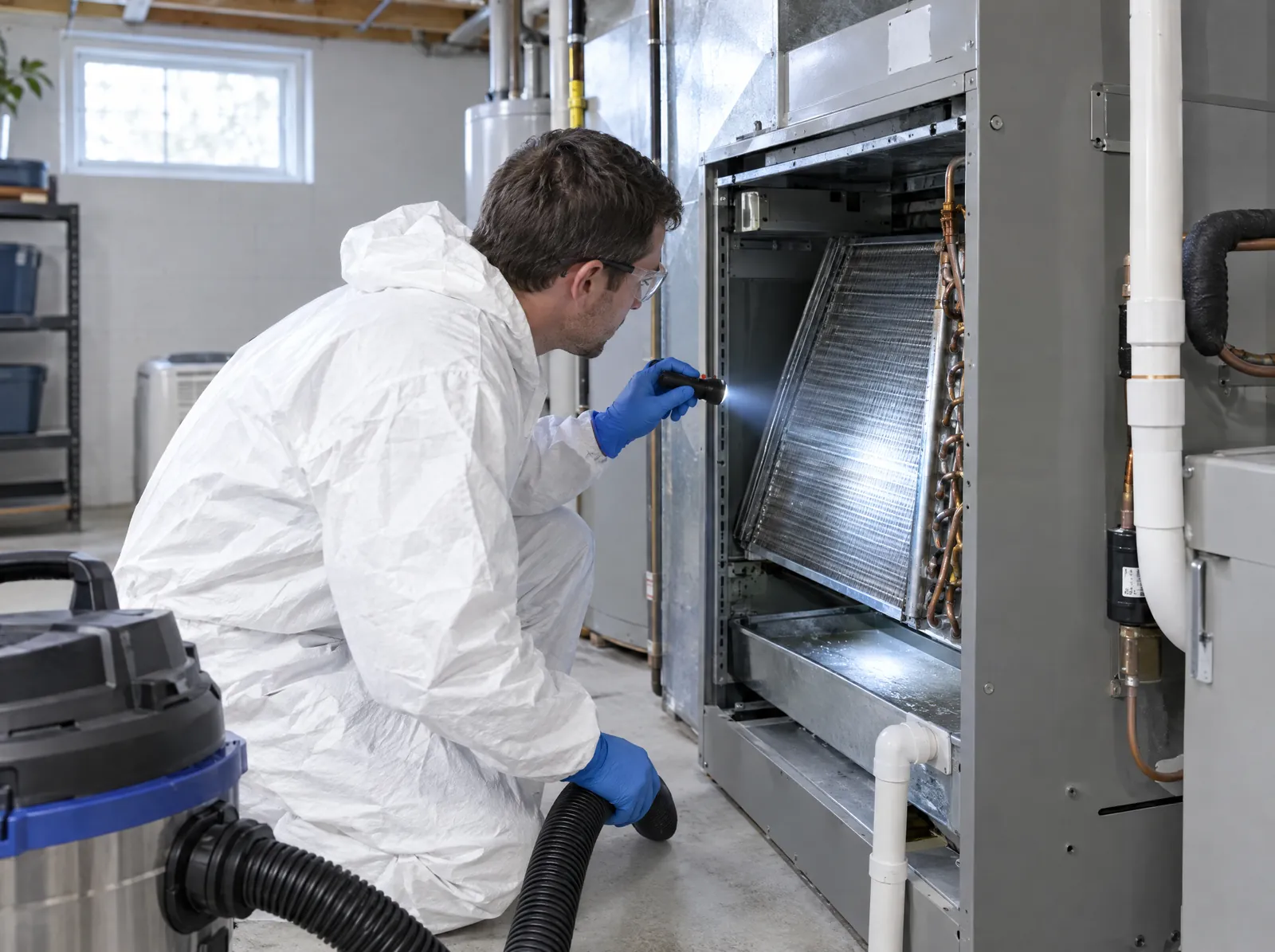
How do you remove duct mold in Indiana homes?
Duct mold in Indiana usually starts at the air conditioner, where the cooling coil and drain pan stay wet all summer, or in ducts running through humid crawl spaces and hot attics. Removing it means cleaning the air handler, coil, drain pan and blower, HEPA-cleaning the ducts under negative pressure, replacing lining that can't be cleaned, and fixing the humidity problem. Testing before and after confirms the air coming out is clean.
Why HVAC mold is a whole-house problem
Mold in a bathroom stays in the bathroom. Mold in an air handler or duct system travels, because the blower moves dust and mold fragments through every supply register in the house, many times a day. In Indiana, the system works hardest in humid July and August, which is exactly when the coil and drain pan are wettest. Cleaning the rooms without cleaning the system just lets it recontaminate them.
Sound familiar?
- The house smells musty every time the air conditioning starts.
- You see dark spotting around supply vents or on the ceiling next to them.
- Mold was cleaned elsewhere in the house, but the smell came back.
- Someone offered to fog your ducts and you're not sure it works.
We do it differently.
| Duct fogging and quick cleaning | AME HVAC remediation | |
|---|---|---|
| Where it starts | Ducts only | Coil, drain pan, blower and air handler first |
| Method | Fog or spray a biocide into the ducts | HEPA source removal under negative pressure |
| Duct lining | Sprayed in place | Replaced when it can't be cleaned |
| Humidity | Not considered | Causes identified, such as sizing, drainage or leaky returns |
| Proof | Before and after photos | Air and dust testing, mycotoxins included |

Why families trust us with their homes
-
Family-owned since 2008
A multigenerational family business. Not a franchise, not a private-equity rollup.
-
Credentialed where it isn't required
Indiana doesn't license mold remediators. We hold IICRC, CMR, CRMI and CCMI credentials anyway.
-
Called on as experts
Attorneys bring us into legal cases involving mold and mycotoxins.
-
Lab results in 24 to 48 hours
Every inspection comes with a written report, color photos and lab results.
- IICRC Certified Firm
- CMR
- CRMI
- CCMI
- BBB A+ Accredited
- NAMRI
- IAQA
- NORMI
- AMMA
- PMII
The AME Clearance Method
The AME Clearance Method for HVAC systems
HVAC work follows the air. We clean from the equipment outward, in this order.
Talk to a specialist-
Test the air and dust
We sample air in several rooms and settled dust near registers, including a mycotoxin panel when needed, and inspect the air handler and accessible ductwork.
-
Find the moisture
Clogged condensate lines, rusted drain pans, sweating ducts, leaky returns pulling crawl space air, or an oversized unit that cools without removing enough humidity.
-
Put the system under negative air
A HEPA-filtered negative air machine is connected to the duct system so dislodged debris is pulled out, not blown into your rooms.
-
Clean the equipment
The coil, drain pan, blower and cabinet are cleaned so the source is gone before we move into the ducts.
-
Clean or replace ductwork
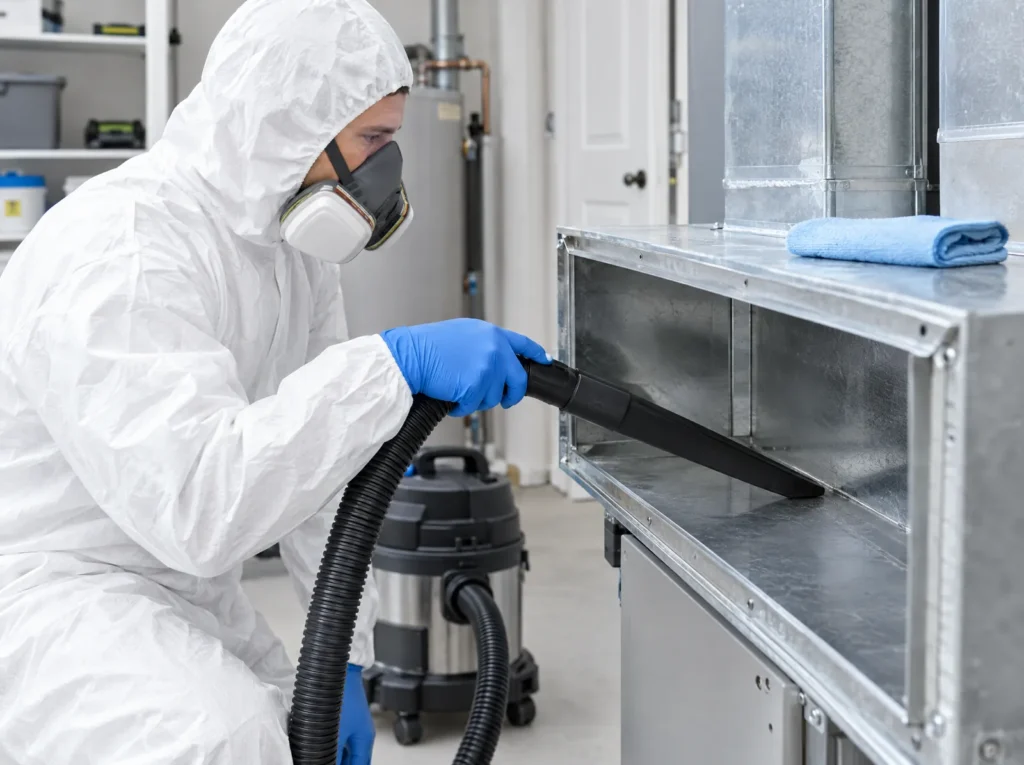
Sheet-metal ducts are cleaned with agitation tools and HEPA vacuums. Contaminated fiberglass liner, duct board or flex duct is replaced when cleaning can't reach it.
-
Treat and verify
Cleaned surfaces are treated with a plant-based enzyme product that breaks down mold and mycotoxins. Clearance testing confirms the result.
What an HVAC mold project includes
- Air and dust testing in multiple rooms
- Inspection of the air handler, coil, drain pan and accessible ductwork
- Moisture and humidity cause assessment
- HEPA negative air connected to the duct system
- Cleaning of the coil, drain pan, blower and cabinet
- Mechanical cleaning of supply and return ducts
- Replacement recommendations for liner or flex duct that can't be cleaned
- Enzyme treatment of cleaned surfaces
- Clearance testing, with lab results in 24 to 48 hours

Proof you can hold in your hands
When we finish, you don't get a handshake and a promise. You get the paperwork your family, your doctor, your insurer or your buyer can rely on.
Inspection report
What we found, where it is coming from, with color photos.
Written remediation plan
Scope, timeline and what will and won't be removed, before work starts.
Clearance lab report
Air, surface and mycotoxin results after the work is done.
A report for your doctor
With your permission, we share results directly with your care team.
Duct and HVAC mold in Indiana, explained
Where HVAC mold starts
An air conditioner is a dehumidifier. As warm air passes over the cold evaporator coil, water condenses and drips into a drain pan, then runs out through a condensate line. In an Indiana summer, that coil can be wet for months. As long as the water drains away, it’s fine. Problems start when it doesn’t:
- Clogged condensate lines back water up into the pan, where dust and moisture feed growth.
- Rusted or cracked drain pans leak into the cabinet and the insulation around it.
- Dirty coils hold dust that stays damp, which gives mold something to grow on.
- Low filter quality or a missing filter lets more dust reach the coil and blower.
Ducts in crawl spaces and attics
Many Indiana homes route ductwork through a crawl space, an unconditioned basement or the attic. In summer, cold supply ducts in a humid crawl space sweat on the outside, soaking the insulation wrap and the wood around them. Return ducts with loose joints do the opposite: they pull air from the crawl space or attic straight into the system and deliver it to every room. That’s why duct mold and crawl space mold in Indiana often show up together, and why fixing one without the other rarely lasts.
Humidity is usually the real cause
An air conditioner that’s too large for the house cools it quickly and shuts off before it has removed much moisture. The house feels cool but clammy, and indoor humidity stays high enough for mold on registers, closets and ducts. A leaky building envelope, a basement without dehumidification, or a whole-house humidifier set too high in winter can do the same. We measure humidity as part of the assessment and tell you what we find. Our guide to how humid an Indiana home should be gives you targets for each season.
Duct cleaning vs. duct mold remediation
Routine duct cleaning removes dust. Mold remediation in an HVAC system goes further: it starts at the equipment, treats the system as a contaminated area under negative pressure, deals with materials that can’t be cleaned, and finishes with testing. Fiberglass duct liner and duct board are porous, and when mold grows into them, replacement is usually more reliable than cleaning. Flex duct is inexpensive enough that replacing contaminated runs often makes more sense than trying to clean the inside of a ribbed plastic tube.
Mycotoxins in the system
Mycotoxins ride on dust and mold fragments, and an HVAC system is designed to move air, and that dust, everywhere. That’s why we test settled dust as well as air, and why we clean and treat the system as part of any whole-house mycotoxin remediation in Indiana. The enzyme product we use comes from US Enzyme. More on how toxins move through ductwork is in can mycotoxins spread through HVAC.
We remove mold and mycotoxins from buildings. We don’t diagnose or treat medical conditions. If you have symptoms, please work with a doctor. With your permission, we’re glad to share test results and our plan with them.
Common questions
Have a question that isn't here? Call a specialist
How do I know if there's mold in my ducts?
Common signs are a musty smell when the system starts, dark growth on or around supply registers, visible growth on the coil or in the drain pan, and symptoms that seem worse when the system runs. Dust on a vent cover isn't proof of mold. Testing is the only reliable answer.
Can I clean mold out of my ducts myself?
Wiping vent covers is fine. Cleaning inside the ducts isn't a DIY job, because loosening debris without negative pressure blows it through the house. The source is also usually the coil or drain pan, which takes equipment and training to reach safely.
Does fogging the ducts get rid of mold?
Fogging can kill some surface mold, but it doesn't remove the mold or the dust it lives in, and it doesn't break down mycotoxins. The debris stays in the system and keeps circulating. Physical removal comes first.
How much does duct mold remediation cost in Indiana?
It depends on the size of the system, how far the contamination has spread and whether any duct sections need replacing. For comparison, Angi reports Indianapolis mold remediation averages about $1,999, with most jobs between $1,026 and $3,005. We give you a written scope after testing.
Is mold in the air conditioner covered by insurance?
Usually it depends on the cause. Mold from a sudden, covered water event may be treated differently than mold from ordinary condensation or lack of maintenance, which many policies exclude. Check with your agent.
Will a UV light keep my coil from growing mold?
UV lights can help keep a coil surface cleaner, but they don't clean ducts, they don't fix drainage or humidity problems, and they don't remove mold that's already there. Think of them as a possible add-on after cleaning, not a replacement for it.
Do you clean HVAC systems in commercial buildings?
Yes. Commercial HVAC work is often part of a larger project, and it's planned so occupied areas stay protected. See our commercial remediation page for more.
We're done when the lab says so.
Every remediation ends with clearance testing, and our work is backed by a complete-removal guarantee. We don't close a job on a failed result.
Talk to a specialistGet your HVAC system tested
Tell us what you smell or see and when it happens. A specialist from our Avon office will call you back.
- (833) 772-6653
- info@americanmoldexperts.com
- Open 7 days, 8am to 8pm