
For facility managers, boards and owners
Commercial mold remediation in Indiana
Planned around your occupants, documented for your records, and verified by the lab before anyone moves back in.
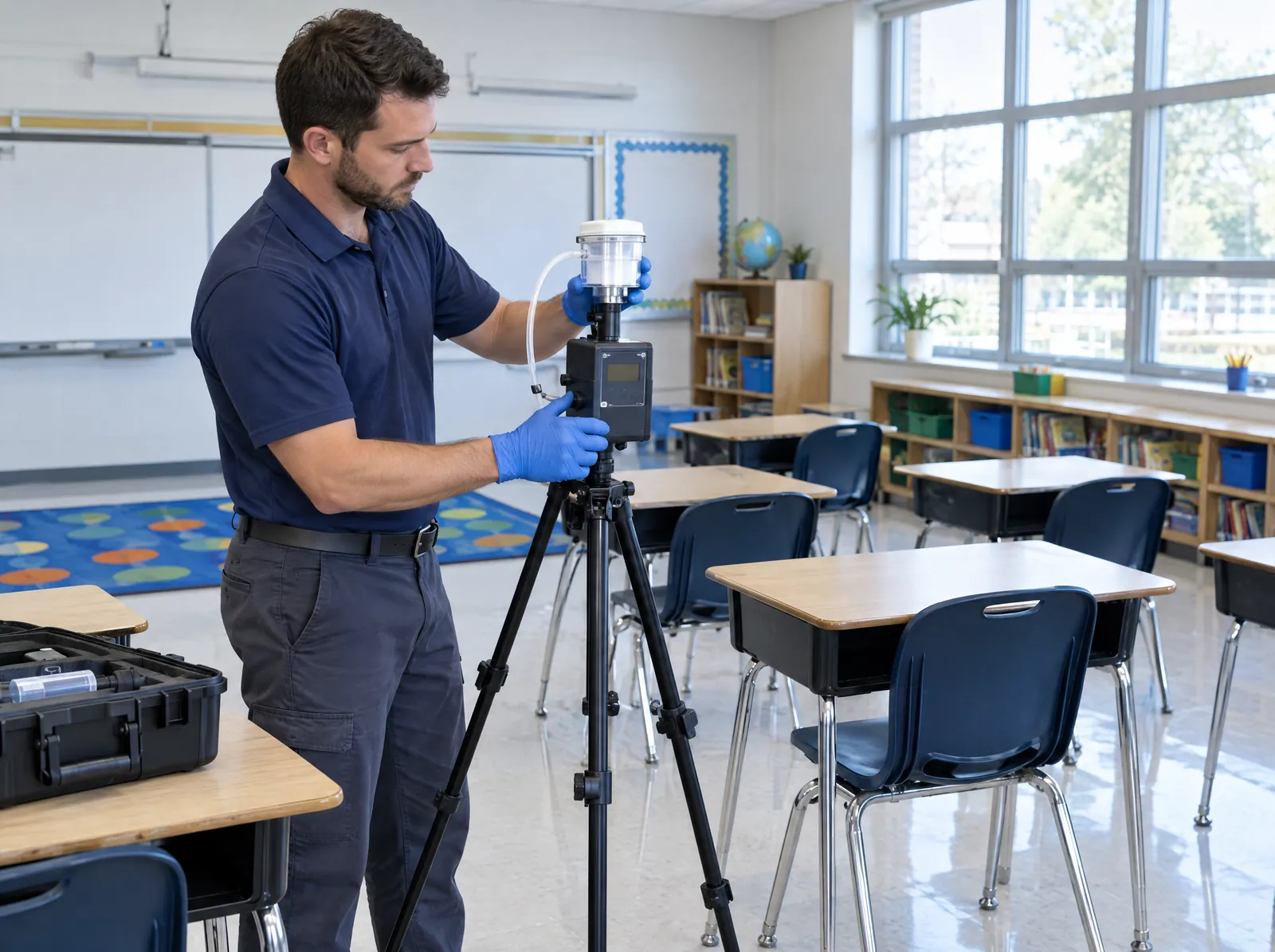
What does commercial mold remediation in Indiana involve?
Commercial mold remediation in Indiana means removing mold from occupied buildings like schools, offices, apartments and churches without putting occupants at risk or shutting down more of the building than necessary. It includes testing to define the scope, a written plan, phased containment, removal and cleaning, HVAC work where needed, and clearance testing. Because Indiana doesn't license mold remediators, documentation and independent lab results carry extra weight.
Why commercial mold jobs go wrong
In a commercial building, the mold is only half the problem. The other half is people: tenants asking questions, parents calling the principal, a board that wants a timeline, an insurer that wants paperwork, and an HVAC system that can carry contamination from one wing to another. A job that treats the building like a big house tends to miss that, and the complaints keep coming after the crew leaves.
Sound familiar?
- Occupants are complaining and you need a credible answer, fast.
- You can't close the whole building while the work happens.
- Your board, insurer or attorney wants documentation, not reassurance.
- A previous contractor cleaned up, but the smell or complaints came back.
We do it differently.
| Typical commercial mold cleanup | AME commercial remediation | |
|---|---|---|
| Scope | Visible growth only | Defined by air, dust and mycotoxin testing |
| Occupancy | Close the building or work around people | Phased containment planned with your team |
| HVAC | Often left out | Assessed and cleaned where it spreads contamination |
| Records | An invoice | Test results, scope, photos and a clearance report |
| Reopening decision | The contractor's opinion | Independent lab results |

Why families trust us with their homes
-
Family-owned since 2008
A multigenerational family business. Not a franchise, not a private-equity rollup.
-
Credentialed where it isn't required
Indiana doesn't license mold remediators. We hold IICRC, CMR, CRMI and CCMI credentials anyway.
-
Called on as experts
Attorneys bring us into legal cases involving mold and mycotoxins.
-
Lab results in 24 to 48 hours
Every inspection comes with a written report, color photos and lab results.
- IICRC Certified Firm
- CMR
- CRMI
- CCMI
- BBB A+ Accredited
- NAMRI
- IAQA
- NORMI
- AMMA
- PMII
The AME Clearance Method
The AME Clearance Method for commercial buildings
Seven steps, sequenced so your building keeps operating wherever it safely can.
Talk to a specialist-
Assess and test
We walk the building with your facilities contact, then sample air, dust and surfaces, including mycotoxins, to map where contamination is and isn't.
-
Write the plan
A written scope covers work areas, sequencing, containment, occupant protection and what clearance looks like, so decision-makers can approve it with facts.
-
Correct the moisture
Roof leaks, plumbing failures, condensation and building envelope issues are identified so the right trade can fix them before or during our work.
-
Contain in phases
Work zones are sealed and kept under HEPA negative air, and we plan the order and timing of each zone with you so occupied areas stay protected.
-
Remove and clean
Contaminated porous materials are removed. Structure and contents are HEPA-vacuumed, wiped and treated with a plant-based enzyme product.
-
Address the HVAC
Air handlers, coils, drain pans and ductwork serving affected areas are assessed and cleaned so the system doesn't redistribute contaminated dust.
-
Clear and document
Clearance testing confirms each zone before it returns to use. You receive the full lab results and a report for your files.
What every commercial project includes
- A site walk with your facilities or property manager
- Pre-remediation air, dust and mycotoxin testing
- A written scope and work plan for approval
- Phased containment with HEPA negative air
- Removal of contaminated building materials
- HEPA cleaning of structure and contents
- HVAC assessment and cleaning where needed
- Clearance testing for each work zone, with lab results in 24 to 48 hours
- Photo documentation and a final report
- Test results you can share with occupants, boards and insurers

Proof you can hold in your hands
When we finish, you don't get a handshake and a promise. You get the paperwork your family, your doctor, your insurer or your buyer can rely on.
Inspection report
What we found, where it is coming from, with color photos.
Written remediation plan
Scope, timeline and what will and won't be removed, before work starts.
Clearance lab report
Air, surface and mycotoxin results after the work is done.
A report for your doctor
With your permission, we share results directly with your care team.
Commercial mold remediation in Indiana, explained
Buildings we work in
Every type of building has its own occupants, schedule and pressure points. We have separate pages for the facilities we’re asked about most:
- Mold remediation for schools: work planned around the school calendar, with results that administrators can share with families.
- Mold remediation for apartments: multi-unit access, occupied neighbors and shared building systems.
- Mold remediation for offices: phased zones so business can continue elsewhere in the building.
- Mold remediation for churches: older buildings, basements and fellowship halls, scheduled around services.
- Mold remediation for healthcare facilities: coordination with the facility’s infection prevention team.
- Mold remediation for daycares: small children, strict cleanliness and parents who want proof.
Where commercial mold starts
Commercial buildings rarely grow mold for mysterious reasons. The usual causes in Indiana are flat or low-slope roofs that leak slowly, plumbing failures inside walls and above ceiling tiles, condensation on cold pipes and ductwork during humid summers, and HVAC systems where drain pans back up or outside air brings in more humidity than the equipment can remove. Buildings that sit partly empty, such as a school over summer break, can see humidity climb when systems are set back.
Ceiling tiles and drywall are the first places it shows, but not always the worst. Mold behind vinyl wall covering on exterior walls, inside unit ventilators and in return air plenums often goes unnoticed until someone complains of a smell.
Testing that holds up to scrutiny
Facility managers answer to other people, so opinions aren’t enough. We define scope with air sampling, settled dust testing and, where it’s warranted, a mycotoxin panel. The same tests are repeated after the work, zone by zone, so you can show that each area met clearance before it reopened. The EPA’s guidance document, Mold Remediation in Schools and Commercial Buildings, is a useful reference for boards and administrators who want to understand the general approach. Our indoor air quality testing in Indiana page explains the sampling methods.
Working in occupied buildings
Containment is what makes it possible to keep a building open. Each work zone is sealed with plastic barriers and a zippered entry, kept under negative pressure with HEPA air scrubbers, and isolated from the HVAC system serving occupied areas. Debris is bagged inside containment. We plan the sequence of zones and the hours we work with your team, and we tell you in advance when an area will be off-limits.
Why mycotoxins matter in commercial buildings
When occupants still report problems after a building “passed” a visual check, mycotoxins in settled dust are one of the things we look for. They stay behind after mold is killed, and a shared HVAC system can move that dust well beyond the original leak. Testing for them before and after is what separates our clearance from a walk-through.
We remove mold and mycotoxins from buildings. We don’t diagnose or treat medical conditions. Occupants with symptoms should work with a doctor. With your permission, we’re glad to share test results with them.
Common questions
Have a question that isn't here? Call a specialist
Can the building stay open during mold remediation?
Often, yes. With sealed containment, negative air and careful sequencing, many projects proceed while other parts of the building stay occupied. Whether that's appropriate depends on the extent of contamination, the HVAC layout and who uses the space. We decide it with you, based on test results.
Does Indiana require a license for commercial mold remediation?
No. Indiana doesn't license mold remediators, for residential or commercial work. We hold IICRC Certified Firm status and CMR, CRMI and CCMI credentials, and we test before and after every job.
How do you communicate with tenants, staff or parents?
We can provide plain-language summaries of the plan and the test results for you to share, and we can answer technical questions from your board or leadership. What gets communicated, and to whom, stays your decision.
Can you provide documentation for insurance or legal matters?
Yes. Every project produces lab results, a written scope and a clearance report. Attorneys also bring us into legal cases involving mold and mycotoxins, so we understand the value of careful records.
Do you handle mold in multifamily buildings?
Yes. Apartment work often means coordinating access across several units, protecting occupied neighbors and sorting out whether a shared system like a roof or plumbing stack caused the problem.
Do you work outside Indianapolis?
Yes. Commercial projects are run from our Avon office. We work across Indiana and travel to Ohio, Kentucky, Illinois and Michigan, and we plan crew scheduling as part of the written scope.
We're done when the lab says so.
Every remediation ends with clearance testing, and our work is backed by a complete-removal guarantee. We don't close a job on a failed result.
Talk to a specialistPlan your commercial project with us
Tell us about the building, who uses it and what's been reported. A specialist will call you back to talk through testing and next steps.
- (833) 772-6653
- info@americanmoldexperts.com
- Open 7 days, 8am to 8pm