
For facility directors, building owners and office managers
Office mold remediation in Indiana
After-hours work, isolated air paths and lab clearance, so the business keeps running around the job.
What does office mold remediation in Indiana involve?
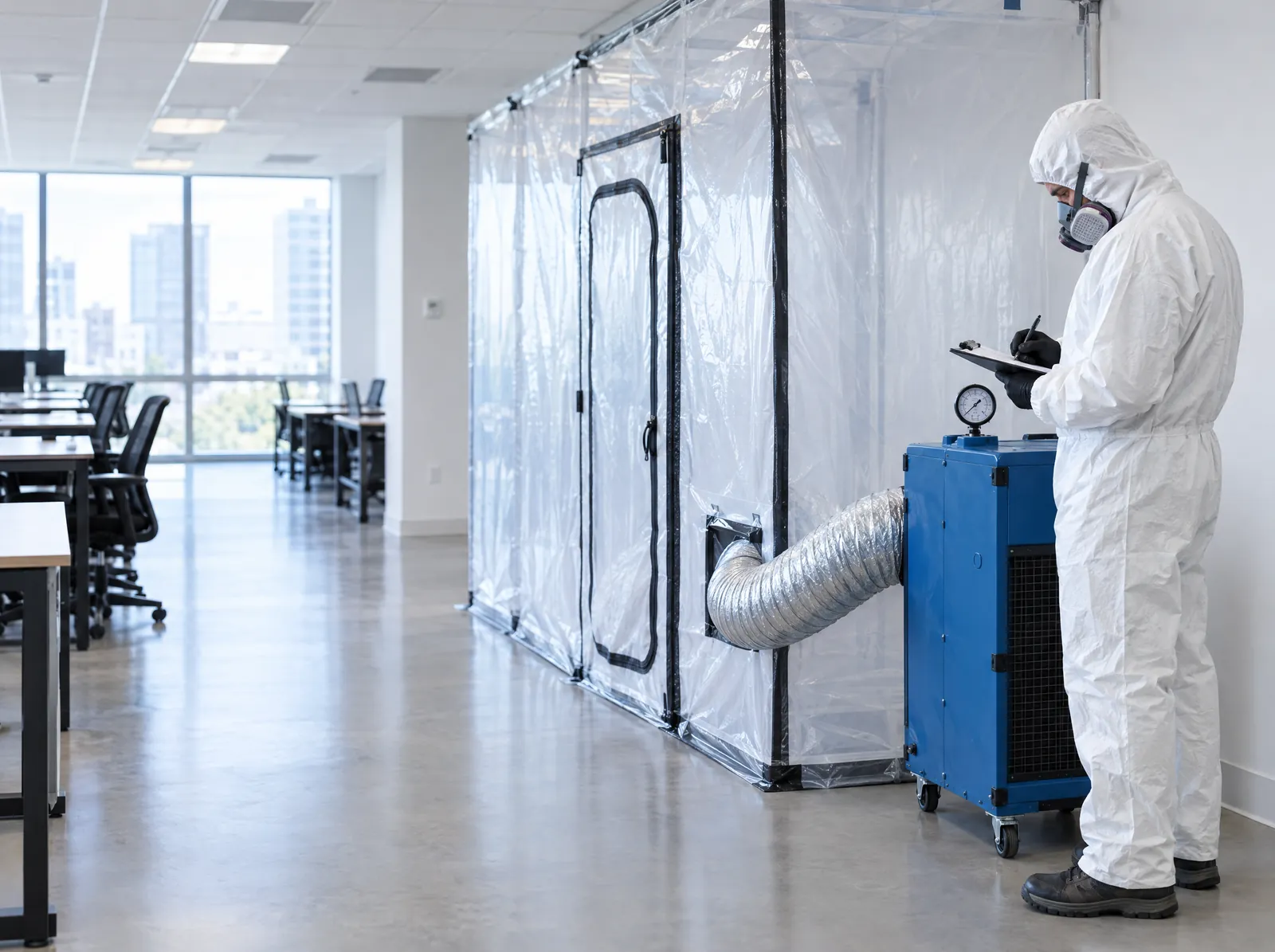
Office mold remediation in Indiana removes mold from suites, common areas and building systems while the business keeps operating. Most of the work is scheduled after hours or over weekends, containment is extended into the ceiling space so the plenum doesn't carry dust to other suites, and equipment and files are protected or cleaned. Clearance testing confirms each area before staff return, and the owner receives records that answer tenants, employees and insurers.
The office has to open on Monday
Offices rarely have a good week to close. Staff need their desks, tenants have leases that promise usable space, and IT rooms, files and client meetings don't move easily. The building also hides the problem well: above a dropped ceiling, the open plenum often doubles as the return air path, so dust from one suite can travel to the next without anyone seeing it. A job that ignores that space tends to produce the next complaint two doors down.
Sound familiar?
- Employees are raising concerns, and HR wants something concrete to share.
- A tenant is asking whether their suite is safe and what you're doing about it.
- You can't lose working days, and the work has to happen around the business.
- Stained ceiling tiles keep coming back after being swapped out.
We do it differently.
| Swap the tiles and repaint | AME office remediation | |
|---|---|---|
| Ceiling space | Replace the stained tile | Inspect and contain the plenum above it |
| Hours | During the workday | Evenings and weekends, planned with building management |
| Air paths | Not considered | Returns and supply serving the area isolated during work |
| Contents | Moved around | Equipment, furniture and files protected or HEPA cleaned |
| Handoff | Crew leaves a note | Clearance results before staff come back in |

Why families trust us with their homes
-
Family-owned since 2008
A multigenerational family business. Not a franchise, not a private-equity rollup.
-
Credentialed where it isn't required
Indiana doesn't license mold remediators. We hold IICRC, CMR, CRMI and CCMI credentials anyway.
-
Called on as experts
Attorneys bring us into legal cases involving mold and mycotoxins.
-
Lab results in 24 to 48 hours
Every inspection comes with a written report, color photos and lab results.
- IICRC Certified Firm
- CMR
- CRMI
- CCMI
- BBB A+ Accredited
- NAMRI
- IAQA
- NORMI
- AMMA
- PMII
The AME Clearance Method
The AME Clearance Method for offices
Six steps, planned so the office loses as little working time as possible.
Talk to a specialist-
Scope with building management
We review complaints, lease boundaries, HVAC zoning and access rules with the building engineer or property manager, then test the complaint area, a comparison suite and outdoors.
-
Set the schedule and access
The written plan sets evening and weekend work windows, elevator and loading dock use, security access and which areas are off-limits on which days.
-
Isolate the air paths
Containment runs from floor to deck, not just to the ceiling grid. Returns and supply diffusers serving the work area are sealed so the plenum stays clean.
-
Protect what stays
Desks, computers, files and furniture are moved out, sealed in plastic or HEPA cleaned. Anything that can't be cleaned is flagged for the owner to decide.
-
Remove, clean and correct
Wet tiles, drywall and insulation come out inside containment, surfaces are HEPA cleaned, and the roof, plumbing or HVAC drain problem is handed to the right trade.
-
Clear before people return
Clearance sampling runs once cleaning is done, with lab results in 24 to 48 hours. Containment comes down and staff return when the results support it.
What an office project includes
- A scoping walk with the property manager or building engineer
- Air and surface sampling, with comparison and outdoor samples
- A written plan with work windows and access details
- Floor-to-deck containment with HEPA negative air
- Sealing of return and supply paths serving the work area
- Protection or HEPA cleaning of furniture, equipment and files
- Removal of affected ceiling tiles, drywall and insulation
- Clearance testing before staff or tenants reoccupy
- A report the owner can share with tenants, HR or an insurer

Proof you can hold in your hands
When we finish, you don't get a handshake and a promise. You get the paperwork your family, your doctor, your insurer or your buyer can rely on.
Inspection report
What we found, where it is coming from, with color photos.
Written remediation plan
Scope, timeline and what will and won't be removed, before work starts.
Clearance lab report
Air, surface and mycotoxin results after the work is done.
A report for your doctor
With your permission, we share results directly with your care team.
Office mold remediation, explained
The ceiling tells you where to look
A stained ceiling tile is the most common first sign of office mold, and the least reliable guide to its size. The water that caused it may have run along a pipe or the roof deck from somewhere else. The top of the tile, the insulation on nearby pipes and the underside of the deck can all hold growth that nobody sees from the floor. That is why we lift tiles well beyond the stain, check the plenum with moisture meters and a light, and trace the water back to where it came in.
Typical sources in Indiana office buildings include flat roof leaks after heavy rain or snowmelt, condensation on chilled water or refrigerant lines, overflowing drain pans in ceiling-mounted units, and restroom or break room plumbing. Our HVAC and duct mold in Indiana page covers what happens when the air handler itself is involved.
A typical after-hours schedule
Every building is different, but a moderate job in a single suite often runs something like this:
| When | What happens |
|---|---|
| Weekday, after close | Contents moved or sealed, containment built floor to deck, air paths sealed |
| Weekend | Removal, HEPA cleaning and treatment inside containment |
| After cleaning | Clearance samples collected and sent to the lab |
| Results in | Containment removed, contents returned, area reopened |
Larger areas, or work that involves a shared air handler, take longer and are phased. We’ll lay out the sequence in writing before anything starts.
Owners, tenants and employees
In a multi-tenant building, three groups want answers at once: the owner, the tenant whose suite is affected, and that tenant’s employees. We work for whoever hires us and keep communication to what they authorize, but we write our summaries so they can be passed along without rewriting. When a tenant has hired its own consultant, we share our data with them if the owner agrees. Clear records also help if the question of who pays ends up with an insurer.
Treatment and cleaning
After removal, framing and surfaces inside containment are HEPA vacuumed, wiped and treated with a plant-based enzyme product that breaks down mold and mycotoxins without harsh lingering fumes. We use products from US Enzyme. Each zone is then verified with clearance testing before people return.
We remove mold and mycotoxins from buildings. We don’t diagnose or treat medical conditions. Employees with symptoms should see a doctor, and with the owner’s permission we’re glad to share test results with them.
Common questions
Have a question that isn't here? Call a specialist
Can you do the work at night and on weekends?
Yes, and most office projects are done that way. The plan accounts for building security, elevator access and cleanup so the space is presentable when people arrive. Containment for a larger area may stay up across several workdays, sealed and marked off.
Why do you care about the space above the ceiling?
In many office buildings, the space above the ceiling tiles is the return air path. Mold on the top of a tile, on pipe insulation or on the deck can shed dust that travels through the building. If the plenum isn't inspected and contained, the problem can reappear somewhere else.
Who is responsible in a leased office, the landlord or the tenant?
It usually depends on the lease and on what caused the water. Roof, envelope and base building systems are often the landlord's; damage a tenant caused may be theirs. We document the cause so both sides are working from the same facts.
Do employees need to leave the building?
Not usually. Staff stay out of the contained area and, when needed, the rooms next to it. If testing shows contamination spread through a shared air handler, the plan may close more space for a short period.
What can we tell employees?
We can write a short, plain-language summary of what was found, what's being done and how the area will be cleared. Sharing facts early usually heads off rumor. What goes out is your decision.
Can computers, files and furniture be cleaned?
Most hard items and electronics can be HEPA vacuumed and wiped. Paper files and fabric chairs depend on how exposed they were. We'll show you what the testing supports before anything is discarded.
We're done when the lab says so.
Every remediation ends with clearance testing, and our work is backed by a complete-removal guarantee. We don't close a job on a failed result.
Talk to a specialistPlan office work that fits your week
Tell us about the building, the affected suite and when the space is empty. A specialist will call you back to talk through testing and scheduling.
- (833) 772-6653
- info@americanmoldexperts.com
- Open 7 days, 8am to 8pm