
For superintendents, facilities directors and principals
School mold remediation in Indiana
Scheduled around the calendar, contained away from students, and cleared by the lab before a classroom reopens.
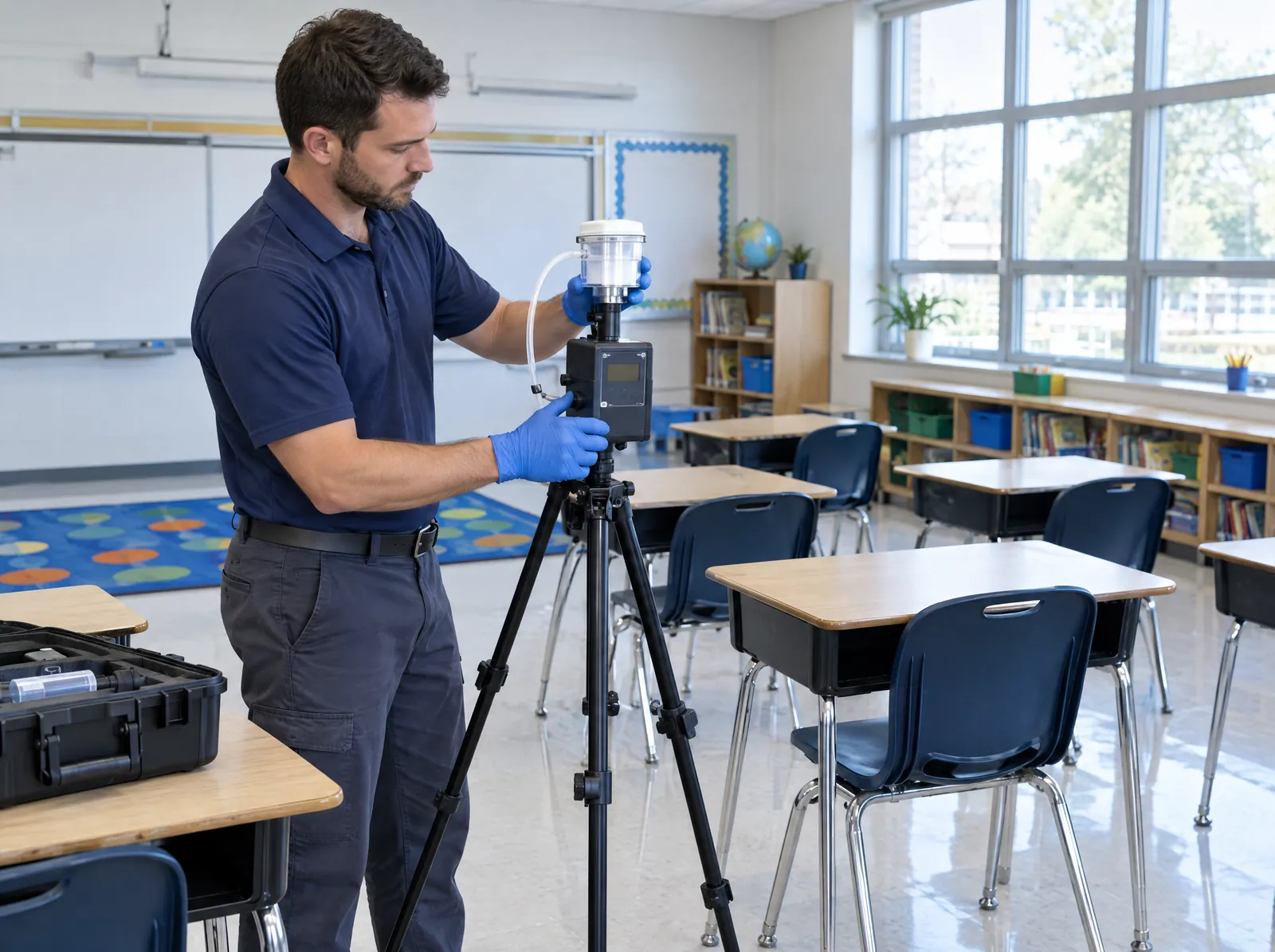
How does school mold remediation in Indiana work?
School mold remediation in Indiana is the contained removal of mold from classrooms, gyms, offices and mechanical spaces, planned around instruction time and student safety. It starts with testing to define the scope, then a written plan that sets work hours, containment and HVAC isolation. Removal, HEPA cleaning and clearance testing follow, and no room goes back into use until results support it. Records are organized so administrators can answer parents, staff and the board.
What makes a school different from any other building
A school can't close a wing for a week in October without consequences. Students need somewhere to learn, teachers need their rooms, and bus and lunch schedules don't bend. Every decision gets explained to parents. The building works against you too: unit ventilators in every classroom, long runs of ceiling tile, flat roofs, and gyms and locker rooms that stay humid.
Sound familiar?
- A teacher reported a musty room and parents are already asking questions.
- The only realistic work windows are nights, weekends and breaks.
- Your superintendent and board want the plan and timing in writing.
- You need to show a room is ready before students return, not just say so.
We do it differently.
| A general cleanup crew | AME school remediation | |
|---|---|---|
| Scheduling | Whenever the crew is free | Built around the school calendar and building use |
| Student protection | Close the door and tape the vents | Sealed containment, negative air and HVAC isolation |
| Scope | Stained tiles and visible growth | Defined by air, dust and surface testing, room by room |
| Communication | Left to the principal | Plain-language summaries for staff, parents and the board |
| Reopening a room | It looks clean | Clearance results reviewed before students return |

Why families trust us with their homes
-
Family-owned since 2008
A multigenerational family business. Not a franchise, not a private-equity rollup.
-
Credentialed where it isn't required
Indiana doesn't license mold remediators. We hold IICRC, CMR, CRMI and CCMI credentials anyway.
-
Called on as experts
Attorneys bring us into legal cases involving mold and mycotoxins.
-
Lab results in 24 to 48 hours
Every inspection comes with a written report, color photos and lab results.
- IICRC Certified Firm
- CMR
- CRMI
- CCMI
- BBB A+ Accredited
- NAMRI
- IAQA
- NORMI
- AMMA
- PMII
The AME Clearance Method
The AME Clearance Method for schools
Six steps, fitted to the school day and the school year.
Talk to a specialist-
Walk the building with your team
We review complaint locations, repair history and HVAC zoning with your facilities director, then sample complaint rooms, comparison rooms and outdoor air.
-
Plan around the calendar
The written scope names the affected rooms, which work happens after dismissal, on weekends or over breaks, and where classes go if a room has to stay closed.
-
Prepare the communication
We draft a plain-language summary of findings and next steps for you to share with staff, families and the board. You decide what goes out and when.
-
Contain away from students
Work zones are sealed, held under HEPA negative air and isolated from the unit ventilators or air handlers serving occupied classrooms. Entrances sit away from student traffic.
-
Remove, clean and fix the source
Wet ceiling tiles, drywall and insulation are bagged inside containment, surfaces are HEPA vacuumed and wiped, and the water source goes to the right trade.
-
Clear each room before reuse
Clearance sampling is repeated in every work zone, with lab results in 24 to 48 hours. A room goes back to its teacher only when the results support it.
What a school project includes
- A site walk with facilities staff and building administrators
- Air, dust and surface sampling, with mycotoxin testing where warranted
- A written scope with work hours tied to your calendar
- Recommendations for relocating classes during the work
- HEPA negative-air containment isolated from occupied zones
- Assessment of unit ventilators and air handlers serving affected rooms
- A plain-language summary you can share with families
- Room-by-room clearance testing before reoccupancy
- Photo documentation and a closeout report for district files

Proof you can hold in your hands
When we finish, you don't get a handshake and a promise. You get the paperwork your family, your doctor, your insurer or your buyer can rely on.
Inspection report
What we found, where it is coming from, with color photos.
Written remediation plan
Scope, timeline and what will and won't be removed, before work starts.
Clearance lab report
Air, surface and mycotoxin results after the work is done.
A report for your doctor
With your permission, we share results directly with your care team.
Mold in Indiana schools, explained
Why Indiana school buildings grow mold
Flat and low-slope roofs leak at drains, seams and rooftop unit curbs, and the first sign is often a stained ceiling tile in a classroom below. Unit ventilators pull in outside air under each window, and their coils and drain pans stay wet through the cooling season. Buildings with several additions also leak where one era of construction meets another.
Summer is its own risk. When HVAC is set back over a humid Indiana summer, indoor humidity can climb for weeks unnoticed, and custodians open a classroom in August to find mold on desks and shelves. That is usually a humidity problem, not a leak, and it needs a different fix.
Using the EPA’s school guidance
Two EPA resources come up in almost every school project. The first is Mold Remediation in Schools and Commercial Buildings, which ties the level of containment and protection to the size of the affected area: under 10 square feet, 10 to 100 square feet, and more than 100 square feet. The second is the EPA’s Indoor Air Quality Tools for Schools program, which helps districts build an internal team and handle complaints consistently.
If your district uses Tools for Schools, our findings slot into that process. Either way, our indoor air quality testing in Indiana gives your team data rather than impressions.
Choosing the work window
Timing is usually the hardest part of the plan:
| Work window | Usually suits | Watch for |
|---|---|---|
| After dismissal | Small areas in a single room with its own air supply | After-school programs and evening events |
| Weekends | Moderate areas that need containment up for a few days | Athletics and community use |
| Fall, winter or spring break | Multiple rooms, a hallway or work on a shared air handler | Clearance results have to be back before students return |
| Summer | Large areas and HVAC cleaning | Summer school and camps |
Build clearance into the schedule, not after it. Lab results come back in 24 to 48 hours, so the last day of work can’t be the night before classes resume.
When the air system is involved
It gets harder when the source is an air handler serving a whole wing, because contaminated dust can reach rooms that never had a leak. Settled dust testing, including mycotoxins when complaints persist, shows how far it traveled. See HVAC and duct mold in Indiana and post-remediation verification for how each zone is cleared.
We remove mold and mycotoxins from buildings. We don’t diagnose or treat medical conditions. Students or staff with symptoms should see a doctor, and with the district’s permission we’re glad to share test results with them.
Common questions
Have a question that isn't here? Call a specialist
Can school stay in session during mold remediation?
Often, yes. Small and moderate areas can usually be contained and worked after dismissal or on weekends. Larger areas, or contamination in an air system serving many classrooms, may need a break or relocated classes. Test results and the HVAC layout decide it.
What do the EPA size categories mean for our building?
The EPA's Mold Remediation in Schools and Commercial Buildings groups problems by the size of the affected area: under 10 square feet, 10 to 100 square feet, and more than 100 square feet. Larger areas call for more containment and protection. We use those tiers as a starting point and adjust for who uses the space.
Are there Indiana rules we need to follow?
Indiana doesn't license mold remediators. State health rules on indoor air quality may still apply to your school, so confirm your obligations with district counsel or the Indiana Department of Health. We'll work to whatever protocol your district adopts.
What should we tell parents?
Facts, early. Most districts share what was found, where, what's being done and how rooms will be cleared before reuse. We can write the summary in plain language and join a board call. What gets shared stays your decision.
Should we test the whole building or just the complaint rooms?
Usually complaint rooms plus comparison rooms, on the same and on different air handlers, with outdoor samples. That shows whether the problem is local or moving through the system.
Can you work with our IAQ coordinator or an outside consultant?
Yes. If your district has an indoor air quality coordinator, or has hired an independent consultant to write the protocol, we work to that plan and share all of our records with them.
We're done when the lab says so.
Every remediation ends with clearance testing, and our work is backed by a complete-removal guarantee. We don't close a job on a failed result.
Talk to a specialistPlan the work around your school calendar
Tell us what's been reported, which rooms are involved and when the building is empty. A specialist will call you back to talk through testing and scheduling.
- (833) 772-6653
- info@americanmoldexperts.com
- Open 7 days, 8am to 8pm