
For center directors, owners and home providers
Daycare mold in Indiana, removed and verified
Worked after hours, cleaned to a child's level, and cleared by the lab before children return to the room.
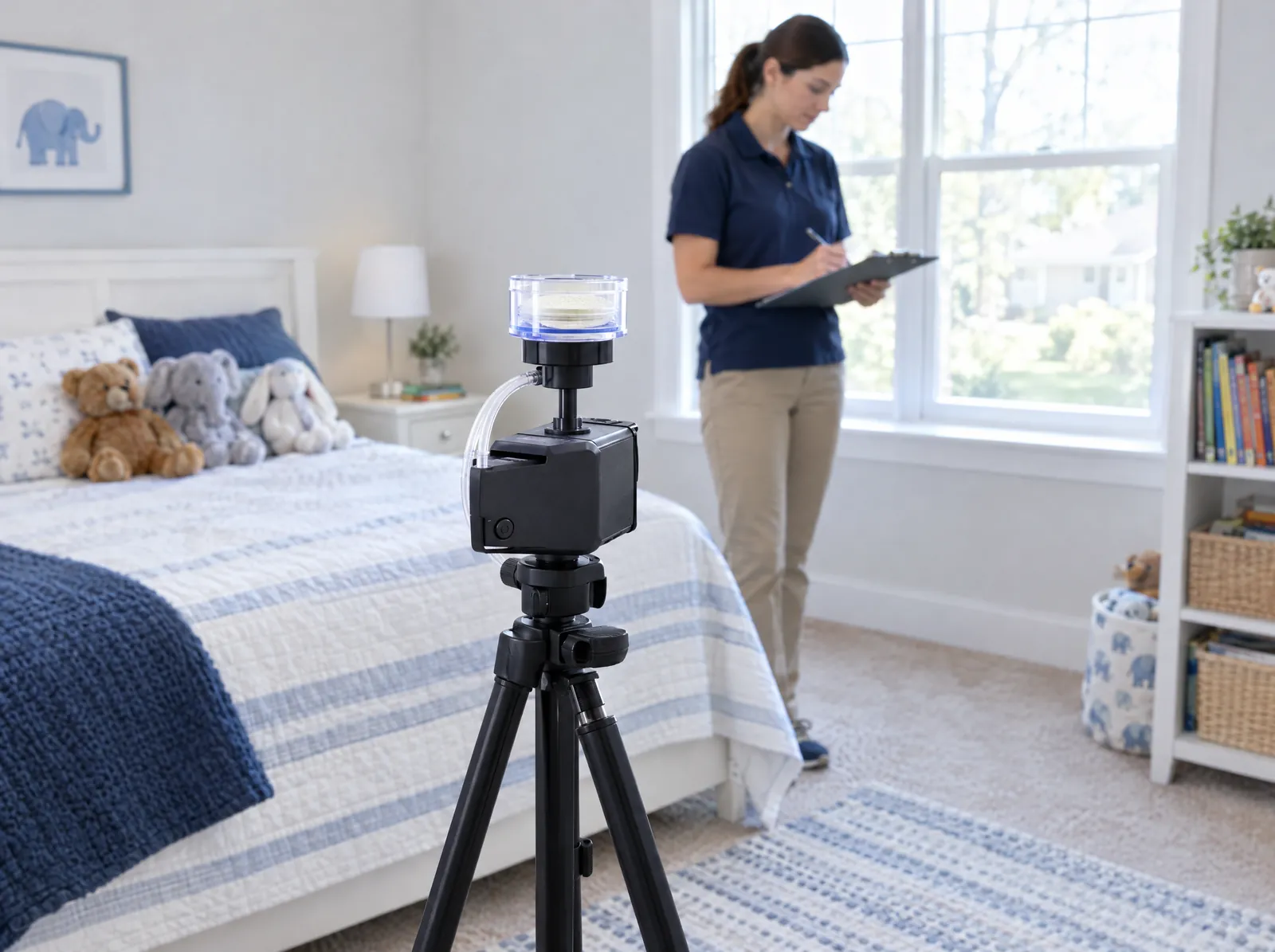
What should a director do about daycare mold in Indiana?
Daycare mold in Indiana calls for testing first, then contained removal scheduled when children aren't present, and clearance testing before a room is used again. Because young children spend their day near the floor, testing and cleaning focus on settled dust and surfaces at their height, including toys, cots and mats. Directors should also contact their child care licensing consultant early, since state licensing rules apply to the building and its use.
Small children, working parents and a licensed building
A daycare can't send children home for a week without affecting every family on the roster. Parents rely on the schedule, staffing ratios have to hold, and closing a classroom means squeezing children into the rooms that are left. At the same time, the people in the building are the youngest you'll find anywhere. They crawl, nap on mats, put toys in their mouths and breathe close to the floor, where settled dust collects. And the center answers to a licensing consultant as well as to parents.
Sound familiar?
- A staff member found mold behind a cubby, under a sink or in the nap room.
- Parents are asking questions, and some have already heard about it.
- You can't close the center without losing families or revenue.
- You're not sure what your licensing consultant needs to know.
We do it differently.
| A general mold cleanup | AME daycare remediation | |
|---|---|---|
| Testing height | Air at standing height | Settled dust and surfaces where children play and nap |
| Timing | During the day | After closing, weekends or planned room closures |
| Products | Biocides and fogging | HEPA cleaning and plant-based enzyme treatment |
| Contents | Not addressed | Toys, cots, mats and soft items sorted and cleaned |
| Parents | No information | A plain-language summary the director can share |

Why families trust us with their homes
-
Family-owned since 2008
A multigenerational family business. Not a franchise, not a private-equity rollup.
-
Credentialed where it isn't required
Indiana doesn't license mold remediators. We hold IICRC, CMR, CRMI and CCMI credentials anyway.
-
Called on as experts
Attorneys bring us into legal cases involving mold and mycotoxins.
-
Lab results in 24 to 48 hours
Every inspection comes with a written report, color photos and lab results.
- IICRC Certified Firm
- CMR
- CRMI
- CCMI
- BBB A+ Accredited
- NAMRI
- IAQA
- NORMI
- AMMA
- PMII
The AME Clearance Method
The AME Clearance Method for daycares
Six steps, planned so children are never in or near active work.
Talk to a specialist-
Test at a child's level
We sample the air and the settled dust on floors, shelves and play surfaces in affected rooms, plus a comparison room and outdoors.
-
Plan with the director
The written scope covers which rooms close and for how long, where children go, and what the director should raise with the licensing consultant before work begins.
-
Work when children are gone
Containment goes up after closing or on a weekend. Rooms under containment stay locked and signed until clearance passes.
-
Sort toys, cots and soft items
Hard toys and furniture are HEPA cleaned. Mats, cots and fabric items are cleaned or set aside for the director to replace, based on exposure.
-
Remove, clean and treat
Affected materials come out inside containment, and surfaces are HEPA vacuumed, wiped and treated with a plant-based enzyme product.
-
Clear before children return
Clearance testing includes settled dust at play height, with lab results in 24 to 48 hours. Rooms reopen only when results support it.
What a daycare project includes
- Air and settled dust testing at children's height
- A written scope the director can share with the licensing consultant
- Work scheduled after closing or on weekends
- Sealed, locked containment with HEPA negative air
- Cleaning of hard toys, furniture and cubbies
- Guidance on mats, cots and soft items to replace
- Moisture source findings for the owner or landlord
- Clearance testing before children reoccupy a room
- A plain-language summary for parents

Proof you can hold in your hands
When we finish, you don't get a handshake and a promise. You get the paperwork your family, your doctor, your insurer or your buyer can rely on.
Inspection report
What we found, where it is coming from, with color photos.
Written remediation plan
Scope, timeline and what will and won't be removed, before work starts.
Clearance lab report
Air, surface and mycotoxin results after the work is done.
A report for your doctor
With your permission, we share results directly with your care team.
Mold in child care settings, explained
Why daycares need a different plan
Most mold guidance is written with adults in mind. Children in child care spend much of the day at floor level, where settled dust collects, and they touch everything. That shapes how we test and how we clean. Air samples taken at standing height tell only part of the story, so we add settled dust and surface samples from floors, low shelves, cubbies and nap areas. Cleaning follows the same logic: the surfaces a child reaches get the most attention. Our page on mold and children explains why families pay close attention to this.
Start with your licensing consultant
Indiana has licensing rules for child care, and they reach the building children use. We won’t guess at what your program’s rules require, and the answer can differ by program type. The practical step is simple: call your licensing consultant as soon as you know there is a problem, share the test results and the written plan, and ask what they need to see before and after the work. Keep a copy of that conversation with our report.
Where daycare mold shows up
- Under sinks and changing stations. Constant handwashing and small, unnoticed leaks soak cabinet bases.
- Behind cubbies and shelving on exterior walls, where air doesn’t move.
- Nap rooms, which are often kept dark and closed with little airflow.
- Lower-level classrooms in church and shared buildings, where basement moisture is common.
- Around window units and HVAC closets in converted houses and storefronts.
Keeping parents informed
Parents usually hear something before the director is ready to explain it. A short, factual note works better than silence: what was found, where, what’s being done, when the room will reopen, and that it won’t reopen until lab testing confirms it. Offering to share the clearance summary answers the question most parents are really asking. For a center housed in a church, our church mold remediation page covers how we coordinate with the building’s owner.
We remove mold and mycotoxins from buildings. We don’t diagnose or treat medical conditions. Parents with concerns about a child’s health should talk with their pediatrician, and with the center’s permission we’re glad to share test results.
Common questions
Have a question that isn't here? Call a specialist
Do we have to tell our licensing consultant about mold?
Indiana has licensing rules for child care, and they cover the condition of the building. We don't advise on those rules. Call your licensing consultant before the work starts, share our findings and plan, and ask what they need from you.
Can children be in the building during remediation?
Not in or near the work area. Small, well-contained jobs are often done after closing or over a weekend so children never see the work. Larger areas may mean closing rooms, or the center, until clearance testing passes.
What happens to toys, cots and nap mats?
Hard plastic, wood and metal toys can usually be cleaned. Vinyl mats and cots often clean well too. Stuffed animals, fabric and foam items that were in the affected room are frequently better replaced. We'll base the recommendation on testing, not guesswork.
What products do you use around children?
We rely on HEPA vacuuming, detailed wiping and a plant-based enzyme product rather than fogging with harsh biocides. We use products from US Enzyme, and product information is available for your records.
What should we tell parents?
Most directors share what was found, which rooms are affected, what's being done and how the rooms will be cleared before children return. We can write a plain-language summary. What goes out, and when, is your decision.
Do you work with home-based child care providers?
Yes. In a home-based program, the home is both the family's residence and the child care space, so we plan around both schedules and share the same testing and clearance records.
We're done when the lab says so.
Every remediation ends with clearance testing, and our work is backed by a complete-removal guarantee. We don't close a job on a failed result.
Talk to a specialistTalk to us before you talk to parents
Tell us what staff found, which rooms are involved and your hours. A specialist will call you back to plan testing around your schedule.
- (833) 772-6653
- info@americanmoldexperts.com
- Open 7 days, 8am to 8pm