
Children's rooms and schools
Mold in kids' bedrooms, nurseries and schools
Where it comes from, what to do with toys and bedding, and how to raise concerns at school.
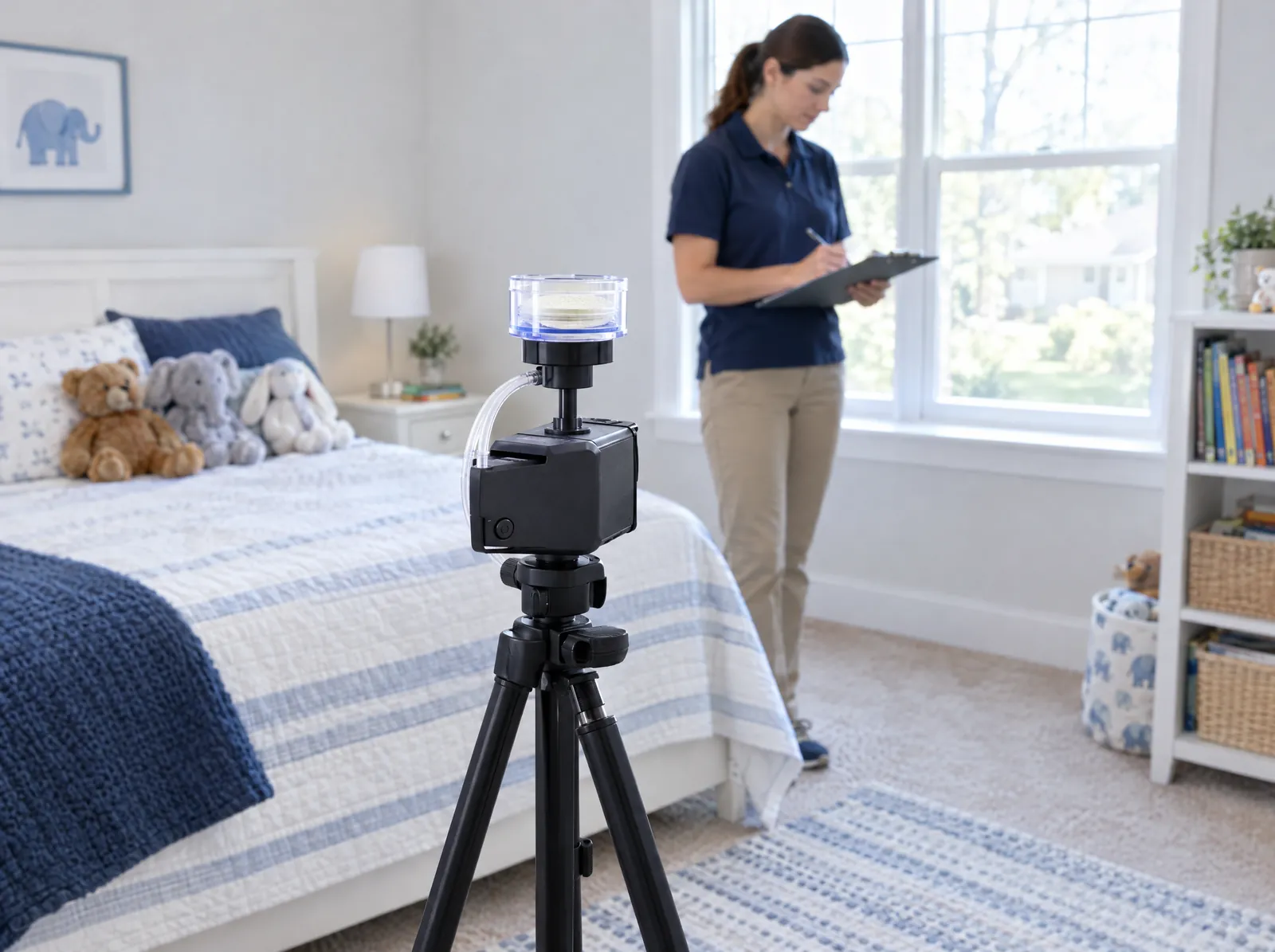
What should you do about mold in a kid's bedroom?
Mold in a kid's bedroom usually traces back to moisture: condensation on windows, a closet on a cold exterior wall, a humidifier running too long, or a leak in a wall or ceiling. Move your child to another room for now, don't scrub or disturb the growth, and have the room inspected so the source is found and fixed. Bedding and washable toys can often be laundered. Questions about your child's health belong with their pediatrician.
Why children's rooms deserve a closer look
Children spend long stretches in their bedrooms, sleeping, playing on the floor and napping with soft toys. Their rooms tend to hold more fabric per square foot than any other room in the house: rugs, stuffed animals, curtains, bean bags, closets full of clothes. All of it collects dust.
Kids' rooms also come with their own moisture sources. Cool-mist humidifiers and vaporizers run for hours. Windows fog up on winter mornings. Basement bedrooms sit below grade. And crib mattresses pushed against a cold exterior wall can trap condensation behind them without anyone seeing it.
Sound familiar?
- You found spots on the window sill or behind the dresser.
- The closet smells musty and you can't see why.
- You don't know which toys and bedding can be kept.
- You're worried about the classroom too, and don't know who to ask.
We do it differently.
| A quick wipe-down | A proper check of the room | |
|---|---|---|
| Source | Not looked for | Found and fixed: window, wall, humidifier or leak |
| Testing | None | The room sampled on its own, not averaged |
| Cleaning | Spray and wipe | Containment, removal where needed, HEPA cleaning |
| Toys and bedding | Left as they are | Sorted: launder, clean or replace |
| Back to bed | Right away | After the room passes clearance |

Why families trust us with their homes
-
Family-owned since 2008
A multigenerational family business. Not a franchise, not a private-equity rollup.
-
Credentialed where it isn't required
Indiana doesn't license mold remediators. We hold IICRC, CMR, CRMI and CCMI credentials anyway.
-
Called on as experts
Attorneys bring us into legal cases involving mold and mycotoxins.
-
Lab results in 24 to 48 hours
Every inspection comes with a written report, color photos and lab results.
- IICRC Certified Firm
- CMR
- CRMI
- CCMI
- BBB A+ Accredited
- NAMRI
- IAQA
- NORMI
- AMMA
- PMII
The AME Clearance Method
How we check and clean a child's room
A child's room gets the same careful process as the rest of the house, with the room treated as its own space rather than part of a whole-house average.
Talk to a specialist-
Hear the room's history
Leaks, humidifier use, window condensation, which wall the bed sits against and what's stored in the closet all help us find the source.
-
Inspect for the source
Moisture meters and a thermal camera on exterior walls, windows, the ceiling below any bathroom and the HVAC supply.
-
Sample the room on its own
Dust and air samples from the child's room are collected and reported separately, so you know what's in that room specifically.
-
Contain and clean
Containment keeps dust out of the rest of the house. Affected materials are removed, and the room is HEPA-vacuumed and wiped top to bottom.
-
Sort the soft things
Bedding, stuffed animals, rugs and clothes are sorted into launder, clean, hold or replace, with extra care for favorite items.
-
Clear it before bedtime
Clearance testing confirms the room before your child sleeps there again. You get the complete lab report.
What a child's room project includes
- A moisture inspection of walls, windows and ceiling
- Separate sampling for the child's room
- Mycotoxin testing where the situation calls for it
- Containment that protects the rest of the house
- Removal of damaged materials
- HEPA vacuuming and damp wiping, top to bottom
- A sorting plan for toys, bedding and clothes
- Clearance testing before the room is used again
- A report you can share with your child's doctor

Proof you can hold in your hands
When we finish, you don't get a handshake and a promise. You get the paperwork your family, your doctor, your insurer or your buyer can rely on.
Inspection report
What we found, where it is coming from, with color photos.
Written remediation plan
Scope, timeline and what will and won't be removed, before work starts.
Clearance lab report
Air, surface and mycotoxin results after the work is done.
A report for your doctor
With your permission, we share results directly with your care team.
Children, bedrooms and classrooms
Where mold hides in children’s rooms
When we inspect a child’s room, we look in the same handful of places first, because that’s where the moisture tends to be:
- Windows and sills. Warm, humid indoor air meets cold glass and condenses. The water runs down to the sill and the wall below it.
- Closets on exterior walls. A closed closet stays colder than the room, and a packed closet has no airflow. Look at the back wall and the floor corners.
- Behind the bed or dresser. Furniture pushed flat against an outside wall traps cool, damp air in the gap.
- Under a humidifier or vaporizer. Carpet, a rug or a nightstand under the mist can stay damp for months.
- Ceilings below a bathroom. A slow leak from a tub or toilet above often shows up as a faint stain or bubbling paint.
- Basement bedrooms. Below-grade walls are cooler and more humid, and carpet over concrete holds moisture.
What to do today
- Move your child to another room for now. It’s a simple step while you find out what’s going on.
- Don’t scrub, sand or spray the growth. Disturbing it sends particles into the air.
- Close the door. If the room has a supply vent, you can close it while you wait.
- Turn off any humidifier in the room.
- Take photos and note what you’ve seen and smelled, and for how long.
- Pull favorite toys and bedding out and launder whatever is washable.
If you’re weighing whether the room needs to be empty until it’s fixed, our short answer on whether kids should sleep in a room with mold covers the home side of that question.
Toys, bedding and keepsakes
This is the part that’s hardest for kids, and often for parents too. It helps to explain that some things are getting a bath and a few are getting replaced, and to let your child choose a favorite or two that get extra care. From the cleaning side:
| Item | Usual approach |
|---|---|
| Sheets, blankets, washable clothes | Launder, sometimes twice |
| Machine-washable stuffed animals | Launder and dry thoroughly |
| Plastic, wood and metal toys | Wipe or wash |
| Non-washable plush toys | Case by case, depending on how close they were to the growth |
| Crib and child mattresses | Often replaced if they were near the affected area |
| Books and art | Clean carefully, or photograph the artwork you want to remember |
Our guide to cleaning belongings exposed to mycotoxins goes into more detail on each material.
Setting the room up to stay dry
Once the room is clean, a few changes help keep it that way. Leave a small gap between furniture and outside walls. Keep a hygrometer in the room so you can see the humidity instead of guessing. Use washable bedding and store toys in bins with lids. Run a humidifier only when the reading calls for it, and clean it often. Our page on keeping a home low-mold has the full routine.
When the concern is at school or daycare
A parent can’t inspect a classroom, but you can ask good questions. Write to the principal or facilities manager, say what you’ve noticed and where (a musty smell, ceiling stains, a room that flooded), and ask how the school handles indoor air quality concerns. Many schools use the EPA’s Indoor Air Quality Tools for Schools guidance. Keep copies of everything, and ask for a written reply.
If the school or daycare decides to bring in a professional, the same principles apply: find the source, contain the work, test before and after. We work with administrators on those projects, and our page on mold remediation for daycares covers that kind of project from the facility’s side.
We remove mold and mycotoxins from buildings. We don’t diagnose or treat medical conditions, and nothing on this page is medical advice. Please bring any questions about your child’s health to their pediatrician or your family’s doctor. With your permission, we’re glad to share test results and our plan with them.
Common questions
Have a question that isn't here? Call a specialist
Should my child keep sleeping in a room with mold?
Most parents move their child to another room while the source is found and the room is cleaned, which is a sensible step. Questions about your child's health, including any symptoms, belong with their pediatrician.
Can I just clean the mold off the window sill myself?
Small spots of surface growth on a hard window sill can often be cleaned, but they're a sign of condensation that will keep coming back. Fix the humidity or window problem, and if the growth is on drywall or keeps returning, have it checked.
Can stuffed animals be saved?
Many machine-washable toys can be laundered. Toys that can't be washed, especially ones that sat close to the affected area, are harder to clean all the way through. A favorite can be set aside in a sealed bag while you decide.
Is a humidifier in a child's room a problem?
It can be if it runs too long or too high. Check the room's humidity with a hygrometer, keep it in a moderate range, and clean the humidifier as the manufacturer directs.
What if I think there's mold at my child's school?
Put your concern in writing to the principal or facilities office, describe what you've seen or smelled and where, and ask how the school handles indoor air quality. Keep copies of what you send and receive.
Do schools have to test for mold?
Requirements vary by state and district. Many schools follow voluntary guidance, such as the EPA's Indoor Air Quality Tools for Schools program. Ask your school or district what plan they follow.
Do you work in schools and daycares?
Yes. We handle commercial mold projects, including schools and daycares, and we can work with administrators and facilities staff on testing and remediation.
We're done when the lab says so.
Every remediation ends with clearance testing, and our work is backed by a complete-removal guarantee. We don't close a job on a failed result.
Talk to a specialistHave your child's room checked
Tell us what you've noticed in the room. A specialist will call you back to talk about an inspection and what to do in the meantime.
- (833) 772-6653
- info@americanmoldexperts.com
- Open 7 days, 8am to 8pm