
For Cape Coral families working with a doctor
Mycotoxin remediation in Cape Coral homes
Block homes, rebuilt walls and closed-up seasons. We remove the toxins, and an independent assessor checks our work.
What does mycotoxin remediation in Cape Coral involve?
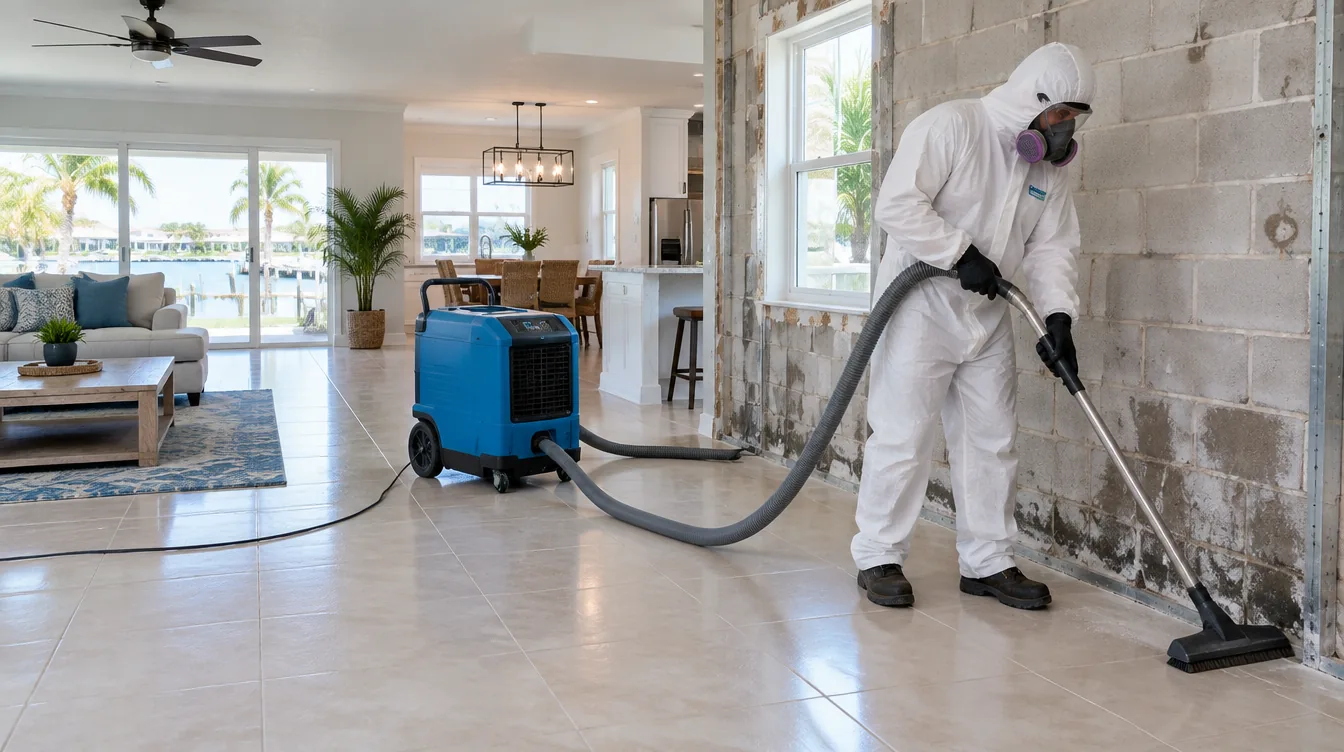
Mycotoxin remediation in Cape Coral removes mold and the toxins it leaves behind in a home's dust, wall cavities, AC system and belongings. Many Cape Coral homes are concrete block on slab, and many were flooded in Hurricane Ian and rebuilt quickly or sold. We fix the moisture source, contain, remove, HEPA-clean and enzyme-treat, and an independent licensed assessor tests before and after.
What we find behind Cape Coral's block walls
Cape Coral was planned from scratch. Development began in 1958, and the city now has more than 400 miles of canals lined with block homes built over six decades. That construction is strong against wind, but block walls, tile floors and drywall furred out over masonry all hide moisture well. After Ian flooded neighborhoods along the canals in 2022, thousands of homes flooded, and many were gutted, repaired and later sold. The families living in them now often have no record of how the drying was done.
Sound familiar?
- You bought a renovated Cape Coral home after Ian and don't know what's behind the new drywall.
- Your doctor suspects the house and you want proof, not guesses.
- The house was closed up all summer and smells musty every fall.
- A previous company sprayed and painted, and nothing changed.
We do it differently.
| Spray-and-paint mold work | AME mycotoxin remediation in Cape Coral | |
|---|---|---|
| Treatment | Biocide spray and a coat of paint | Removal, HEPA cleaning and enzyme treatment |
| Wall cavities | Left closed | Opened where the protocol calls for it, cleaned and treated |
| Post-Ian repairs | Assumed fine | Checked against the assessor's results |
| AC system | New filter | Air handler, coil and ducts cleaned where needed |
| Proof | A certificate from the same company | Clearance by an independent licensed assessor |

Why families trust us with their homes
-
Family-owned since 2008
A multigenerational family business. Not a franchise, not a private-equity rollup.
-
Trained and certified
Our team holds IICRC, CMR, CRMI and CCMI credentials in mold remediation and inspection.
-
Called on as experts
Attorneys bring us into legal cases involving mold and mycotoxins.
-
Documentation at every step
Photos, moisture logs and lab reports you can hand to your insurer or FEMA.
- IICRC Certified Firm
- CMR
- CRMI
- CCMI
- BBB A+ Accredited
- NAMRI
- IAQA
- NORMI
- AMMA
- PMII
The AME Clearance Method
Mycotoxin remediation in a Cape Coral home, in six steps
Testing first, by someone independent. Then the work, done in an order that keeps toxins from spreading.
Talk to a specialist-
Independent assessment
A licensed Florida mold assessor, independent of us, samples air and settled dust, runs a mycotoxin panel where warranted and writes the protocol.
-
Find the water
We trace moisture in the block, slab and AC system. Common sources here are sliding doors to the lanai, roof penetrations, plumbing walls and the air handler.
-
Contain
Sealed barriers and negative air separate the work from the rest of the house, so the family can often stay in unaffected rooms.
-
Remove and HEPA-clean
Contaminated drywall, furring strips, insulation and pad come out. Block, framing and slab are HEPA-vacuumed and wiped.
-
Treat toxins and the AC
Plant-based enzyme treatments go on cleaned surfaces and into cavities, and the air handler and ducts are cleaned where needed.
-
Independent clearance
The assessor retests before walls are closed. The report is yours to keep and share with your doctor.
What a Cape Coral mycotoxin project includes
- Coordination with an independent licensed mold assessor
- Moisture tracing in block, slab and the AC system
- Containment with negative air
- Removal of contaminated drywall, furring strips and insulation
- HEPA vacuuming and detailed wiping
- Enzyme treatment for mycotoxins
- Air handler and duct cleaning where needed
- A plan for belongings
- A clearance report you can share with your doctor

Proof you can hold in your hands
When we finish, you don't get a handshake and a promise. You get the paperwork your family, your doctor, your insurer or your buyer can rely on.
Inspection report
What we found, where it is coming from, with color photos.
Written remediation plan
Scope, timeline and what will and won't be removed, before work starts.
Clearance lab report
Air, surface and mycotoxin results after the work is done.
A report for your doctor
With your permission, we share results directly with your care team.
Mycotoxins in Cape Coral homes, explained
A planned city of block homes
Cape Coral began in 1957, when developers Leonard and Jack Rosen bought the land, and building started the next year. The city incorporated in 1970 and grew outward in waves, so a single street can hold a 1960s ranch, a 1990s pool home and a house finished last year. Almost all of them share the same basic build: concrete block walls, stucco outside, drywall and tile inside, a slab floor, an attached garage and often a screened pool lanai.
That build is what shapes mycotoxin work here. Mold in a Cape Coral home rarely shows up in the middle of a wall. It grows in the places where moisture collects and nobody looks:
- Behind drywall on exterior block walls, in the narrow gap over the furring strips
- Along the bottom of walls next to sliding doors that open onto the lanai
- Inside the AC closet, on the air handler cabinet, the coil and the drain pan
- Under kitchen and bathroom cabinets, where a slow leak can run for months
- In garage walls shared with bedrooms or the laundry room
- In closets on the west and south sides, where walls take the most sun and rain
Our guide to mold in concrete block homes explains why block holds water the way it does.
After Ian: rebuilt homes and new owners
The National Hurricane Center estimated 6 to 9 feet of flooding above ground in Cape Coral and the other communities at the mouth of the Caloosahatchee during Ian. The surge came in through the canals, flooding homes from the back yard and seawall side. In southwest Cape Coral, the storm destroyed the city’s Yacht Club, and nearby canal-front homes took salt water.
In the months that followed, contractors across the city cut out drywall and insulation, dried what they could and rebuilt. Many homes were then sold. Housing and insurance costs rose, and a lot of owners decided to leave. That means many Cape Coral families now live in homes repaired by someone they never met. Some of that work was careful. Some was fast. When walls were closed before the block behind them was dry, or cavities were never cleaned after the wet drywall came out, mold could return out of sight.
If someone in your household has developed symptoms their doctor connects to mold, the repair history matters. An independent assessor can compare dust from the rebuilt rooms with dust from rooms that never flooded, which helps show whether the problem is left over from the storm or something newer. Our guide to buying a home with mold in Florida covers what to ask before you close on a rebuilt home.
Seasonal homes and vacation rentals
Plenty of Cape Coral homes sit empty for part of the year, whether they belong to seasonal residents or are rented to visitors by the week. An empty house with the AC set high through a wet summer can grow mold in closets and cabinets without anyone noticing. Rental turnovers don’t help, because cleaners wipe what they can see. If you own a seasonal home, a humidity monitor you can check from your phone and a home watch service that opens the AC closet on every visit catch most problems early. Our page on seasonal-home mold has a longer checklist.
Why testing and removal are separate in Florida
Florida licenses mold assessors and mold remediators separately. Under Florida Statute 468.8419, an assessor may not remediate a structure it assessed within 12 months, and a remediator may not assess or clear a structure it remediated within 12 months. Certified Division I contractors are the exception. On our Cape Coral projects, an independent licensed mold assessor inspects and samples the home, writes the scope, and performs clearance testing. We do the remediation to that protocol.
For a family dealing with mold illness, that is reassuring. The company testing your home has no reason to find more mold than is there, and the company removing it can’t grade its own work. The assessor may use air sampling, dust-based mold testing such as ERMI or HERTSMI-2, and a mycotoxin panel on settled dust.
What happens to your belongings
For families dealing with mold illness, belongings are often the hardest part. Contaminated dust settles on everything in a room, and moving a sofa or a box of linens from a moldy house into a clean one can carry the problem with it. We go through it with you, room by room, based on what the assessor’s results show. Hard items like glass, metal, stone and finished wood can almost always be HEPA-vacuumed and wiped. Clothing and washable fabrics are often saved with repeated laundering. Mattresses, upholstered furniture, pillows and rugs from affected rooms are decided case by case, and many families replace them. Papers, books and electronics need individual judgment. Our page on mycotoxins on belongings explains the options in more detail.
Keeping a Cape Coral home dry afterward
Remediation removes what’s there. Keeping it from coming back depends on moisture, and in Cape Coral that mostly means the AC and the rain. After a project we’ll walk you through the house and point out the specific risks we found. For most homes the list looks like this:
- Keep indoor humidity in check. The EPA recommends staying below 60 percent, ideally between 30 and 50 percent, so use a humidity monitor rather than relying on the thermostat alone.
- Have the AC condensate drain line flushed and the drain pan checked on a schedule, not just when it overflows.
- Watch the sliding doors to the lanai. Worn seals and clogged tracks let summer rain reach the slab edge.
- Don’t set the AC too high when the house is empty for the summer. A cooler, drier house is far less likely to grow mold.
- Call early when something gets wet. A small leak dried in a day is a repair. The same leak found in October is a mold job.
Working alongside your doctor
Many families call us after a functional or integrative physician has suggested the house could be involved. With your permission, we’ll talk with that office, explain what the home results show and send them the clearance report. We’ll help you plan the practical side too: where the family sleeps during the work, what happens to mattresses and upholstered furniture, and how to keep the house dry afterward. We stay on the building side and leave health decisions to you and your doctor.
Our Southwest Florida team serves Cape Coral and the rest of Lee, Collier and Charlotte counties. American Mold Experts is family-owned and has been in business since 2008, and every project is backed by a complete-removal guarantee. We don’t close a job on a failed result.
We remove mold and mycotoxins from buildings. We don’t diagnose, treat or give medical advice, and home test results are not medical tests. Please rely on your doctor for health decisions. With your permission, we’ll share the results and our plan with them.
Common questions
Have a question that isn't here? Call a specialist
We're buying a Cape Coral home that was rebuilt after Ian. Should we test first?
If anyone in your family is sensitive to mold, it's worth considering. An independent licensed mold assessor can sample the home during your inspection period, and the results give you facts to negotiate with or walk away on. A standard home inspection isn't designed to find mycotoxins.
Do Cape Coral block homes need walls opened?
Not always. The assessor's results and moisture readings decide it. When mold has grown behind drywall on the inside of exterior block walls, opening the wall is usually the only way to clean and treat the cavity properly.
Who tests and clears the home?
An independent licensed mold assessor. Florida Statute 468.8419 generally bars a remediator from assessing or clearing a structure it remediated within 12 months, and bars an assessor from remediating one it assessed, with an exception for certified Division I contractors.
Can we stay in the house during the work?
Many families stay in the rooms outside containment. People who are sick from mold exposure often choose to stay elsewhere until clearance passes. That's a decision for you and your doctor, and we'll plan the work around it.
Should we remediate or sell?
It depends on how much of the home is affected, how sensitive your family is and what the testing shows. Some families remediate and stay. Others decide to move. Our guide on remediating or moving walks through the questions to ask.
Is a canal-front home more likely to have mycotoxins?
Not simply because it's on a canal. What matters is whether the house has been wet and how well it was dried. Canal-front homes in low areas were more likely to flood in Ian, so their repair history deserves a closer look.
We're done when the lab says so.
Every remediation ends with clearance testing, and our work is backed by a complete-removal guarantee. We don't close a job on a failed result.
Talk to a specialistTalk with us about your Cape Coral home
Tell us about the house, its storm history and what your doctor has asked. A specialist will call you back.
Not sure yet? Try the free AI Mold Risk Check