
Southwest Florida buyer's guide
Buying a house with mold in Florida
Mold doesn't have to kill a deal. Not knowing how far it goes can. Here's how to find out.
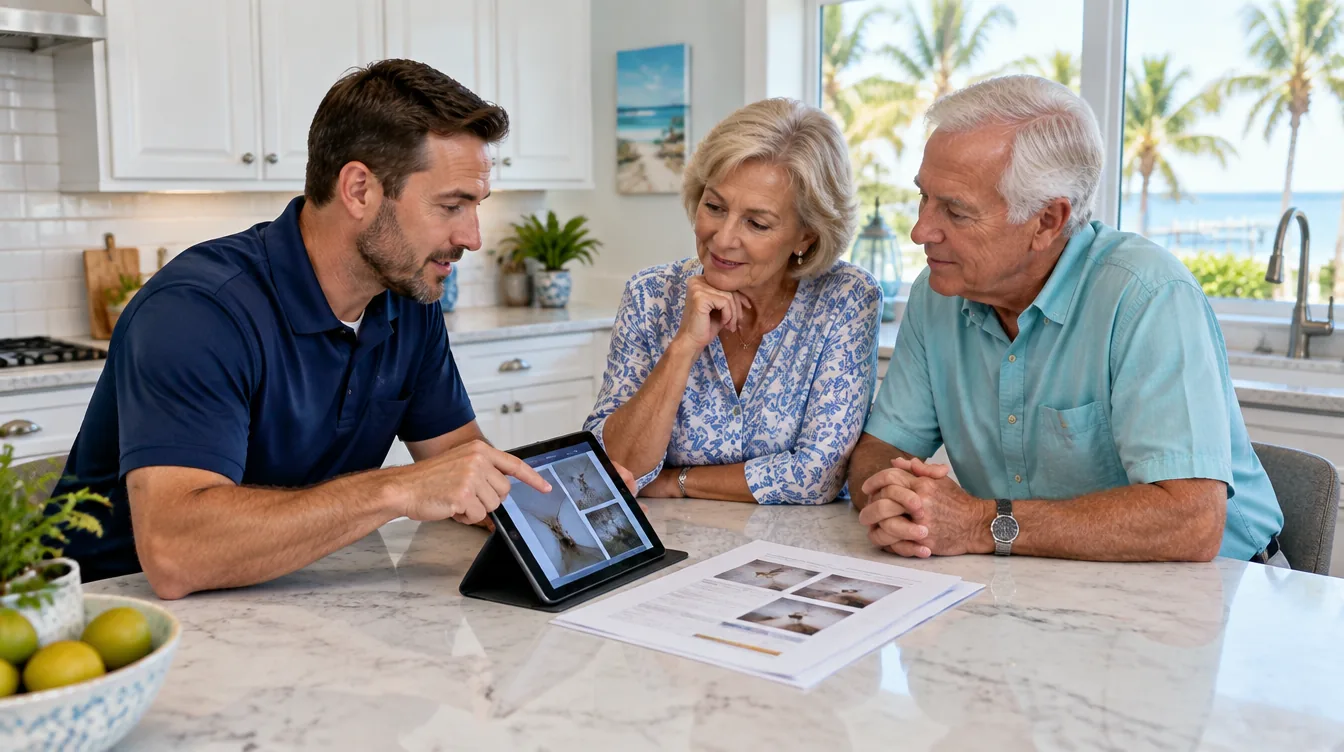
Can you buy a house with mold in Florida?
Yes. Buying a house with mold in Florida is common and often reasonable, as long as you know the cause, the extent and the cost to fix it before you close. Many Southwest Florida homes have had water from storms, AC problems or humidity at some point. The key steps are an independent mold assessment during your inspection period, a remediation scope based on that assessment, and clearance testing once the work is done.
Why mold is easy to miss in a Florida home purchase
Southwest Florida homes change hands quickly, often after a storm season, and many have been closed up for months. Fresh paint, new baseboards and a cold AC can hide a lot during a one-hour showing. A standard home inspection is mostly visual, and a musty smell is easy to write off in a house that has been sitting empty.
Sound familiar?
- The inspector noted a stain and a musty smell, and nothing more.
- The listing says the home was renovated after Hurricane Ian.
- Your inspection period ends in a few days.
- The seller says they don't know of any mold.
We do it differently.
| A typical purchase | A mold-aware purchase | |
|---|---|---|
| Inspection | Visual home inspection only | Home inspection plus independent mold assessment when there are signs |
| Storm history | Taken on the seller's word | Asked about, documented and checked with moisture readings |
| Fresh drywall | Seen as a plus | A reason to ask what was behind it and whether clearance was done |
| Repair cost | Guessed | Based on a written scope from the assessment |
| After closing | Hope it's fine | Clearance testing before you move in |

Why families trust us with their homes
-
Family-owned since 2008
A multigenerational family business. Not a franchise, not a private-equity rollup.
-
Trained and certified
Our team holds IICRC, CMR, CRMI and CCMI credentials in mold remediation and inspection.
-
Called on as experts
Attorneys bring us into legal cases involving mold and mycotoxins.
-
Documentation at every step
Photos, moisture logs and lab reports you can hand to your insurer or FEMA.
- IICRC Certified Firm
- CMR
- CRMI
- CCMI
- BBB A+ Accredited
- NAMRI
- IAQA
- NORMI
- AMMA
- PMII
The AME Clearance Method
How to check a Florida home for mold before you close
Your inspection period is short, so sequence matters. Six steps, in order.
Talk to a specialist-
Read the disclosures and ask direct questions
Ask about roof leaks, AC overflows, plumbing leaks, storm water, insurance claims and any mold work. Ask for the paperwork, including any prior clearance report.
-
Watch for Florida warning signs
Musty closets, stained ceiling vents, new drywall at the bottom of walls, a sweating AC closet and dehumidifiers running in an empty house all deserve a closer look.
-
Book an independent mold assessment
A licensed Florida mold assessor inspects, takes moisture readings and samples, and writes up where the mold is and what caused it. Book early in your inspection period.
-
Get a scope and a price for the fix
The assessor's scope tells a remediation company what needs removing and cleaning. A written remediation quote turns an unknown into a number you can negotiate on.
-
Decide with your agent and attorney
Repair credit, seller-paid remediation, a price change or walking away. Your contract terms and deadlines control which options you have.
-
Insist on clearance
If remediation happens before or after closing, the job should end with clearance testing by an independent assessor, and you should get the report.
Questions to ask the seller or listing agent
- Has the home taken on water in a hurricane or flood?
- Has there been an insurance claim for water or mold?
- Has the AC drain pan or line ever overflowed?
- Was any drywall replaced, and why?
- Was the home closed up for the season, and with what AC setting?
- Has mold ever been tested for or removed?
- Is there a clearance report from that work?
- Who did the work, and were they licensed?
- Are there roof, window or slider leaks you know of?
- Does the condo or HOA have records of water events?

Proof you can hold in your hands
When we finish, you don't get a handshake and a promise. You get the paperwork your family, your doctor, your insurer or your buyer can rely on.
Inspection report
What we found, where it is coming from, with color photos.
Written remediation plan
Scope, timeline and what will and won't be removed, before work starts.
Clearance lab report
Air, surface and mycotoxin results after the work is done.
A report for your doctor
With your permission, we share results directly with your care team.
Buying a Florida home with mold, explained
What makes Southwest Florida purchases different
After Hurricanes Ian, Helene and Milton, plenty of homes for sale in Lee, Collier and Charlotte counties have some history with storm water. Many were repaired well. Some were dried with fans, patched and painted. From the street, and often from inside, the two can look identical.
Part-time living adds another layer. A home that sat closed up through a Florida summer, with the AC off or set high, can grow mold on walls, furniture and cabinetry without a single leak. Sellers who were out of state for months may honestly not know. That’s why your own inspection matters more than anyone’s memory.
Home inspection versus mold assessment
A home inspector looks at the whole house: roof, structure, electrical, plumbing, AC. They may flag staining, a musty odor or signs of past water. That’s valuable, but it isn’t a mold assessment. Florida defines mold assessment in Chapter 468, Part XVI as sampling and evaluating a building to work out the origin, identity, location and extent of mold growth larger than 10 square feet, and it licenses mold assessors to do that work.
Florida also keeps assessment and removal apart. Under Florida Statute 468.8419, an assessor can’t remediate a home it assessed within 12 months, and a remediator can’t assess a home it remediated, with an exception for certified Division I contractors. For a buyer, that’s useful: the assessor has no reason to inflate the problem, and the remediator can’t sign off on its own work. Our national page on real estate mold inspections covers what sampling can and can’t tell you.
What sellers have to tell you
In Johnson v. Davis (1985), the Florida Supreme Court held that a seller of a home who knows of facts materially affecting its value, which are not readily observable and are not known to the buyer, has a duty to disclose them. That case involved a leaking roof, not mold, and it doesn’t settle what counts as known or material in your situation.
We’re not lawyers, and nothing here is legal advice. If you think a seller hid mold or water damage, or you’re deciding whether to cancel a contract, talk to a Florida real estate attorney before your deadlines pass. Our short answer on whether Florida sellers have to disclose mold is a starting point, not a substitute.
Reading the signs in a Florida house
- New drywall at the same height in several rooms. Often a flood cut. Ask when, why and whether clearance testing was done before the walls were closed.
- A dehumidifier running in an empty house. Sometimes good practice, sometimes a sign someone is managing a problem.
- Stains on ceiling vents or the AC closet. Point to humidity or condensate issues in the system that moves air through every room.
- Musty closets on exterior walls. Block walls can hold moisture behind drywall.
- Strong air fresheners or fresh paint on one wall. Worth a moisture reading.
If the assessment finds mold
Take the assessor’s report and scope to one or more remediation companies for written quotes. That gives you and your agent real numbers to work with. Many problems are very fixable: remove what can’t be saved, clean what can, correct the moisture source and confirm with clearance. On our Southwest Florida projects, an independent licensed mold assessor inspects and samples the home, writes the scope, and performs clearance testing. We do the remediation to that protocol, and the job is backed by a complete-removal guarantee. We don’t close a job on a failed result.
If someone in your family is sensitive to mold, ask the assessor about mycotoxin sampling as well. Our page on mycotoxin testing in Southwest Florida explains what it measures.
This guide is general information, not legal or medical advice. For questions about disclosure, contracts or your rights as a buyer, speak with a Florida real estate attorney. We remove mold and mycotoxins from buildings and don’t diagnose or treat medical conditions.
Common questions
Have a question that isn't here? Call a specialist
Should I walk away from a house with mold?
Not automatically. A small area from a fixed leak is a very different problem from mold throughout a flood-damaged home. The decision should rest on the cause, how far it has spread and the cost to fix it, all of which an assessment and a written scope can answer.
Does a Florida home inspection include mold testing?
Usually not. A standard home inspection is visual and may note signs of moisture or possible mold. Mold assessment, including sampling, is a separate service, and in Florida it's licensed separately from mold remediation.
Do Florida sellers have to disclose mold?
Under the Florida Supreme Court's decision in Johnson v. Davis (1985), a seller of a home who knows of facts that materially affect its value, which aren't readily observable and aren't known to the buyer, has a duty to disclose them. How that applies to your purchase is a question for a real estate attorney.
Can the company that finds the mold also fix it?
Generally not on the same home. Florida Statute 468.8419 bars a mold assessor from remediating a structure it assessed within 12 months, and bars a remediator from assessing one it remediated, with an exception for certified Division I contractors.
Is it safe to buy a house that already had mold remediation?
It can be. Ask for the assessment, the remediation scope and the clearance report, and check that the cause was fixed. If there's no clearance report, consider an independent assessment before you close.
Who pays for mold remediation when buying a house?
That's negotiable and depends on your contract. Buyers commonly ask for a price reduction, a credit or seller-paid remediation with clearance before closing. Your agent and attorney can tell you what your contract allows.
We're done when the lab says so.
Every remediation ends with clearance testing, and our work is backed by a complete-removal guarantee. We don't close a job on a failed result.
Talk to a specialistFound mold in a home you're buying?
Tell us what the inspection found and your deadline. A Southwest Florida specialist will call you back.
Not sure yet? Try the free AI Mold Risk Check