
Southwest Florida guide
Mold in concrete block and stucco homes
Block doesn't rot, but it holds water. What's fastened to it is where the mold grows.
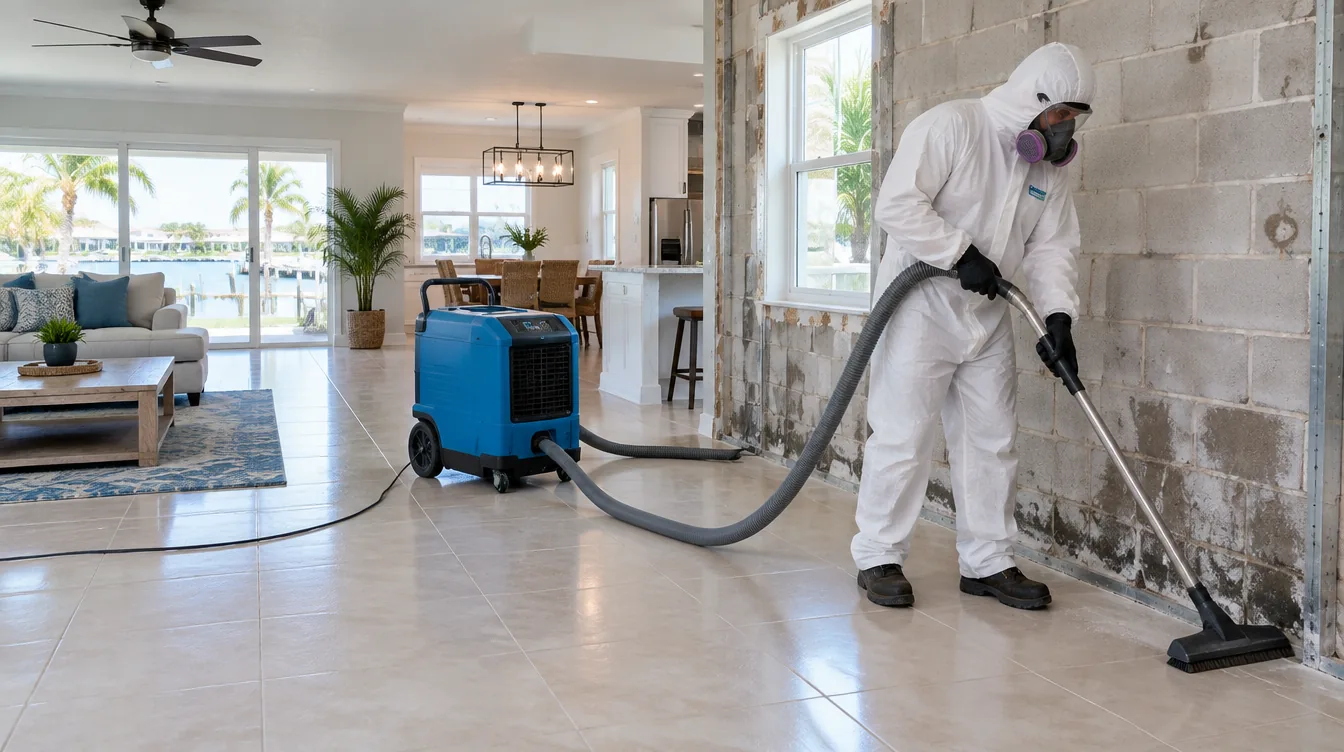
Why does mold grow in concrete block homes?
Mold in concrete block homes usually isn't growing on the block itself. Concrete block is porous, so it absorbs water from rain, stucco cracks, storm surge or humid air and releases it slowly. That moisture feeds mold on what's attached to the inside of the wall: drywall paper, wood furring strips, insulation, baseboards and the dust film on the masonry. Fixing it means drying the wall, removing damaged finishes and cleaning the block, not just painting it.
A strong wall that stays damp
Many Southwest Florida homes, from 1950s to 1970s ranches to newer subdivisions, are built from concrete block finished with stucco. Its weak point is moisture. Block soaks up water and gives it back over days or weeks, and the inside face of an exterior wall can run cooler than the room when the AC is on. Drywall fastened to that wall sits in a damp pocket that you can't see from the room.
Sound familiar?
- Baseboards on exterior walls are swollen or stained.
- The bottom of the drywall looks fine but the room smells musty.
- Paint is bubbling on the inside of a wall that faces the weather.
- Someone told you to seal the block and paint over it.
We do it differently.
| Quick fix on block walls | A lasting fix | |
|---|---|---|
| Moisture source | Assumed to be humidity | Stucco cracks, windows, surge and condensation checked one by one |
| Drywall | Painted over | Opened where readings show moisture or growth |
| Furring strips | Left in place | Inspected and removed if damp or growing |
| Block surface | Sprayed | HEPA vacuumed, cleaned and treated |
| Closing up | Right away | Only after the wall reads dry and clearance passes |

Why families trust us with their homes
-
Family-owned since 2008
A multigenerational family business. Not a franchise, not a private-equity rollup.
-
Trained and certified
Our team holds IICRC, CMR, CRMI and CCMI credentials in mold remediation and inspection.
-
Called on as experts
Attorneys bring us into legal cases involving mold and mycotoxins.
-
Documentation at every step
Photos, moisture logs and lab reports you can hand to your insurer or FEMA.
- IICRC Certified Firm
- CMR
- CRMI
- CCMI
- BBB A+ Accredited
- NAMRI
- IAQA
- NORMI
- AMMA
- PMII
The AME Clearance Method
How mold in block walls is handled
The order matters, because a block wall closed up damp will grow again.
Talk to a specialist-
Find the water path
Moisture readings along the base, around windows and sliders, and under sills, plus a look at the stucco outside for cracks, failed sealant and missing flashing.
-
Independent assessment
A licensed Florida mold assessor, independent of the removal work, inspects and samples, then writes the scope the remediation follows.
-
Contain the room
Plastic barriers and HEPA air machines under negative pressure keep dust from the wall cavity out of the rest of the house.
-
Open and remove
Damaged drywall, baseboards, furring strips and insulation come out and are bagged. Dry, sound materials stay.
-
Clean and dry the block
HEPA vacuuming and detailed cleaning of the masonry, enzyme treatment, then dehumidifiers until the block reads dry.
-
Clearance, then rebuild
The independent assessor retests before new drywall goes up. Rebuilding waits for a passing result.
Where to look for mold in a block home
- Bottom 12 inches of drywall on exterior walls
- Behind baseboards and door casings
- Under window sills and around sliders
- Inside closets on exterior walls
- Behind kitchen cabinets on outside walls
- Behind furniture and headboards against block
- Where the lanai slab meets the house
- Around the AC closet and air handler
- Garage walls shared with living space
- Anywhere paint is bubbling or peeling

Proof you can hold in your hands
When we finish, you don't get a handshake and a promise. You get the paperwork your family, your doctor, your insurer or your buyer can rely on.
Inspection report
What we found, where it is coming from, with color photos.
Written remediation plan
Scope, timeline and what will and won't be removed, before work starts.
Clearance lab report
Air, surface and mycotoxin results after the work is done.
A report for your doctor
With your permission, we share results directly with your care team.
Mold in Florida block homes, explained
How a Florida block wall is built
Walk around most Southwest Florida neighborhoods and you’ll see stucco, not siding. Underneath is usually concrete masonry unit block, often called CBS construction. On the inside, the block is typically covered by wood or metal furring strips, sometimes a thin layer of insulation, and drywall. Tile or vinyl plank runs to the base of the wall, and baseboards cover the joint.
Each of those layers affects mold. The block holds water. The furring strips and drywall paper are food. The small gap behind the drywall has little airflow. And a tile floor hides a slab that may be damp at the edges. None of that is a flaw in block construction, which stands up well to storms. It simply means a block wall needs to be dried and checked differently from a wood-framed wall.
Four ways water gets into block walls here
- Wind-driven rain. Summer storms push water sideways into hairline stucco cracks, window perimeters and gaps around hose bibs and light fixtures.
- Storm surge and flooding. After Hurricane Ian, Helene and Milton, many homes had water standing against the inside of their walls. Block absorbs it and releases it slowly, long after the floor is dry.
- Condensation. When the AC keeps a room cool, the inner face of an exterior wall can reach the point where humid air condenses behind furniture or inside closets.
- Plumbing and AC leaks. A slow supply leak or overflowing condensate pan near an exterior wall can wick into the base of the block.
Why painting over it doesn’t work
It’s tempting to treat a stain on an exterior wall as a cosmetic problem. But when the source is moisture moving through the block, new paint just seals the damp in. Growth continues on the back of the drywall and the furring strips, and the stain returns in a few months, often larger. Our national answer on whether painting over mold works explains why coatings aren’t a fix.
The same goes for bleach. It can lighten stains on the surface but does little for what’s inside porous materials, and it adds water to a wall that’s already too wet.
Drying block takes longer than you think
Drywall dries in days once it’s opened up. Block can take much longer, depending on how wet it got, the weather and how much dehumidification is running. That’s why readings, not the calendar, decide when a wall is ready to close. Rebuilding over damp block is a common reason mold comes back in Florida homes that were repaired quickly after a storm.
The EPA advises drying water-damaged materials within 24 to 48 hours to prevent mold growth. With block, you can get the drywall out and the air dry in that window, but expect the masonry to keep giving up water for a while after.
Testing and clearance in Florida
Florida licenses mold assessors and mold remediators separately, and under Florida Statute 468.8419 the same company generally can’t do both on one home within 12 months, apart from certified Division I contractors. On our Southwest Florida projects, an independent licensed mold assessor inspects and samples the home, writes the scope, and performs clearance testing. We do the remediation to that protocol, using HEPA cleaning and products from US Enzyme on the block and framing. For storm-soaked walls, see our hurricane and flood mold remediation page.
We remove mold and mycotoxins from buildings. We don’t diagnose or treat medical conditions. If anyone in your home has symptoms, please work with a doctor. With your permission, we’re glad to share test results and our plan with them.
Common questions
Have a question that isn't here? Call a specialist
Can mold grow on concrete block?
Concrete isn't food for mold, but the dust, paint and organic film on it are, and block can stay damp long enough for growth. Mold on bare block usually cleans off well, which is why masonry is cleaned and treated rather than removed.
Why does mold keep coming back on my exterior walls?
Usually because water is still getting into the wall, through stucco cracks, windows or condensation, or because damp materials behind the drywall were never removed. Cleaning the surface won't hold until the wall itself is dry.
Is it the stucco or the block?
Often both play a part. Stucco sheds most rain, but cracks and failed seals around windows let water reach the block, which then carries it inward. A moisture survey inside and a look at the stucco outside usually show the path.
Should I seal or paint my block walls to stop mold?
Not over existing growth or damp block. Coatings can trap moisture and hide the problem. Clean and dry first, fix the water source, and ask a contractor which coatings suit your wall before anything is sealed.
Do flood-damaged block walls have to be replaced?
Rarely. Block itself usually survives flood water. The drywall, insulation and wood fastened to it usually come out, and the block is cleaned, treated and dried before rebuilding.
What is the white powder on my block wall?
It may be efflorescence, mineral salts left as water moves through masonry. It isn't mold, but it tells you water is passing through the wall. Mold tends to smear and smell musty; efflorescence crumbles.
We're done when the lab says so.
Every remediation ends with clearance testing, and our work is backed by a complete-removal guarantee. We don't close a job on a failed result.
Talk to a specialistMusty exterior walls in your block home?
Tell us which walls and what you're seeing. A Southwest Florida specialist will call you back.
Not sure yet? Try the free AI Mold Risk Check