
Southwest Florida storm recovery
Hurricane and flood mold remediation in Southwest Florida
After a storm, mold can take hold within 48 hours. We dry, remove and clean, then independent testing confirms it's gone.
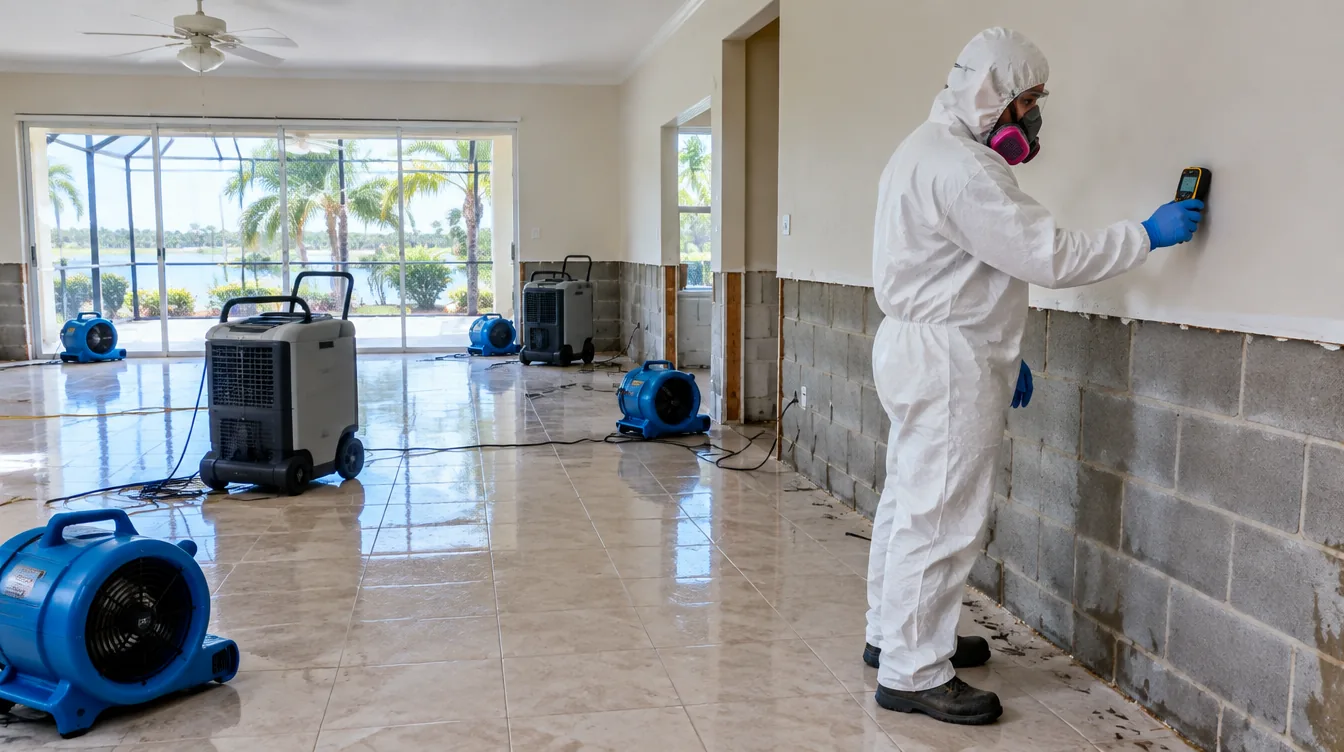
What is hurricane and flood mold remediation?
Hurricane and flood mold remediation is the work of drying a storm-damaged home, removing the materials flood water ruined, and cleaning out the mold and mycotoxins that follow before they spread. In Southwest Florida's heat and humidity, mold can start growing within 24 to 48 hours of water damage. The job should end with clearance testing, and in Florida that testing is normally done by a licensed mold assessor who is independent of the company doing the removal.
Why storm mold in Southwest Florida is different
Mold needs water, warmth and something to eat, and a Southwest Florida home after a hurricane has all three. Storm surge and flood water soak the bottom of drywall, baseboards and cabinets. The power is often out for days, so the air conditioning that normally pulls moisture out of the house isn't running. And behind the tile and the painted drywall, concrete block walls hold water and give it back slowly.
Sound familiar?
- Your home took on water in the storm and you don't know what to keep.
- The walls look dry, but the house smells musty with the AC running.
- A crew cut out drywall, but nobody tested before the walls were closed.
- Your insurance company wants documentation you don't have.
We do it differently.
| Typical storm cleanup | AME hurricane mold remediation | |
|---|---|---|
| Drying | Fans until it feels dry | Moisture readings until materials test dry |
| Flood water | Wipe down and paint over | Porous materials flood water touched are removed |
| Testing | Often skipped | Independent licensed assessor, before and after |
| Mycotoxins | Not considered | Enzyme treatment and HEPA cleaning for toxins |
| Paperwork | An invoice | Photos, moisture logs and lab reports for your claim |

Why families trust us with their homes
-
Family-owned since 2008
A multigenerational family business. Not a franchise, not a private-equity rollup.
-
Trained and certified
Our team holds IICRC, CMR, CRMI and CCMI credentials in mold remediation and inspection.
-
Called on as experts
Attorneys bring us into legal cases involving mold and mycotoxins.
-
Documentation at every step
Photos, moisture logs and lab reports you can hand to your insurer or FEMA.
- IICRC Certified Firm
- CMR
- CRMI
- CCMI
- BBB A+ Accredited
- NAMRI
- IAQA
- NORMI
- AMMA
- PMII
The AME Clearance Method
How we handle storm mold, step by step
Seven steps, in this order. The first two can't wait: every day a home stays wet in Florida heat, the job gets bigger.
Talk to a specialist-
Make it safe and stop the water
We check that the power and structure are safe, get standing water out, and find where water is still getting in, from a damaged roof, window or wall.
-
Dry it fast
Commercial dehumidifiers and air movers go in, and we map moisture in walls, block and floors. We keep drying until readings show materials are actually dry.
-
Independent assessment
A licensed Florida mold assessor, independent of the removal work, inspects and samples the home and writes the scope. We follow that protocol.
-
Contain and remove
Sealed barriers and negative air keep spores and dust out of clean rooms. Drywall, insulation, carpet and pad that flood water touched are cut out and bagged.
-
Clean and break down toxins
HEPA vacuuming and detailed cleaning of framing, block and slab, then plant-based enzyme treatments made to break down mycotoxins instead of covering them.
-
Clean the air and the AC
Air scrubbers capture fine particles. If the air handler or ducts took on water or show growth, they are cleaned before the system runs again.
-
Independent clearance
The independent assessor retests before walls are closed up. You get the lab report for your records, your insurer and your doctor if you need it.
What every storm mold project includes
- Moisture mapping of walls, block and floors
- Photo documentation from start to finish
- Containment with negative air
- Removal of porous materials flood water touched
- HEPA vacuuming and detailed surface cleaning
- Enzyme treatment for mycotoxins
- AC, air handler and duct cleaning where needed
- Coordination with an independent licensed assessor
- A documentation packet for insurance or FEMA
- A plan for your belongings

Proof you can hold in your hands
When we finish, you don't get a handshake and a promise. You get the paperwork your family, your doctor, your insurer or your buyer can rely on.
Inspection report
What we found, where it is coming from, with color photos.
Written remediation plan
Scope, timeline and what will and won't be removed, before work starts.
Clearance lab report
Air, surface and mycotoxin results after the work is done.
A report for your doctor
With your permission, we share results directly with your care team.
Storm mold in Southwest Florida, explained
The first 48 hours after the water goes down
What you do in the first two days decides how big the mold job becomes. If it’s safe to go back in, work through this list in order:
- Make sure the power is off in wet areas before you walk through standing water.
- Photograph and video every room, the waterline on the walls and damaged belongings before anything is moved. Your insurer and FEMA will ask for this.
- Get standing water out and open the house up to dry if the outside air is drier than the inside.
- Pull up wet rugs and move soaked furniture and boxes outside or into the garage.
- Run dehumidifiers once you have power. Keep the AC off if the air handler or ducts took on water.
- Call your insurance company, and if a disaster has been declared, apply for help at DisasterAssistance.gov.
The EPA advises drying water-damaged areas within 24 to 48 hours to prevent mold growth. In a Southwest Florida summer, treat that as a deadline rather than a guideline.
Why Southwest Florida homes hide storm mold
Most homes here are built from concrete block with drywall and tile over it. Block soaks up water and gives it back slowly, so the back of the drywall can stay damp long after the room looks dry. Tile floors hide wet slab and baseboards. And many homes sit closed up for months at a time, when nobody is there to notice a musty smell or a sweating AC closet.
Hurricane Ian in 2022, and Helene and Milton in 2024, showed how quickly a storm can leave thousands of homes wet at the same time. When every crew in the region is booked, homes wait, and waiting is what turns water damage into a mold problem.
Flood water is different from a roof leak
Water from a leaking roof or a burst supply line is relatively clean at first. Storm surge and flood water are not. They carry sewage, soil and bacteria, and the restoration industry treats them as the most contaminated category of water. Porous materials they soak into, including drywall, insulation, carpet and pad, generally have to be removed rather than dried in place. Drywall is usually cut away in a straight line above the highest waterline so the wet section and anything growing behind it come out together.
Mold that grows after a flood also produces mycotoxins, the toxic compounds some molds make. They stay behind in dust and building materials after the mold is dead, which is why we clean for them specifically. Our guide to mycotoxins explains what they are and how they’re removed.
How testing and clearance work in Florida
Florida licenses mold assessors and mold remediators separately. Under Florida Statute 468.8419, a mold assessor may not remediate a structure it assessed in the last 12 months, and a remediator may not assess a structure it remediated in the last 12 months. Certified Division I contractors are the exception.
For you, that separation is a good thing. The company testing your home has no reason to find more mold than is there, and the company removing it can’t grade its own work. On our Southwest Florida storm projects, an independent licensed assessor tests before the work, writes the scope, and runs the clearance test at the end. Whoever you hire, ask how they handle this.
Paperwork for insurance and FEMA
Storm claims are won and lost on documentation. On every project, we keep:
- Dated photos and video of the damage, the waterline and each stage of the work
- Moisture readings from the first day until materials test dry
- The independent assessor’s inspection report, scope and lab results
- A list of materials and belongings removed, with photos
- The final clearance report
An NFIP flood policy excludes mold caused by failing to inspect and maintain a property after the flood recedes, so records showing you acted quickly matter. FEMA’s Individuals and Households Program may help homeowners with disaster-caused mold when it makes the home unlivable. Not sure where you stand yet? Our free AI Mold Risk Check takes about three minutes.
Common questions
Have a question that isn't here? Call a specialist
How soon after a hurricane does mold start to grow?
Mold can start growing within 24 to 48 hours of water damage, according to the EPA, and Southwest Florida's heat and humidity work in its favor. That's why getting water out and drying the house matters more than anything else in the first two days.
Does FEMA pay for mold remediation?
It can. FEMA's Individuals and Households Program may provide Home Repair assistance to homeowners for cleaning up or remediating mold caused by a declared disaster, when FEMA verifies the mold makes the home unlivable. Apply through DisasterAssistance.gov and keep photos, receipts and reports.
Will flood insurance cover mold?
FEMA's mold guidance says NFIP flood policies won't cover damage from mold, and the policy also excludes mold caused by failing to inspect and maintain the property after the water recedes. Ask your adjuster in writing how your claim will be handled, and keep records of everything you did. Taking reasonable steps quickly, and documenting them, protects your claim.
Does homeowners insurance cover mold after a hurricane?
It depends on your policy and on the cause of the water, since wind-driven rain and flood water are often treated differently. Many policies limit mold coverage. Read the mold or fungi section of your policy, and ask us for the moisture logs, photos and lab reports your adjuster will want.
Can the same company test and remove mold in Florida?
Generally not on the same property. Florida Statute 468.8419 bars a mold assessor from remediating a structure it assessed in the last 12 months, and bars a remediator from assessing one it remediated, with an exception for certified Division I contractors. That's why testing and clearance on these projects are done by an independent licensed assessor.
Should I run my AC after a flood?
Air conditioning helps pull moisture out of a house, but only if the system itself is clean. If the air handler, return or ducts took on water or show signs of mold, the EPA advises not running it until it has been checked, because it can spread mold through the home.
What should I throw away after a flood?
Porous things soaked by flood water, such as mattresses, upholstered furniture, carpet and pad, drywall and insulation, usually can't be cleaned well enough to keep. Hard, non-porous items like tile, glass and sealed wood can usually be cleaned. We'll walk you through it room by room.
My home sat closed up for months after the storm. What should I check?
Look and smell around the AC closet, under sinks, inside cabinets and closets, and along the bottom of walls that faced the weather. A musty smell with no visible growth often means mold is hidden. An inspection with moisture readings is the fastest way to know.
We're done when the lab says so.
Every remediation ends with clearance testing, and our work is backed by a complete-removal guarantee. We don't close a job on a failed result.
Talk to a specialistStorm damage? Talk to a specialist today
Tell us what the water touched and when. A Southwest Florida specialist will call you back.
Not sure yet? Try the free AI Mold Risk Check