
Florida mold remediation
Mold remediation in Florida, built around block homes and AC
Contained removal, mycotoxin cleanup and AC cleaning, built for block homes and verified by an independent assessor.
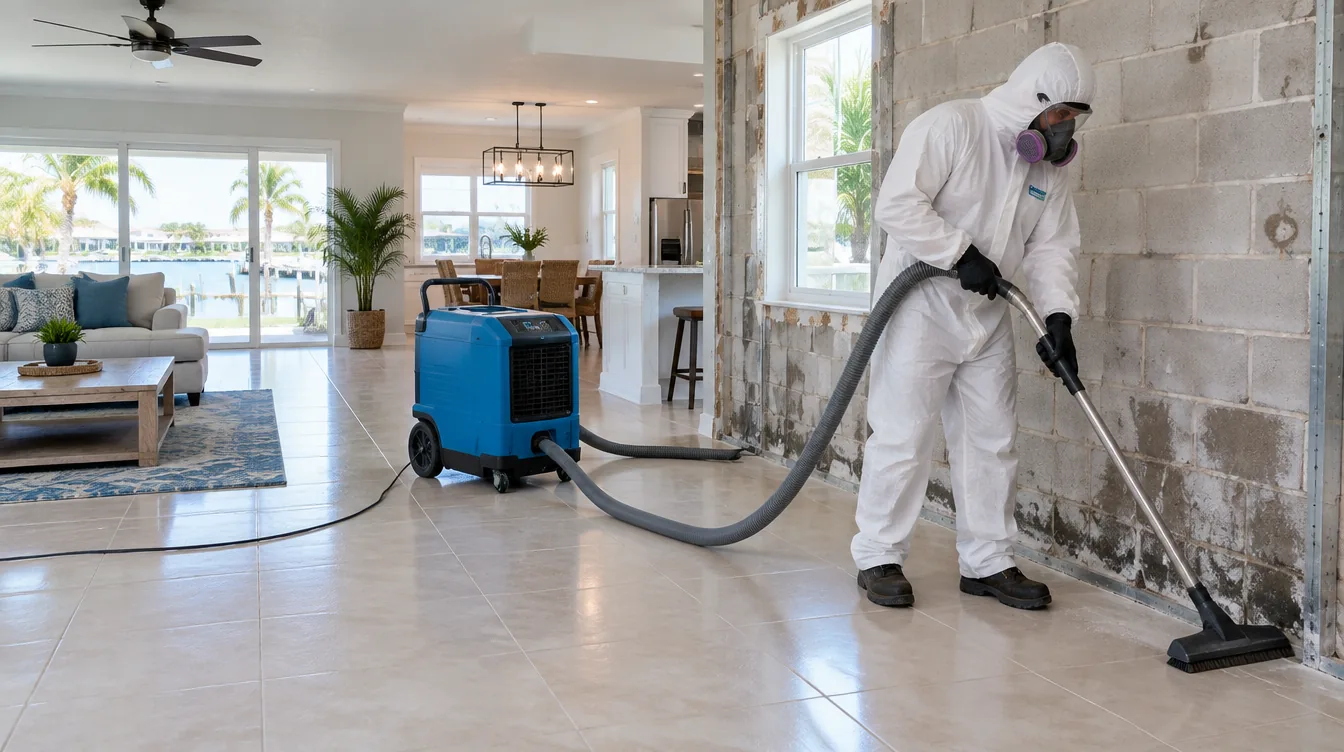
What does mold remediation involve for a Southwest Florida home?
Mold remediation for Southwest Florida homes means finding and fixing the moisture source, sealing off the affected area, removing materials mold has damaged, and cleaning out the spores, fragments and mycotoxins left behind, including in the AC system. In Florida, an independent licensed mold assessor usually inspects the home and writes the scope first, then runs clearance testing at the end to confirm the work passed.
Why mold keeps coming back in Florida homes
Most failed mold jobs in Southwest Florida fail for one of two reasons. Either the moisture source was never fixed, so the humid air, the leak or the AC problem just grows the mold back, or the job stopped at killing mold instead of removing it. A sprayed and painted wall can look fine for a season while the dust in the room and the air handler still carry what the mold left behind.
Sound familiar?
- You had mold treated before and the musty smell came back.
- A contractor wants to spray and paint without opening the wall.
- Nobody has checked the air handler or the ducts.
- You don't know if the job actually passed.
We do it differently.
| Typical mold treatment | AME mold remediation | |
|---|---|---|
| Moisture source | Treat the stain, leave the cause | Leak, humidity or AC problem found and corrected |
| Containment | Plastic over the doorway, if that | Sealed barriers and negative air |
| Mycotoxins | Not considered | HEPA cleaning and enzyme treatment |
| AC system | Left running during the work | Protected, then cleaned when involved |
| Clearance | The contractor says it's done | Independent licensed assessor retests |

Why families trust us with their homes
-
Family-owned since 2008
A multigenerational family business. Not a franchise, not a private-equity rollup.
-
Trained and certified
Our team holds IICRC, CMR, CRMI and CCMI credentials in mold remediation and inspection.
-
Called on as experts
Attorneys bring us into legal cases involving mold and mycotoxins.
-
Documentation at every step
Photos, moisture logs and lab reports you can hand to your insurer or FEMA.
- IICRC Certified Firm
- CMR
- CRMI
- CCMI
- BBB A+ Accredited
- NAMRI
- IAQA
- NORMI
- AMMA
- PMII
The AME Clearance Method
The AME Clearance Method, Florida version
The same order on every job. What changes in Florida is who tests: an independent licensed assessor, as state law expects.
Talk to a specialist-
Independent assessment
A licensed Florida mold assessor, independent of the removal work, inspects and samples the home and writes the remediation protocol.
-
Written scope
We turn that protocol into a written plan and price, so you see what comes out, what gets cleaned and what clearance should show.
-
Fix the moisture
A roof or window leak, a plumbing line, a clogged AC drain or indoor humidity that runs too high. The source is corrected, or the mold returns.
-
Contain
Sealed plastic barriers, negative air and air scrubbers keep spores and dust out of the rest of the house. AC returns in the area are sealed.
-
Remove and clean
Damaged drywall, insulation and baseboard come out and are bagged. Block, framing and slab are HEPA vacuumed and wiped down.
-
Break down toxins
Plant-based enzyme treatments made to break down mycotoxins go on the cleaned surfaces. We use products from US Enzyme.
-
Independent clearance
The assessor retests before walls are closed. If it doesn't pass, we keep working. You keep the lab report.
What's included in a Southwest Florida remediation
- Coordination with an independent licensed assessor
- A written scope and price before work starts
- Moisture readings on walls, block and slab
- Containment with negative air
- Removal of damaged porous materials
- HEPA vacuuming and detailed surface cleaning
- Enzyme treatment for mycotoxins
- AC, air handler and duct cleaning when involved
- Photo documentation from start to finish
- A complete-removal guarantee

Proof you can hold in your hands
When we finish, you don't get a handshake and a promise. You get the paperwork your family, your doctor, your insurer or your buyer can rely on.
Inspection report
What we found, where it is coming from, with color photos.
Written remediation plan
Scope, timeline and what will and won't be removed, before work starts.
Clearance lab report
Air, surface and mycotoxin results after the work is done.
A report for your doctor
With your permission, we share results directly with your care team.
Mold remediation in Southwest Florida, explained
Remediation starts with the water, not the mold
Mold is a symptom. In a Southwest Florida home, the cause is almost always one of a handful of things: a roof or window leak during summer storms, a slow plumbing leak under a sink or behind a dishwasher, an AC condensate line that clogs and overflows, storm surge or flood water, or indoor humidity that stays too high because the AC can’t keep up or has been turned off.
Any remediation that doesn’t deal with that cause is temporary. Before we remove anything, the moisture source has to be identified and a plan made to correct it. Sometimes that’s a roofer or plumber. Sometimes it’s an AC technician, or simply a change in how the house is run while it sits empty.
Why block homes need a different approach
Most homes in Lee, Collier and Charlotte counties are concrete block with stucco on the outside and drywall, often on furring strips, on the inside. Block is porous. It absorbs wind-driven rain through hairline cracks in the stucco and gives the water up slowly, toward the cooler, air-conditioned side of the wall. The result is drywall that can grow mold on the back while the painted face looks clean.
That changes how we work. Moisture readings go on the block itself, not just the drywall. When drywall comes out, the block face and furring are HEPA vacuumed and cleaned, and nothing goes back up until readings show the wall is dry. Our guide to mold in concrete block homes goes deeper on why these walls behave the way they do.
The AC system is part of the job
In Florida, the air handler runs for most of the year, and it’s cold and wet inside by design. Drain pans, coils, return plenums and the drywall around an AC closet are common places for mold to grow. Once it’s there, the system moves spores and contaminated dust through every room it serves.
During remediation, we seal the returns and supplies in the work area so the AC doesn’t pull dust from the containment into the rest of the house. If the assessment shows the air handler or ducts are involved, they’re cleaned before the system runs normally again. The AC, duct and HVAC mold page covers that work in detail.
Removing mycotoxins, not just killing mold
Some molds that grow in water-damaged buildings produce mycotoxins. These compounds aren’t alive, so biocides and bleach don’t remove them, and they stay in settled dust and on building materials after the mold is dead. That’s the gap in most mold work, and it’s the reason our process doesn’t stop at visible growth.
Physical removal comes first: damaged materials out, then HEPA vacuuming and detailed wiping of every surface in the work area. Enzyme treatment follows on the cleaned surfaces to break down what remains. When mycotoxins are the main concern, our mycotoxin remediation service extends that cleaning to belongings and to the rest of the home.
Who tests, and why it’s not us
Florida licenses mold assessors and mold remediators separately under Chapter 468, Part XVI. Section 468.8419 says an assessor may not remediate a structure it assessed within 12 months, and a remediator may not assess, clearance included, a structure it remediated within 12 months. Certified Division I contractors are the exception.
On our Southwest Florida projects, an independent licensed mold assessor inspects and samples the home, writes the scope, and performs clearance testing. We do the remediation to that protocol. The company testing your home has no reason to find more mold than is there, and the company removing it can’t grade its own work. If a company offers to test, remove and clear your home all by itself, ask how that fits Florida law.
Keeping it from coming back
- Keep the AC running and the condensate drain clear, including while you’re away.
- Watch indoor humidity with an inexpensive hygrometer, and add dehumidification if it stays high.
- Repair stucco cracks and window seals before rainy season.
- Dry any leak within a day or two. In this climate, that’s the window before mold starts.
- Have the home checked after any storm that put water inside, even if it looks dry.
We remove mold and mycotoxins from buildings. We don’t diagnose or treat medical conditions. If you have symptoms, please work with a doctor. With your permission, we’re glad to share test results and our plan with them.
Common questions
Have a question that isn't here? Call a specialist
How much does mold remediation cost in Southwest Florida?
It depends on the size of the affected area, what has to be removed, whether the AC system is involved and whether mycotoxins need cleaning. A contained bathroom job and a storm-damaged house with flood-cut walls are very different projects. You get a written price based on the assessor's protocol before any work starts.
How long does mold remediation take?
Small, contained jobs can be finished quickly, while whole-house projects with AC cleaning take longer. The biggest variables are drying time, how much material comes out, and scheduling the independent clearance test. Your written scope includes an expected schedule.
Can I stay in my home during remediation?
Often, yes, as long as you stay out of the contained work area and the AC serving that area is shut off or sealed. If someone in the home is sensitive to mold, many families choose to stay elsewhere until clearance passes.
Why can't the remediator do the testing in Florida?
Florida Statute 468.8419 bars a remediator from assessing a structure it remediated within 12 months, and bars an assessor from remediating one it assessed, with an exception for certified Division I contractors. An independent licensed assessor handles testing and clearance on our Florida projects.
Can mold grow back after remediation?
It can if the moisture comes back. That's why fixing the source and keeping indoor humidity under control matter as much as the removal. In Florida, that usually means a working AC, a clear condensate drain and prompt repairs after any leak.
Do you have to tear out walls?
Not always. Drywall that's wet, stained or growing mold on the back usually comes out, but sound materials can often be cleaned and kept. The assessor's protocol and moisture readings decide, not a habit of cutting everything.
Will bleach take care of it?
No. Bleach can lighten a stain on a hard surface, but it doesn't reach mold rooted in drywall or wood, and it doesn't remove mycotoxins. Painting over it just hides the problem for a while.
We're done when the lab says so.
Every remediation ends with clearance testing, and our work is backed by a complete-removal guarantee. We don't close a job on a failed result.
Talk to a specialistTalk to a Southwest Florida remediation specialist
Tell us what you've found and where. If you already have an assessor's report, have it handy. A specialist will call you back.
Not sure yet? Try the free AI Mold Risk Check