
Hamilton County mold testing
Mold testing in Carmel, IN, for basements and home sales
Moisture mapping and lab sampling that looks behind finished walls, with results fast enough for a Carmel inspection period.
What should mold testing in Carmel cover?
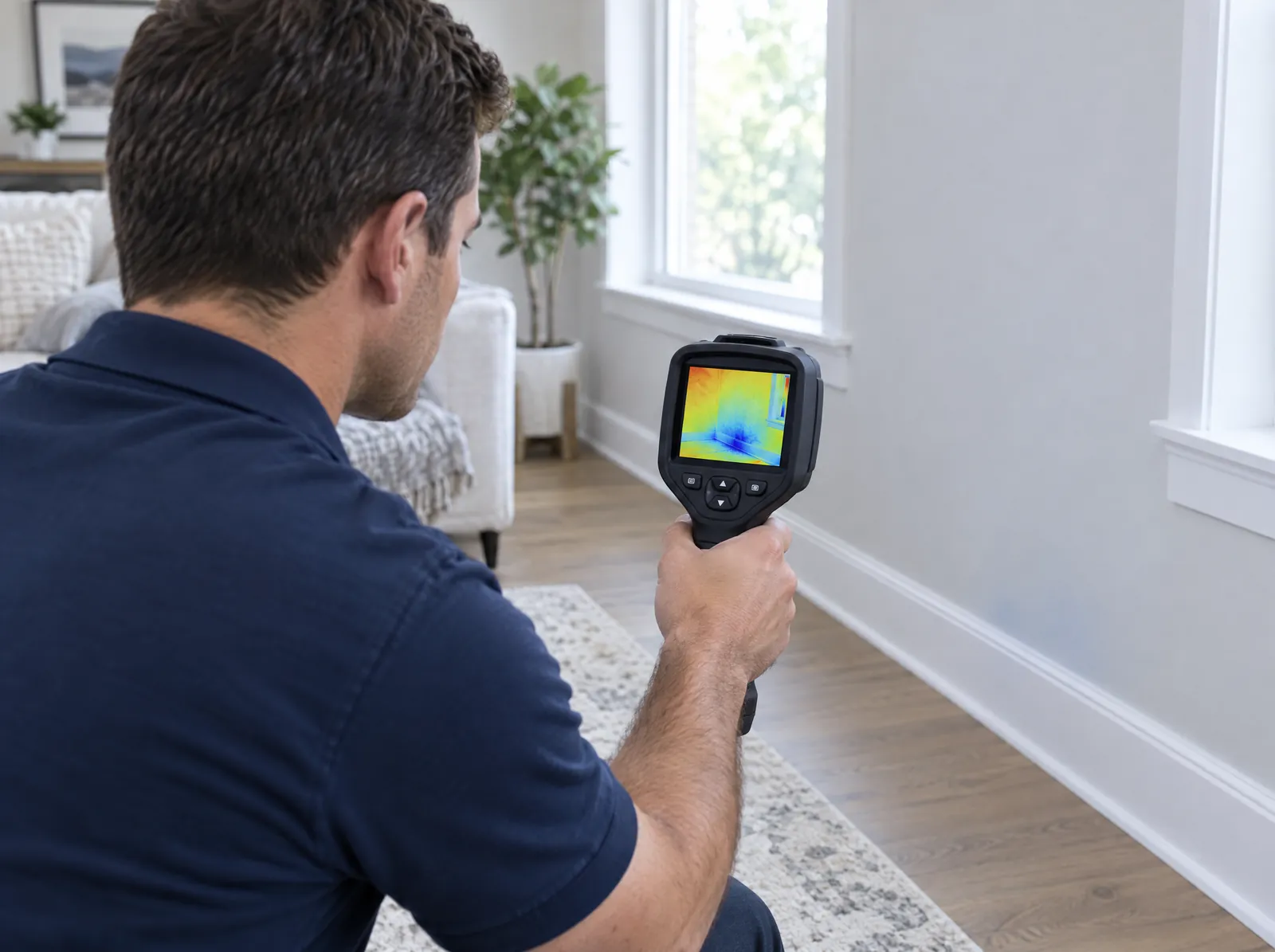
Mold testing in Carmel should cover the finished lower level, not just the main floor. We map moisture behind drywall and under flooring, take indoor air samples with an outdoor comparison, sample settled dust when the history calls for it, and swab anything visible. A lab reports results in 24 to 48 hours, and we explain what they mean for the house, the sale or the next step.
Why a single air sample misses Carmel basement mold
Many Carmel homes have lower levels finished with carpet, drywall, a wet bar and sometimes a guest bedroom. That finish work covers the concrete where moisture actually shows up. Growth on the back of drywall or in carpet pad releases fewer spores into the room than people expect, especially while the HVAC system is running and mixing the air. A family-room sample can come back normal while the bottom two feet of a basement wall is damp.
Sound familiar?
- You're under contract on a Carmel home and the inspector noted possible microbial growth near the sump.
- You're about to list and want to know what a buyer's inspector will find.
- The finished basement smells musty after heavy rain, but nothing looks wrong.
- You're planning to finish your basement and want a baseline before the walls go up.
We do it differently.
| A walk-through air test | AME Carmel mold testing | |
|---|---|---|
| Finished walls | Judged by appearance | Scanned with a thermal camera and moisture meter |
| Sump and window wells | Glanced at | Checked for seepage and damp framing nearby |
| Sampling | One room upstairs | Lower level and living areas, plus outdoors |
| Timing | Whenever the lab gets to it | Lab results in 24 to 48 hours |
| For a transaction | A number with no context | A report both agents and the buyer can follow |

Why families trust us with their homes
-
Family-owned since 2008
A multigenerational family business. Not a franchise, not a private-equity rollup.
-
Credentialed where it isn't required
Indiana doesn't license mold remediators. We hold IICRC, CMR, CRMI and CCMI credentials anyway.
-
Called on as experts
Attorneys bring us into legal cases involving mold and mycotoxins.
-
Lab results in 24 to 48 hours
Every inspection comes with a written report, color photos and lab results.
- IICRC Certified Firm
- CMR
- CRMI
- CCMI
- BBB A+ Accredited
- NAMRI
- IAQA
- NORMI
- AMMA
- PMII
The AME Clearance Method
What happens during a Carmel mold test
Five steps, with most of the time spent downstairs, because that's where most Carmel findings are.
Talk to a specialist-
Ask what changed
When was the basement finished? Has the sump ever failed, or has water come in at a window well? A home's timeline narrows where to look.
-
Scan the lower level
A thermal camera along exterior walls, a moisture meter on baseboards and bottom plates, and a close look at the sump pit, egress windows and the space under the stairs.
-
Sample where it counts
Air from the lower level and the main floor, compared against an outdoor sample, plus a dust sample for ERMI or HERTSMI-2 when growth may have been there a while.
-
Confirm visible spots
Tape or swab samples from suspicious staining tell you what it is, instead of leaving it to guesswork.
-
Deliver results and a plan
Lab results typically arrive in 24 to 48 hours. We walk you through them and write up recommendations, including when a dehumidifier and some drainage work are all that's needed.
Included in every Carmel mold test
- A lower-level focused inspection
- Thermal imaging of finished exterior walls
- Moisture readings at baseboards, bottom plates and flooring
- Sump pit, window well and egress window checks
- Indoor air samples on two levels with an outdoor comparison
- ERMI or HERTSMI-2 dust testing when the history suggests it
- Tape or swab samples of visible staining
- A written report suitable for a buyer, seller or agent

Proof you can hold in your hands
When we finish, you don't get a handshake and a promise. You get the paperwork your family, your doctor, your insurer or your buyer can rely on.
Inspection report
What we found, where it is coming from, with color photos.
Written remediation plan
Scope, timeline and what will and won't be removed, before work starts.
Clearance lab report
Air, surface and mycotoxin results after the work is done.
A report for your doctor
With your permission, we share results directly with your care team.
Mold testing in Carmel, explained
What we look at in a Carmel lower level
Finished basements in Carmel range from simple family rooms to full living suites. The places that show moisture first are much the same in all of them:
- Bottom plates on exterior walls. The wood under framed walls sits on or near the slab and wicks moisture upward.
- Egress windows and window wells. Leaves and poor drainage let water pool against the glass and run down inside the wall.
- Around the sump. A pit that cycles often, or failed once, leaves damp framing and carpet nearby.
- Under the stairs and in storage rooms. Closed-off, unconditioned spaces with almost no airflow.
Checking those spots first is why most Carmel tests don’t require opening walls. For the details, see how mold is tested behind walls.
Testing on a real estate timeline
Carmel homes often sell quickly, and a buyer’s inspection window is short. When a report flags a musty lower level or old staining, the question becomes whether it’s a cosmetic mark or active growth, and you need that answer before the deadline, not after it. A lab turnaround of 24 to 48 hours is what makes that practical.
Sellers have their own reason to test. Knowing what’s behind the basement drywall before listing lets you decide how to handle it on your terms. Our answer on whether Indiana sellers have to disclose mold covers the disclosure side.
When a dust test is worth adding
Air samples capture a moment. A dust test captures months. If the basement was finished years ago, or the family has lived with a faint musty smell for a long time, an ERMI test can reveal mold types that built up gradually and that one day’s air sample might miss.
We test homes for mold. Our work stops at the building, and we don’t diagnose or treat any medical condition. If anyone in the household has symptoms, please talk with a doctor, and we can share the report with them at your request.
Common questions
Have a question that isn't here? Call a specialist
Can you finish testing within a Carmel inspection period?
In most cases, yes. Lab results usually come back 24 to 48 hours after sampling. Call as soon as your offer is accepted so the visit lands early in the window.
I'm selling. Should I test before listing?
If the basement has had water in the past, testing before listing lets you fix anything on your own schedule and hand buyers documentation instead of open questions. Talk with your agent about what you'd need to disclose.
Can mold be tested behind finished walls without opening them?
Largely, yes. Thermal imaging and moisture readings find the damp areas, and air or dust samples show whether mold is present. If a cavity needs confirming, a small inspection hole or a wall-cavity air sample is usually enough, and we ask before doing either.
Should I test before finishing my basement?
It's a good idea if the basement has ever had seepage or high summer humidity. A baseline test and moisture check tell you whether the concrete is dry enough to cover, and give you something to compare against years later.
What does a mold inspection cost for a Carmel home?
Angi lists typical Indianapolis-area mold inspections at roughly $240 to $400. Larger homes with finished lower levels may need more samples. We recommend a plan and quote it before the visit.
We're done when the lab says so.
Every remediation ends with clearance testing, and our work is backed by a complete-removal guarantee. We don't close a job on a failed result.
Talk to a specialistBook mold testing for your Carmel home
Let us know whether you're buying, selling or just uneasy about the basement, and your deadline if there is one. We'll call back to set a time.
- (833) 772-6653
- info@americanmoldexperts.com
- Open 7 days, 8am to 8pm