
Mold-focused air testing
Indoor air quality testing, focused on mold
Measured air samples, an outdoor baseline and humidity readings, analyzed by a lab and explained in plain English.
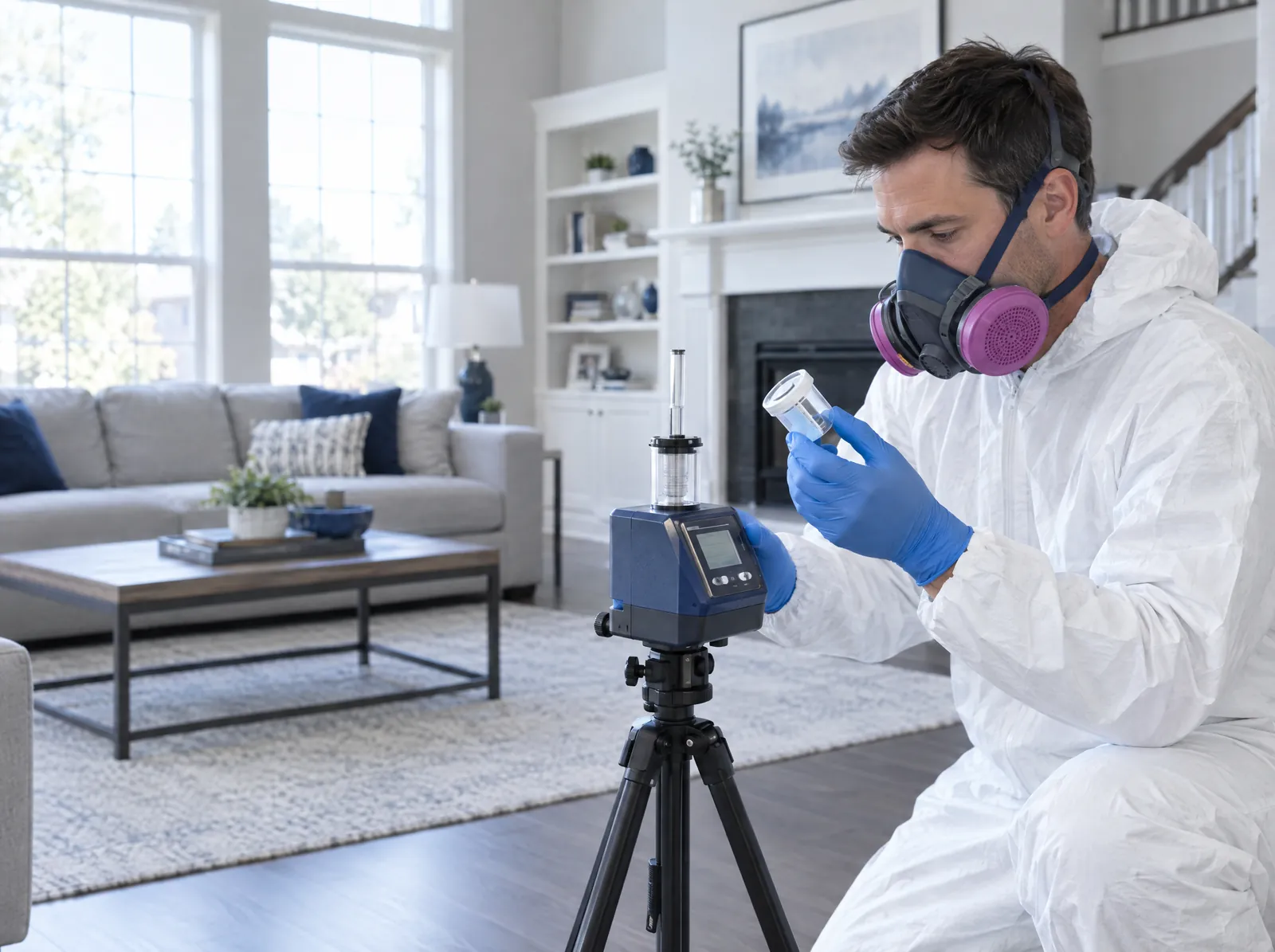
What does indoor air quality testing measure?
Indoor air quality testing measures what is in the air inside a building and compares it with the air outside. Ours is built around mold: a calibrated pump draws a set volume of air through a spore trap in each room of concern and outdoors, and a lab counts and identifies what it catches. We also record temperature and relative humidity, because moisture is what lets mold grow. Radon, carbon monoxide and VOCs need separate tests.
What an air test can and can't tell you
An air sample is good at one thing: showing what is floating in a room during the few minutes the pump runs. That makes it useful for comparing rooms, comparing indoors with outdoors, and spotting molds that shouldn't be airborne inside a home. It is weak at finding growth sealed behind a wall, and a single sample taken on the wrong day can read low. Good air testing is designed around those limits instead of pretending they don't exist.
Sound familiar?
- An air purifier runs all day, but the house still smells musty.
- One air test came back normal, and you don't trust it.
- Allergies seem worse in one room than anywhere else in the house.
- You were quoted an indoor air quality package and can't tell what it actually measures.
We do it differently.
| One-sample air check | AME indoor air quality testing | |
|---|---|---|
| Samples | One indoor sample | Each room of concern, plus an outdoor control |
| Conditions | Whatever the day happens to be | Recorded: humidity, temperature, HVAC status and weather |
| Hidden spaces | Not checked | Moisture readings, and wall cavity samples where they're justified |
| HVAC system | Ignored | Filter, return and air handler area considered in the plan |
| Report | Spore counts with no context | Counts compared room to room and with outdoors, then explained |

Why families trust us with their homes
-
Family-owned since 2008
A multigenerational family business. Not a franchise, not a private-equity rollup.
-
Credentialed where it isn't required
Indiana doesn't license mold remediators. We hold IICRC, CMR, CRMI and CCMI credentials anyway.
-
Called on as experts
Attorneys bring us into legal cases involving mold and mycotoxins.
-
Lab results in 24 to 48 hours
Every inspection comes with a written report, color photos and lab results.
- IICRC Certified Firm
- CMR
- CRMI
- CCMI
- BBB A+ Accredited
- NAMRI
- IAQA
- NORMI
- AMMA
- PMII
The AME Clearance Method
How we run an indoor air quality test
The sampling itself takes minutes. Setting it up correctly is what makes the numbers mean something.
Talk to a specialist-
Set the conditions
Before the visit we'll ask you to keep windows and exterior doors closed and run the HVAC system as you normally would, so the air we sample reflects everyday living.
-
Walk the home first
Sample locations come from what we find: odors, staining, moisture readings and the rooms you spend the most time in. We don't sample by a fixed number per house.
-
Measure humidity and temperature
Relative humidity and temperature are recorded in each sampled room and outdoors. Humidity that stays high indoors tells us more about future mold than any single spore count.
-
Collect the air samples
A calibrated pump pulls a measured volume of air through a spore trap cassette at about breathing height. An outdoor sample is taken on the same visit as the baseline.
-
Check the hidden spaces
Where a wall or ceiling reads wet, we may draw a small sample from inside the cavity through a pinhole to see whether growth is hiding behind the surface.
-
Lab analysis
A laboratory counts and identifies the spores and mold fragments on each cassette. Results typically come back in 24 to 48 hours.
-
Explain the pattern
We walk you through the report and what the pattern points to: a clean result, a room to investigate further, or a moisture problem to fix.
What an indoor air quality visit includes
- A pre-visit checklist so the house is sampled under normal conditions
- A walk-through focused on odors, staining and moisture
- Relative humidity and temperature readings, indoors and out
- Air samples in each room of concern
- An outdoor control sample on the same visit
- Wall cavity samples where moisture readings justify them
- A look at the HVAC filter, return and air handler area
- Analysis by an accredited laboratory
- A written report with the original lab results attached
- A clear answer on whether further testing is worth it

Proof you can hold in your hands
When we finish, you don't get a handshake and a promise. You get the paperwork your family, your doctor, your insurer or your buyer can rely on.
Inspection report
What we found, where it is coming from, with color photos.
Written remediation plan
Scope, timeline and what will and won't be removed, before work starts.
Clearance lab report
Air, surface and mycotoxin results after the work is done.
A report for your doctor
With your permission, we share results directly with your care team.
Indoor air quality and mold, explained
What indoor air quality covers, and what we test
Indoor air quality is a broad term. It can mean fine particles from cooking and candles, gases such as radon and carbon monoxide, chemical vapors from paint and new furniture, and biological material like mold, pollen and pet dander. A company that says it tests indoor air quality could be talking about any of those, which is why it’s worth asking what the samples actually measure.
Our testing covers the biological side, specifically mold, together with the humidity and moisture conditions that let mold grow. That focus is deliberate. It’s the part of indoor air quality our inspectors and our lab partners are set up to measure well, and it’s the part that leads to a building problem we can find and fix.
Why the outdoor sample is only the start
Every air test needs an outdoor control, but reading it well takes more than comparing two totals. Outdoor mold levels swing with the season and the weather. In warm, humid months they can run high. Under snow cover or after a hard freeze they can drop sharply, and then even a healthy house may read above outdoors. So we look at the mix of molds as well as the count.
| What the samples show | What it can suggest |
|---|---|
| Indoor types match outdoor types, at similar or lower counts | Mostly outdoor air coming in. Usually not an indoor source. |
| One mold dominates indoors but is minor outdoors | Something inside may be growing it. Worth a closer look. |
| Water-damage molds such as Stachybotrys or Chaetomium appear indoors | Material has likely stayed wet for a long time somewhere, even if the count is low. |
| One room much higher than the others | The source is probably in or near that room, or on its air path. |
| Many hyphal fragments | Active or recently disturbed growth. |
A deeper walk through reading a lab report is in our answer on what mold spore counts mean.
How the HVAC system changes the results
A forced-air system moves the air in every room through one air handler, several times an hour when it runs. That has two effects on testing. It mixes the house, so a problem in one area can show up in rooms far away from it. And the system itself can be the source: a wet coil, a drain pan that doesn’t drain, or dust built up in the return side of the ductwork.
We note whether the system was running during sampling, look at the filter and the area around the air handler, and sometimes take a sample near a supply register. If the pattern points at the system, the next step is a closer look under HVAC mold.
Humidity: the reading that predicts trouble
A spore count describes the past few minutes. Humidity describes the conditions mold will have for the next few months. A basement that sits at high relative humidity all summer, or a bedroom where condensation forms on cold window frames every winter, will keep producing mold problems after any cleanup. That’s why humidity readings appear in every report we write, room by room, next to the outdoor reading. Our answer on what humidity level prevents mold covers the targets and how to hold them.
When air testing isn’t the right first step
- You can already see the mold. Fix the moisture and plan the cleanup. Sampling may still help define the extent, but it isn’t needed to prove the mold is there.
- You want to know the home’s history. Settled dust holds months of it. A dust DNA test such as an ERMI test answers that better than air.
- You’re worried about toxins. Mycotoxins travel mostly on dust and tiny fragments, so a mycotoxin panel on settled dust is the better tool.
Air testing describes the building, not anyone’s health. We don’t diagnose or treat medical conditions. If you have symptoms, please talk with a doctor, and with your permission we’re glad to share your results with them.
Common questions
Have a question that isn't here? Call a specialist
Does your indoor air quality testing include radon, VOCs or carbon monoxide?
No. Our indoor air quality testing is built around mold and the moisture behind it. Radon needs its own dedicated test, carbon monoxide is best watched with working CO alarms, and VOC or formaldehyde testing uses different sampling equipment. If something we see suggests one of those is worth checking, we'll tell you.
What is a normal mold spore count indoors?
There is no federal standard for indoor mold, so there's no single normal number. In a home without a mold problem, indoor counts are usually similar to or lower than outdoor counts taken the same day, and the types of mold look similar. Results always have to be read against the outdoor sample and the other rooms.
Can an air test miss hidden mold?
Yes. Growth sealed inside a wall cavity may release very little into the room, and some molds, such as Stachybotrys, have heavy, sticky spores that don't stay airborne well. That's why we pair air sampling with moisture readings, and add cavity or dust samples when the inspection calls for them.
How should I prepare my home for air testing?
Keep windows and exterior doors closed, run the heating or cooling normally, and skip vacuuming, dusting or running fans aimed at the sampled rooms on the day of the visit. Turn off standalone air purifiers beforehand if you can. We'll send specific instructions when you book.
What humidity should a home be kept at?
The EPA recommends keeping indoor relative humidity below 60 percent, and ideally between 30 and 50 percent. Basements, bathrooms and closets on exterior walls are the places most likely to run higher than the rest of the house.
How long do air test results take?
Results typically come back in 24 to 48 hours after the samples reach the lab. We review them with you once they arrive, rather than just forwarding the report.
We're done when the lab says so.
Every remediation ends with clearance testing, and our work is backed by a complete-removal guarantee. We don't close a job on a failed result.
Talk to a specialistBook an indoor air quality test
Tell us which rooms concern you and what you've noticed. A specialist will call you back to plan the sampling.
- (833) 772-6653
- info@americanmoldexperts.com
- Open 7 days, 8am to 8pm