
Village of Estero, Lee County
Mycotoxin remediation in Estero homes
Gated communities, shared walls and seasonal schedules. We remove the toxins, and an independent assessor confirms it.
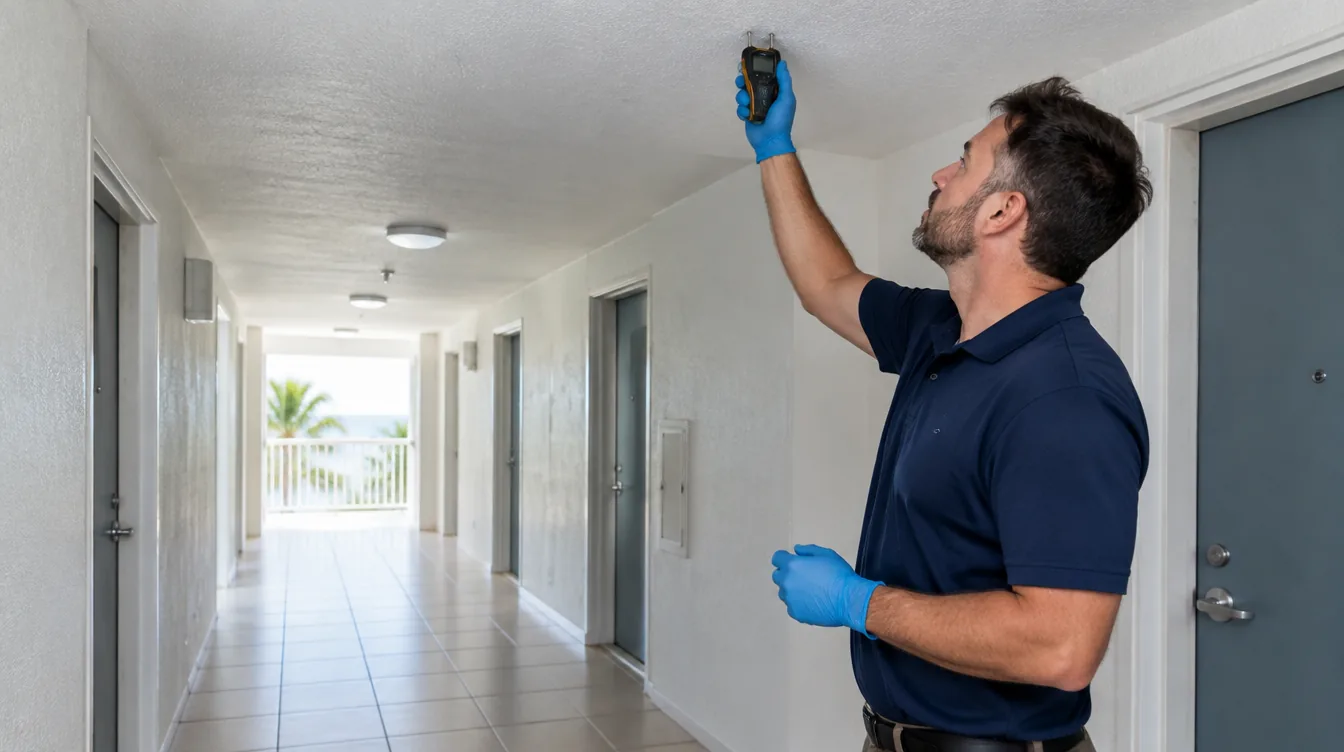
How does mycotoxin remediation work in Estero?
Mycotoxin remediation in Estero removes mold and the toxins it leaves in dust, wall cavities, AC systems and belongings, then proves the result. Most Estero homes are in gated communities, many with shared walls and association rules, so the work is planned with your HOA or condo association. An independent licensed assessor tests before and after, and we do the remediation to that protocol.
Why mycotoxin work in Estero takes planning
Estero is a young village, incorporated in 2014, and most of its homes are newer than those in Fort Myers or Naples. That doesn't make them immune. Newer homes are built tight, which keeps humid air in when the AC isn't keeping up, and many sit closed for the summer. Many are also coach homes, villas or condos that share walls, roofs and sometimes AC closets. When mold shows up, you're often dealing with a neighbor and an association as well as the house.
Sound familiar?
- Your doctor has asked about your home, and your HOA has its own rules about contractors.
- The mold seems to be coming from the unit next door or from a shared roof.
- The house was closed all summer and you've felt worse since you came back.
- Your home is west of US 41 and took water in Ian.
We do it differently.
| A quick mold treatment | AME mycotoxin remediation in Estero | |
|---|---|---|
| Association | Left to you to sort out | Work scheduled and documented to fit HOA and condo rules |
| Shared walls | Your side only | Source traced, even when it starts next door |
| Toxins | Fogging or spray | HEPA cleaning and enzyme treatment |
| Testing | The same company checks its own work | Independent licensed assessor, before and after |
| Your doctor | Not involved | Clearance report shared with your permission |

Why families trust us with their homes
-
Family-owned since 2008
A multigenerational family business. Not a franchise, not a private-equity rollup.
-
Trained and certified
Our team holds IICRC, CMR, CRMI and CCMI credentials in mold remediation and inspection.
-
Called on as experts
Attorneys bring us into legal cases involving mold and mycotoxins.
-
Documentation at every step
Photos, moisture logs and lab reports you can hand to your insurer or FEMA.
- IICRC Certified Firm
- CMR
- CRMI
- CCMI
- BBB A+ Accredited
- NAMRI
- IAQA
- NORMI
- AMMA
- PMII
The AME Clearance Method
Mycotoxin remediation in Estero, step by step
Six steps. The association conversation happens early so the work isn't held up halfway through.
Talk to a specialist-
Independent assessment
A licensed Florida mold assessor, independent of us, samples air and settled dust, runs a mycotoxin panel where warranted and writes the protocol.
-
Coordinate with the association
We confirm contractor rules, work hours and access, and flag any shared areas or neighboring units the protocol touches.
-
Correct the moisture
Roof leaks, shared plumbing, AC drain problems and summer humidity are fixed first, with the association where common elements are involved.
-
Contain and remove
Sealed barriers and negative air keep dust inside the work area. Contaminated drywall, insulation and pad are bagged and carried out.
-
Clean and treat
HEPA vacuuming and hand wiping, enzyme treatment for mycotoxins, and AC air handler and duct cleaning where needed.
-
Independent clearance
The assessor retests. The report goes to you, and to your doctor and association if you choose.
What an Estero mycotoxin project includes
- Coordination with an independent licensed mold assessor
- Coordination with your HOA or condo association
- Moisture source correction
- Containment with negative air
- Removal of contaminated porous materials
- HEPA vacuuming and detailed wiping
- Enzyme treatment for mycotoxins
- AC and duct cleaning where needed
- A plan for belongings
- A clearance report you can share with your doctor

Proof you can hold in your hands
When we finish, you don't get a handshake and a promise. You get the paperwork your family, your doctor, your insurer or your buyer can rely on.
Inspection report
What we found, where it is coming from, with color photos.
Written remediation plan
Scope, timeline and what will and won't be removed, before work starts.
Clearance lab report
Air, surface and mycotoxin results after the work is done.
A report for your doctor
With your permission, we share results directly with your care team.
Mycotoxins in Estero homes, explained
Gated communities, shared walls and association rules
Estero has around 35 gated communities, and a large share of the village’s homes sit inside one. That shapes mycotoxin work here in practical ways. Contractors need gate access and often have to follow set work hours. Many homes are coach homes, villas or condos, where a roof, an exterior wall or an AC closet may be shared with a neighbor. And when mold turns up, the first question is often whose responsibility it is.
For condominiums, Florida’s condo law, s. 718.111(11), says associations generally maintain and insure the common elements while owners are generally responsible for their unit interiors. The declaration of condominium controls, and HOA communities run on their own governing documents, so check yours and talk with your community manager or an attorney. What we can do is make the work easier for everyone: we confirm the rules before we start, keep containment inside the unit where possible, schedule around neighbors, and give the association the documentation it needs. Our guide to condo and HOA mold in Southwest Florida goes into more detail.
Newer homes, tighter houses
Estero grew mostly after the 1970s, and much of its housing is newer than in the older cities around it. Newer homes are built to be airtight, which is good for energy bills, but it means the AC does all the work of removing humidity. When the system is oversized, set too high, or shut down for the summer, moisture builds up inside with nowhere to go.
In newer Estero homes, the problems we see most often are:
- AC condensate drain lines that clog and overflow into the closet or the ceiling below
- Air handler closets and returns with mold on the cabinet, coil or duct liner
- Roof and window leaks in the first few years, when construction defects show up
- Moisture trapped in new block and slab that was closed in before it dried
- Closets and bathrooms on shared walls, where a neighbor’s leak finds its way through
Our guide to new-construction mold in Florida explains why a new home isn’t automatically a dry one.
Closed for the summer
Many Estero homes belong to seasonal residents who leave in spring and return in fall. The months they’re away are Southwest Florida’s hottest and wettest. A house left with the AC set high, the doors closed and nobody checking the air handler can grow mold quietly all summer. When the family comes back and someone in the house starts feeling unwell, that summer is often where the story starts. For seasonal owners we plan around your schedule, work with your home watch service or community manager for access, and send updates as the work goes.
West of US 41: the Ian homes
Not every Estero home is new or gated. Older neighborhoods near the Estero River and Estero Bay, west of US 41, took the brunt of Hurricane Ian. By the village’s count at the end of October 2022, more than 1,000 homes had been affected by flooding and storm surge, including all 120 homes in Estero River Heights, and other areas off West Broadway flooded too, among them single-family subdivisions and mobile home parks.
Those homes were gutted and rebuilt under heavy time pressure. If walls were closed before the block and framing dried, or cavities weren’t cleaned before new drywall went up, mold and its toxins may be sitting out of sight. Our guide to mycotoxins after hurricane water damage explains why they can outlast a flood by years, and our page on hurricane mold remediation in Estero covers the storm itself.
Independent testing and clearance
Florida licenses mold assessors and mold remediators separately. Under Florida Statute 468.8419, an assessor may not remediate a structure it assessed within 12 months, and a remediator may not assess or clear a structure it remediated within 12 months. Certified Division I contractors are the exception. On our Estero projects, an independent licensed mold assessor inspects and samples the home, writes the scope, and performs clearance testing. We do the remediation to that protocol.
For a family working with a doctor, and for an association that wants to know the job was done right, that independence counts. The company testing your home has no reason to find more mold than is there, and the company removing it can’t grade its own work. The assessor may use air sampling, dust-based mold testing such as ERMI or HERTSMI-2, and a mycotoxin panel on settled dust.
What your association will want to see
Associations tend to ask the same questions when mold work happens in their community, and it helps to have the answers ready. We give you, and with your permission the community manager, a short packet that covers:
- The independent assessor’s findings and the protocol the work follows
- Where containment will go and whether any shared hallway, roof or wall is involved
- Work dates, hours and the number of people on site
- How debris will leave the property and where the dumpster or trailer will sit
- The final clearance report once the assessor has retested
When the source is in a common element, such as a shared roof or a wall between units, the association may need to fix it before remediation inside your home makes sense. Getting that sorted early keeps a project from stalling halfway through.
Keeping it dry next summer
Once the home is clean, the goal is to keep it that way through the next wet season. Keep the AC running on a schedule that controls humidity, not just temperature. The EPA recommends keeping indoor humidity below 60 percent, ideally between 30 and 50 percent. Have the condensate drain line flushed before you leave for the summer, add a humidity monitor you can check from your phone, and ask your home watch service to open the AC closet on every visit. Our page on seasonal-home mold has a fuller checklist.
Working alongside your doctor
Many families come to us after a functional or integrative physician has raised the question of the home. With your permission, we’ll talk with that office, explain what the home results show and send them the clearance report. We’ll also help you plan the practical side: which rooms stay in use, what happens to mattresses and upholstered furniture, and whether a short stay elsewhere makes sense during the work. Health decisions stay with you and your doctor.
Our Southwest Florida team serves Estero and the rest of Lee, Collier and Charlotte counties. American Mold Experts is family-owned and has been in business since 2008, and every project is backed by a complete-removal guarantee. We don’t close a job on a failed result.
We remove mold and mycotoxins from buildings. We don’t diagnose, treat or give medical advice, and home test results are not medical tests. Please rely on your doctor for health decisions. With your permission, we’ll share the results and our plan with them.
Common questions
Have a question that isn't here? Call a specialist
The mold is coming from my neighbor's side of the wall. What can I do?
Start with your association, since shared walls and roofs are often common elements. Under Florida condo law, associations generally handle common elements and owners generally handle their unit interiors, but your declaration controls, and HOA communities have their own documents. An independent assessor's report gives everyone the same facts to work from.
Can a newer Estero home really have mycotoxins?
Yes. Age isn't what matters. Moisture is. A newer home that sat closed through a humid summer, had a construction defect or took water in a storm can grow mold like any other. Our guide to new-construction mold in Florida explains the common causes.
Who does the testing?
An independent licensed mold assessor. Florida Statute 468.8419 generally bars a remediator from assessing or clearing a structure it remediated within 12 months, with an exception for certified Division I contractors.
Will my HOA need to approve the work?
Many Estero associations have rules for contractors, work hours and gate access, and some want notice before work starts. Check your documents or ask your community manager. We'll work within whatever rules apply.
Can the work happen while we're away?
Usually. Many owners arrange access through the gate, a home watch service or the community manager. We send photos and updates, and the clearance report comes to you when the assessor is done.
Will you talk with my doctor?
Yes, with your permission. We'll explain what the home results show and send the clearance report. We don't give medical advice.
We're done when the lab says so.
Every remediation ends with clearance testing, and our work is backed by a complete-removal guarantee. We don't close a job on a failed result.
Talk to a specialistTalk with us about your Estero home
Tell us about the home, your community and what your doctor has asked. A specialist will call you back.
Not sure yet? Try the free AI Mold Risk Check