
Southwest Florida condos and HOAs
Condo and HOA mold remediation in Southwest Florida
Condo mold rarely stays in one unit. We work for owners and associations, with one shared record.
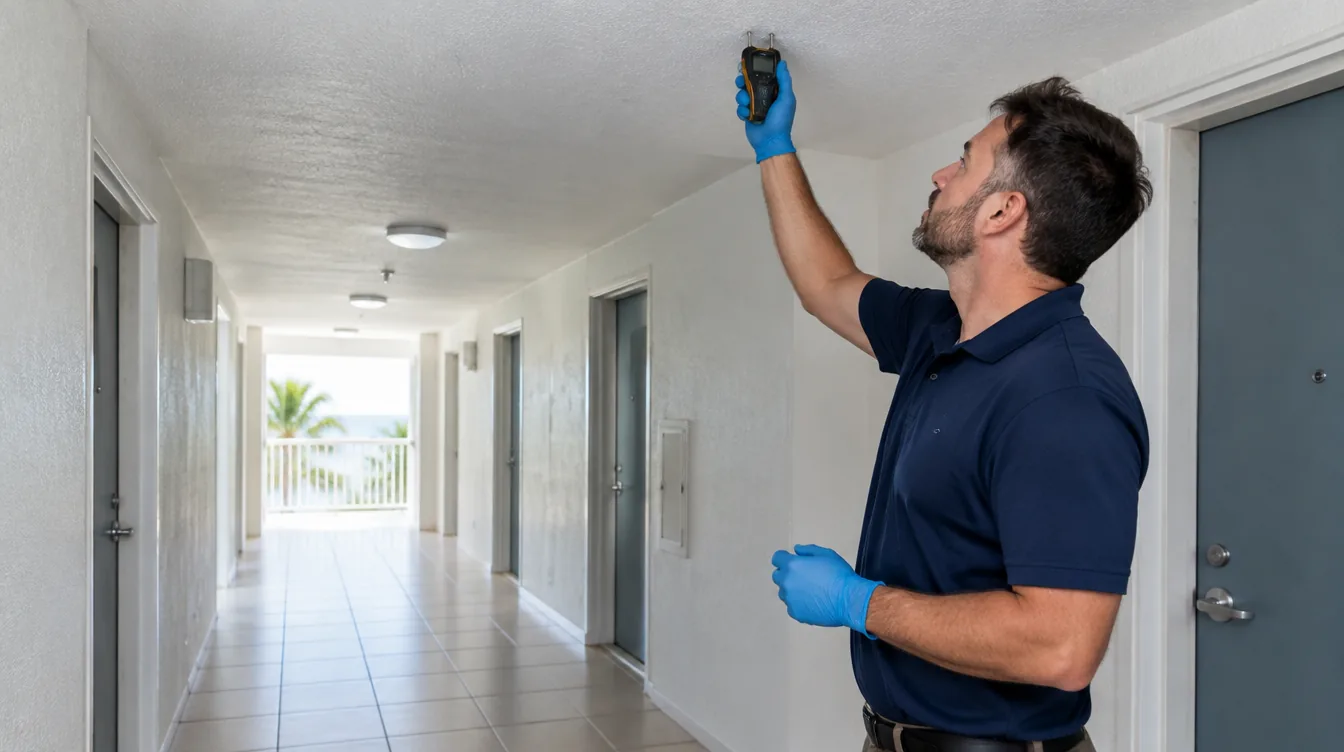
How is condo mold handled in Florida?
Condo mold in Florida is handled like any mold job, with one added layer: deciding what belongs to the unit and what belongs to the association. Florida Statute 718.111(11) generally has the association insure the common elements and the unit owner cover the unit interior, but your declaration of condominium controls. We remediate units, hallways and shared spaces, coordinate with managers, and leave the question of who pays to your documents and your attorney.
Why condo mold is harder than house mold
In a single-family home, one owner makes every decision. In a condo, a leak from the unit above can put mold in your ceiling, a shared wall can hide growth that touches two units, and the AC closet, the roof and the hallway may each have a different responsible party. Owners wait on the association, the association waits on insurers, and meanwhile the wall stays wet. Our job is to keep the mold work moving and documented while those conversations happen.
Sound familiar?
- Water came through your ceiling from the unit above and nobody will take charge.
- The association says the mold is inside your unit, and you're not sure it started there.
- You manage a building with musty units after a storm and need one plan.
- Owners are seasonal, so nobody is there to let a crew in.
We do it differently.
| One-unit mold crew | AME condo and HOA remediation | |
|---|---|---|
| Scope | The unit that called | The source traced across units and common areas |
| Testing | The remediator checks its own work | Independent licensed assessor, before and after |
| Communication | Whoever answers the phone | Updates to the owner and the manager |
| Records | One invoice | Photos, moisture logs and lab reports split by unit and area |
| Access | Owner must be present | Coordinated with managers, home-watch services and absent owners |

Why families trust us with their homes
-
Family-owned since 2008
A multigenerational family business. Not a franchise, not a private-equity rollup.
-
Trained and certified
Our team holds IICRC, CMR, CRMI and CCMI credentials in mold remediation and inspection.
-
Called on as experts
Attorneys bring us into legal cases involving mold and mycotoxins.
-
Documentation at every step
Photos, moisture logs and lab reports you can hand to your insurer or FEMA.
- IICRC Certified Firm
- CMR
- CRMI
- CCMI
- BBB A+ Accredited
- NAMRI
- IAQA
- NORMI
- AMMA
- PMII
The AME Clearance Method
How we run a condo mold project
Seven steps built around shared buildings. The order keeps the work moving while responsibility is still being sorted out.
Talk to a specialist-
Map the problem, not just the unit
We look above, below and beside the affected unit, and at the roof, balconies, stacks and hallway ceilings that could be feeding the water.
-
Independent assessment
A licensed Florida mold assessor, independent of us, inspects and samples each affected area and writes the scope.
-
Agree on access and schedule
We set the plan with the owner, the manager and any other units involved: work hours, elevator and parking rules, and who lets us in.
-
Contain for a shared building
Sealed barriers and negative air keep dust out of hallways, neighboring units and the building's air paths.
-
Remove and clean
Affected drywall, insulation and flooring come out. Block, framing and slab are HEPA cleaned and treated with plant-based enzymes.
-
Document by unit and area
Photos, moisture readings and removed materials are logged separately for each unit and each common area.
-
Independent clearance
The assessor retests each area. Owners and the association each receive the reports that apply to them.
What every condo and HOA project includes
- Source tracing across neighboring units and common areas
- Coordination with an independent licensed assessor
- A written scope for each affected area
- Scheduling with managers, owners and home-watch services
- Containment that protects hallways and neighbors
- Removal, HEPA cleaning and enzyme treatment
- Unit AC closet and air handler cleaning where needed
- Records separated by unit and common area
- Photo and moisture documentation for insurers
- Independent clearance for each area

Proof you can hold in your hands
When we finish, you don't get a handshake and a promise. You get the paperwork your family, your doctor, your insurer or your buyer can rely on.
Inspection report
What we found, where it is coming from, with color photos.
Written remediation plan
Scope, timeline and what will and won't be removed, before work starts.
Clearance lab report
Air, surface and mycotoxin results after the work is done.
A report for your doctor
With your permission, we share results directly with your care team.
Condo and HOA mold in Florida, explained
What Florida condo law generally says
This is general background, not legal advice. Florida Statute 718.111(11) covers condominium insurance. In general terms, the association maintains and insures the common elements and the building as originally built, and unit owners are responsible for the unit interior. The statute’s insurance section lists items inside a unit that serve only that unit, such as floor, wall and ceiling coverings, built-in cabinets and countertops, and appliances, as the owner’s to insure.
Mold rarely follows those lines neatly. The declaration of condominium controls, and the cause of the water often matters as much as where the mold is growing. Before anyone argues about the bill, read your declaration and speak with an attorney or your association manager. Our answer page on who pays for mold in a Florida condo covers the common questions in more detail.
Where condo mold starts in Southwest Florida
Condo mold usually has a water source someone else can’t see. These are the ones we trace most often in Lee, Collier and Charlotte county buildings:
- The unit above. A supply line, water heater, washing machine or shower pan that leaks into the ceiling below.
- AC closets and condensate lines. A clogged drain line or an overflowing pan can soak the closet floor and the wall behind it, and sometimes the unit below.
- Plumbing stacks. Shared drain lines running through walls between units.
- Balconies and sliding doors. Wind-driven rain gets past thresholds and tracks during storms.
- Roofs and exterior walls. Top-floor units and exterior walls take the weather first, especially after hurricanes like Ian, Helene and Milton.
- Closed-up units. Seasonal owners leave for months, and a small leak or high humidity goes unnoticed.
Keeping owners and the association on the same page
Disputes in condos tend to start with missing information. So we document each unit and each common area as its own record: where the water came from, what we found, what was removed and what clearance showed. The owner gets the records for their unit. The association gets the records for common areas and for the building as a whole. Both work from the same photos and the same lab reports.
We don’t decide responsibility. That belongs to your documents, your insurers and, if it comes to it, your attorneys. What we can do is get the mold out quickly and leave a record that makes those conversations shorter.
Independent testing protects everyone in the building
Florida licenses mold assessors and mold remediators separately. Under Florida Statute 468.8419, an assessor may not remediate a structure it assessed within 12 months, and a remediator may not assess one it remediated, with an exception for certified Division I contractors. On our projects, an independent licensed mold assessor inspects and samples, writes the scope, and performs clearance testing. We do the remediation to that protocol.
In a condo, that separation carries extra weight. When an owner, a board and two insurers are all looking at the same report, it helps that the company testing the building has no reason to find more mold than is there, and the company removing it can’t grade its own work.
For property managers
If you manage an association, you need a contractor who follows building rules, protects the neighbors and gives you something useful for the board. We plan work hours, elevator use, parking and access with you before the job starts, and keep containment tight in shared hallways. For larger buildings, see our commercial mold remediation page.
Common questions
Have a question that isn't here? Call a specialist
Who pays for mold in a Florida condo?
It depends on where the water came from, what was damaged and what your declaration says. Florida Statute 718.111(11) generally has the association insure the common elements and the owner cover the unit interior, but the declaration controls. Check your documents and speak with an attorney or your association manager.
Can you work directly with our property manager or board?
Yes. We can schedule around the building's rules, report to the manager and the owner, and keep records the association and each owner can use.
Water from the unit above caused mold in my ceiling. What should I do?
Photograph it, report it to your association and your insurer, and keep copies of everything. Don't open the ceiling yourself. Getting the leak stopped and an assessor in quickly limits how far the mold spreads, whoever ends up paying.
Can you handle several units at once?
Yes. After a storm or a stack leak, several units are often affected together. We plan containment, crews and clearance so units can be released as each one passes.
Is the AC closet in my unit my responsibility?
That is set by your declaration and your association's rules, so check them and ask your manager or an attorney. Either way, a musty AC closet should be inspected, because it can move mold through the whole unit.
Do residents have to move out during the work?
Usually not, when the work is limited to part of a unit and containment is in place. Larger jobs, or units with someone who is sensitive to mold, may be better vacated until clearance passes.
Do you work in HOA communities with single-family homes and villas?
Yes. In HOA communities the governing documents set what the association maintains. We work for the homeowner or the association and keep the paperwork clear for both.
We're done when the lab says so.
Every remediation ends with clearance testing, and our work is backed by a complete-removal guarantee. We don't close a job on a failed result.
Talk to a specialistMold in a condo or community? Let's make a plan
Owner or manager, tell us which units and areas are affected. A Southwest Florida specialist will call you back.
Not sure yet? Try the free AI Mold Risk Check