
Who pays for mold in a Florida condo?
Short answer
It depends on where the mold is and what caused it. Under Florida Statute 718.111(11), the association generally maintains and insures the common elements, and unit owners are generally responsible for their unit's interior finishes, fixtures and contents. Damage caused by an owner's negligence can shift to that owner. Your declaration of condominium controls, so read it and talk with an attorney.
Start with where the water came from
Mold follows water, and in a condo the source of the water usually decides whose problem it is. A leak from the roof, an exterior wall or a pipe that serves more than one unit often points toward the association. A leak from something inside your unit, such as your water heater, your washing machine or the condensate line from your own air handler, often points toward you. When water comes from the unit above, the owner of that unit can be part of the picture too.
Those are patterns, not rules. Every condominium’s declaration defines where the unit ends and the common elements begin, and who maintains what. Two buildings on the same street in Naples or Cape Coral can split the same leak differently.
What Florida’s condo statute says, in plain terms
The Florida Condominium Act addresses insurance and repair in section 718.111(11). In general terms, it says:
- The association must insure the condominium property as originally installed, or replacement of like kind and quality.
- That association coverage excludes items inside the unit’s boundaries such as floor, wall and ceiling coverings, electrical fixtures, appliances, water heaters, water filters, built-in cabinets, countertops and window treatments. Those are generally the unit owner’s to insure.
- When an owner, their family, tenants or guests damage the property through intentional conduct, negligence or failure to follow the declaration or rules, the cost of that damage can be charged to the owner.
What this means for mold: the drywall behind your cabinets may sit on the association’s side of the line while the cabinets, flooring and paint sit on yours. A single cleanup can involve both sides, and both insurers. Most policies also treat mold differently from the water that caused it, so read the mold or fungi section of your own policy too.
Why Florida condos make this harder
Southwest Florida condo buildings stack units on shared walls, slabs and plumbing stacks, and most units have their own air handler in a closet. A clogged condensate line on the fifth floor can wet the ceiling on the fourth. Many owners are seasonal, so a leak can run for weeks before anyone smells it. And after a storm like Hurricane Ian in 2022, or Helene and Milton in 2024, whole buildings took on water at the same time, which turns a simple repair question into a building-wide one.
What to do when you find mold in your unit
- Photograph the growth, any staining and the likely water source before anything is moved or cleaned.
- Notify the association or management company in writing, and keep a copy.
- Report it to your own unit owner’s insurer, even if you think the association is responsible.
- Don’t open walls or scrub large areas yourself. Disturbing growth spreads spores and can blur the evidence of where the water came from.
- Ask for an assessment by a licensed mold assessor. One independent report that shows the source, the extent and the scope of work gives the association, the owners and the insurers the same set of facts.
In Florida, the assessor who writes that report can’t also do the removal on the same building within 12 months, under Florida Statute 468.8419. That separation helps in a condo dispute. The company testing the unit has no reason to find more mold than is there, and the company removing it can’t grade its own work.
Questions to ask before anyone pays
- Where does the declaration draw the line between the unit and the common elements for walls, ceilings, windows and the AC system?
- Does the declaration or the rules make owners responsible for their own air handler, water heater or supply lines?
- Has the association’s insurer and your own insurer each been notified, and has an adjuster seen the damage?
- Is the water source fixed, and who confirmed it?
- Who will hire the assessor, and will every party get a copy of the report and the clearance results?
Getting written answers to these early keeps a mold problem from sitting untouched while people argue over the bill. In Florida heat and humidity, a wall that stays wet for weeks while the question is decided usually becomes a bigger wall.
Where we fit
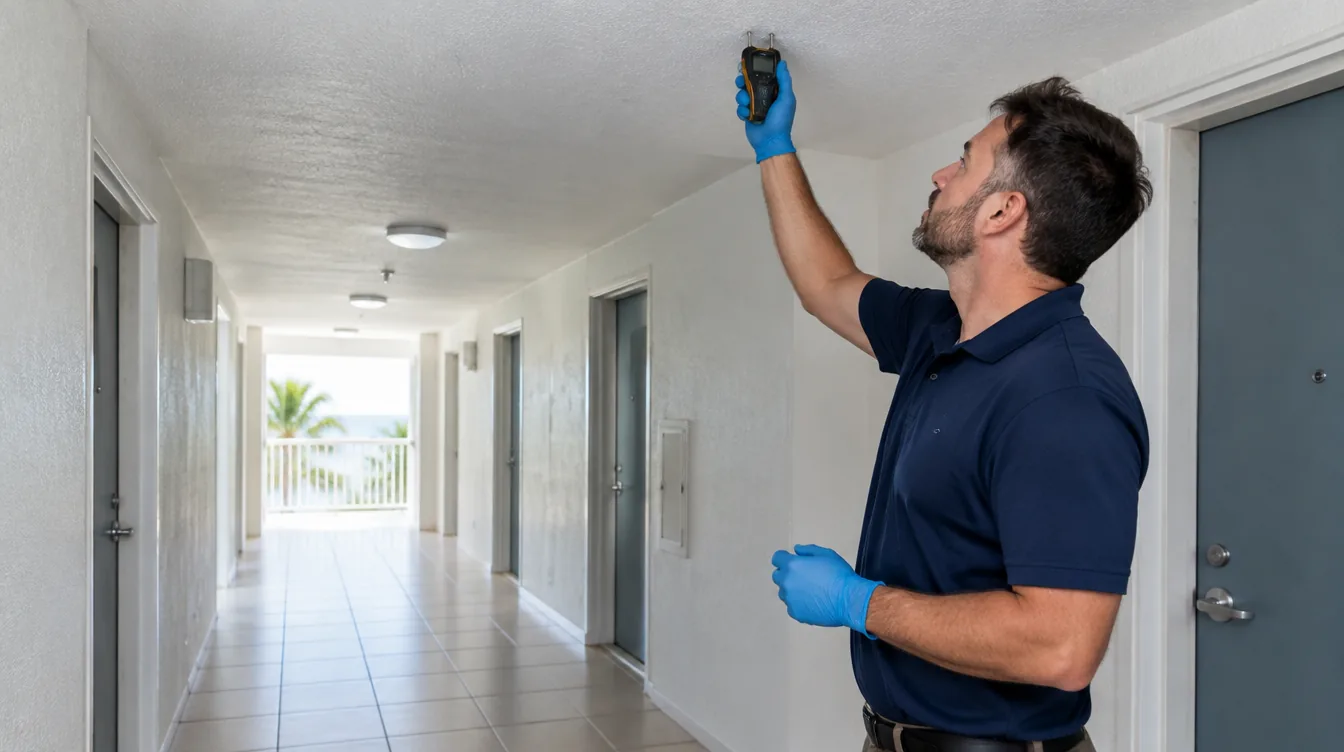
We work with unit owners, boards and property managers on both sides of the line. An independent licensed assessor inspects, samples and writes the scope, and we do the remediation to that protocol, with containment that protects neighboring units and hallways. Our condo and HOA mold service explains how we coordinate access, documentation and clearance in occupied buildings, and our guide to Florida homeowners insurance and mold covers the policy questions.
This page is general information, not legal advice. Condo responsibilities depend on your declaration of condominium, your bylaws and your insurance policies. Before you pay for, deny or dispute a mold repair, speak with a Florida attorney or your association manager.
We're done when the lab says so.
Every remediation ends with clearance testing, and our work is backed by a complete-removal guarantee. We don't close a job on a failed result.
Talk to a specialistMold in your unit or your building?
Tell us where you found it and where the water came from. A Southwest Florida specialist will call you back.
Not sure yet? Try the free AI Mold Risk Check