
Why do Indiana basements get moldy?
Short answer
Indiana basements get moldy because they're cool rooms sitting in wet ground. Clay-heavy soil across much of the state holds rain against foundation walls, spring storms raise groundwater, and humid summer air condenses on concrete that stays cool year-round. Add drywall, carpet and cardboard boxes, which mold feeds on, and a basement doesn't need to flood. Staying damp is enough.
A cool room in the middle of a humid summer
The ground a few feet down stays cool all year, and a basement’s walls and slab take on that temperature. In an Indiana July, outdoor dew points regularly reach the 60s and can push into the 70s. When that air drifts into the basement through open doors, leaky ductwork or the porous concrete itself, it meets surfaces cooler than its dew point, and water condenses right onto the wall.
That’s why so many basement mold calls come in during summer even when nothing has leaked. The water isn’t coming through a crack. It’s coming out of the air. A basement can hold relative humidity well above what the EPA recommends for weeks at a time without anyone seeing a drop of water on the floor. Our page on how humid an Indiana home should be gives the target numbers.
What the glaciers left under central Indiana
Much of central and northern Indiana sits on material left behind by glaciers, and a lot of it is clay-rich. Clay soaks up water slowly and gives it up slowly. After a wet spring week, the soil around a foundation can stay saturated long after the sky clears, pressing water against the walls and under the slab. Water finds the easy paths: form tie holes, shrinkage cracks, the joint where the wall meets the floor, and gaps around pipes.
Southern Indiana is different ground, hillier and less glaciated, but homes built into slopes face their own problem: water running downhill toward the uphill wall. We go into the soil side in more depth in does Indiana clay soil cause basement moisture.
What we put in basements matters as much as the water
Mold needs moisture and food. Bare concrete offers little food, although dust and grime on its surface can support some growth, as we explain in can mold grow on concrete. The bigger problem is everything we add:
- Paper-faced drywall installed tight to the foundation wall, often with fiberglass insulation behind it that holds moisture.
- Carpet and pad laid directly over a slab that wicks ground moisture upward.
- Cardboard boxes stacked against exterior walls, full of paper, fabric and holiday decorations.
- Wood framing with the bottom plate sitting on concrete.
- Laundry and mechanicals. Dryers, water heaters and furnaces with condensate lines add their own moisture.
An unfinished basement with a bare wall and a stained spot is easy to deal with. A finished basement can hide growth on the back of the drywall for years while the painted side looks clean.
Spring, summer and the sump pit
Indiana basements tend to fail in two seasons. Spring brings heavy rain on top of snowmelt, the water table rises, and sump pumps run hard. If a pump fails, loses power in a storm, or discharges right next to the foundation, water comes back in. See whether a sump pump failure causes mold for what to do in the first day or two.
Summer is the humidity season described above, and it tends to produce slower, wider problems: musty smells, spotting on stored items, growth along the bottom of walls. Winter is usually the quietest stretch below grade, though a cold basement wall can still collect condensation.
Finding the cause in your basement
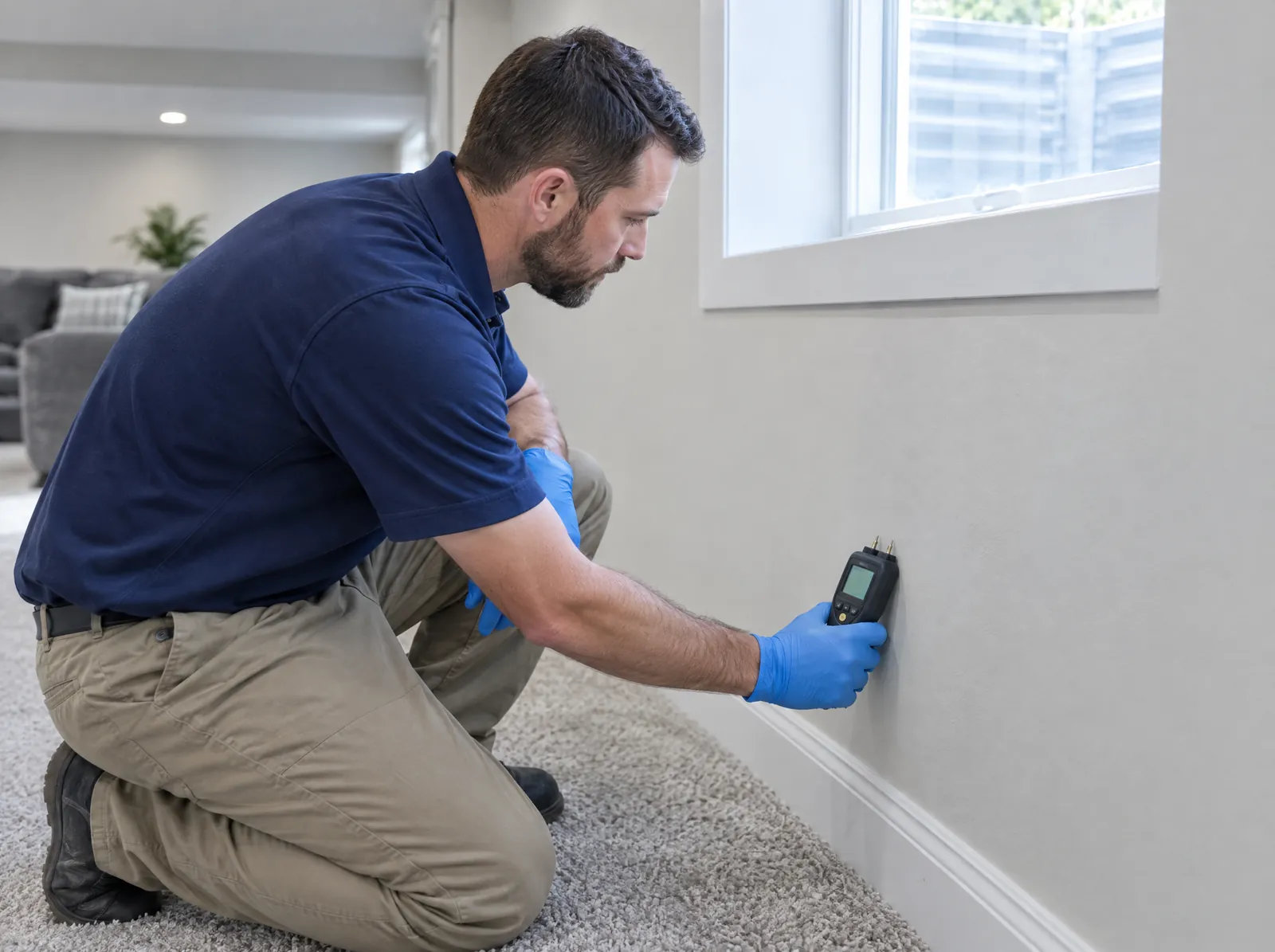
Start with your nose and a cheap hygrometer. A musty smell and humidity readings that stay high tell you there’s a moisture problem even before you see anything. Then look low: the bottom few inches of drywall, the base of stored boxes, the tack strip under carpet at exterior walls. If you find growth, or the smell doesn’t match what you can see, testing shows how far it goes. Our basement mold removal page explains how we trace the water and clean up without tearing out more than we need to.
We're done when the lab says so.
Every remediation ends with clearance testing, and our work is backed by a complete-removal guarantee. We don't close a job on a failed result.
Talk to a specialistSmell something in the basement?
Moisture readings and lab samples show whether it's mold and where it's coming from. Tell us what you're noticing, and a specialist from our Avon office will call you back.
- (833) 772-6653
- info@americanmoldexperts.com
- Open 7 days, 8am to 8pm