
Southwest Florida AC and duct mold
AC, duct and air handler mold in Southwest Florida
In Florida the AC runs almost all year, and so does the moisture inside it. We clean the whole system.
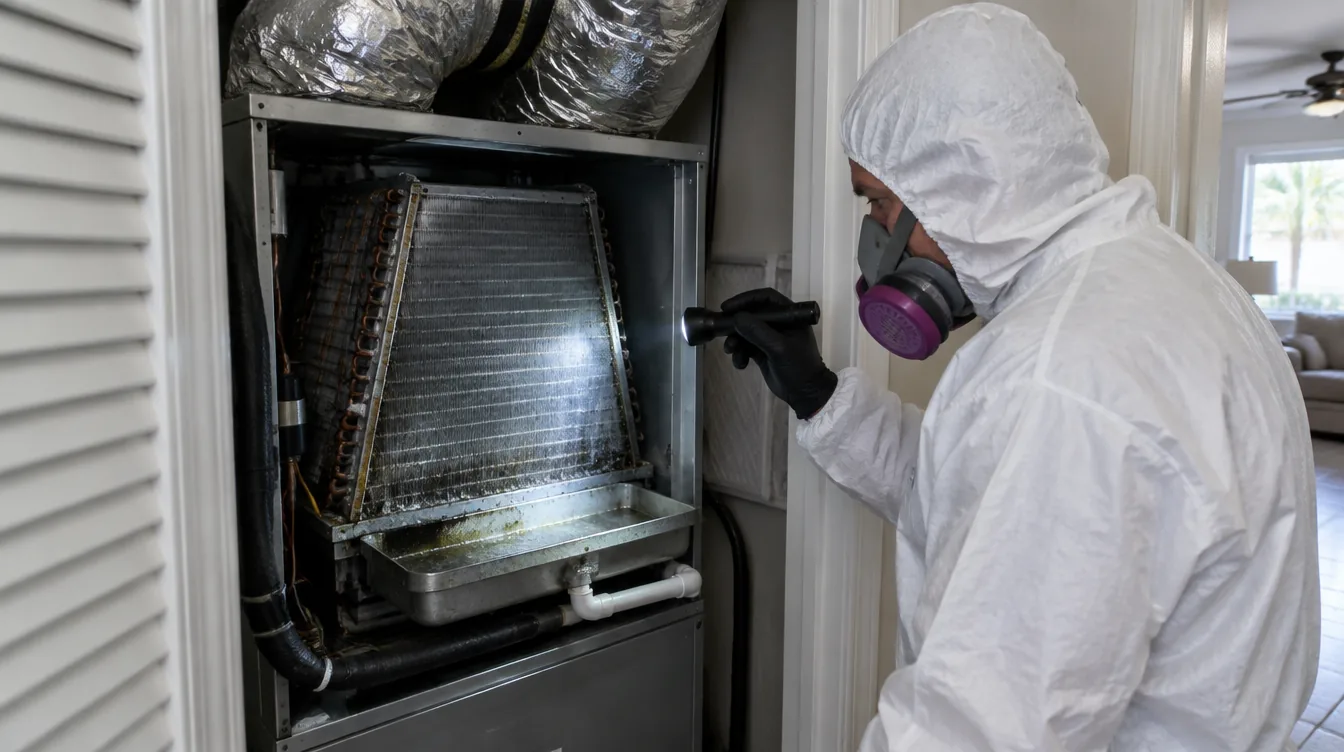
How is AC mold removed in Florida?
AC mold in Florida is removed by cleaning the whole system, starting where the water is: the air handler cabinet, evaporator coil, drain pan and condensate line, then the blower, return and ducts, with HEPA equipment under negative pressure. Moldy duct board or lined duct is usually replaced. The drainage or humidity problem that fed the mold gets corrected, and an independent licensed assessor confirms the result with clearance testing.
Why Florida AC systems grow mold
An air conditioner is a dehumidifier. Every hour it runs, the cold coil pulls water out of the air, and that water has to drip into a pan and drain away. In Southwest Florida the system does this for most of the year, often from a closet in the middle of the house or a corner of the garage. When the drain line slows, the pan overflows, or the system can't pull humidity down, the inside of the air handler becomes the wettest, darkest place in the home, with the house's dust as food.
Sound familiar?
- The house smells musty for a few minutes every time the AC kicks on.
- There's dark growth on the vents or the ceiling around them.
- The AC closet floor or the wall behind the air handler is stained or soft.
- A duct cleaning company fogged the system and the smell came back.
We do it differently.
| Duct cleaning special | AME AC mold remediation | |
|---|---|---|
| Starting point | Supply ducts | Air handler, coil, drain pan and condensate line |
| Method | Brush and fog | HEPA cleaning under negative pressure |
| Moldy duct board | Sprayed and left in place | Replaced |
| The AC closet | Not included | Closet walls, floor and platform inspected and cleaned |
| Verification | None | Independent licensed assessor, before and after |

Why families trust us with their homes
-
Family-owned since 2008
A multigenerational family business. Not a franchise, not a private-equity rollup.
-
Trained and certified
Our team holds IICRC, CMR, CRMI and CCMI credentials in mold remediation and inspection.
-
Called on as experts
Attorneys bring us into legal cases involving mold and mycotoxins.
-
Documentation at every step
Photos, moisture logs and lab reports you can hand to your insurer or FEMA.
- IICRC Certified Firm
- CMR
- CRMI
- CCMI
- BBB A+ Accredited
- NAMRI
- IAQA
- NORMI
- AMMA
- PMII
The AME Clearance Method
How we clean mold out of an AC system
Seven steps, in this order. Cleaning ducts before the air handler just reloads them the first time the system runs.
Talk to a specialist-
Shut it down and inspect
The system goes off. We open the air handler and look at the coil, drain pan, blower, return plenum, closet and the duct connections.
-
Independent assessment
A licensed Florida mold assessor, independent of us, samples the air and surfaces, in the system and in the living space, and writes the scope.
-
Find the water
A clogged condensate line, a rusted or cracked pan, a sweating duct in the attic, a leaking closet or indoor humidity the system can't keep down.
-
Seal the system
Registers and returns are sealed and the work runs under negative air, so loosened debris goes into HEPA filtration, not your rooms.
-
Clean at the source
Cabinet, blower, pan and accessible coil surfaces are cleaned, and the AC closet itself is HEPA vacuumed and cleaned or repaired.
-
Clean or replace ductwork
Sheet metal ducts are HEPA cleaned. Duct board and lined ducts with growth are replaced, since mold grows into them.
-
Independent clearance
The assessor retests before the system runs full time again. You get the report.
What every AC mold project includes
- Air handler, coil area, blower and drain pan inspection
- Coordination with an independent licensed assessor
- Condensate line and drainage check
- Sealing of registers and returns during the work
- HEPA cleaning under negative air
- AC closet cleaning and repair
- Duct cleaning, or replacement of moldy duct board
- HEPA cleaning of rooms where dust traveled
- Photo documentation of the system before and after
- Independent clearance testing

Proof you can hold in your hands
When we finish, you don't get a handshake and a promise. You get the paperwork your family, your doctor, your insurer or your buyer can rely on.
Inspection report
What we found, where it is coming from, with color photos.
Written remediation plan
Scope, timeline and what will and won't be removed, before work starts.
Clearance lab report
Air, surface and mycotoxin results after the work is done.
A report for your doctor
With your permission, we share results directly with your care team.
AC mold in Florida homes, explained
The parts of a Florida AC system where mold starts
Most Southwest Florida homes have a split system: a condenser outside and an air handler inside, often in a hall closet, a utility room or the garage. Mold almost never starts in the supply ducts. It starts where water collects, and then the blower carries it everywhere else.
| Part | What goes wrong | What it takes to fix |
|---|---|---|
| Evaporator coil | Wet for hours a day, and dust sticks to it | Cleaning accessible coil surfaces, and a filter that fits properly |
| Drain pan | Standing water, rust or cracks | Cleaning, and repair or replacement by an HVAC contractor |
| Condensate line | Slime and debris clog it, so the pan backs up | Clearing the line and checking that it drains freely |
| AC closet and platform | Overflow soaks the floor, drywall and wood stand | Removing damaged drywall or wood, cleaning and treating the closet |
| Return plenum | Pulls in humid, dusty air; often built from duct board | HEPA cleaning, or replacement if it has growth |
| Ducts and registers | Condensation where cold air meets humid air | HEPA cleaning of metal duct, replacement of moldy duct board or flex |
Why the system stops controlling humidity
An AC that cools the house but leaves it clammy is a mold risk. A few common reasons in Florida homes:
- An oversized system cools the air quickly and shuts off before it has pulled much moisture out.
- A fan left on “On” instead of “Auto” can blow air across a wet coil after the compressor stops, putting some of that moisture back into the house.
- Leaky return ducts in a hot attic or garage pull humid air straight into the system.
- A thermostat set very high while the house is empty means the AC barely runs, so humidity climbs.
The EPA recommends keeping indoor relative humidity below 60 percent, and ideally between 30 and 50 percent. An inexpensive humidity monitor tells you whether your system is getting there. If it isn’t, fixing that is part of the job. For more on thermostat settings, see what temperature to set your AC to prevent mold.
Duct cleaning is not mold remediation
Duct cleaning is a maintenance service. It removes dust and debris from the ducts. Mold remediation deals with growth, and in an AC system the growth is usually in the air handler and the closet around it. Fogging a system with a disinfectant may kill some mold on the surface, but it doesn’t remove it, doesn’t touch mold grown into duct board, and does nothing for mycotoxins carried in dust. Our national page on HVAC mold remediation covers the general standards.
After a storm or a power outage
When the power goes out for days after a hurricane, the AC stops pulling moisture out of a house that may already be wet. Air handlers in garages can take on flood water. If the air handler, return or ducts got wet, or you smell mustiness when the system restarts, have it checked before it runs full time. The EPA advises against running a system you know or suspect is contaminated with mold. Our hurricane and flood mold remediation page covers the rest of the house.
Who tests the system in Florida
Florida licenses mold assessors and mold remediators separately, and Florida Statute 468.8419 keeps the two roles apart on the same structure for 12 months, except for certified Division I contractors. On our projects, an independent licensed mold assessor inspects and samples the home, writes the scope, and performs clearance testing. We do the remediation to that protocol. The company testing your AC has no reason to find more mold than is there, and the company cleaning it can’t grade its own work.
Common questions
Have a question that isn't here? Call a specialist
How can I tell if there's mold in my AC?
Common signs are a musty smell when the system starts, dark growth on or around vents, water or stains in the AC closet, and a drain pan that holds standing water. None of these prove mold on their own. An inspection of the air handler and sampling by an assessor will.
Should I keep running the AC if I think it has mold?
The EPA advises not running an HVAC system you know or suspect is contaminated with mold, because it can spread mold through the building. In a Florida summer that's hard, so call quickly and ask about running portable dehumidifiers in the meantime.
What temperature should I set my AC to prevent mold?
Humidity matters more than temperature. The EPA recommends keeping indoor humidity below 60 percent, ideally between 30 and 50 percent. Our answer page on AC settings for Florida homes covers the details, including what to do when you're away.
Can I just have my ducts cleaned?
Standard duct cleaning removes dust, but it usually starts and ends with the ducts. If the mold is in the air handler, coil or drain pan, clean ducts get recontaminated as soon as the system runs.
Will a UV light solve the problem?
UV lights aimed at a coil can help limit growth on that surface. They don't clean existing growth in ducts, duct board or the closet, and they don't fix a drainage or humidity problem.
Do you repair or replace the AC unit?
No. If the equipment needs repair or replacement, a licensed HVAC contractor handles that part, and we coordinate so the mold cleaning and the repair happen in the right order.
Can mycotoxins spread through the AC?
They can travel on dust and mold fragments that the system moves around the house. That's why we clean the system and HEPA clean the rooms it serves, not just the ducts.
We're done when the lab says so.
Every remediation ends with clearance testing, and our work is backed by a complete-removal guarantee. We don't close a job on a failed result.
Talk to a specialistMusty AC? Talk to a specialist
Tell us where your air handler is and what you're noticing. A Southwest Florida specialist will call you back.
Not sure yet? Try the free AI Mold Risk Check