
What temperature should I set my AC to prevent mold?
Short answer
In a Southwest Florida home, about 75 to 78°F while you're home, with the fan on AUTO, works for most houses. UF/IFAS Extension suggests no lower than 78°F in summer to discourage mold while saving energy. When you're away, FPL suggests about 80 to 82°F. The number that really matters is indoor humidity, which should stay below 60 percent.
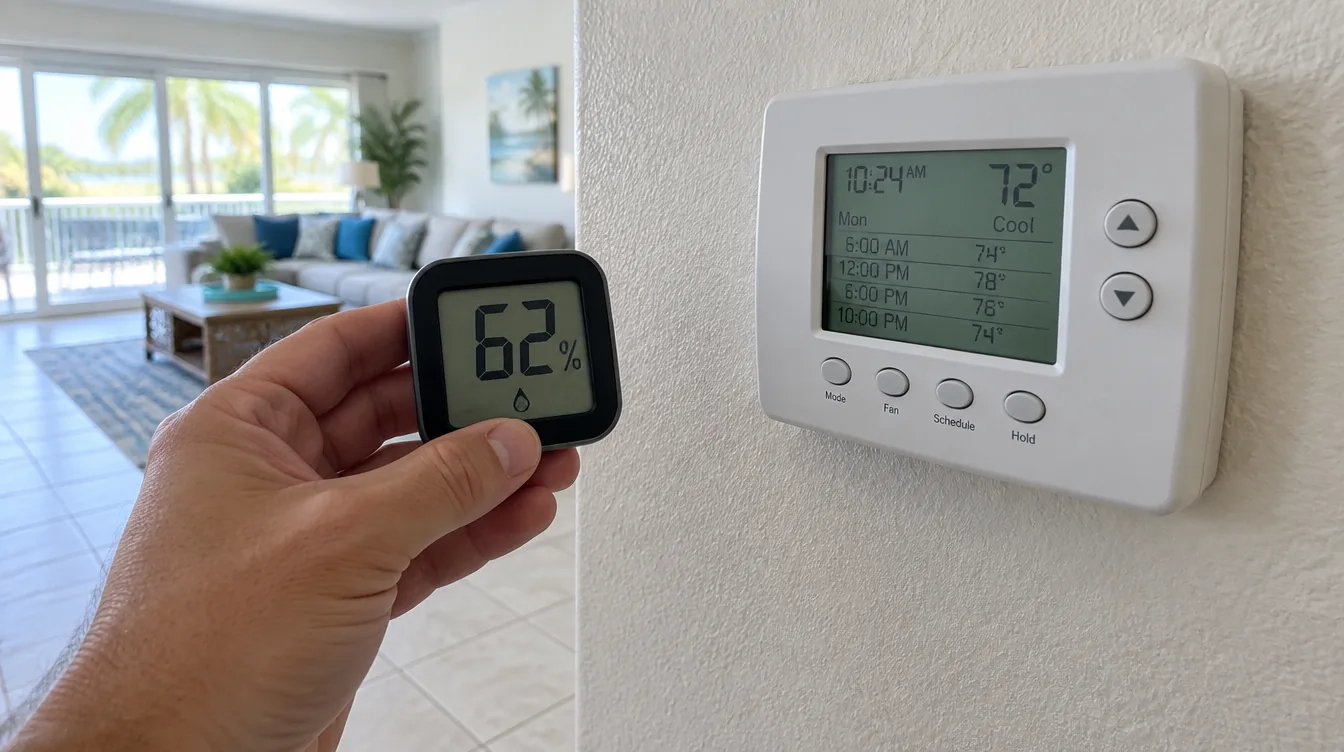
Temperature is the dial, humidity is the goal
Mold doesn’t respond to the number on your thermostat. It responds to moisture. In Florida, your air conditioner is the main thing drying your house: as humid air passes over the cold coil, water condenses, drips into the drain pan and runs outside. The thermostat setting matters because it controls how long and how often that happens.
So the right setting is the one that keeps indoor relative humidity below 60 percent, and ideally around 50, without wasting energy. The general humidity guidance is on our page about what humidity to keep a Florida home at.
Recommended settings from Florida sources
| Situation | Suggested setting | Source |
|---|---|---|
| Home, summer | No lower than 78°F | UF/IFAS Extension |
| Home, comfort range | 75 to 78°F | FPL |
| Away a few days | 80°F | FPL |
| Away for weeks | 82°F | FPL |
| Seasonal residents away for months | Around 78 to 82°F, keeping humidity below 60 percent | FPL |
| Fan switch | AUTO, never ON | Florida Solar Energy Center |
Sources: UF/IFAS Extension Sarasota County, FPL and the Florida Solar Energy Center.
Why colder isn’t better
It seems logical that a colder house would be a drier one. It doesn’t always work that way. UF/IFAS Extension notes that lowering the thermostat quickly can actually raise indoor relative humidity. Relative humidity depends on temperature: the same amount of water in the air reads higher as the air gets cooler, and a very cold surface, like a supply register, can drop below the point where moisture condenses on it.
A steady, moderate setting lets the system run longer, even cycles, which is when it removes the most moisture.
Why the fan belongs on AUTO
This is the setting most Florida homeowners get wrong. With the fan switch on ON, the blower keeps running after the compressor stops. The Florida Solar Energy Center explains that the moisture sitting on the wet coil then evaporates and blows right back into the house. On AUTO, the fan stops with the compressor and the water has time to drain away.
Summer versus the dry season
The hardest months are the rainy season, mid-May to mid-October in Southwest Florida, when outdoor air is at its most humid and the AC runs nearly nonstop. That’s when the settings above matter most. In the drier winter months, the system may barely run on mild days, and indoor humidity usually drops with the outdoor air. UF/IFAS Extension suggests heating to no higher than 68°F in winter. Don’t assume winter is safe, though: a cool, cloudy stretch with the AC idle can let humidity creep up in a closed house, so keep an eye on a hygrometer year round.
Smart and programmable thermostats
Many newer thermostats show indoor humidity, and some can run the system to control it. If yours does, use the humidity reading as your guide and set the target below 60 percent. Be careful with aggressive energy-saving schedules that let the house warm up for most of the day and then cool it hard in the evening. Long off periods in a Florida summer let moisture build up in the house, even if the temperature comes back down later.
Signs your AC isn’t controlling moisture
- Humidity readings above 60 percent even though the thermostat is satisfied
- A cool but clammy feel in the house
- The system cools quickly and shuts off after short runs. FSEC notes that the more an air conditioner is oversized, the poorer its humidity removal.
- Sweating supply vents, or spotting on the ceiling around them
- Water around the air handler or a drain line that backs up
- A musty smell when the system starts
The Florida Department of Health advises that if a central AC system needs help from a dehumidifier to get below 60 percent, the system should be examined for problems. A licensed HVAC contractor can check sizing, airflow, the coil and the condensate drain.
When the setting isn’t the problem
If the house smells musty with the AC running, the system itself may be growing mold on the coil, in the drain pan or in the ducts. Changing the thermostat won’t fix that. Our page on how to tell if there is mold in your AC walks through the signs, and our national guide to HVAC mold explains how it’s removed. In Florida, an independent licensed mold assessor inspects and samples the home, writes the scope and performs clearance testing, and we do the remediation to that protocol.
We're done when the lab says so.
Every remediation ends with clearance testing, and our work is backed by a complete-removal guarantee. We don't close a job on a failed result.
Talk to a specialistAC running but the house still feels damp?
That's often the first sign of a moisture problem. Tell us what you're noticing and a Southwest Florida specialist will call you back.
Not sure yet? Try the free AI Mold Risk Check