
Noblesville mycotoxin testing
Mycotoxin testing in Noblesville homes
Dust panels for families whose doctor suspects the house, with each basement, crawlspace and living area tested on its own.
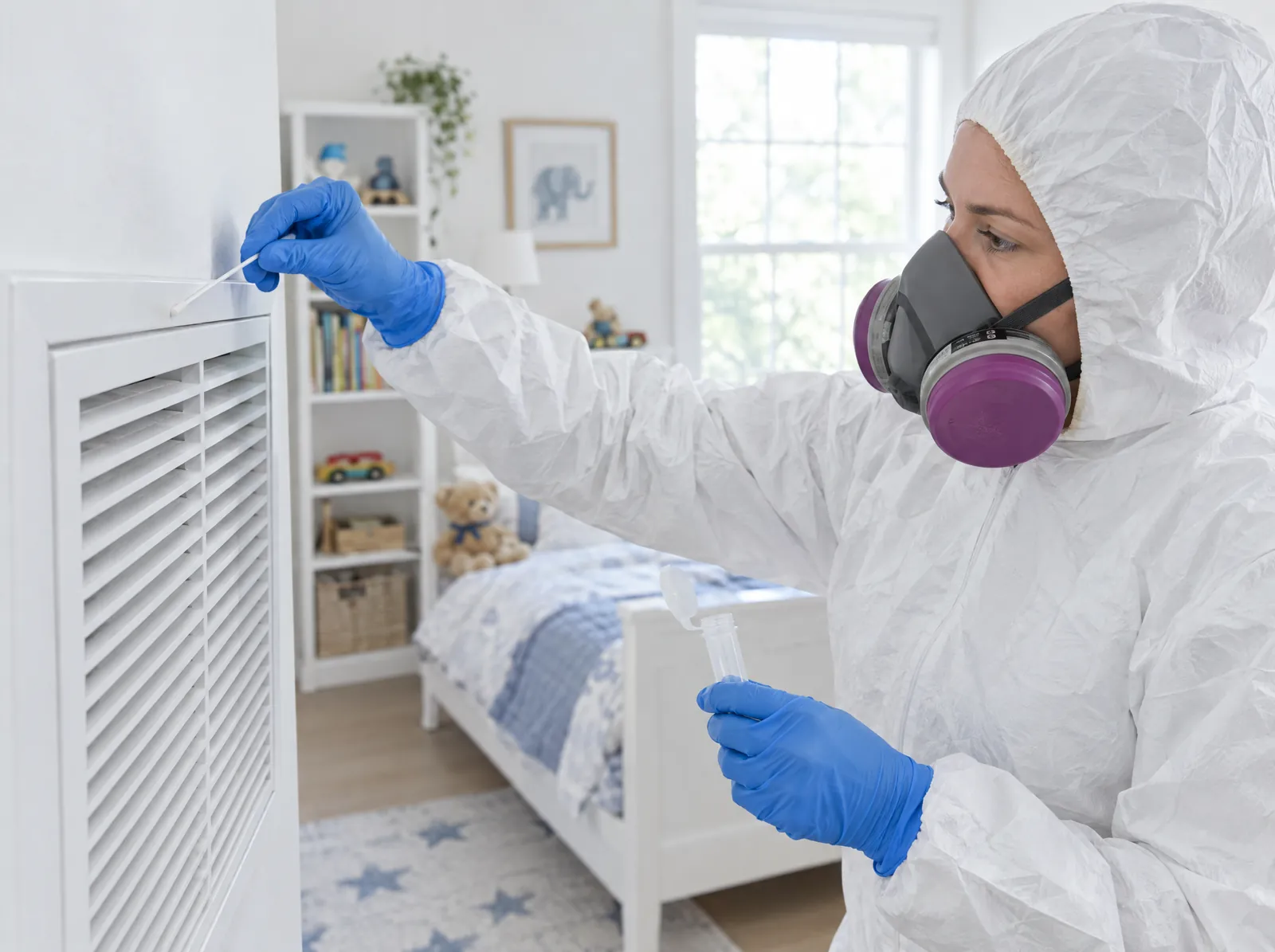
What is mycotoxin testing in Noblesville?
Mycotoxin testing in Noblesville measures mold toxins in a home's settled dust and on surfaces, using a lab panel. We usually recommend it when a doctor has asked whether the house could be involved. Because many Noblesville homes combine an old basement, a crawlspace addition and newer rooms, and some have flood history, we sample in zones and pair the panel with mold testing to locate the source.
What basic testing misses after floods and old repairs
When drywall or ceiling paper stays wet for a long stretch, as it can after a basement flood, molds like Stachybotrys may grow and produce trichothecenes. Once everything dries, spore release drops and the air may test fine. The toxins stay in the material, the dust around it and anything stored nearby. In an older Noblesville home with a crawlspace addition tied into the same ductwork, that dust has a path into the living space. A spore test on a dry day sees none of it.
Sound familiar?
- Your basement took on water once, and now your doctor asks whether the house could be involved.
- Papers, books and heirlooms were stored in a damp basement or crawlspace for years.
- The addition over the crawlspace is the room where your family spends the most time.
- You need results precise enough to decide which part of the house to remediate.
We do it differently.
| Spore testing alone | AME Noblesville mycotoxin testing | |
|---|---|---|
| After a flood dries | Often reads normal | Dust panel shows what the wet period left |
| Older multi-part homes | One sample for everything | Basement, crawlspace and living areas sampled in zones |
| Stored heirlooms | Not addressed | Storage dust sampled to guide decisions |
| Source location | Unclear | Zone comparison points to the source |
| Clearance | Rarely repeated | The same panel repeated after remediation |

Why families trust us with their homes
-
Family-owned since 2008
A multigenerational family business. Not a franchise, not a private-equity rollup.
-
Credentialed where it isn't required
Indiana doesn't license mold remediators. We hold IICRC, CMR, CRMI and CCMI credentials anyway.
-
Called on as experts
Attorneys bring us into legal cases involving mold and mycotoxins.
-
Lab results in 24 to 48 hours
Every inspection comes with a written report, color photos and lab results.
- IICRC Certified Firm
- CMR
- CRMI
- CCMI
- BBB A+ Accredited
- NAMRI
- IAQA
- NORMI
- AMMA
- PMII
The AME Clearance Method
How we test a Noblesville home for mycotoxins
Five steps, organized around the zones of your house and the history of water in each one.
Talk to a specialist-
Gather the story
What your doctor has asked for, when water came in, where belongings were stored and which rooms your family uses most.
-
Define the zones
We divide the house by foundation and HVAC path, such as the original basement, a crawlspace addition and upstairs bedrooms, and check each for moisture.
-
Collect dust in each zone
Undisturbed settled dust, plus surface samples where helpful, taken with fresh gloves and sealed media at every location.
-
Identify the molds
Dust-based ERMI or HERTSMI-2 testing, and air samples when useful, show which molds are involved in each zone.
-
Compare and explain
Lab results typically arrive in 24 to 48 hours. We compare the zones, explain what the pattern suggests and share it with your doctor if you ask.
Included in Noblesville mycotoxin testing
- A conversation about your doctor's request and the home's flood history
- A zone plan based on foundations and ductwork
- Moisture checks in basement, crawlspace and attic
- Settled-dust and surface samples in each zone
- A lab mycotoxin panel
- ERMI or HERTSMI-2 mold testing
- Optional samples from storage areas
- A zone-by-zone report you can share with your doctor

Proof you can hold in your hands
When we finish, you don't get a handshake and a promise. You get the paperwork your family, your doctor, your insurer or your buyer can rely on.
Inspection report
What we found, where it is coming from, with color photos.
Written remediation plan
Scope, timeline and what will and won't be removed, before work starts.
Clearance lab report
Air, surface and mycotoxin results after the work is done.
A report for your doctor
With your permission, we share results directly with your care team.
Mycotoxin testing in Noblesville, explained
Floods, stored belongings and long memories
Many Noblesville families have lived in their homes for a long time, and their basements show it: file boxes, photo albums, furniture from a parent’s house. If that basement took on water from a storm or high groundwater, what was stored there may have stayed damp for days. Paper and cardboard feed mold readily. Our page on whether books and papers can hold mycotoxins explains why they need particular attention.
When the storage area is part of the question, we sample its dust separately from the living areas. That keeps results about the house distinct from results about the belongings, and helps you decide about each.
Which toxins show up after water damage
The toxins on a panel depend on which molds grew. Long-wet drywall and paper favor Stachybotrys, which is associated with trichothecenes. Damp dust and HVAC systems favor Aspergillus and Penicillium, associated with toxins such as ochratoxin A. Matching the panel to ERMI or HERTSMI-2 results helps tell which kind of source you’re dealing with.
Using results to plan the work
A zone-by-zone report makes remediation planning simpler. If toxins are concentrated in the crawlspace addition and the rooms above it, the work can be contained there, with cleaning in the rest of the house. If the original basement is the source and the ducts have carried it upstairs, the HVAC system becomes part of the scope. Our page on mycotoxin remediation in Indiana covers how that work is done and verified.
Our testing is of the building, for mold and mycotoxins. We don’t diagnose or treat illness, and home results are not a medical test. Please work with your doctor on health questions, and with your permission we’ll send them every result.
Common questions
Have a question that isn't here? Call a specialist
Our basement flooded years ago. Would toxins still show up now?
They can. Mycotoxins are chemically stable and can stay in dust and materials for a long time. If the flood was cleaned up without removing wet drywall or insulation, a panel is a reasonable way to check.
Can you test old books, photos and papers?
We sample dust from where they're stored, which is usually more useful than testing items one by one. Paper is porous, so if the storage area shows toxins, we'll talk through which items can be cleaned and which are harder to save.
Why test in zones instead of one whole-house sample?
In a house with a basement, a crawlspace and a slab addition, a combined sample blurs which part is contributing. Zones make the source clearer and keep remediation focused on the areas that need it.
Does a positive result mean we need to move out?
Not necessarily. Results show where toxins are, not what anyone should do medically. Families usually decide about staying or leaving during remediation with their doctor, based on the results and who in the home is most sensitive.
Will the same test be used after remediation?
Yes. Repeating the same panel in the same zones after the work lets you compare before and after directly, and that comparison is how we decide the job is done.
We're done when the lab says so.
Every remediation ends with clearance testing, and our work is backed by a complete-removal guarantee. We don't close a job on a failed result.
Talk to a specialistAsk about mycotoxin testing in Noblesville
Tell us about any flooding, stored belongings and what your doctor wants to know. We'll call to map out the zones with you.
- (833) 772-6653
- info@americanmoldexperts.com
- Open 7 days, 8am to 8pm