
Plainfield and White Lick Creek
Mold testing in Plainfield after water gets in
Creek flooding, older US 40 basements and newer subdivisions each call for a different sampling plan.
What does mold testing in Plainfield cover?
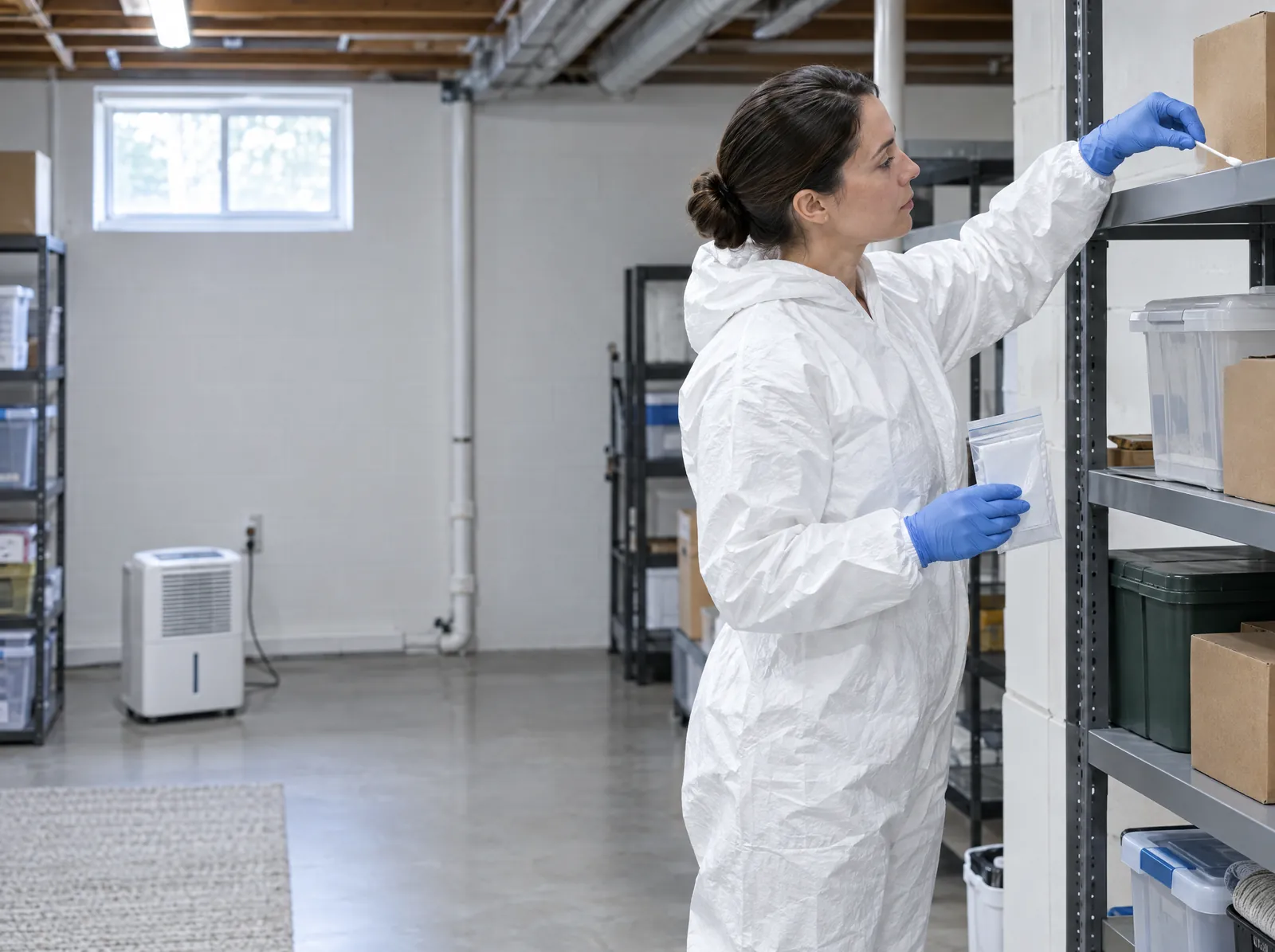
Mold testing in Plainfield starts by finding where water has been, with moisture readings in basements and crawlspaces, especially in homes on lower ground near White Lick Creek. We then take indoor air samples with an outdoor comparison, surface or tape samples of visible growth and, when the history warrants it, settled dust for ERMI or HERTSMI-2 analysis. Expect lab results within 24 to 48 hours.
Why a standard test falls short in Plainfield
Plainfield's water problems come from several directions. Homes on low ground near White Lick Creek can take on water when it rises after heavy rain. Older houses near the US 40 corridor, the historic National Road, have block foundations that have cracked over decades of freeze and thaw. Newer subdivisions on former farmland sit on the same clay soils. In each case growth tends to start low and out of sight: behind stored boxes, under carpet, inside the bottom of a finished wall. An air sample taken upstairs may not catch it at all.
Sound familiar?
- Your basement took on water when the creek came up.
- White mineral streaks keep appearing on an old block wall.
- Boxes stored on the basement floor feel damp or smell stale.
- You manage a commercial building near the airport and a tenant has complained.
We do it differently.
| An upstairs air test | AME testing in Plainfield | |
|---|---|---|
| Flood history | Not asked about | Water lines and wicking traced with meters |
| Stored belongings | Ignored | Checked, since cardboard and fabric grow mold early |
| Block foundations | A glance from the stairs | Readings along cracks and mortar joints |
| Samples | One or two indoors | Indoor, outdoor, surface and dust as needed |
| Commercial space | A residential approach | Sampling scoped to the affected area |

Why families trust us with their homes
-
Family-owned since 2008
A multigenerational family business. Not a franchise, not a private-equity rollup.
-
Credentialed where it isn't required
Indiana doesn't license mold remediators. We hold IICRC, CMR, CRMI and CCMI credentials anyway.
-
Called on as experts
Attorneys bring us into legal cases involving mold and mycotoxins.
-
Lab results in 24 to 48 hours
Every inspection comes with a written report, color photos and lab results.
- IICRC Certified Firm
- CMR
- CRMI
- CCMI
- BBB A+ Accredited
- NAMRI
- IAQA
- NORMI
- AMMA
- PMII
The AME Clearance Method
Testing a Plainfield property
The order matters: water first, samples second, answers last.
Talk to a specialist-
Find the high-water mark
If water came in, we trace how high it reached and how far it wicked into drywall, framing and flooring.
-
Check the foundation
Cracks, mortar joints, window wells and floor drains on block and poured walls are measured for moisture.
-
Look behind what's stored
Shelving, boxes and furniture along exterior walls often hide the first growth, so we look before we sample.
-
Collect samples
Indoor and outdoor air, tape samples of visible spots, and settled dust when the history calls for it.
-
Lab analysis
An independent lab analyzes every sample, usually within 24 to 48 hours.
-
Written findings
The report ties each result to a location and says plainly whether remediation, drying or nothing at all is needed.
Included in Plainfield mold testing
- A flood and leak history review
- Moisture mapping of basement and crawlspace
- A foundation crack and window well check
- Indoor air samples with an outdoor comparison
- Tape or surface samples of visible growth
- ERMI or HERTSMI-2 dust testing when warranted
- Guidance on stored items near damp areas
- A written report in plain English

Proof you can hold in your hands
When we finish, you don't get a handshake and a promise. You get the paperwork your family, your doctor, your insurer or your buyer can rely on.
Inspection report
What we found, where it is coming from, with color photos.
Written remediation plan
Scope, timeline and what will and won't be removed, before work starts.
Clearance lab report
Air, surface and mycotoxin results after the work is done.
A report for your doctor
With your permission, we share results directly with your care team.
Mold testing in Plainfield, explained
Low ground near White Lick Creek
When White Lick Creek rises after heavy rain, the homes that feel it first sit on lower ground near its banks. Water that enters a basement from outside isn’t clean, and it rarely stays where it lands. It wicks up drywall, soaks the bottom plate of framed walls and settles under flooring. Testing after a flood is less about whether mold is present and more about how far the water traveled. Our guide on what to do after a basement flood in Indiana covers the first few days.
Block walls along the old National Road
The houses closest to Plainfield’s historic center have foundations that have been through many decades of freeze and thaw. Cracks and worn mortar let a little water in with most rains. Owners notice white mineral streaks, a stale smell or rust on metal shelving. We take readings along each crack and at the base of the wall, then sample the air near stored belongings, since that’s where growth often begins.
Subdivisions, rentals and commercial space
Plainfield’s newer neighborhoods were built on former farmland with the same clay underneath, so finished basements here can still sweat and seep. Near the airport, warehouses and distribution buildings raise different questions: roof leaks, HVAC condensation and large open spaces. For those, see commercial mold inspection. If health is part of the concern, Plainfield mycotoxin testing adds a dust panel for mold toxins.
Our work is limited to buildings, and diagnosing or treating medical conditions is outside it. Anyone with symptoms should see a doctor, and we’ll share the lab results with them if you ask us to.
Common questions
Have a question that isn't here? Call a specialist
White Lick Creek flooded our basement. When should we test?
Moisture mapping is useful right away, since it shows what got wet and how far water traveled. If the space was dried quickly, air and dust sampling a little later shows whether growth started anyway. Porous materials that stayed wet for more than a day or two deserve a close look regardless.
Do you test commercial buildings in Plainfield?
Yes. Warehouses, offices and multifamily buildings get the same sampling approach, scoped to the affected area, with the documentation owners and property managers need.
Our old basement wall has white powder on it. Is that mold?
Often it's efflorescence, the mineral salts left behind when water moves through masonry. It isn't mold, but it shows water is getting through, and mold can grow on anything organic nearby. A tape sample settles the question.
How much is a mold inspection near Plainfield?
Angi reports typical mold inspection costs in the Indianapolis area of about $240 to $400. The number of samples sets the price for your house, and we'll tell you what it is before we come out.
How close are you to Plainfield?
Our office is in neighboring Avon, also in Hendricks County, so Plainfield is part of our home territory.
Can a landlord and tenant use the same report?
Yes. One lab report that both sides can read keeps the conversation on facts. We explain the results the same way to whoever orders the test.
We're done when the lab says so.
Every remediation ends with clearance testing, and our work is backed by a complete-removal guarantee. We don't close a job on a failed result.
Talk to a specialistGet mold testing in Plainfield
Let us know whether water came in, when, and where. We'll call back to set up testing from our office next door in Avon.
- (833) 772-6653
- info@americanmoldexperts.com
- Open 7 days, 8am to 8pm