
Joists, subfloor and ground moisture
Crawl space mold removal, from the dirt up
The air under your floor becomes the air in your house. We clean it out and keep it dry.
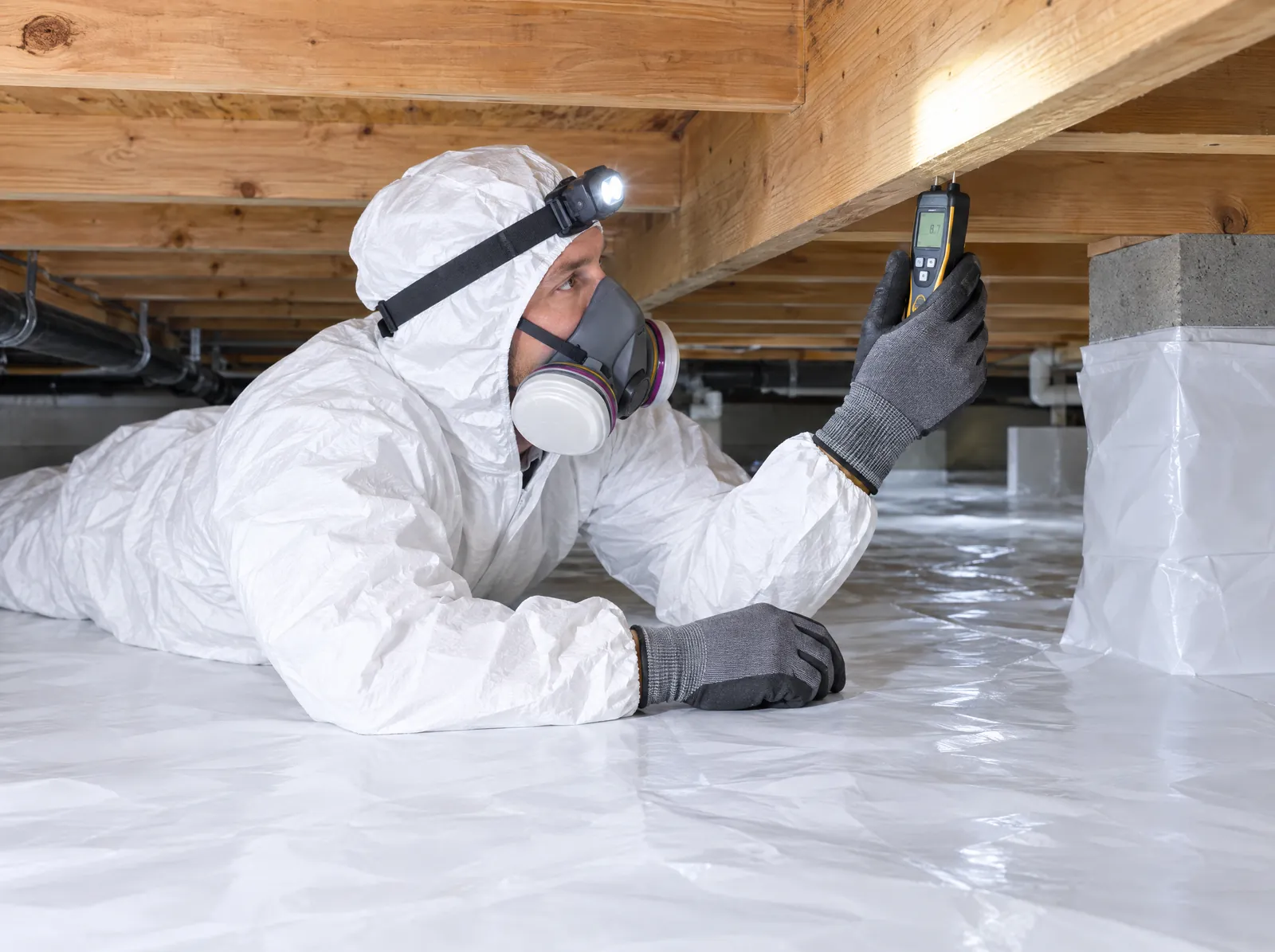
What does crawl space mold removal involve?
Crawl space mold removal means cleaning mold from the floor joists, beams and underside of the subfloor, removing wet or moldy insulation and debris, and correcting the ground moisture or humid vent air that caused it. The work happens under containment so disturbed spores don't rise into the living space. It finishes with drying, a new or repaired vapor barrier where needed, and clearance testing to confirm the result.
Out of sight, but not out of your air
Nobody goes into the crawl space, so problems there run for years. Meanwhile warm air rises through a house and pulls air up from below it, through gaps around plumbing, wiring and ductwork. Whatever is growing on the joists, and whatever it leaves in the dust, becomes part of what the family breathes on the first floor. That's why a musty smell in a home with a crawl space so often traces back to what's underneath.
Sound familiar?
- There's a musty smell on the first floor you can't find the source of.
- An inspector wrote "microbial growth on joists" in a home inspection report.
- The vapor barrier is torn, missing or covered in standing water.
- Insulation is sagging or has fallen out from between the joists.
We do it differently.
| Spray-the-joists crawl space jobs | AME crawl space remediation | |
|---|---|---|
| Growth on joists | Sprayed with a biocide | HEPA vacuumed, cleaned and enzyme-treated |
| Wet insulation | Left in place | Removed and bagged |
| Ground moisture | Not addressed | Vapor barrier repaired or replaced |
| Air rising into the house | Not considered | Containment during work and testing upstairs |
| Proof | Photos of clean wood | Clearance testing with lab results |

Why families trust us with their homes
-
Family-owned since 2008
A multigenerational family business. Not a franchise, not a private-equity rollup.
-
Credentialed where it isn't required
Indiana doesn't license mold remediators. We hold IICRC, CMR, CRMI and CCMI credentials anyway.
-
Called on as experts
Attorneys bring us into legal cases involving mold and mycotoxins.
-
Lab results in 24 to 48 hours
Every inspection comes with a written report, color photos and lab results.
- IICRC Certified Firm
- CMR
- CRMI
- CCMI
- BBB A+ Accredited
- NAMRI
- IAQA
- NORMI
- AMMA
- PMII
The AME Clearance Method
How crawl space mold removal works
Tight spaces make shortcuts tempting. These six steps are the ones we don't cut.
Talk to a specialist-
Inspect and measure
We check wood moisture on joists, sills and subfloor, look at the vapor barrier, vents, ductwork and plumbing, and sample air in the living space above.
-
Stop the water
Plumbing leaks, standing water, poor drainage or humid vent air: the cause gets identified and corrected, or scheduled, before cleaning.
-
Contain the access
The crawl space is put under negative air with HEPA filtration, and floor registers and gaps above are sealed so disturbed spores stay below.
-
Clear it out
Wet or moldy insulation, old torn vapor barrier, cardboard and construction debris come out bagged.
-
Clean the wood
Joists, beams, sill plates and subfloor are HEPA vacuumed, cleaned and treated with plant-based enzyme products.
-
Dry, seal and verify
Once the wood is dry, the ground cover is restored and clearance testing confirms the crawl space and the rooms above are back to normal.
What a crawl space project includes
- Wood moisture readings on joists, sills and subfloor
- Air testing in the living space above
- A written scope, including what moisture work is needed
- Negative air containment of the crawl space
- Removal of wet or moldy insulation and debris
- HEPA vacuuming and cleaning of framing
- Enzyme treatment of wood surfaces
- Vapor barrier repair or replacement where needed
- Clearance testing and a lab report

Proof you can hold in your hands
When we finish, you don't get a handshake and a promise. You get the paperwork your family, your doctor, your insurer or your buyer can rely on.
Inspection report
What we found, where it is coming from, with color photos.
Written remediation plan
Scope, timeline and what will and won't be removed, before work starts.
Clearance lab report
Air, surface and mycotoxin results after the work is done.
A report for your doctor
With your permission, we share results directly with your care team.
Crawl space mold, explained
Why crawl spaces grow mold
A crawl space is a room with a dirt or gravel floor that nobody lives in. Soil gives off moisture constantly, even when it looks dry. Wood framing sits just above it. Temperatures stay cooler than the house. Put those together and you have a space that can reach the humidity mold needs without any leak at all. Four sources account for most of what we find:
- Ground moisture. Without an intact vapor barrier, water vapor rises from the soil into the air under the floor.
- Humid vent air. In warm, humid weather, outdoor air coming through foundation vents can condense on cooler joists and subfloor, the same way a cold glass sweats in summer.
- Plumbing and ductwork. Drips from supply lines and drains, and condensation on uninsulated air conditioning ducts, wet the wood right around them.
- Drainage. Gutters, downspouts and grading that send water toward the foundation can leave standing water in the crawl space after storms.
How crawl space air reaches your living space
Warm air rises and leaves a house through the upper floors and the attic. As it does, it pulls replacement air in low, and in a home with a crawl space a share of that air comes up through the floor: around pipes, wires, ducts, toilet flanges and the gaps at the edge of the subfloor. Building scientists call this the stack effect. It’s the reason a crawl space problem so often shows up as a smell in a first-floor bedroom or closet, and why we test the air upstairs as well as below. If your ductwork runs through the crawl space, leaks in the return side can pull crawl space air directly into the system, which our page on HVAC and duct mold covers.
What gets cleaned and what gets replaced
| Material | Usual approach |
|---|---|
| Floor joists, beams and sill plates | HEPA vacuum, clean and treat; replace only if rotted |
| Underside of the subfloor | Clean and treat |
| Fiberglass batts between joists | Remove if wet, moldy or fallen; they trap moisture against the wood |
| Old vapor barrier | Usually replaced if torn, buried or contaminated |
| Debris, wood scraps and cardboard | Removed |
| Ductwork in the crawl space | Inspected; cleaned or replaced depending on type and condition |
Vapor barrier, encapsulation or vents?
This is where homeowners get the most conflicting advice. A vapor barrier is a plastic sheet laid over the soil to slow moisture coming up from the ground. Encapsulation goes further: a heavier liner runs up the foundation walls and is sealed, vents are closed, and the space is dehumidified or conditioned so it behaves more like part of the house. Both can work. Which one makes sense depends on how wet the soil is, whether water pools after storms, your climate, and what else is in the crawl space. Encapsulating over active drainage problems or leftover mold only hides them, so the remediation and the moisture fix come first.
A note on safety and access
Crawl spaces are tight, dark and sometimes shallow enough that a technician works lying on their back. They can hold standing water, old wiring, sharp fasteners and pests. That’s part of why this work takes longer than a basement of the same size, and part of why we don’t recommend it as a do-it-yourself project. If you’d still like to understand the safe way to handle a small area elsewhere in the house, read can I remediate mold myself?
We use plant-based enzyme products from US Enzyme on crawl space framing, and we test afterward on every job. In Indiana? See crawl space mold removal in Indiana.
We remove mold and mycotoxins from buildings. We don’t diagnose or treat medical conditions. If anyone in your home has symptoms, please work with a doctor. With your permission, we’re glad to share test results and our plan with them.
Common questions
Have a question that isn't here? Call a specialist
Is crawl space mold a problem if nobody goes down there?
It can be. Air rises through a house and draws air up from the crawl space through gaps in the floor. Spores, mold fragments and the odor come with it. Ductwork running through the crawl space can also pull that air straight into the system.
What causes mold in a crawl space?
Moisture from the ground, humid outdoor air entering through vents and condensing on cooler wood, plumbing leaks, and poor drainage around the foundation. A missing or damaged vapor barrier makes all of these worse.
Does crawl space mold removal include encapsulation?
Not necessarily. Remediation removes the mold and corrects moisture. Encapsulation, which seals the crawl space with a heavy liner and conditions or dehumidifies the air, is one way to keep it dry afterward. We'll tell you whether your crawl space needs it or whether a proper vapor barrier and drainage fix is enough.
Do moldy floor joists have to be replaced?
Rarely. Mold on solid wood is almost always on the surface and can be cleaned. Joists are replaced only when they are rotted or structurally weakened, which is a question for a contractor or structural engineer as well as a remediator.
Can I clean crawl space mold myself?
It's one of the harder places to do it safely: tight, poorly lit, often wet, and directly connected to the air in your home. Without containment, scrubbing joists can send spores upward. For anything beyond a very small area, we recommend a professional.
Should the crawl space vents be open or closed?
It depends on the climate and the house. In humid summer weather, open vents can let in moist air that condenses on cool wood. Closing vents without dealing with moisture another way can also trap it. Decide as part of a moisture plan, not on its own.
We're done when the lab says so.
Every remediation ends with clearance testing, and our work is backed by a complete-removal guarantee. We don't close a job on a failed result.
Talk to a specialistFind out what's under your floor
Tell us what you've noticed upstairs and what the crawl space looks like. A specialist will call you back.
- (833) 772-6653
- info@americanmoldexperts.com
- Open 7 days, 8am to 8pm