
Choosing a dust test
ERMI vs. HERTSMI-2: choosing the right dust test
Both read mold DNA in settled dust. They score it differently, and that difference shapes what you do next.
What's the difference between ERMI and HERTSMI-2?
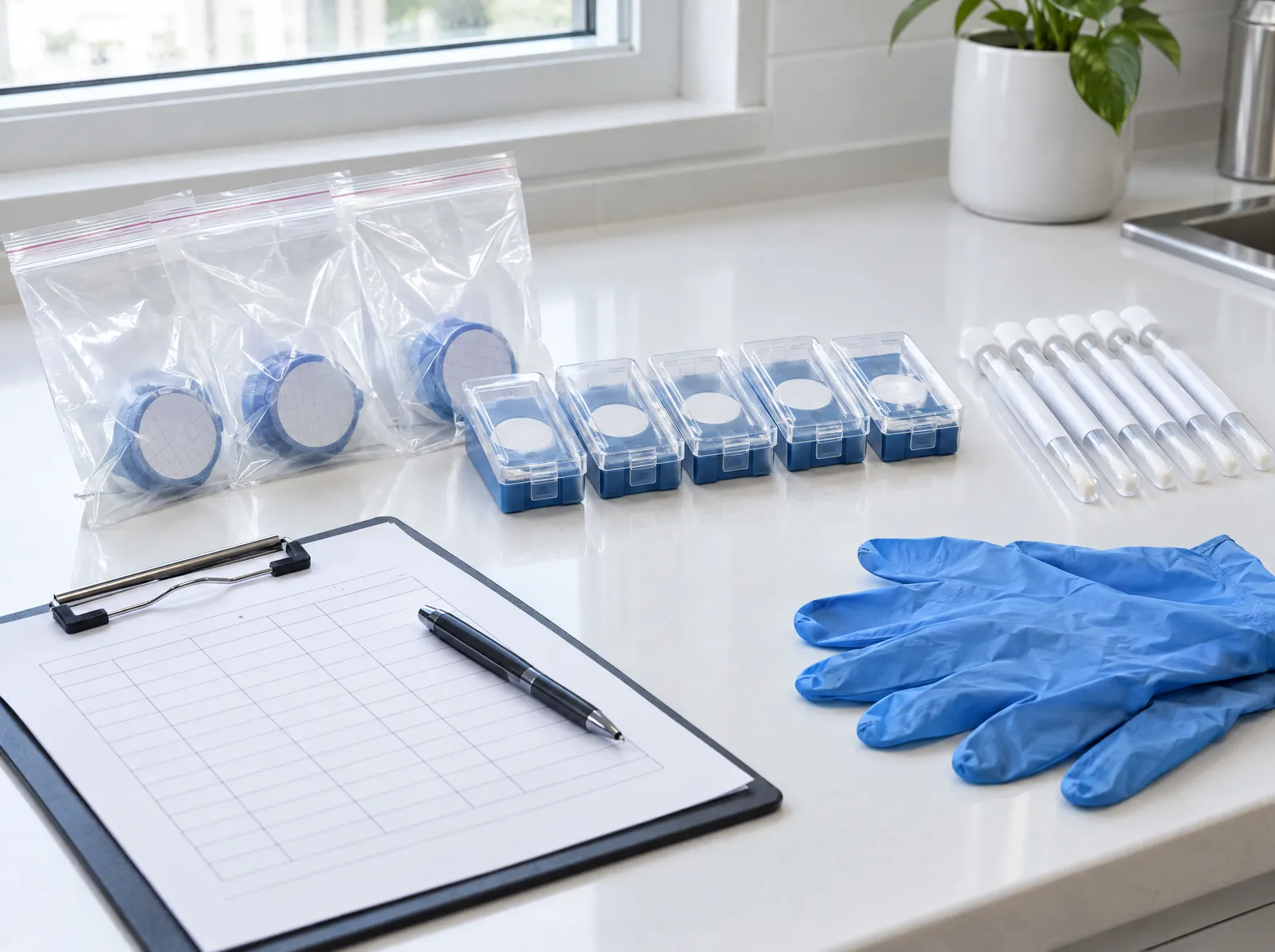
ERMI vs. HERTSMI-2 comes down to breadth and purpose. Both tests measure mold DNA in settled dust using MSQPCR. ERMI measures 36 species and scores the home against a national sample, giving a broad view of its water-damage history. HERTSMI-2 scores only five molds tied to water-damaged buildings, producing a shorter, targeted number many physicians prefer. Because all five HERTSMI-2 molds are on the ERMI panel, many labs can report both from one sample.
Why people end up with the wrong dust test
Families usually hear about these tests from a doctor, an online forum or a friend, and each source tends to favor one. Order the wrong one and you may get a number your doctor doesn't use, or pay for two separate tests when one sample could have covered both. The choice is less about which test is better and more about which question you're asking and who will read the result.
Sound familiar?
- Your doctor mentioned one test and a forum swears by the other.
- You already have an ERMI, and your doctor now wants a HERTSMI-2 score.
- Your before and after results came from different tests and can't be compared.
- You're not sure which number belongs in a remediation agreement.
We do it differently.
| Picking a test by reputation | Picking a test with AME | |
|---|---|---|
| Starting point | Whatever a forum or friend recommended | The question you need answered and who will read the result |
| Doctor's protocol | Not checked | Confirmed before sampling, target score included |
| Samples | A separate kit for each test | One dust sample reported both ways when the lab supports it |
| Before and after | Different tests, not comparable | Same test, same lab, same rooms |
| Interpretation | A single number | Score plus species detail, tied to the moisture inspection |

Why families trust us with their homes
-
Family-owned since 2008
A multigenerational family business. Not a franchise, not a private-equity rollup.
-
Credentialed where it isn't required
Indiana doesn't license mold remediators. We hold IICRC, CMR, CRMI and CCMI credentials anyway.
-
Called on as experts
Attorneys bring us into legal cases involving mold and mycotoxins.
-
Lab results in 24 to 48 hours
Every inspection comes with a written report, color photos and lab results.
- IICRC Certified Firm
- CMR
- CRMI
- CCMI
- BBB A+ Accredited
- NAMRI
- IAQA
- NORMI
- AMMA
- PMII
The AME Clearance Method
How we help you choose and run the right test
Five steps that keep the test tied to the decision it's supposed to support.
Talk to a specialist-
Ask who will use the result
A doctor following a specific protocol, a buyer screening a house, or a family tracking a remediation. Each points toward a different test.
-
Match the test to the question
Broad history and a national comparison favor ERMI. A short, targeted score to a doctor's threshold favors HERTSMI-2. Often the answer is both.
-
Collect one well-documented sample
Settled dust collected to the lab's protocol, with locations and method recorded so the test can be repeated the same way.
-
Report both scores when useful
Where the lab supports it, one sample gives an ERMI score, a HERTSMI-2 score and the species concentrations behind both.
-
Keep the method fixed for retesting
Future tests use the same lab, method and rooms, so changes in the numbers reflect changes in the house rather than in the sampling.
What dust testing with us includes
- A short consult on which test fits your question
- Confirmation of your doctor's preferred test and target
- A moisture inspection alongside the dust sampling
- Dust collection to the lab's protocol, with chain of custody
- ERMI, HERTSMI-2 or both from one sample where the lab supports it
- Species-level results, not only the headline score
- A plain-English review of the report
- A documented method for future comparison testing

Proof you can hold in your hands
When we finish, you don't get a handshake and a promise. You get the paperwork your family, your doctor, your insurer or your buyer can rely on.
Inspection report
What we found, where it is coming from, with color photos.
Written remediation plan
Scope, timeline and what will and won't be removed, before work starts.
Clearance lab report
Air, surface and mycotoxin results after the work is done.
A report for your doctor
With your permission, we share results directly with your care team.
ERMI and HERTSMI-2, side by side
The two tests at a glance
| ERMI | HERTSMI-2 | |
|---|---|---|
| Where it came from | EPA researchers | Dr. Ritchie Shoemaker’s work on water-damaged buildings |
| Lab method | MSQPCR on settled dust | MSQPCR on settled dust |
| Molds measured | 36: 26 water-damage (Group 1) and 10 common (Group 2) | 5: Aspergillus penicillioides, Aspergillus versicolor, Chaetomium globosum, Stachybotrys chartarum, Wallemia sebi |
| How it scores | Log concentrations of Group 1 minus Group 2, compared with a national sample of homes | Points for each of the five molds by concentration, added together |
| Best at showing | A broad picture of a home’s water-damage history | A focused score on the molds most tied to water-damaged buildings |
| Main caution | The EPA has said it was built as a research tool, not for routine public use | A short list can miss other molds and says nothing about toxins |
| Typically requested by | Researchers, some physicians, some homeowners | Many physicians who work with mold-related illness |
When ERMI is the better fit
ERMI earns its place when you want the wide view. Because it measures 36 species, the report shows the full mix of molds in the dust, including water-damage species that HERTSMI-2 doesn’t count. That breadth helps when the source isn’t obvious, since different molds point to different moisture conditions. It’s also the right choice when a doctor or an earlier report already used ERMI and you want a result that compares. Our page on ERMI testing covers the scoring in detail.
When HERTSMI-2 is the better fit
HERTSMI-2 is the more practical choice when a doctor has given you a HERTSMI-2 target, or when you want a simple number to track. Because it adds up points for five molds rather than comparing against a national average, the result doesn’t move just because a home has unusually little ordinary outdoor mold in its dust. That makes it easier to explain and easier to follow over time. Our HERTSMI-2 testing page describes what each of the five molds suggests about a building.
Why many people end up running both
All five HERTSMI-2 species sit inside ERMI’s Group 1, so the lab work behind an ERMI already measures them. When the lab supports it, one dust sample can produce both scores, plus the concentrations of every species. That’s often the most efficient choice for a household that isn’t sure which number their doctor, or a future doctor, will want. It also protects against the most frustrating outcome: a before-and-after comparison that can’t be made because the two tests were different.
What neither test does
- Neither shows where mold is growing. Dust settles from the whole area around it. Finding the source takes a moisture inspection.
- Neither measures mycotoxins. For toxins, see mycotoxin testing.
- Neither tells living mold from dead. DNA remains after mold dies, so both reflect accumulated history.
- Neither is a medical test. They describe a building’s dust. What a score means for a person is a question for a doctor.
For households managing mold illness, we cover how these tests fit into a full home assessment in mold testing for mold illness.
ERMI and HERTSMI-2 measure mold in a building’s dust. They don’t diagnose anything, and we don’t diagnose or treat medical conditions. Your doctor decides which score matters for your household. With your permission, we’ll share every result with them.
Common questions
Have a question that isn't here? Call a specialist
Is ERMI or HERTSMI-2 more accurate?
Neither. Both rely on the same lab method, MSQPCR, to measure mold DNA. They differ in which molds are counted and how the results are scored. Accuracy depends mostly on how the dust was collected, which is the same for both.
Can one dust sample give both scores?
Often, yes. All five HERTSMI-2 molds are among ERMI's 36 species, so many labs can calculate both from one ERMI sample. Confirm with the lab before sampling, since not every lab or kit offers it.
Which test do doctors prefer?
It varies. Many physicians who work with mold-related illness use HERTSMI-2 because it focuses on the molds most tied to water-damaged buildings. Others want ERMI, or both. Ask your doctor before you order anything.
Can a home score high on ERMI but low on HERTSMI-2?
Yes. ERMI can be driven up by water-damage molds that HERTSMI-2 doesn't count, or by low levels of common outdoor molds, which are subtracted in the ERMI formula. The reverse can happen too, when one of the five HERTSMI-2 molds is high but the rest of the ERMI panel is modest.
Which test is better for checking remediation?
Whichever one you used before the work, run the same way. Switching tests between before and after leaves you comparing two different measurements.
Does either test measure mycotoxins?
No. Both measure mold DNA. Toxins require a separate mycotoxin panel on settled dust or surfaces.
Do I need either test when buying a house?
Not usually. A standard pre-purchase mold inspection uses moisture readings, air and surface samples. Dust DNA tests make sense when someone in the household is sensitive to mold and their doctor wants a specific score.
We're done when the lab says so.
Every remediation ends with clearance testing, and our work is backed by a complete-removal guarantee. We don't close a job on a failed result.
Talk to a specialistNot sure which dust test to order?
Tell us who asked for the test and why. A specialist will call you back and help you choose before you pay for anything.
- (833) 772-6653
- info@americanmoldexperts.com
- Open 7 days, 8am to 8pm