
Offices, schools, multifamily and facilities
Commercial mold remediation, fully documented
Planned around your occupants, documented for your records, and verified by a lab before anyone moves back in.
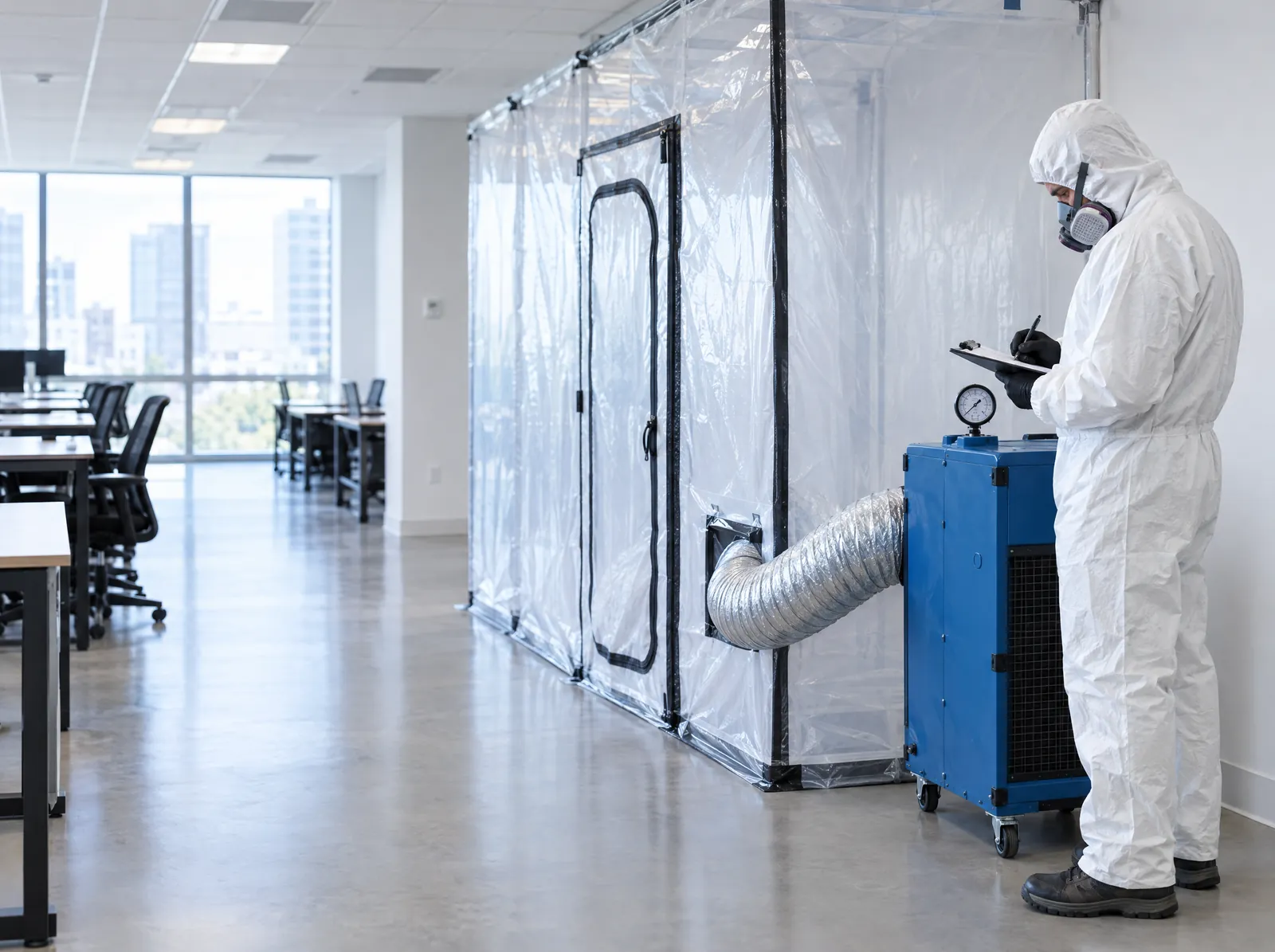
What is commercial mold remediation?
Commercial mold remediation is the removal of mold from offices, schools, apartment buildings, healthcare and other non-residential properties, planned around the people who use them. It follows the same core steps as residential work, including moisture correction, containment, removal, HEPA cleaning and clearance testing, but adds phasing around occupancy, larger HVAC systems, communication with tenants or staff, and the written documentation owners, insurers and attorneys need.
In a commercial building, the paperwork is part of the job
A mold problem in a commercial building rarely stays a maintenance issue. Tenants complain, parents ask questions, staff want to know if it's safe, an insurer wants a cause, and sometimes an attorney wants a file. The work itself has to happen without shutting the building down. A contractor who only cleans, and can't show what was found, what was done and what the lab said afterward, leaves the owner exposed long after the crew has gone.
Sound familiar?
- Occupants are reporting odors or complaints and want answers.
- You need the work done without closing the building.
- Your insurer, board or legal counsel wants a documented scope and results.
- A previous contractor left no records you can point to.
We do it differently.
| Janitorial-style mold cleanup | AME commercial remediation | |
|---|---|---|
| Planning | Show up and start | Written scope, containment plan and schedule |
| Occupants | Work around them as best as possible | Phased work, after-hours options and clear notices |
| HVAC | Not included | Air handlers and distribution evaluated and cleaned |
| Records | An invoice | Daily logs, photos, lab reports and a closeout file |
| Clearance | Visual | Lab-verified clearance before reoccupancy |

Why families trust us with their homes
-
Family-owned since 2008
A multigenerational family business. Not a franchise, not a private-equity rollup.
-
Credentialed where it isn't required
Indiana doesn't license mold remediators. We hold IICRC, CMR, CRMI and CCMI credentials anyway.
-
Called on as experts
Attorneys bring us into legal cases involving mold and mycotoxins.
-
Lab results in 24 to 48 hours
Every inspection comes with a written report, color photos and lab results.
- IICRC Certified Firm
- CMR
- CRMI
- CCMI
- BBB A+ Accredited
- NAMRI
- IAQA
- NORMI
- AMMA
- PMII
The AME Clearance Method
How we run a commercial mold project
Seven steps, with a written record at each one.
Talk to a specialist-
Assess and sample
We inspect the affected areas and building systems, take moisture readings and collect air and surface samples to define the extent.
-
Write the scope
A written scope, containment plan and schedule are shared with building owners, facilities staff and, when needed, your insurer or consultant.
-
Plan around occupants
Work is phased by area, scheduled after hours when needed, and occupants are told what's happening and where not to go.
-
Contain and isolate HVAC
Work areas are sealed under negative air, and the zones of the HVAC system that serve them are isolated.
-
Remove and clean
Affected materials are removed and bagged, and structure and contents are HEPA cleaned and treated with plant-based enzyme products.
-
Correct the moisture
Roof leaks, plumbing, condensation and HVAC drainage are identified so facilities staff or contractors can correct them.
-
Verify and close out
Clearance testing is completed before containment comes down and occupants return, and you receive a closeout file.
What a commercial project includes
- Pre-work assessment with moisture readings and sampling
- A written scope, containment plan and schedule
- Occupant communication support
- Phased and after-hours work when needed
- Containment with negative air and HVAC isolation
- Removal of affected materials and HEPA cleaning
- HVAC evaluation and cleaning where testing shows it's involved
- Daily logs and photo documentation
- Clearance testing with lab reports
- A closeout file for owners, insurers and counsel

Proof you can hold in your hands
When we finish, you don't get a handshake and a promise. You get the paperwork your family, your doctor, your insurer or your buyer can rely on.
Inspection report
What we found, where it is coming from, with color photos.
Written remediation plan
Scope, timeline and what will and won't be removed, before work starts.
Clearance lab report
Air, surface and mycotoxin results after the work is done.
A report for your doctor
With your permission, we share results directly with your care team.
Commercial mold remediation, explained
What makes commercial work different
The science of mold doesn’t change between a house and an office building. Mold still needs moisture, containment still keeps disturbed spores in the work area, and clearance testing still decides when the job is done. What changes is everything around the work.
- The building is occupied. People keep working, learning or living there, so work is phased by area and containment has to hold up to foot traffic next door.
- HVAC systems are larger and shared. One air handler can serve many rooms or floors, so the zones connected to a work area have to be isolated, and the system itself may be part of the problem.
- More people need answers. Owners, property managers, facilities staff, tenants, parents, insurers and sometimes attorneys all want to know what’s happening.
- The record matters. A commercial owner may need to show, months or years later, what was found and what was done.
The documentation you should expect
For a commercial owner, a closeout file is as much a deliverable as the clean room. Whether you hire us or someone else, ask for these:
| Document | Why it matters |
|---|---|
| Pre-work assessment and lab results | Establishes the baseline and the extent of contamination |
| Written scope of work | Shows what was planned and why each area was included |
| Containment plan | Shows how occupied areas were protected |
| Daily logs and photos | Record what was actually done, and when |
| Waste and disposal records | Show removed materials were handled properly |
| Moisture source findings | Identify what needs correcting so it doesn’t recur |
| Clearance results | Prove the area met the criteria before reoccupancy |
Building types we work in
Each kind of building has its own pressure points. Schools and daycares need work scheduled around the calendar and clear communication with parents. Offices often need after-hours work and careful HVAC isolation on shared floors. Apartments and multifamily buildings involve tenant access, shared walls and plumbing stacks that can carry a leak through several units. Healthcare facilities have occupants who may be more vulnerable and stricter infection-control expectations. Churches and community buildings often have large, rarely used spaces, like basements and fellowship halls, where problems go unnoticed. Before any remediation starts, a commercial mold inspection defines the scope.
Where commercial mold usually starts
Commercial buildings get wet in predictable places. Flat roofs pond water and leak at seams, drains and rooftop equipment curbs, often above a dropped ceiling where the first sign is a stained tile. Large air handlers produce a lot of condensate, and a clogged drain line or overflowing pan can soak insulation and ceilings around a mechanical room. Plumbing stacks in multifamily buildings carry a single leak through several units. Exterior walls with failed sealant around windows let water into the cavity. And buildings that sit partly empty, or have their HVAC set back to save energy, can drift into high humidity without anyone noticing. Knowing the building type narrows the search, and it tells facilities staff what to watch once the work is done.
Standards and guidance
Two references shape most commercial mold work in the United States. The EPA’s Mold Remediation in Schools and Commercial Buildings sets out how the size of the affected area relates to the level of containment and protection. The IICRC S520 standard describes professional mold remediation practice, including the goal of returning areas to normal fungal ecology and verifying that before containment is removed. Some states and municipalities add their own licensing or procedural requirements, so we confirm those for each project location. When an owner has an independent consultant, we work to that consultant’s protocol.
Credentials and experience
We’re an IICRC Certified Firm with CMR, CRMI and CCMI credentials, and members of NAMRI, IAQA, NORMI, AMMA and PMII. We’ve been family-owned since 2008, we hold a BBB A+ rating, and attorneys bring us into legal cases involving mold and mycotoxins. For structure and contents treatment we use plant-based enzyme products from US Enzyme. For how the verification step works, read post-remediation verification. In Indiana? See commercial mold remediation in Indiana.
We remove mold and mycotoxins from buildings. We don’t diagnose or treat medical conditions. Occupants with symptoms should work with a doctor, and with the owner’s permission we’re glad to share test results and our plan with them.
Common questions
Have a question that isn't here? Call a specialist
Can the building stay open during mold remediation?
Usually, yes. Work areas are contained under negative pressure and isolated from the HVAC zones serving occupied space, and work can be phased or scheduled after hours. Areas under containment stay closed until clearance testing passes.
What documentation should a commercial mold remediation include?
At minimum: the pre-work assessment and lab results, a written scope, the containment plan, daily logs and photos, disposal records, and clearance test results. That file protects the owner if questions come up later from tenants, insurers or attorneys.
What guidance applies to mold in commercial buildings?
The EPA publishes Mold Remediation in Schools and Commercial Buildings, and the IICRC S520 standard covers professional mold remediation. Some states and cities have their own rules. We work to these references and can adapt to a consultant's specifications.
Do you work with third-party consultants?
Yes. Many owners hire an independent indoor environmental professional to write the protocol and perform clearance. We're glad to work to their scope and share all of our records with them.
Do you handle mold in apartments and multifamily buildings?
Yes. Multifamily work adds tenant communication, unit access and shared building systems, and often requires checking adjacent units and common walls. We plan around those from the start.
Do you get involved in legal cases involving mold?
Yes. Attorneys bring us into cases involving mold and mycotoxins, and we document commercial work with that possibility in mind.
Do you take commercial projects outside Indiana?
Yes. We work from our office in Avon, Indiana, have a team in Southwest Florida, and travel for commercial projects across the United States.
We're done when the lab says so.
Every remediation ends with clearance testing, and our work is backed by a complete-removal guarantee. We don't close a job on a failed result.
Talk to a specialistTalk to our commercial team
Tell us about the building, who uses it and what's been reported. A specialist will call you back.
- (833) 772-6653
- info@americanmoldexperts.com
- Open 7 days, 8am to 8pm